Tunisia Carbon Credit Market Size, Share & Growth Rate
The Tunisia Carbon Credit Market was estimated at USD 702 Million in 2025 and is projected to reach USD 1007 Million by 2032, growing at a CAGR of 5.3% from 2026 to 2032. This growth trajectory is primarily driven by an increased focus on renewable energy projects, heightened awareness of sustainability, and a stronger commitment from businesses to meet emissions reduction targets. As Tunisia aligns itself with international climate agreements, investor interest in clean energy initiatives and carbon credits is steadily rising.
Tunisia Carbon Credit Market Year-wise Growth Rate and Key Drivers
This graph highlights how the Tunisia Carbon Credit Market has steadily grown over the years, supported by major growth factors.
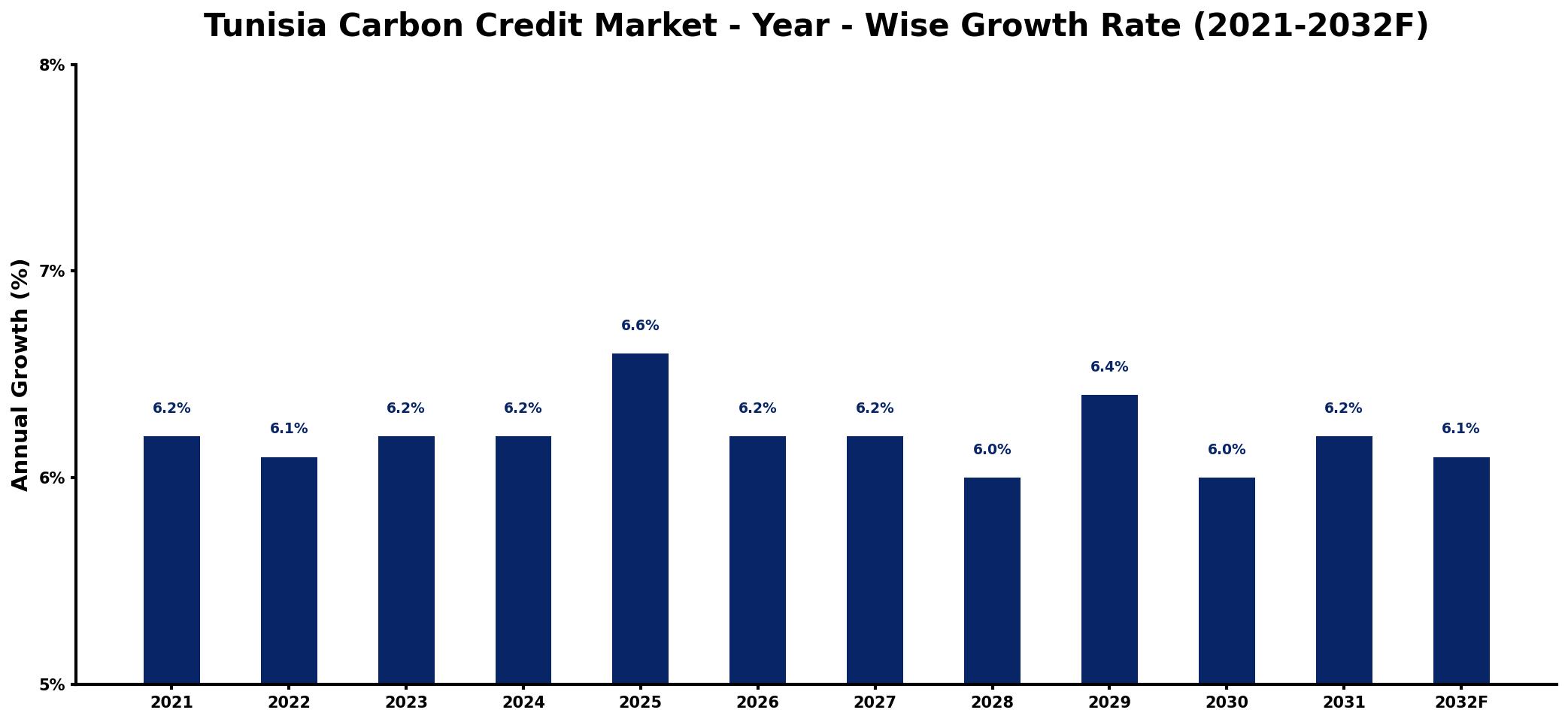
The table below presents the year‑wise growth rates along with the key drivers influencing the market
| Year | Growth Rate | Major Drivers |
| 2021 | 6.2% | Increased renewable energy investments |
| 2022 | 6.1% | Growing corporate sustainability initiatives |
| 2023 | 6.2% | Expansion of green technology adoption |
| 2024 | 6.2% | Rising public environmental awareness |
| 2025 | 6.6% | Strengthened regulatory frameworks established |
| 2026 | 6.2% | Innovations in sustainable agriculture practices |
| 2027 | 6.2% | Enhanced energy efficiency measures implemented |
| 2028 | 6.0% | Developments in waste management solutions |
| 2029 | 6.4% | Increased participation in environmental programs |
| 2030 | 6.0% | Growth in international climate partnerships |
| 2031 | 6.2% | Emergence of eco-friendly business models |
| 2032 | 6.1% | rising demand from electronics |
Note: Market size estimations and growth projections presented in this report are based on 6Wresearch's proprietary forecasting methodology, utilizing the latest available industry data, government publications, and primary research inputs.
Tunisia Carbon Credit Market Synopsis
The strongest force shaping the Tunisia Carbon Credit Market is the country's commitment to reducing greenhouse gas emissions through renewable energy and sustainable practices. With strategic government policies aimed at attracting foreign investments, the market is poised for growth, particularly in sectors like renewable energy and waste management.
Tunisia has actively engaged in international carbon trading mechanisms, such as the Clean Development Mechanism (CDM). This engagement not only enhances the country's credibility in the global market but also facilitates the funding of clean energy projects, thus driving further carbon credit generation.
Tunisia Carbon Credit Market Key Takeaways
- The Tunisia Carbon Credit Market is expected to grow from USD 702 Million in 2025 to USD 1007 Million by 2032.
- Renewable energy initiatives are the primary driver of carbon credit generation in Tunisia.
- Growing corporate sustainability goals are increasing the demand for carbon credits.
- The government is enhancing regulatory frameworks to support the carbon trading environment.
- Investment in carbon credits offers companies financial returns while advancing environmental objectives.
Evaluation of Restraints in Tunisia Carbon Credit Market
Despite its potential, the Tunisia Carbon Credit Market is hampered by several constraints. A significant challenge is the limited understanding of carbon credit mechanisms among local businesses, which may deter participation. Furthermore, the absence of robust government regulations and clear incentives creates an uncertain environment for investors. Economic instability and political uncertainty further complicate the market landscape, often leading to hesitation among potential investors to engage in carbon credit projects. The lack of developed trading platforms and verification mechanisms also restricts market efficiency and growth.
Tunisia Carbon Credit Market Trends
Currently, the market is witnessing an increasing interest in projects focused on renewable energy, energy efficiency, and waste management. Companies are proactively seeking ways to mitigate their carbon footprints, leading to a greater reliance on carbon credits. Additionally, there is a growing demand for transparency and accountability in carbon credit trading, as stakeholders emphasize the credibility and environmental integrity of the credits exchanged. This trend towards sustainability is indicative of the broader transition towards a low-carbon economy.
Tunisia Carbon Credit Market Opportunities
The Tunisia Carbon Credit Market is ripe with investment opportunities. As Tunisia moves towards its sustainability goals, there is a burgeoning demand for carbon credits, especially from initiatives related to renewable energy, energy efficiency, and reforestation. Companies can leverage this demand by purchasing credits to offset their emissions, while investors can diversify their portfolios through investments in carbon credit-generating projects. Aligning investment strategies with ESG (Environmental, Social, and Governance) principles can also attract socially responsible investors seeking to contribute to climate change mitigation.
Government Initiatives in the Tunisia Carbon Credit Market
The Tunisian government has taken significant steps to foster the development of the Carbon Credit Market. Establishing a regulatory framework is a cornerstone of these initiatives, providing a foundation for carbon trading activities. There are also incentives for businesses to adopt renewable energy solutions and support for projects that contribute to carbon reduction. The government encourages collaboration between public and private sectors to enhance sustainability efforts, actively seeking alignment with international agreements such as the Paris Agreement to bolster investments in carbon credit projects.
Future Insights of the Tunisia Carbon Credit Market
Looking ahead to 2026-2032, the future of the Tunisia Carbon Credit Market is optimistic. As awareness of climate change intensifies, businesses are increasingly recognizing the value of carbon credits as a mechanism to offset emissions. The government's commitment to enhancing regulatory measures and fostering investment in renewable energy positions the market for steady growth. Collaborations with international organizations may further amplify the market's reach, solidifying Tunisia's place in the global carbon trading landscape.
Tunisia Carbon Credit Market Latest Developments (2025 - 2026)
In recent months, the Tunisia Carbon Credit Market has seen noteworthy developments aimed at enhancing its operational frameworks. Efforts are underway to improve verification processes, ensuring higher credibility of carbon credits. Additionally, discussions regarding new incentives for renewable energy projects have gained momentum, positioning the market for accelerated growth. Collaborations with international partners are being explored, emphasizing a collective commitment to fostering environmental sustainability within the region.
Tunisia Carbon Credit Market - Key Attractiveness of the Report
- 10 Years of Market Numbers
- Historical Data Starting from 2022 to 2025
- Base Year: 2025
- Forecast Data until 2032
- Key Performance Indicators Impacting the Market
- Major Upcoming Developments and Projects
Key Highlights of the Report:
- Tunisia Carbon Credit Market Outlook
- Market Size of Tunisia Carbon Credit Market, 2025
- Forecast of Tunisia Carbon Credit Market, 2032
- Historical Data and Forecast of Tunisia Carbon Credit Revenues & Volume for the Period 2022-2032F
- Tunisia Carbon Credit Market Trend Evolution
- Tunisia Carbon Credit Market Drivers and Challenges
- Tunisia Carbon Credit Price Trends
- Tunisia Carbon Credit Porter's Five Forces
- Tunisia Carbon Credit Industry Life Cycle
- Historical Data and Forecast of Tunisia Carbon Credit Market Revenues & Volume By Sector for the Period 2022-2032F
- Historical Data and Forecast of Tunisia Carbon Credit Market Revenues & Volume By Energy for the Period 2022-2032F
- Historical Data and Forecast of Tunisia Carbon Credit Market Revenues & Volume By Transportation for the Period 2022-2032F
- Historical Data and Forecast of Tunisia Carbon Credit Market Revenues & Volume By Residential And Commercial Buildings for the Period 2022-2032F
- Historical Data and Forecast of Tunisia Carbon Credit Market Revenues & Volume By Industry for the Period 2022-2032F
- Historical Data and Forecast of Tunisia Carbon Credit Market Revenues & Volume By Agriculture for the Period 2022-2032F
- Historical Data and Forecast of Tunisia Carbon Credit Market Revenues & Volume By Forestry for the Period 2022-2032F
- Historical Data and Forecast of Tunisia Carbon Credit Market Revenues & Volume By Water And Wastewater for the Period 2022-2032F
- Tunisia Carbon Credit Import Export Trade Statistics
- Market Opportunity Assessment By Sector
- Tunisia Carbon Credit Top Companies Market Share
- Tunisia Carbon Credit Competitive Benchmarking By Technical and Operational Parameters
- Tunisia Carbon Credit Company Profiles
- Tunisia Carbon Credit Key Strategic Recommendations






































