Tunisia Carbon Fibre Market Size, Share & Growth Rate
The Tunisia Carbon Fibre Market was estimated at USD 740 Million in 2025 and is projected to reach USD 1059 Million by 2032, growing at a CAGR of 5.3% from 2026 to 2032. This promising trajectory is primarily fueled by the increasing demand from key sectors, particularly automotive and aerospace, where the push for lighter and more efficient materials is becoming imperative. As industries recognize the advantages of carbon fibre in enhancing performance while reducing environmental impact, the adoption of these high-performance materials is expected to gain further momentum.
Tunisia Carbon Fibre Market Year-wise Growth Rate and Key Drivers
This graph highlights how the Tunisia Carbon Fibre Market has steadily grown over the years, supported by major growth factors.
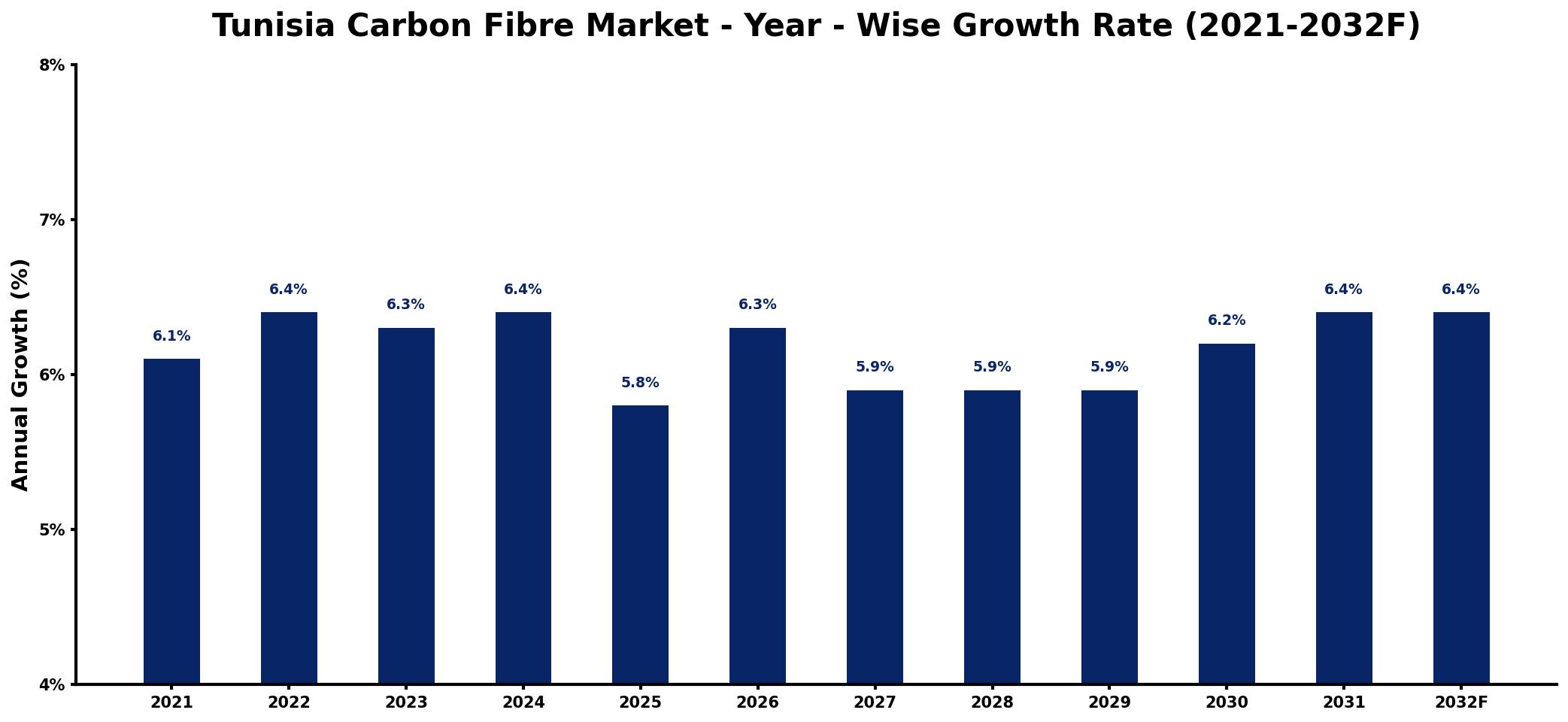
The table below presents the year‑wise growth rates along with the key drivers influencing the market
| Year | Growth Rate | Major Drivers |
| 2021 | 6.1% | Increased investments in aerospace sector |
| 2022 | 6.4% | Growing automotive industry adoption |
| 2023 | 6.3% | Rising demand from renewable energy |
| 2024 | 6.4% | Expansion of sports equipment manufacturing |
| 2025 | 5.8% | Emerging applications in construction |
| 2026 | 6.3% | Increased military and defense spending |
| 2027 | 5.9% | Growth in consumer electronics market |
| 2028 | 5.9% | Surge in wind energy sector |
| 2029 | 5.9% | Advancements in manufacturing technologies |
| 2030 | 6.2% | Rising interest in lightweight materials |
| 2031 | 6.4% | Increased research and development funding |
| 2032 | 6.4% | Growing demand for sustainable solutions |
Note: Market size estimations and growth projections presented in this report are based on 6Wresearch's proprietary forecasting methodology, utilizing the latest available industry data, government publications, and primary research inputs.
Tunisia Carbon Fibre Market Synopsis
The Tunisia carbon fibre market has recently witnessed a surge in interest, propelled by rising industrial needs and growing awareness of carbon fibre's benefits. As manufacturers strive for sustainability and improved operational efficiency, the demand for carbon fibre solutions is anticipated to maintain its upward trend. Looking ahead, the market is on a trajectory for substantial growth, supported by ongoing technological advancements and strategic investments.
With sectors such as automotive and aerospace leading the charge, the utilization of carbon fibres is expected to broaden across various applications, including sports equipment and renewable energy technologies. This expanding landscape signifies a shift towards innovative practices, enhancing Tunisia's position within the global carbon fibre market.
Tunisia Carbon Fibre Market Key Takeaways
- The market is driven by increasing demand for lightweight materials in automotive and aerospace sectors.
- Technological advancements and R&D initiatives are pivotal in enhancing production processes.
- Government policies are geared toward promoting sustainability and attracting foreign investment.
- A focus on eco-friendly production methods is emerging as a significant trend.
- Investment opportunities are ripe for both domestic and international players in the market.
Evaluation of Restraints in Tunisia Carbon Fibre Market
Despite the promising growth prospects, the Tunisia carbon fibre market faces certain constraints. A notable challenge is the prevailing lack of expertise and awareness regarding carbon fibre technology, which hampers its widespread adoption across various industries. Additionally, the high production costs associated with carbon fibre materials, coupled with the limited availability of raw materials, pose significant obstacles. Competing alternatives, such as fiberglass and steel, further complicate the market landscape, as these materials have well-established supply chains and lower cost structures. Addressing these challenges will be crucial for fostering growth and encouraging broader acceptance of carbon fibre in Tunisia.
Tunisia Carbon Fibre Market Trends
The current trend in the Tunisia carbon fibre market is marked by a strong shift towards lightweight and high-performance materials. Industries are increasingly recognizing the advantages of carbon fibres in reducing weight while maintaining structural integrity, which is essential for enhancing fuel efficiency and lowering carbon emissions. Furthermore, there is a burgeoning emphasis on sustainability, driving demand for eco-friendly production methods and renewable materials. As manufacturers invest in R&D, we anticipate more innovative applications of carbon fibre composites to emerge, solidifying their role across various sectors.
Tunisia Carbon Fibre Market Opportunities
Investment opportunities abound in the Tunisia carbon fibre market, particularly in the automotive, aerospace, and renewable energy sectors. The strategic location of Tunisia offers an advantageous gateway for exporting carbon fibre products to European and African markets. As industries increasingly prioritize reducing emissions and enhancing performance, there is a substantial potential for establishing carbon fibre production facilities. Partnerships with local manufacturers could further streamline operations and promote technology transfer, making it an appealing prospect for investors seeking to capitalize on this evolving market.
Government Initiatives in the Tunisia Carbon Fibre Market
The Tunisian government has enacted several supportive policies aimed at nurturing the carbon fibre industry. Initiatives include providing incentives for research and development projects and offering financial support to companies engaged in carbon fibre production. By fostering partnerships with international organizations, the government seeks to enhance knowledge sharing and facilitate technology transfer. Furthermore, investments in infrastructure and workforce training programs are being prioritized to ensure a skilled labor pool is available for the burgeoning carbon fibre sector. These proactive measures demonstrate the government's commitment to positioning Tunisia as a competitive player in the global market.
Future Insights of the Tunisia Carbon Fibre Market
Looking ahead to 2026-2032, the Tunisia carbon fibre market is expected to experience robust growth driven by escalating demand across diverse applications. Key factors such as advancements in production technology and heightened environmental awareness will continue to propel the adoption of carbon fibres. With ongoing government support and an increasing emphasis on sustainability, the market is well-poised to realize its potential, enhancing the performance capabilities of various sectors and solidifying Tunisia's role in the global carbon fibre landscape.
Tunisia Carbon Fibre Market Latest Developments (2025 - 2026)
Recent developments in the Tunisia carbon fibre market have highlighted a growing focus on innovation and sustainability. Companies are increasingly investing in advanced manufacturing technologies aimed at optimizing production processes and reducing costs. Collaborative efforts among industry stakeholders are fostering knowledge exchange and driving the establishment of best practices in carbon fibre applications. Furthermore, initiatives to expand the domestic supply chain for raw materials are gaining traction, enhancing self-sufficiency within the market. These trends indicate a positive shift towards a more resilient and competitive carbon fibre sector in Tunisia.
Tunisia Carbon Fibre Market - Key Attractiveness of the Report
- 10 Years of Market Numbers
- Historical Data Starting from 2022 to 2025
- Base Year: 2025
- Forecast Data until 2032
- Key Performance Indicators Impacting the Market
- Major Upcoming Developments and Projects
Key Highlights of the Report:
- Tunisia Carbon Fibre Market Outlook
- Market Size of Tunisia Carbon Fibre Market, 2025
- Forecast of Tunisia Carbon Fibre Market, 2032
- Historical Data and Forecast of Tunisia Carbon Fibre Revenues & Volume for the Period 2022-2032F
- Tunisia Carbon Fibre Market Trend Evolution
- Tunisia Carbon Fibre Market Drivers and Challenges
- Tunisia Carbon Fibre Price Trends
- Tunisia Carbon Fibre Porter's Five Forces
- Tunisia Carbon Fibre Industry Life Cycle
- Historical Data and Forecast of Tunisia Carbon Fibre Market Revenues & Volume By Raw Material for the Period 2022-2032F
- Historical Data and Forecast of Tunisia Carbon Fibre Market Revenues & Volume By Pan??based Carbon Fiber for the Period 2022-2032F
- Historical Data and Forecast of Tunisia Carbon Fibre Market Revenues & Volume By Pitch??based Carbon Fiber for the Period 2022-2032F
- Historical Data and Forecast of Tunisia Carbon Fibre Market Revenues & Volume By Product Type for the Period 2022-2032F
- Historical Data and Forecast of Tunisia Carbon Fibre Market Revenues & Volume By Continuous Carbon Fiber for the Period 2022-2032F
- Historical Data and Forecast of Tunisia Carbon Fibre Market Revenues & Volume By Long Carbon Fiber for the Period 2022-2032F
- Historical Data and Forecast of Tunisia Carbon Fibre Market Revenues & Volume By Short Carbon Fiber for the Period 2022-2032F
- Historical Data and Forecast of Tunisia Carbon Fibre Market Revenues & Volume By Fiber Type for the Period 2022-2032F
- Historical Data and Forecast of Tunisia Carbon Fibre Market Revenues & Volume By Virgin Carbon Fiber for the Period 2022-2032F
- Historical Data and Forecast of Tunisia Carbon Fibre Market Revenues & Volume By Recycled Carbon Fiber for the Period 2022-2032F
- Historical Data and Forecast of Tunisia Carbon Fibre Market Revenues & Volume By Modulus for the Period 2022-2032F
- Historical Data and Forecast of Tunisia Carbon Fibre Market Revenues & Volume By Standard Modulus for the Period 2022-2032F
- Historical Data and Forecast of Tunisia Carbon Fibre Market Revenues & Volume By Intermediate Modulus for the Period 2022-2032F
- Historical Data and Forecast of Tunisia Carbon Fibre Market Revenues & Volume By High Modulus for the Period 2022-2032F
- Historical Data and Forecast of Tunisia Carbon Fibre Market Revenues & Volume By Application for the Period 2022-2032F
- Historical Data and Forecast of Tunisia Carbon Fibre Market Revenues & Volume By Composite for the Period 2022-2032F
- Historical Data and Forecast of Tunisia Carbon Fibre Market Revenues & Volume By Non-composite for the Period 2022-2032F
- Historical Data and Forecast of Tunisia Carbon Fibre Market Revenues & Volume By End-use for the Period 2022-2032F
- Historical Data and Forecast of Tunisia Carbon Fibre Market Revenues & Volume By Aerospace & Defense for the Period 2022-2032F
- Historical Data and Forecast of Tunisia Carbon Fibre Market Revenues & Volume By Automotive for the Period 2022-2032F
- Historical Data and Forecast of Tunisia Carbon Fibre Market Revenues & Volume By Wind Energy for the Period 2022-2032F
- Historical Data and Forecast of Tunisia Carbon Fibre Market Revenues & Volume By Sporting Goods for the Period 2022-2032F
- Historical Data and Forecast of Tunisia Carbon Fibre Market Revenues & Volume By Electrical & Electronics for the Period 2022-2032F
- Historical Data and Forecast of Tunisia Carbon Fibre Market Revenues & Volume By Civil Engineering for the Period 2022-2032F
- Historical Data and Forecast of Tunisia Carbon Fibre Market Revenues & Volume By Pipe & Tank for the Period 2022-2032F
- Historical Data and Forecast of Tunisia Carbon Fibre Market Revenues & Volume By Marine for the Period 2022-2032F
- Tunisia Carbon Fibre Import Export Trade Statistics
- Market Opportunity Assessment By Raw Material
- Market Opportunity Assessment By Product Type
- Market Opportunity Assessment By Fiber Type
- Market Opportunity Assessment By Modulus
- Market Opportunity Assessment By Application
- Market Opportunity Assessment By End-use
- Tunisia Carbon Fibre Top Companies Market Share
- Tunisia Carbon Fibre Competitive Benchmarking By Technical and Operational Parameters
- Tunisia Carbon Fibre Company Profiles
- Tunisia Carbon Fibre Key Strategic Recommendations






































