Tunisia Chatbot Market Size & Growth Rate (2026-2032)
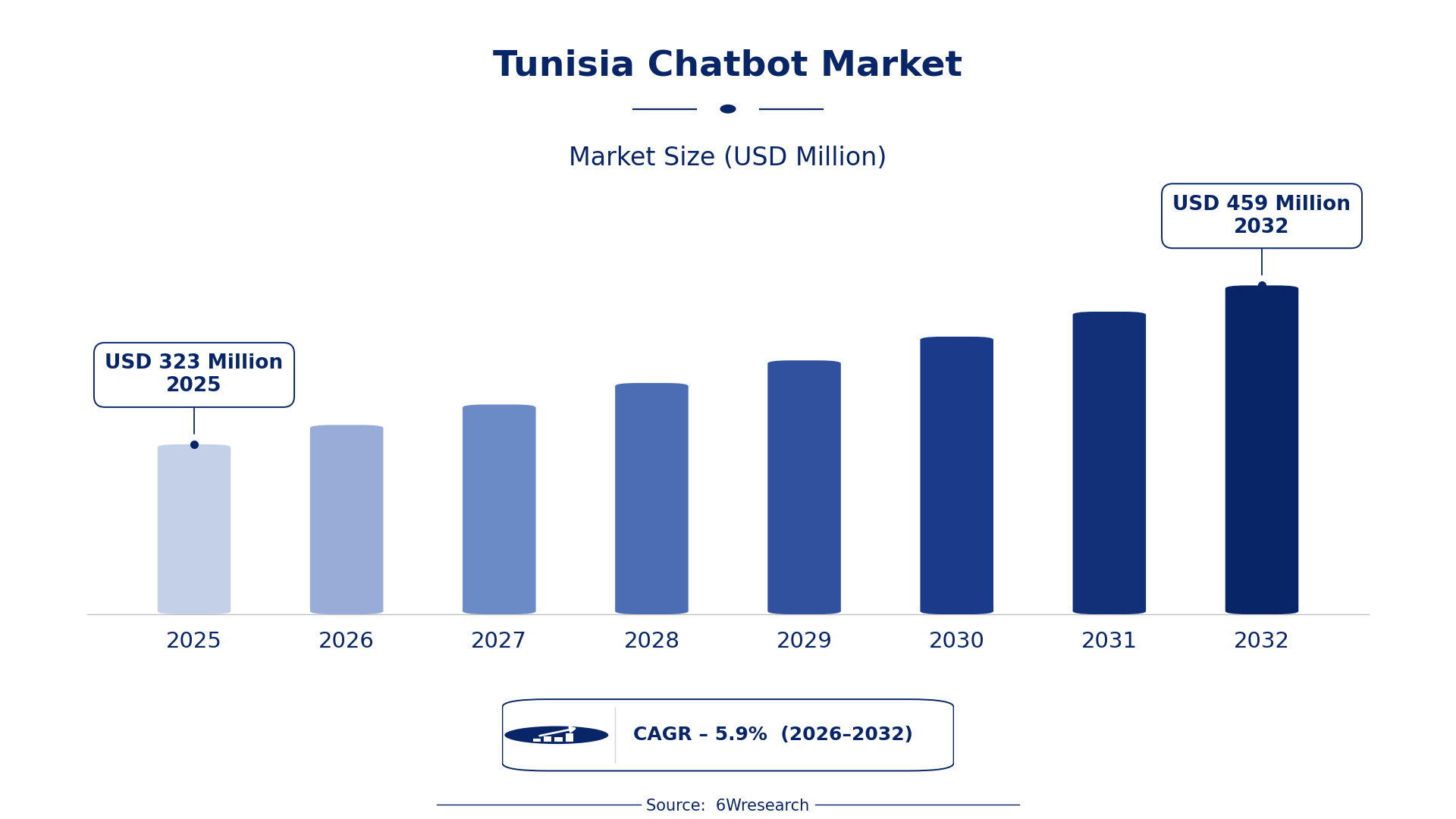
The Tunisia Chatbot Market was estimated at USD 323 Million in 2025 and is projected to reach USD 459 Million by 2032, growing at a CAGR of 5.9% from 2026 to 2032.
Tunisia Chatbot Market Synopsis
The Tunisia chatbot market is on a dynamic growth trajectory, spurred by the escalating demand for AI-driven solutions across various sectors. Businesses in e-commerce, banking, and healthcare are increasingly adopting chatbots to improve customer engagement and streamline operations.
A surge in digital transformation initiatives, supported by government policies aimed at fostering innovation, is propelling the market forward. As organizations recognize the efficiency and cost-saving benefits of chatbots, the landscape is evolving rapidly, paving the way for customized solutions and enhanced user experiences.
Tunisia Chatbot Market Year-wise Growth Rate and Key Drivers
This graph illustrates the annual growth rates of the Tunisia Chatbot Market from 2021 to 2032, highlighting a steady upward trajectory and projected expansion over the forecast period.
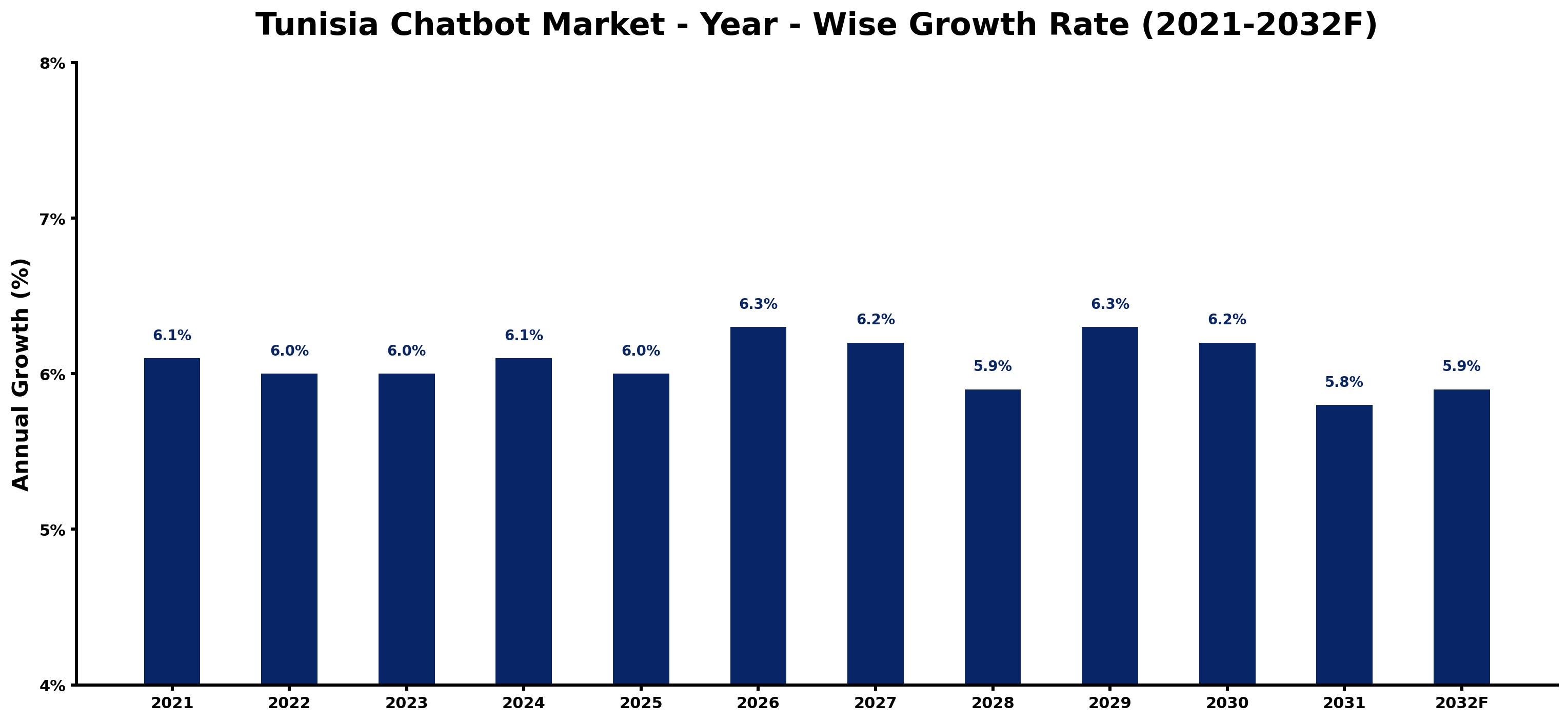
The table below presents the year‑wise growth rates along with the key drivers influencing the market
| Year | Growth Rate | Major Drivers |
| 2021 | 6.1% | Rising e-commerce adoption among Tunisian consumers. |
| 2022 | 6.0% | Increasing smartphone penetration facilitating chatbot access. |
| 2023 | 6.0% | Growing interest in AI-driven customer engagement tools. |
| 2024 | 6.1% | Tunisian startups leveraging chatbots for enhanced user experience. |
| 2025 | 6.0% | Emergence of local chatbot development platforms. |
| 2026 | 6.3% | Supportive regulations encouraging digital business solutions. |
| 2027 | 6.2% | Local universities enhancing AI and chatbot curriculum. |
| 2028 | 5.9% | Demand for multilingual support in customer interactions. |
| 2029 | 6.3% | Surge in social media usage fueling chatbot integration. |
| 2030 | 6.2% | Adoption of chatbots for tourism industry service improvement. |
| 2031 | 5.8% | Healthcare sector exploring chatbot applications for patient inquiries. |
| 2032 | 5.9% | Small businesses increasing efficiency through chatbot solutions. |
Note: Market size estimations and growth projections presented in this report are based on 6Wresearch's proprietary forecasting methodology, utilizing the latest available industry data, government publications, and primary research inputs.
Tunisia Chatbot Market Key Takeaways
Below are some of the specific key takeaways from the market, including:
- The integration of AI technologies is enabling personalized customer interactions.
- Multilingual capabilities are increasingly important to cater to Tunisia's diverse population.
- Government initiatives are fostering a favorable environment for market growth.
- Emerging sectors such as tourism and education present new opportunities for chatbot adoption.
- Ongoing advancements in natural language processing are enhancing chatbot functionalities.
Evaluation of Restraints in Tunisia Chatbot Market
Despite the promising outlook, several constraints hinder market expansion. A primary barrier is the limited understanding of chatbot technology among many businesses, which can lead to underutilization of the available tools. Additionally, there is a noticeable shortage of skilled professionals capable of developing and maintaining these sophisticated systems. Concerns regarding data privacy and security further complicate the adoption process, as businesses strive to protect user information while integrating new technologies. Compounding these issues is the competition from established global players, which can be daunting for local firms trying to carve out their niche.
Tunisia Chatbot Market Trends
Current trends in the Tunisia chatbot market reflect a strong inclination towards automation and efficiency. Companies are increasingly integrating artificial intelligence to enhance customer service interactions, leading to quicker response times and improved satisfaction rates. Additionally, the rise of multilingual capabilities is crucial for engaging a broader customer base, especially in a multicultural society like Tunisia.
The adoption of chatbots is also expanding beyond traditional sectors, making inroads into education and tourism, where personalized customer engagement is essential. This shift indicates a growing recognition of chatbots as versatile tools that can enhance operational efficiency across various industries.
Tunisia Chatbot Market Opportunities
The opportunities within the Tunisia chatbot market are both plentiful and compelling. Customized chatbot solutions tailored to specific industry needs can drive significant growth, especially as businesses seek to improve customer interactions. on top of that, the tourism sector is ripe for technological disruption, offering a fertile ground for chatbot innovation.
As organizations strive for seamless omnichannel experiences, investing in chatbots that integrate with popular messaging platforms will be crucial. This adaptability not only enhances user engagement but also positions businesses to capture a larger market share as digital communication channels continue to evolve.
Government Initiatives in the Tunisia Chatbot Market
The Tunisian government is actively shaping the chatbot market through various initiatives aimed at promoting digital innovation and entrepreneurship. By implementing strategic policies, the government seeks to create an environment conducive to technological advancement, ultimately enhancing service delivery across public and private sectors.
- A recent initiative launched in 2023 focuses on funding startups that develop AI-based solutions, including chatbots, to bolster local technological capabilities.
- Currently underway is the National Digital Transformation Strategy, which emphasizes integrating digital solutions in government services to improve efficiency.
- A planned regulatory framework set to be introduced in 2026 aims to strengthen data privacy and cybersecurity measures for chatbot applications.
- In 2024, a nationwide campaign will begin to raise awareness of AI technologies among businesses, aiming to bridge the knowledge gap in chatbot utilization.
- The government is also collaborating with educational institutions to enhance training programs focused on AI and chatbot development, expected to launch by mid-2025.
Future Insights of the Tunisia Chatbot Market
Looking ahead to 2026-2032, the Tunisia chatbot market is set for notable advancements fueled by technological innovations in AI and machine learning. Businesses across various sectors, particularly e-commerce, finance, and healthcare, will increasingly adopt chatbots to enhance operational efficiency and customer satisfaction.
The ongoing push for digital transformation, paired with a shift toward online communication channels, will further stimulate demand for sophisticated chatbot solutions. This evolving landscape will create ample opportunities for vendors and service providers to innovate and capture a larger share of this burgeoning market.
Tunisia Chatbot Market Latest Developments
Over the past 12-14 months, the Tunisia chatbot market has witnessed a flurry of activity, as businesses and government entities alike recognize the transformative potential of AI technologies. This has led to increased collaborations and the introduction of new chatbot solutions aimed at enhancing customer experiences across various sectors.
- A major technology vendor launched an advanced chatbot platform in early 2025, designed to integrate seamlessly with popular messaging apps.
- An ongoing initiative that began in late 2024 focuses on developing AI-driven customer service tools for local banks, enhancing their operational capabilities.
- A partnership between a leading telecom operator and a software firm is currently underway to create chatbots tailored for the healthcare industry, expected to roll out in Q2 2026.
- In late 2025, a new service aimed at providing customized chatbot solutions for the tourism sector was announced, with pilot programs planned for early 2026.
- Upcoming in mid-2026 is a government-supported initiative to launch a national chatbot directory, helping businesses connect with technology providers.
Tunisia Chatbot Market - Key Attractiveness of the Report
- 10 Years of Market Numbers
- Historical Data Starting from 2022 to 2025
- Base Year: 2025
- Forecast Data until 2032
- Key Performance Indicators Impacting the Market
- Major Upcoming Developments and Projects
Key Highlights of the Report:
- Tunisia Chatbot Market Outlook
- Market Size of Tunisia Chatbot Market, 2025
- Forecast of Tunisia Chatbot Market, 2032
- Historical Data and Forecast of Tunisia Chatbot Revenues & Volume for the Period 2022-2032F
- Tunisia Chatbot Market Trend Evolution
- Tunisia Chatbot Market Drivers and Challenges
- Tunisia Chatbot Price Trends
- Tunisia Chatbot Porter's Five Forces
- Tunisia Chatbot Industry Life Cycle
- Historical Data and Forecast of Tunisia Chatbot Market Revenues & Volume By Component for the Period 2022-2032F
- Historical Data and Forecast of Tunisia Chatbot Market Revenues & Volume By Solutions for the Period 2022-2032F
- Historical Data and Forecast of Tunisia Chatbot Market Revenues & Volume By Services for the Period 2022-2032F
- Historical Data and Forecast of Tunisia Chatbot Market Revenues & Volume By Type for the Period 2022-2032F
- Historical Data and Forecast of Tunisia Chatbot Market Revenues & Volume By Rule Based for the Period 2022-2032F
- Historical Data and Forecast of Tunisia Chatbot Market Revenues & Volume By AI Based for the Period 2022-2032F
- Historical Data and Forecast of Tunisia Chatbot Market Revenues & Volume By Deployment Mode for the Period 2022-2032F
- Historical Data and Forecast of Tunisia Chatbot Market Revenues & Volume By On-premises for the Period 2022-2032F
- Historical Data and Forecast of Tunisia Chatbot Market Revenues & Volume By Cloud for the Period 2022-2032F
- Historical Data and Forecast of Tunisia Chatbot Market Revenues & Volume By Channel Integration for the Period 2022-2032F
- Historical Data and Forecast of Tunisia Chatbot Market Revenues & Volume By Websites for the Period 2022-2032F
- Historical Data and Forecast of Tunisia Chatbot Market Revenues & Volume By Contact Centers for the Period 2022-2032F
- Historical Data and Forecast of Tunisia Chatbot Market Revenues & Volume By Social Media for the Period 2022-2032F
- Historical Data and Forecast of Tunisia Chatbot Market Revenues & Volume By Mobile Applications for the Period 2022-2032F
- Historical Data and Forecast of Tunisia Chatbot Market Revenues & Volume By Organization Size for the Period 2022-2032F
- Historical Data and Forecast of Tunisia Chatbot Market Revenues & Volume By Large Enterprises for the Period 2022-2032F
- Historical Data and Forecast of Tunisia Chatbot Market Revenues & Volume By SMEs for the Period 2022-2032F
- Historical Data and Forecast of Tunisia Chatbot Market Revenues & Volume By Business Function for the Period 2022-2032F
- Historical Data and Forecast of Tunisia Chatbot Market Revenues & Volume By Information Technology Service Management for the Period 2022-2032F
- Historical Data and Forecast of Tunisia Chatbot Market Revenues & Volume By Human Resources for the Period 2022-2032F
- Historical Data and Forecast of Tunisia Chatbot Market Revenues & Volume By Sales and Marketing for the Period 2022-2032F
- Historical Data and Forecast of Tunisia Chatbot Market Revenues & Volume By Finance for the Period 2022-2032F
- Historical Data and Forecast of Tunisia Chatbot Market Revenues & Volume By Application for the Period 2022-2032F
- Historical Data and Forecast of Tunisia Chatbot Market Revenues & Volume By Customer Service for the Period 2022-2032F
- Historical Data and Forecast of Tunisia Chatbot Market Revenues & Volume By Personal Assistant for the Period 2022-2032F
- Historical Data and Forecast of Tunisia Chatbot Market Revenues & Volume By Branding and Advertisement for the Period 2022-2032F
- Historical Data and Forecast of Tunisia Chatbot Market Revenues & Volume By Customer Engagement and Retention for the Period 2022-2032F
- Historical Data and Forecast of Tunisia Chatbot Market Revenues & Volume By Data Privacy and Compliance for the Period 2022-2032F
- Historical Data and Forecast of Tunisia Chatbot Market Revenues & Volume By Employee Engagement and On Boarding for the Period 2022-2032F
- Historical Data and Forecast of Tunisia Chatbot Market Revenues & Volume By Payment Processing for the Period 2022-2032F
- Historical Data and Forecast of Tunisia Chatbot Market Revenues & Volume By Others for the Period 2022-2032F
- Historical Data and Forecast of Tunisia Chatbot Market Revenues & Volume By Vertical for the Period 2022-2032F
- Historical Data and Forecast of Tunisia Chatbot Market Revenues & Volume By BFSI for the Period 2022-2032F
- Historical Data and Forecast of Tunisia Chatbot Market Revenues & Volume By IT and Telecom for the Period 2022-2032F
- Historical Data and Forecast of Tunisia Chatbot Market Revenues & Volume By Retail and Ecommerce for the Period 2022-2032F
- Historical Data and Forecast of Tunisia Chatbot Market Revenues & Volume By Healthcare and Life Sciences for the Period 2022-2032F
- Historical Data and Forecast of Tunisia Chatbot Market Revenues & Volume By Transportation and Logistics for the Period 2022-2032F
- Historical Data and Forecast of Tunisia Chatbot Market Revenues & Volume By Government for the Period 2022-2032F
- Historical Data and Forecast of Tunisia Chatbot Market Revenues & Volume By Travel and Hospitality for the Period 2022-2032F
- Historical Data and Forecast of Tunisia Chatbot Market Revenues & Volume By Media and Entertainment for the Period 2022-2032F
- Tunisia Chatbot Import Export Trade Statistics
- Market Opportunity Assessment By Component
- Market Opportunity Assessment By Type
- Market Opportunity Assessment By Deployment Mode
- Market Opportunity Assessment By Channel Integration
- Market Opportunity Assessment By Organization Size
- Market Opportunity Assessment By Business Function
- Market Opportunity Assessment By Application
- Market Opportunity Assessment By Vertical
- Tunisia Chatbot Top Companies Market Share
- Tunisia Chatbot Competitive Benchmarking By Technical and Operational Parameters
- Tunisia Chatbot Company Profiles
- Tunisia Chatbot Key Strategic Recommendations






































