Tunisia Chemical Packaging Market Summary
The tunisia chemical packaging market was estimated at USD 1103 Million in 2025 and is projected to reach USD 1607 Million by 2032, growing at a CAGR of 6.5% from 2026 to 2032.
Tunisia Chemical Packaging Market Year-wise Growth Rate and Key Drivers
This graph highlights how the Tunisia Chemical Packaging Market has steadily grown over the past five years, supported by major growth factors.
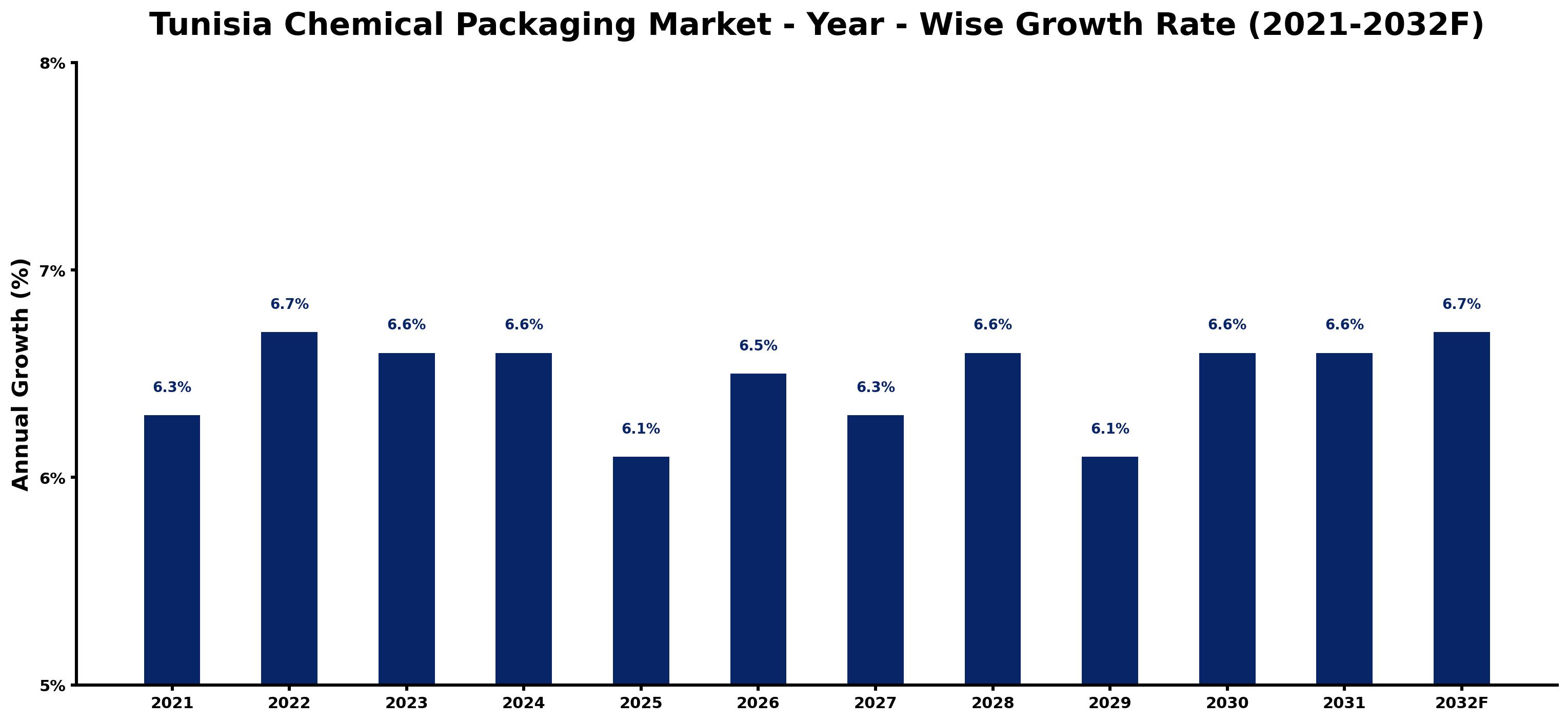
The table below presents the year wise growth rates along with the key drivers influencing the market
| Year | Growth Rate | Major Drivers |
| 2021 | 6.3% | Market recovery followed supply chain disruptions, encouraging local chemical packaging production. |
| 2022 | 6.7% | Increased infrastructure projects spurred demand for specialized chemical packaging solutions. |
| 2023 | 6.6% | Sustainability concerns prompted innovations in biodegradable and recyclable packaging materials. |
| 2024 | 6.6% | International partnerships expanded local manufacturers' access to advanced packaging technologies. |
| 2025 | 6.1% | E-commerce growth necessitated efficient packaging solutions for chemical products distribution. |
| 2026 | 6.5% | Investment in logistics infrastructure enhanced distribution channels for chemical packaging. |
| 2027 | 6.3% | Consumer preferences shifted towards sustainable packaging, influencing manufacturers' product lines. |
| 2028 | 6.6% | Investment in renewable energy sources impacted production processes within the chemical sector. |
| 2029 | 6.1% | Emerging markets within North Africa increased competition in chemical packaging offerings. |
| 2030 | 6.6% | Technological advancements in automation improved manufacturing efficiency for chemical packaging. |
| 2031 | 6.6% | Regulatory frameworks evolved, enforcing stricter standards on packaging materials and safety. |
| 2032 | 6.7% | Focus on circular economy practices transformed product lifecycle management within the industry. |
Note - Market size estimations and growth projections presented in this report are based on 6Wresearch's advanced forecasting approach, validated with industry datasets as of June 2026.
Tunisia Chemical Packaging Market Synopsis
The Tunisia Chemical Packaging Market is projected to reach 6.5% and witness significant growth during the forecast period (2026-2032). This market encompasses a variety of packaging solutions specifically engineered for the safe storage, handling, and transportation of chemicals. Containers, drums, and bottles are designed not only for efficiency but also to comply with stringent safety regulations, thereby reducing environmental impact during chemical distribution.
Tunisia Chemical Packaging Market Growth Drivers
The Tunisia Chemical Packaging Market is experiencing robust growth driven by several factors. Firstly, the increasing demand for safe and effective packaging solutions across multiple industries has become a significant catalyst. Many sectors, including agriculture, pharmaceuticals, and manufacturing, require specialized packaging to manage both hazardous and non-hazardous chemicals securely.
- Technological advancements are pivotal in enhancing packaging materials, offering improved barrier properties and compliance with international safety standards.
- Heightened awareness surrounding environmental issues has led to a growing preference for eco-friendly packaging solutions, thereby driving innovation.
- Regulatory frameworks are tightening, necessitating upgrades in packaging to ensure that materials meet the latest safety and handling regulations.
- As global supply chains evolve, the demand for more efficient logistics and packaging systems to minimize waste and improve safety is rising.
- The trend towards sustainable practices among organizations is creating opportunities for manufacturers focused on developing greener packaging solutions.
Tunisia Chemical Packaging Market Challenges and Restraints
Despite the upward trajectory of the Tunisia Chemical Packaging Market, several challenges may impede growth. High production costs pose significant concern, particularly for small and medium-sized enterprises striving to compete against larger manufacturers. Compliance with stringent regulatory standards related to environmental sustainability and safety can strain resources and operational capabilities.
- Competition from alternative packaging materials, including biodegradable options, is intensifying, forcing traditional chemical packaging suppliers to innovate continuously.
- Limited consumer awareness about the benefits and importance of specialized chemical packaging often leads to underutilization of available products.
- The potential for economic instability can hinder investment in necessary upgrades and innovations within packaging facilities.
- Supply chain disruptions can affect the availability and delivery of raw materials, complicating production processes for packaging solutions.
- As sustainability takes center stage, there exists a pressing need for the industry to pivot towards practices that not only comply with regulations but also meet consumer expectations for eco-friendly products.
Tunisia Chemical Packaging Market Government Investment and Initiatives
Government policies and initiatives play a vital role in shaping the Tunisia Chemical Packaging Market. Regulations focused on safety and environmental sustainability are designed to ensure that chemical packaging adheres to international standards, especially in handling hazardous materials. The government is providing various incentives for manufacturers who adopt eco-friendly materials and technologies, encouraging a shift towards sustainable operations.
- Public spending on infrastructure improvements is aimed at enhancing logistics and distribution networks, benefiting the overall chemical packaging sector.
- Development plans targeting the chemical industry are being implemented to foster a safe and efficient operational environment.
- Collaboration between government entities and industry stakeholders helps to facilitate knowledge sharing and best practices in packaging standards.
- Investment in research and development is being promoted to encourage innovation within the chemical packaging landscape.
- Awareness campaigns are being launched to educate businesses about the importance of specialized chemical packaging and compliance with safety regulations.
Tunisia Chemical Packaging Market Latest Developments (May 2025 - June 2026)
Recent developments in the Tunisia Chemical Packaging Market reflect a period of adaptation and innovation. The industry is witnessing a gradual transition towards materials that not only meet safety guidelines but also address sustainability concerns. There has been an increased emphasis on research and technological advancements aimed at enhancing the durability and eco-friendliness of packaging solutions.
- Significant strides in material science have led to the development of new packaging options that offer better protection and reduced environmental impact.
- The market is increasingly focusing on circular economy initiatives, prompting many manufacturers to explore recyclable and reusable packaging designs.
- Industry conferences and seminars have gained popularity, serving as platforms for stakeholders to exchange insights on regulatory updates and best practices.
- Collaborations between packaging manufacturers and environmental organizations are on the rise, aimed at creating awareness and implementing more sustainable practices.
- Consumer demand for transparency regarding material sourcing and manufacturing processes is prompting businesses to adopt more stringent quality control measures.
Tunisia Chemical Packaging Market - Key Attractiveness of the Report
- 10 Years of Market Numbers
- Historical Data Starting from 2022 to 2025
- Base Year: 2025
- Forecast Data until 2032
- Key Performance Indicators Impacting the Market
- Major Upcoming Developments and Projects
Key Highlights of the Report:
- Tunisia Chemical Packaging Market Outlook
- Market Size of Tunisia Chemical Packaging Market, 2025
- Forecast of Tunisia Chemical Packaging Market, 2032
- Historical Data and Forecast of Tunisia Chemical Packaging Revenues & Volume for the Period 2022-2032F
- Tunisia Chemical Packaging Market Trend Evolution
- Tunisia Chemical Packaging Market Drivers and Challenges
- Tunisia Chemical Packaging Price Trends
- Tunisia Chemical Packaging Porter's Five Forces
- Tunisia Chemical Packaging Industry Life Cycle
- Historical Data and Forecast of Tunisia Chemical Packaging Market Revenues & Volume By Product Types for the Period 2022-2032F
- Historical Data and Forecast of Tunisia Chemical Packaging Market Revenues & Volume By Sacks for the Period 2022-2032F
- Historical Data and Forecast of Tunisia Chemical Packaging Market Revenues & Volume By Drums for the Period 2022-2032F
- Historical Data and Forecast of Tunisia Chemical Packaging Market Revenues & Volume By FIBC for the Period 2022-2032F
- Historical Data and Forecast of Tunisia Chemical Packaging Market Revenues & Volume By Other for the Period 2022-2032F
- Historical Data and Forecast of Tunisia Chemical Packaging Market Revenues & Volume By Applications for the Period 2022-2032F
- Historical Data and Forecast of Tunisia Chemical Packaging Market Revenues & Volume By Pharmaceutical Factory? for the Period 2022-2032F
- Historical Data and Forecast of Tunisia Chemical Packaging Market Revenues & Volume By Laboratory for the Period 2022-2032F
- Historical Data and Forecast of Tunisia Chemical Packaging Market Revenues & Volume By Chemical Plant? for the Period 2022-2032F
- Historical Data and Forecast of Tunisia Chemical Packaging Market Revenues & Volume By Others for the Period 2022-2032F
- Tunisia Chemical Packaging Import Export Trade Statistics
- Market Opportunity Assessment By Product Types
- Market Opportunity Assessment By Applications
- Tunisia Chemical Packaging Top Companies Market Share
- Tunisia Chemical Packaging Competitive Benchmarking By Technical and Operational Parameters
- Tunisia Chemical Packaging Company Profiles
- Tunisia Chemical Packaging Key Strategic Recommendations






































