Tunisia Coal Market Size Growth Rate
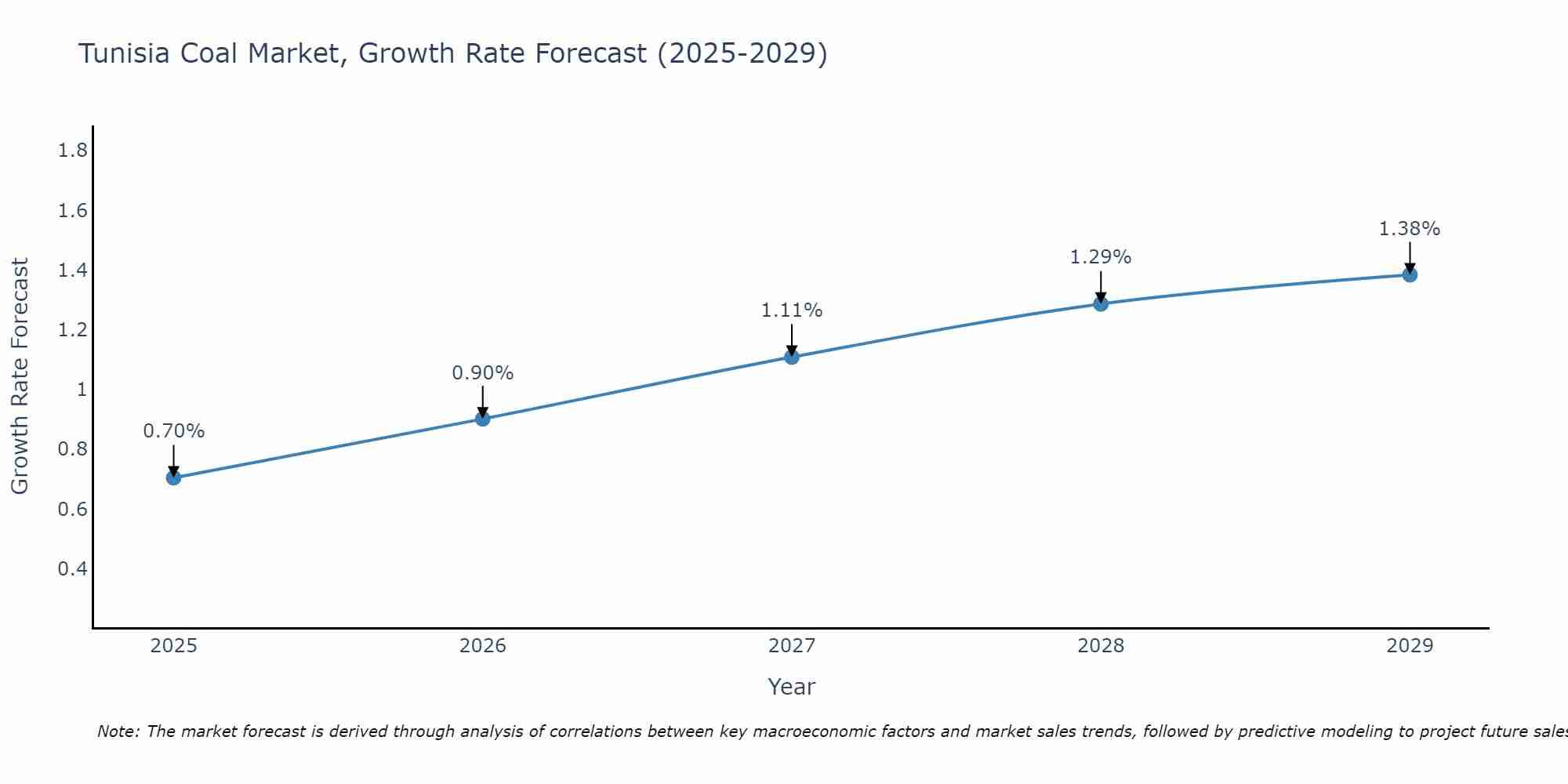
The Tunisia Coal Market is likely to experience consistent growth rate gains over the period 2025 to 2029. Commencing at 0.70% in 2025, growth builds up to 1.38% by 2029.
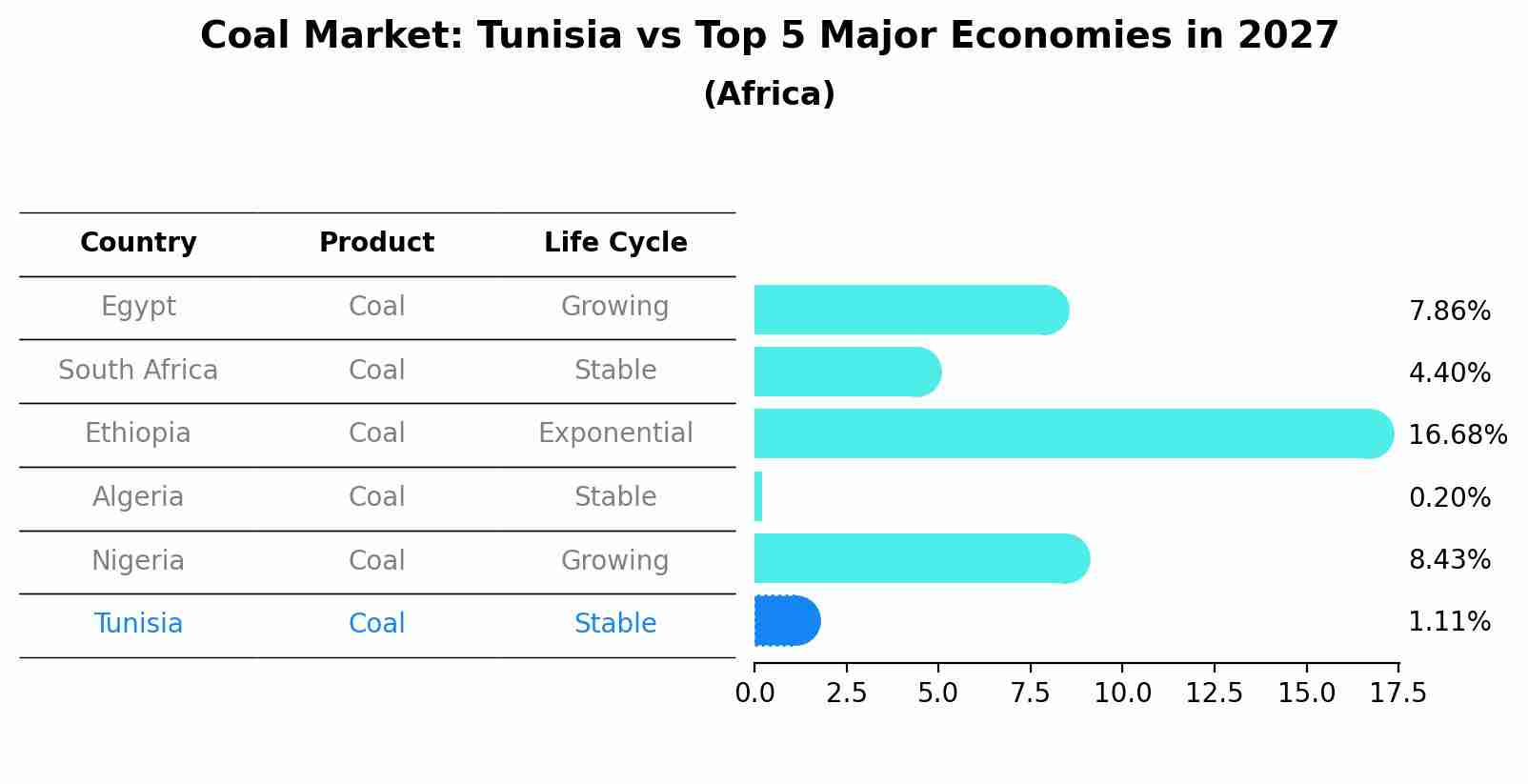
Coal Market: Tunisia vs Top 5 Major Economies in 2027 (Africa)
Tunisia's Coal market is anticipated to experience a stable growth rate of 1.11% by 2027, reflecting trends observed in the largest economy Egypt, followed by South Africa, Ethiopia, Algeria and Nigeria.
Tunisia Coal Market Overview
The coal market in Tunisia is significant, providing a vital source of energy for the country`s power generation needs. Despite global trends towards renewable energy, coal remains an important part of Tunisia`s energy mix.
Drivers of the market
The Tunisia coal market is influenced by energy demands, industrial growth, and policies related to energy security. However, global trends towards cleaner energy sources and renewable energy adoption pose challenges to market growth.
Challenges of the market
The Tunisia coal market confronts declining demand amid global shifts towards renewable energy sources. Economic viability and environmental considerations pose substantial challenges to the coal sector`s sustainability. Transition strategies towards cleaner energy alternatives are crucial for future market resilience.
Government Policy of the market
Policies include regulations on coal mining, extraction, and use, focusing on environmental sustainability, worker safety, and energy security.
Key Highlights of the Report:
- Tunisia Coal Market Outlook
- Market Size of Tunisia Coal Market, 2024
- Forecast of Tunisia Coal Market, 2031
- Historical Data and Forecast of Tunisia Coal Revenues & Volume for the Period 2021-2031
- Tunisia Coal Market Trend Evolution
- Tunisia Coal Market Drivers and Challenges
- Tunisia Coal Price Trends
- Tunisia Coal Porter's Five Forces
- Tunisia Coal Industry Life Cycle
- Historical Data and Forecast of Tunisia Coal Market Revenues & Volume By Types for the Period 2021-2031
- Historical Data and Forecast of Tunisia Coal Market Revenues & Volume By Bituminous Coal for the Period 2021-2031
- Historical Data and Forecast of Tunisia Coal Market Revenues & Volume By Sub-Bituminous Coal for the Period 2021-2031
- Historical Data and Forecast of Tunisia Coal Market Revenues & Volume By Anthracite for the Period 2021-2031
- Historical Data and Forecast of Tunisia Coal Market Revenues & Volume By Lignite for the Period 2021-2031
- Historical Data and Forecast of Tunisia Coal Market Revenues & Volume By End-Users for the Period 2021-2031
- Historical Data and Forecast of Tunisia Coal Market Revenues & Volume By Electricity for the Period 2021-2031
- Historical Data and Forecast of Tunisia Coal Market Revenues & Volume By Steel for the Period 2021-2031
- Historical Data and Forecast of Tunisia Coal Market Revenues & Volume By Cement for the Period 2021-2031
- Historical Data and Forecast of Tunisia Coal Market Revenues & Volume By Others for the Period 2021-2031
- Tunisia Coal Import Export Trade Statistics
- Market Opportunity Assessment By Types
- Market Opportunity Assessment By End-Users
- Tunisia Coal Top Companies Market Share
- Tunisia Coal Competitive Benchmarking By Technical and Operational Parameters
- Tunisia Coal Company Profiles
- Tunisia Coal Key Strategic Recommendations






































