Tunisia Coated Fabric Market Size, Share & Growth Rate
The Tunisia Coated Fabric Market was estimated at USD 439 Million in 2025 and is projected to reach USD 613 Million by 2032, growing at a CAGR of 4.9% from 2026 to 2032. This growth is primarily fueled by an increasing demand for coated fabrics in key sectors such as automotive upholstery, furniture, and industrial applications. The durability and water resistance of these materials make them particularly appealing to manufacturers and consumers alike, enhancing their adoption across various industries.
Tunisia Coated Fabric Market Year-wise Growth Rate and Key Drivers
This graph highlights how the Tunisia Coated Fabric Market has steadily grown over the years, supported by major growth factors.
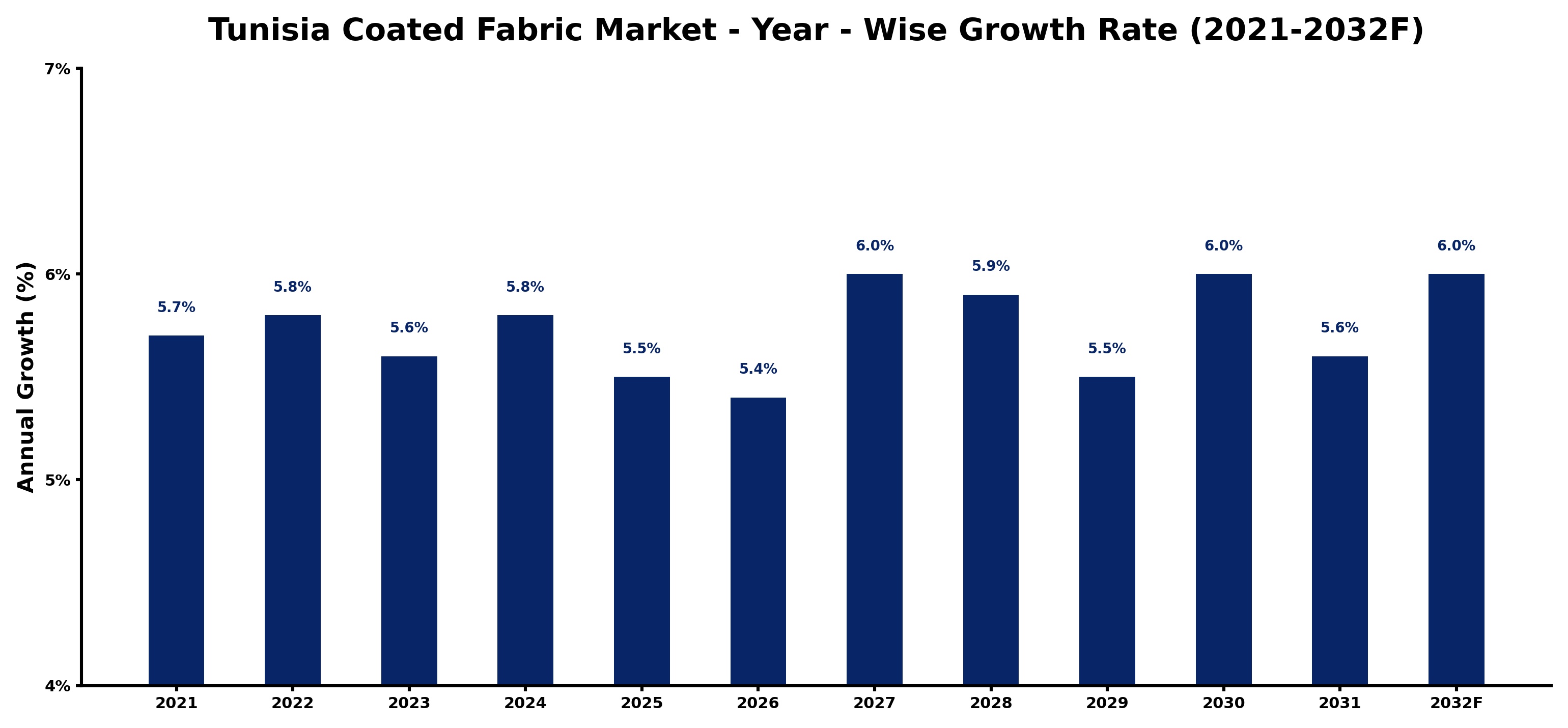
The table below presents the year‑wise growth rates along with the key drivers influencing the market
| Year | Growth Rate | Major Drivers |
| 2021 | 5.7% | Government infrastructure modernization initiatives |
| 2022 | 5.8% | Increasing industrial infrastructure investments |
| 2023 | 5.6% | Growing urbanization and commercial development |
| 2024 | 5.8% | Expansion of manufacturing activities |
| 2025 | 5.5% | Expansion of commercial construction activities |
| 2026 | 5.4% | Increasing adoption of advanced technologies |
| 2027 | 6.0% | Growing renewable energy integration projects |
| 2028 | 5.9% | Growing urbanization and commercial development |
| 2029 | 5.5% | Increasing industrial automation investments |
| 2030 | 6.0% | Increasing smart city development projects |
| 2031 | 5.6% | Expansion of manufacturing activities |
| 2032 | 6.0% | Rapid growth in telecom and data center sectors |
Note - Market size estimations and growth projections presented in this report are based on 6Wresearch's advanced forecasting approach, validated with industry datasets as of June 2026.
Tunisia Coated Fabric Market Synopsis
Recent momentum in the Tunisia coated fabric market reflects a robust demand from diverse applications, yet the future landscape promises even more dynamic growth. Emerging trends toward innovation in material technology and enhanced durability are poised to drive significant advancements in this sector.
As the market evolves, manufacturers are increasingly focusing on quality and sustainability. This shift not only supports compliance with rising environmental regulations but also meets the growing consumer preference for eco-friendly products. A combination of innovation and strategic government initiatives is expected to further bolster market growth.
Tunisia Coated Fabric Market Key Takeaways
- The market is projected to grow from USD 439 Million in 2025 to USD 613 Million by 2032.
- Key drivers include applications in automotive, protective clothing, and furniture sectors.
- Quality consistency and supply chain disruptions present ongoing challenges.
- Government policies are increasingly supporting innovation and quality standards.
- Emerging trends focus on sustainable practices and technological advancements.
Evaluation of Restraints in Tunisia Coated Fabric Market
The Tunisia coated fabric market faces several restraints that may hinder its growth trajectory. Notably, issues around quality consistency across different suppliers create challenges for manufacturers striving to maintain product standards. Additionally, supply chain disruptions—exacerbated by global economic fluctuations—can lead to delays and increased operational costs. Raw material price volatility also poses a threat, compelling businesses to adapt pricing strategies to remain competitive while ensuring product quality. Without enhanced manufacturing efficiencies and advanced quality control measures, market participants may struggle to achieve the desired stability and growth.
Tunisia Coated Fabric Market Trends
Current trends within the Tunisia coated fabric market highlight a significant shift towards sustainable production methods. Eco-friendly coated fabrics are gaining traction, driven by consumer preferences and regulatory pressures. Innovations such as lightweight, multi-functional materials are becoming essential, particularly in the automotive and industrial sectors. Furthermore, technological advancements in production processes are allowing manufacturers to enhance durability, thereby increasing the product's lifecycle and performance.
Tunisia Coated Fabric Market Opportunities
There exist considerable growth opportunities within the Tunisia coated fabric market. The automotive sector, in particular, is poised for expansion, with increasing vehicle production and a shift towards higher-quality materials for interiors. Furthermore, the rising demand for protective clothing in various industries, including healthcare and manufacturing, presents a lucrative avenue for coated fabric applications. As manufacturers invest in sustainable practices and innovative technologies, the market can capitalize on an evolving consumer landscape that values durability and eco-friendliness.
Government Initiatives in the Tunisia Coated Fabric Market
The Tunisian government has implemented several initiatives aimed at bolstering the textile and manufacturing sectors, including those related to coated fabrics. Policies that ensure compliance with quality standards and environmental regulations are increasingly prevalent. Additionally, government support for research and innovation within the textile industry fosters an environment conducive to advancements in coated fabric production. Such initiatives are crucial for enhancing competitiveness and ensuring long-term sustainability in this growing market.
Future Insights of the Tunisia Coated Fabric Market
Looking ahead to 2026-2032, the Tunisia coated fabric market is positioned for a robust expansion trajectory. With continued advancements in material technology and growing applications in high-demand sectors, the market is set to benefit from increasing investments and innovations. Additionally, a heightened focus on sustainability will drive the adoption of eco-friendly products, aligning with global trends. The combination of government support and market responsiveness to consumer needs will be vital in shaping the future landscape of coated fabrics in Tunisia.
Tunisia Coated Fabric Market Latest Developments (May 2025 - June 2026)
Recent developments in the Tunisia coated fabric market indicate a shift towards more technologically advanced production processes. Manufacturers are increasingly adopting automation and smart technologies to enhance efficiency and product quality. Additionally, collaborations between industry stakeholders and research institutions are fostering innovation, focusing on sustainability and functional improvements. The market is witnessing heightened competition as local players seek to meet both domestic and international demand for coated fabrics.
Tunisia Coated Fabric Market - Key Attractiveness of the Report
- 10 Years of Market Numbers
- Historical Data Starting from 2022 to 2025
- Base Year: 2025
- Forecast Data until 2032
- Key Performance Indicators Impacting the Market
- Major Upcoming Developments and Projects
Key Highlights of the Report:
- Tunisia Coated Fabric Market Outlook
- Market Size of Tunisia Coated Fabric Market, 2025
- Forecast of Tunisia Coated Fabric Market, 2032
- Historical Data and Forecast of Tunisia Coated Fabric Revenues & Volume for the Period 2022-2032F
- Tunisia Coated Fabric Market Trend Evolution
- Tunisia Coated Fabric Market Drivers and Challenges
- Tunisia Coated Fabric Price Trends
- Tunisia Coated Fabric Porter's Five Forces
- Tunisia Coated Fabric Industry Life Cycle
- Historical Data and Forecast of Tunisia Coated Fabric Market Revenues & Volume By Product for the Period 2022-2032F
- Historical Data and Forecast of Tunisia Coated Fabric Market Revenues & Volume By Polymer-coated Fabric for the Period 2022-2032F
- Historical Data and Forecast of Tunisia Coated Fabric Market Revenues & Volume By Rubber-coated Fabric for the Period 2022-2032F
- Historical Data and Forecast of Tunisia Coated Fabric Market Revenues & Volume By Fabric-backed Wall Coverings for the Period 2022-2032F
- Historical Data and Forecast of Tunisia Coated Fabric Market Revenues & Volume By Application for the Period 2022-2032F
- Historical Data and Forecast of Tunisia Coated Fabric Market Revenues & Volume By Transportation for the Period 2022-2032F
- Historical Data and Forecast of Tunisia Coated Fabric Market Revenues & Volume By Protective Clothing for the Period 2022-2032F
- Historical Data and Forecast of Tunisia Coated Fabric Market Revenues & Volume By Industrial for the Period 2022-2032F
- Historical Data and Forecast of Tunisia Coated Fabric Market Revenues & Volume By Roofing, Awnings & Canopies for the Period 2022-2032F
- Historical Data and Forecast of Tunisia Coated Fabric Market Revenues & Volume By Furniture & Seating for the Period 2022-2032F
- Historical Data and Forecast of Tunisia Coated Fabric Market Revenues & Volume By Others for the Period 2022-2032F
- Tunisia Coated Fabric Import Export Trade Statistics
- Market Opportunity Assessment By Product
- Market Opportunity Assessment By Application
- Tunisia Coated Fabric Top Companies Market Share
- Tunisia Coated Fabric Competitive Benchmarking By Technical and Operational Parameters
- Tunisia Coated Fabric Company Profiles
- Tunisia Coated Fabric Key Strategic Recommendations






































