Tunisia Commercial Boiler Market Size, Share & Growth Rate
The Tunisia Commercial Boiler Market was estimated at USD 395 Million in 2025 and is projected to reach USD 518 Million by 2032, growing at a CAGR of 3.9% from 2026 to 2032. This anticipated growth is primarily fueled by an increasing demand for efficient heating and cooling solutions amidst a growing population and improving living standards. Furthermore, government initiatives promoting renewable energy investments and rising awareness around sustainability are pivotal in shaping this positive trajectory.
Tunisia Commercial Boiler Market Growth Rate Analysis (2021-2032)
The Tunisia Commercial Boiler Market has exhibited stable growth, exemplified by a 4.3% increase in 2021, followed by a surge to 5.0% in 2022. The growth trend reflects heightened consumer demand for energy-efficient solutions as businesses prioritize sustainability and compliance with evolving regulatory policies. While 2023 saw a slight slowdown to 4.8%, projections indicate a rebound with consistent growth rates of around 4.4% to 5.0% through 2026. Investments in infrastructure and the ongoing energy transition are further bolstering this sector, ensuring that Tunisia's commercial boiler market remains responsive to technological advancements and market needs, with growth expected to maintain a steady pace through the end of the decade.
Tunisia Commercial Boiler Market Year-wise Growth Rate and Key Drivers
This graph highlights how the Tunisia Commercial Boiler Market has steadily grown over the past five years, supported by major growth factors.
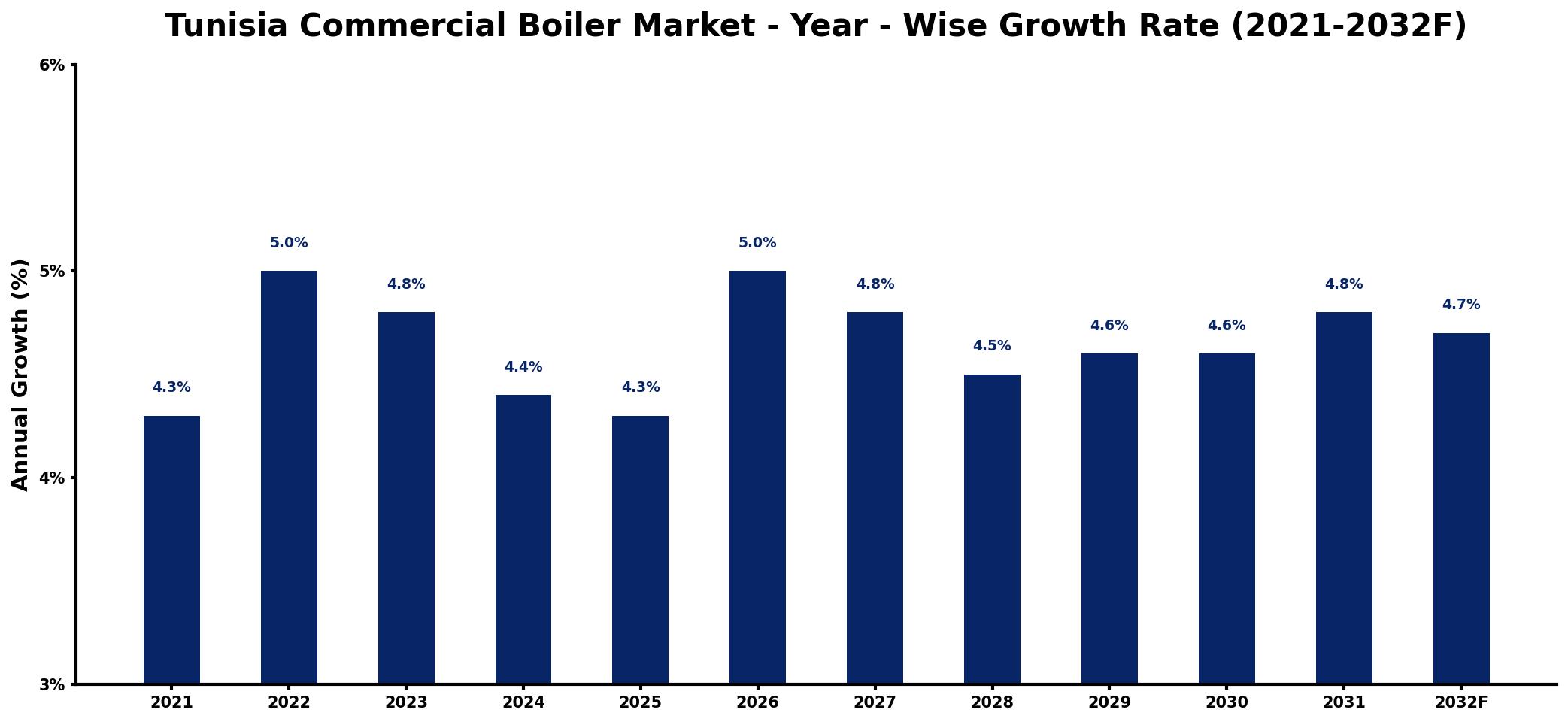
The table below presents the year‑wise growth rates along with the key drivers influencing the market
| Year | Growth Rate | Major Drivers |
| 2021 | 4.3% | Rising industrial energy needs |
| 2022 | 5.0% | Increased focus on efficiency |
| 2023 | 4.8% | Growth in renewable energy projects |
| 2024 | 4.4% | Expansion of construction sector |
| 2025 | 4.3% | Higher investments in infrastructure |
| 2026 | 5.0% | Demand for sustainable solutions |
| 2027 | 4.8% | Regulatory support for energy efficiency |
| 2028 | 4.5% | Technological advancements in energy |
| 2029 | 4.6% | Growing hospitality and tourism sector |
| 2030 | 4.6% | Increase in residential retrofitting |
| 2031 | 4.8% | Development of green technologies |
| 2032 | 4.7% | Rise in energy service companies |
Note: Market size estimations and growth projections presented in this report are based on 6Wresearch's proprietary forecasting methodology, utilizing the latest available industry data, government publications, and primary research inputs.
Tunisia Commercial Boiler Market Synopsis
The demand for commercial boilers in Tunisia is uniquely driven by a combination of industrial growth and the urgent need for energy efficiency. As sectors like hospitality, healthcare, and manufacturing expand, the necessity for reliable heating systems becomes paramount, creating a robust market environment.
Additionally, the local market is witnessing a shift towards more sustainable practices. This has led to a greater preference for energy-efficient boiler systems capable of meeting environmental regulations while also providing cost savings to businesses through reduced energy consumption.
Tunisia Commercial Boiler Market Key Takeaways
- The market is poised for steady growth due to rising demand for energy-efficient heating solutions.
- Gas boilers currently lead the market share owing to their efficiency and lower operational costs.
- Government incentives for renewable energy are expected to spur innovation in the sector.
- Technological advancements, particularly in smart controls and AI integration, are gaining traction.
- Oil-fired boilers are gaining popularity for their reliability during power interruptions.
Evaluation of Restraints in Tunisia Commercial Boiler Market
Despite the promising growth prospects, the Tunisia Commercial Boiler Market faces several restraints. One of the primary challenges is the high initial investment cost associated with advanced boiler technologies. Additionally, the limited availability of skilled technicians for installation and maintenance further restricts widespread adoption. The market is also sensitive to fluctuations in energy prices, which can hinder operational planning for businesses reliant on these systems. Lastly, regulatory challenges may impede the pace of technological advancements, particularly for newer, eco-friendly boiler systems.
Tunisia Commercial Boiler Market Trends
A significant trend reshaping the Tunisia Commercial Boiler Market is the increasing incorporation of smart technologies. These systems offer enhanced control over energy usage and maintenance schedules, appealing to businesses seeking to optimize operational efficiencies. Moreover, the shift towards renewable energy solutions is encouraging manufacturers to innovate around solar-powered heat pumps, which are gaining traction as viable alternatives. These trends reflect a broader industry movement towards sustainability and cost-effectiveness, aligning with global energy conservation efforts.
Tunisia Commercial Boiler Market Opportunities
Opportunities in the Tunisia Commercial Boiler Market are ripe for exploration, particularly in the realm of R&D. Investments focusing on energy-efficient products and technologies can yield substantial rewards. There is also a growing niche for hybrid systems that combine traditional boiler technology with renewable sources. The tourism and hospitality sectors present significant avenues for growth, with increasing demand for sustainable heating solutions. Moreover, enhancing collaboration between private sectors and government bodies can facilitate the adoption of innovative boiler solutions in line with national sustainability goals.
Government Initiatives in the Tunisia Commercial Boiler Market
The Tunisian government has rolled out several initiatives aimed at bolstering the commercial boiler market, particularly through promoting renewable energy sources. This includes tax incentives for businesses investing in energy-efficient technologies. Efforts to reduce electricity prices also support the operational feasibility of these systems. Additionally, regulations promoting the use of environmentally friendly heating solutions are progressively shaping market dynamics, ensuring that the transition towards sustainable practices is not only encouraged but effectively implemented.
Future Insights of the Tunisia Commercial Boiler Market
Looking ahead to 2026-2032, the Tunisia Commercial Boiler Market is expected to experience robust growth driven by continuous advancements in technology and heightened awareness of energy efficiency. The integration of AI capabilities in smart boiler systems will likely enhance operational efficiencies. Furthermore, the transition towards green energy solutions and increasing government support will catalyze market expansion. With a focus on sustainability, businesses in Tunisia are poised to increasingly adopt technologies that not only meet regulatory standards but also provide economic advantages, setting a solid foundation for future growth.
Tunisia Commercial Boiler Market Latest Developments (2025 - 2026)
Recent developments in the Tunisia Commercial Boiler Market indicate a shift towards more innovative and energy-efficient technologies. Companies are increasingly focusing on R&D for hybrid boiler systems, combining traditional heating solutions with renewable energy sources. The trend towards smart technology integration is also becoming more pronounced, with many businesses exploring options for enhanced energy management. Collaborations between public and private sectors are being established to drive the adoption of eco-friendly systems, reflecting a growing commitment to sustainable practices in the market.
Tunisia Commercial Boiler Market - Key Attractiveness of the Report
- 10 Years of Market Numbers
- Historical Data Starting from 2022 to 2025
- Base Year: 2025
- Forecast Data until 2032
- Key Performance Indicators Impacting the Market
- Major Upcoming Developments and Projects
Key Highlights of the Report:
- Tunisia Commercial Boiler Market Outlook
- Market Size of Tunisia Commercial Boiler Market, 2025
- Forecast of Tunisia Commercial Boiler Market, 2032
- Historical Data and Forecast of Tunisia Commercial Boiler Revenues & Volume for the Period 2022-2032F
- Tunisia Commercial Boiler Market Trend Evolution
- Tunisia Commercial Boiler Market Drivers and Challenges
- Tunisia Commercial Boiler Price Trends
- Tunisia Commercial Boiler Porter's Five Forces
- Tunisia Commercial Boiler Industry Life Cycle
- Historical Data and Forecast of Tunisia Commercial Boiler Market Revenues & Volume By Fuel Type for the Period 2022-2032F
- Historical Data and Forecast of Tunisia Commercial Boiler Market Revenues & Volume By Natural Gas for the Period 2022-2032F
- Historical Data and Forecast of Tunisia Commercial Boiler Market Revenues & Volume By Oil for the Period 2022-2032F
- Historical Data and Forecast of Tunisia Commercial Boiler Market Revenues & Volume By Coal for the Period 2022-2032F
- Historical Data and Forecast of Tunisia Commercial Boiler Market Revenues & Volume By Others for the Period 2022-2032F
- Historical Data and Forecast of Tunisia Commercial Boiler Market Revenues & Volume By Technology for the Period 2022-2032F
- Historical Data and Forecast of Tunisia Commercial Boiler Market Revenues & Volume By Condensing for the Period 2022-2032F
- Historical Data and Forecast of Tunisia Commercial Boiler Market Revenues & Volume By Non-Condensing for the Period 2022-2032F
- Historical Data and Forecast of Tunisia Commercial Boiler Market Revenues & Volume By Capacity for the Period 2022-2032F
- Historical Data and Forecast of Tunisia Commercial Boiler Market Revenues & Volume By Less than 10 MMBtu/hr for the Period 2022-2032F
- Historical Data and Forecast of Tunisia Commercial Boiler Market Revenues & Volume By 10-50 MMBtu/hr for the Period 2022-2032F
- Historical Data and Forecast of Tunisia Commercial Boiler Market Revenues & Volume By Others for the Period 2022-2032F
- Historical Data and Forecast of Tunisia Commercial Boiler Market Revenues & Volume By End User for the Period 2022-2032F
- Historical Data and Forecast of Tunisia Commercial Boiler Market Revenues & Volume By Offices for the Period 2022-2032F
- Historical Data and Forecast of Tunisia Commercial Boiler Market Revenues & Volume By Hospitals for the Period 2022-2032F
- Historical Data and Forecast of Tunisia Commercial Boiler Market Revenues & Volume By Educational Institutions for the Period 2022-2032F
- Historical Data and Forecast of Tunisia Commercial Boiler Market Revenues & Volume By Lodging for the Period 2022-2032F
- Historical Data and Forecast of Tunisia Commercial Boiler Market Revenues & Volume By Others for the Period 2022-2032F
- Tunisia Commercial Boiler Import Export Trade Statistics
- Market Opportunity Assessment By Fuel Type
- Market Opportunity Assessment By Technology
- Market Opportunity Assessment By Capacity
- Market Opportunity Assessment By End User
- Tunisia Commercial Boiler Top Companies Market Share
- Tunisia Commercial Boiler Competitive Benchmarking By Technical and Operational Parameters
- Tunisia Commercial Boiler Company Profiles
- Tunisia Commercial Boiler Key Strategic Recommendations






































