Tunisia Construction and Mining Equipment Market Size, Share & Growth Rate
The Tunisia Construction and Mining Equipment Market was estimated at USD 219 Million in 2025 and is projected to reach USD 299 Million by 2032, growing at a CAGR of 4.5% from 2026 to 2032. This growth trajectory is primarily fueled by an increasing demand for heavy machinery in both construction and mining sectors, where the efficiency of equipment like excavators and drilling rigs plays a critical role. Additionally, the ongoing infrastructure projects and mineral exploration activities further stimulate investments in advanced equipment, thus enhancing productivity and operational safety.
Tunisia Construction and Mining Equipment Market Year-wise Growth Rate and Key Drivers
This graph highlights how the Tunisia Construction and Mining Equipment Market has steadily grown over the years, supported by major growth factors.
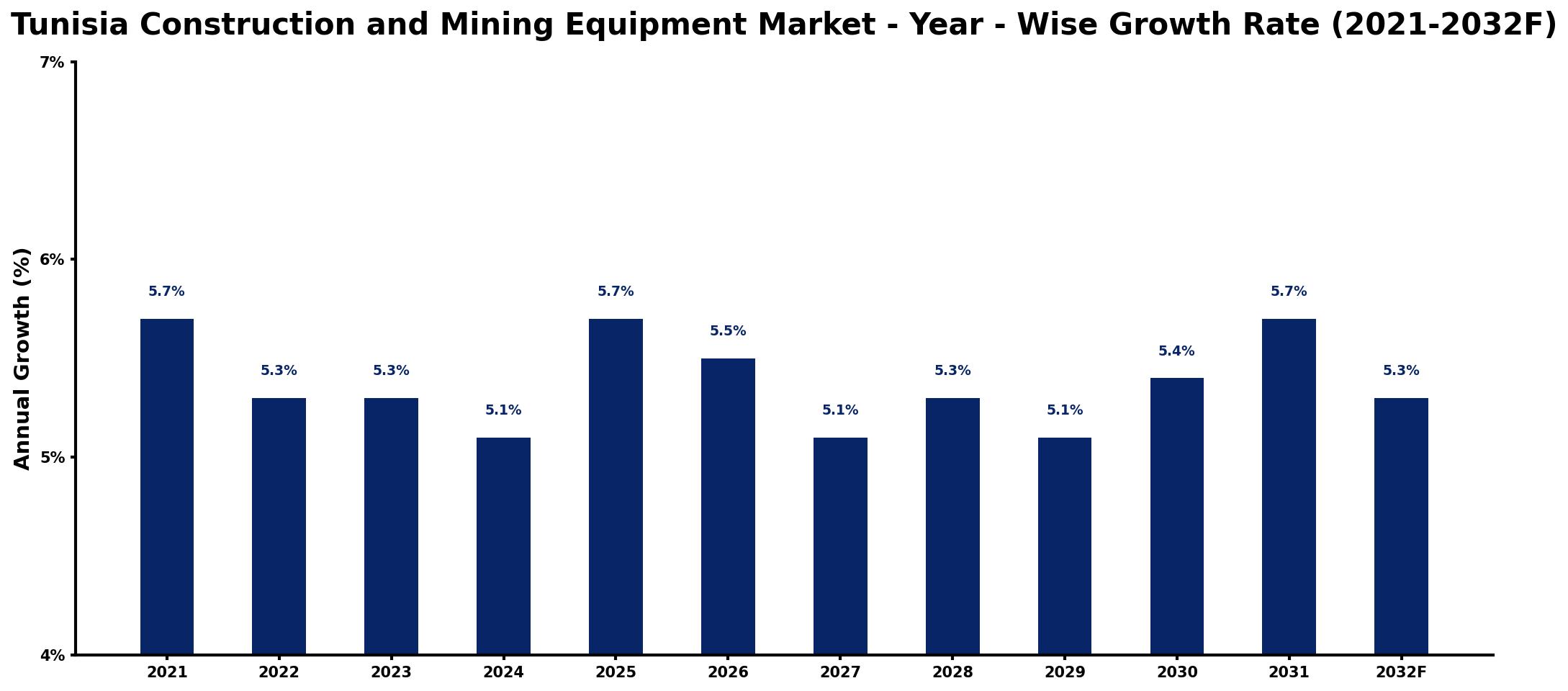
The table below presents the year‑wise growth rates along with the key drivers influencing the market
| Year | Growth Rate | Major Drivers |
| 2021 | 5.7% | Rising infrastructure development projects |
| 2022 | 5.3% | Increased foreign direct investments |
| 2023 | 5.3% | Growing urbanization and housing demand |
| 2024 | 5.1% | Government initiatives for modernization |
| 2025 | 5.7% | Expansion of renewable energy projects |
| 2026 | 5.5% | Boost in public-private partnerships |
| 2027 | 5.1% | Surge in regional trade agreements |
| 2028 | 5.3% | Focus on sustainable development goals |
| 2029 | 5.1% | Technological advancements in industry |
| 2030 | 5.4% | expanding healthcare application demand |
| 2031 | 5.7% | Growing demand for smart cities |
| 2032 | 5.3% | Enhanced workforce training programs |
Note: Market size estimations and growth projections presented in this report are based on 6Wresearch's proprietary forecasting methodology, utilizing the latest available industry data, government publications, and primary research inputs.
Tunisia Construction and Mining Equipment Market Synopsis
In Tunisia, the demand for specialized machinery such as excavators and loaders is steadily rising, driven by large-scale construction projects that require efficient and reliable equipment. Moreover, the mining sector is witnessing an uptick in exploration activities, which directly boosts the need for sophisticated drilling and hauling equipment.
Additionally, the local market shows an increasing preference for machinery that supports not only productivity but also adherence to safety standards. This shift is aligned with global trends in equipment reliability and lifecycle management, which impacts purchasing decisions across the industry.
Tunisia Construction and Mining Equipment Market Key Takeaways
- Growing demand for excavators, loaders, and drilling rigs fuels market expansion.
- Infrastructure development and mining operations serve as primary growth drivers.
- Technological advancements in machinery are essential for maintaining competitiveness.
- Local partnerships and training initiatives are critical for equipment manufacturers.
- Government regulations ensure safety and quality standards within the industry.
Evaluation of Restraints in Tunisia Construction and Mining Equipment Market
The Tunisia Construction and Mining Equipment Market faces several restraints that hinder its potential growth. Economic fluctuations can impact investment levels in infrastructure projects and mining operations. Additionally, regulatory hurdles related to equipment imports create complications for manufacturers and distributors seeking to enter or expand in this market. Moreover, the necessity for high-quality, reliable machinery in a context where lifecycle costs are a major concern poses a challenge for buyers. The demand for versatile equipment that can adapt to various operational needs is further complicating purchasing decisions.
Tunisia Construction and Mining Equipment Market Trends
Current trends indicate a shift toward automation and smart technologies within the construction and mining sectors. Equipment manufacturers are increasingly integrating digital solutions that enhance operational efficiency and safety. Additionally, sustainability is becoming a focal point, with more demand for eco-friendly machinery that minimizes environmental impact. These trends are not only reshaping the industry landscape but also influencing buyer expectations in terms of innovation and performance.
Tunisia Construction and Mining Equipment Market Opportunities
Significant opportunities lie in the realm of public-private partnerships, particularly in infrastructure projects that require modern equipment. Furthermore, the governments focus on mining as a key economic driver presents a lucrative avenue for manufacturers. Investing in local training programs can also enhance the overall effectiveness of machinery deployment, creating a more skilled workforce and fostering long-term customer relationships.
Government Initiatives in the Tunisia Construction and Mining Equipment Market
Government policies in Tunisia aim to enhance workplace safety and bolster the competitiveness of the construction and mining sectors. Regulations governing safety standards, equipment certification, and import/export controls are in place to ensure that both domestic and international operations adhere to strict compliance. Additionally, public spending initiatives targeting infrastructure development are expected to provide a further boost to equipment demand.
Future Insights of the Tunisia Construction and Mining Equipment Market
Looking ahead to 2026-2032, the Tunisia Construction and Mining Equipment Market is poised for continued growth, driven by an expanding economy and the necessity for advanced machinery. As infrastructure investments rise, coupled with increasing mining activities, the demand for state-of-the-art equipment will remain robust. Furthermore, ongoing technological advancements and shifts towards greener solutions are anticipated to redefine market dynamics, making it an exciting space for stakeholders.
Tunisia Construction and Mining Equipment Market Latest Developments (2025 - 2026)
Recent developments in the Tunisia Construction and Mining Equipment Market reveal a growing focus on integrating advanced technologies to improve operational efficiencies. Various stakeholders are actively exploring collaborations that enhance the supply chain, and there is an increasing number of local partnerships being formed to support training and skill development in equipment operation. Regulatory changes and updates on safety standards are also shaping the market landscape, ensuring that operators comply with international best practices.
Tunisia Construction and Mining Equipment Market - Key Attractiveness of the Report
- 10 Years of Market Numbers
- Historical Data Starting from 2022 to 2025
- Base Year: 2025
- Forecast Data until 2032
- Key Performance Indicators Impacting the Market
- Major Upcoming Developments and Projects
Key Highlights of the Report:
- Tunisia Construction and Mining Equipment Market Outlook
- Market Size of Tunisia Construction and Mining Equipment Market, 2025
- Forecast of Tunisia Construction and Mining Equipment Market, 2032
- Historical Data and Forecast of Tunisia Construction and Mining Equipment Revenues & Volume for the Period 2022-2032F
- Tunisia Construction and Mining Equipment Market Trend Evolution
- Tunisia Construction and Mining Equipment Market Drivers and Challenges
- Tunisia Construction and Mining Equipment Price Trends
- Tunisia Construction and Mining Equipment Porter's Five Forces
- Tunisia Construction and Mining Equipment Industry Life Cycle
- Historical Data and Forecast of Tunisia Construction and Mining Equipment Market Revenues & Volume By Product Type for the Period 2022-2032F
- Historical Data and Forecast of Tunisia Construction and Mining Equipment Market Revenues & Volume By Loaders for the Period 2022-2032F
- Historical Data and Forecast of Tunisia Construction and Mining Equipment Market Revenues & Volume By Dozers for the Period 2022-2032F
- Historical Data and Forecast of Tunisia Construction and Mining Equipment Market Revenues & Volume By Excavators for the Period 2022-2032F
- Historical Data and Forecast of Tunisia Construction and Mining Equipment Market Revenues & Volume By Crushing for the Period 2022-2032F
- Historical Data and Forecast of Tunisia Construction and Mining Equipment Market Revenues & Volume By Pulverizing & Screening Equipment for the Period 2022-2032F
- Historical Data and Forecast of Tunisia Construction and Mining Equipment Market Revenues & Volume By Others for the Period 2022-2032F
- Historical Data and Forecast of Tunisia Construction and Mining Equipment Market Revenues & Volume By Application for the Period 2022-2032F
- Historical Data and Forecast of Tunisia Construction and Mining Equipment Market Revenues & Volume By Infrastructure for the Period 2022-2032F
- Historical Data and Forecast of Tunisia Construction and Mining Equipment Market Revenues & Volume By Mineral Mining for the Period 2022-2032F
- Historical Data and Forecast of Tunisia Construction and Mining Equipment Market Revenues & Volume By Residential Building for the Period 2022-2032F
- Historical Data and Forecast of Tunisia Construction and Mining Equipment Market Revenues & Volume By Metal Mining for the Period 2022-2032F
- Historical Data and Forecast of Tunisia Construction and Mining Equipment Market Revenues & Volume By Others for the Period 2022-2032F
- Tunisia Construction and Mining Equipment Import Export Trade Statistics
- Market Opportunity Assessment By Product Type
- Market Opportunity Assessment By Application
- Tunisia Construction and Mining Equipment Top Companies Market Share
- Tunisia Construction and Mining Equipment Competitive Benchmarking By Technical and Operational Parameters
- Tunisia Construction and Mining Equipment Company Profiles
- Tunisia Construction and Mining Equipment Key Strategic Recommendations






































