Tunisia Cutting Equipment Market Size, Share & Growth Rate
The Tunisia Cutting Equipment Market was estimated at USD 1336 Million in 2025 and is projected to reach USD 1913 Million by 2032, growing at a CAGR of 5.3% from 2026 to 2032. This upward trajectory is largely fueled by the burgeoning demand for precision tools in key sectors such as manufacturing and construction. The incorporation of advanced technologies, such as laser cutting and waterjet systems, further boosts operational efficiencies and supports the competitiveness of Tunisian industries on a global scale.
Tunisia Cutting Equipment Market Year-wise Growth Rate and Key Drivers
This graph highlights how the Tunisia Cutting Equipment Market has steadily grown over the years, supported by major growth factors.
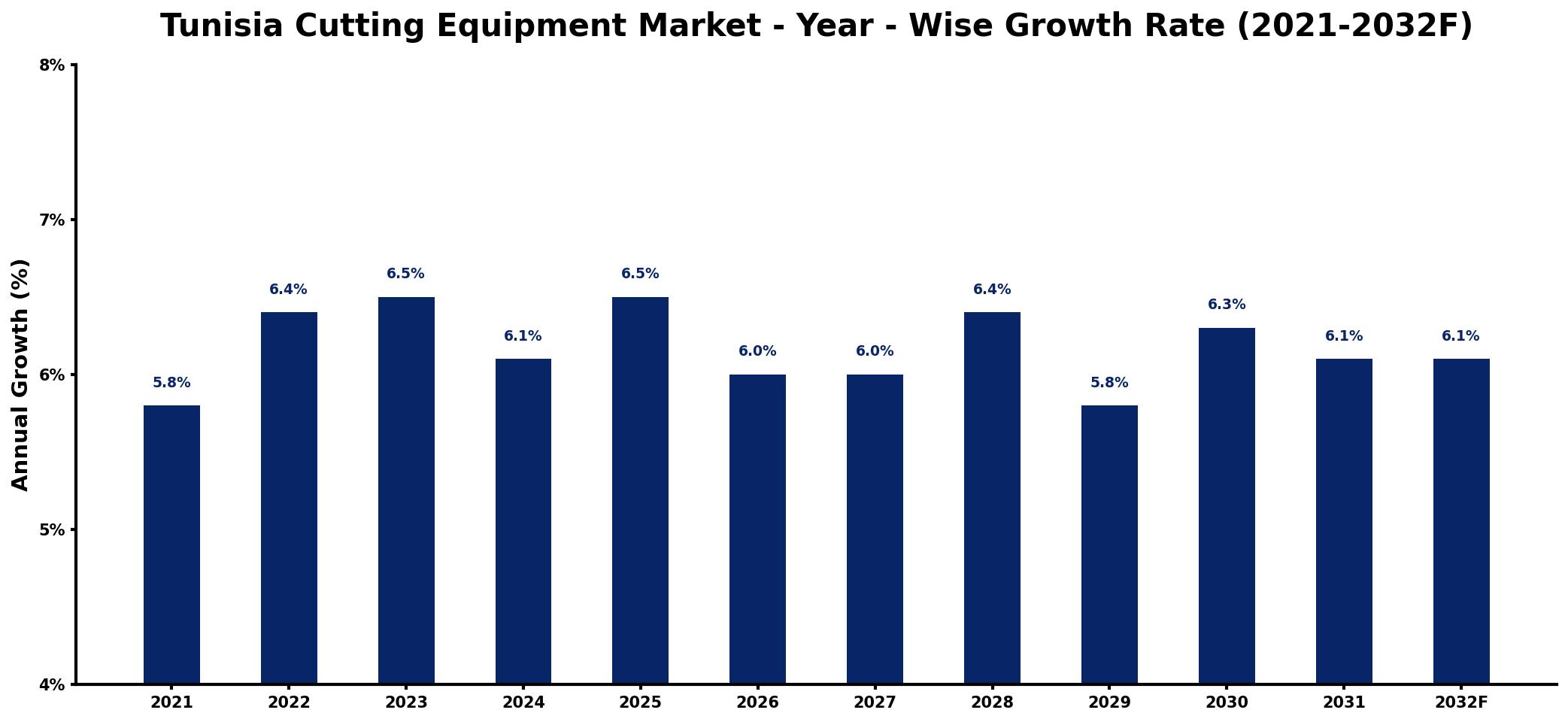
The table below presents the year‑wise growth rates along with the key drivers influencing the market
| Year | Growth Rate | Major Drivers |
| 2021 | 5.8% | Rising demand from construction sector |
| 2022 | 6.4% | Increased investment in manufacturing |
| 2023 | 6.5% | Expansion of renewable energy projects |
| 2024 | 6.1% | Growth in automotive production facilities |
| 2025 | 6.5% | Surge in infrastructure development plans |
| 2026 | 6.0% | Higher demand from aerospace industry |
| 2027 | 6.0% | Investment in technology upgrades |
| 2028 | 6.4% | Increase in regional export activities |
| 2029 | 5.8% | Growing focus on precision industries |
| 2030 | 6.3% | enhanced product quality standards |
| 2031 | 6.1% | Rising need for automation solutions |
| 2032 | 6.1% | Increased utilization of advanced materials |
Note: Market size estimations and growth projections presented in this report are based on 6Wresearch's proprietary forecasting methodology, utilizing the latest available industry data, government publications, and primary research inputs.
Tunisia Cutting Equipment Market Synopsis
The growing automotive and construction industries in Tunisia have escalated the need for high-performance cutting equipment that can handle diverse materials. As industries increasingly embrace digital manufacturing solutions, cutting equipment's role in optimizing production processes and minimizing material waste has become vital.
Moreover, the trend towards industrial automation necessitates modern cutting technologies that ensure precision and reliability. This shift not only enhances productivity but also addresses the evolving needs of manufacturers striving for operational excellence.
Tunisia Cutting Equipment Market Key Takeaways
- The market is expected to grow from USD 1336 Million in 2025 to USD 1913 Million by 2032.
- Technological advancements are playing a crucial role in transforming cutting methods across industries.
- Precision and efficiency demands are driving innovation and adoption of advanced cutting tools.
- Integration of automation technologies is increasingly shaping market dynamics.
- Government regulations ensure safety and operational efficiency in the cutting equipment sector.
Evaluation of Restraints in Tunisia Cutting Equipment Market
Despite promising growth prospects, the Tunisia Cutting Equipment Market faces significant restraints that can hinder its development. Notably, the challenges of integrating cutting-edge precision technologies with existing manufacturing systems pose operational hurdles. Additionally, the variability in material compatibility can restrict the effectiveness and efficiency of cutting tools in diverse applications. The industry also needs to address the durability of cutting tools and the versatility of machine tools to meet the specific demands of sectors like automotive and aerospace.
Tunisia Cutting Equipment Market Trends
A clear trend is emerging towards the adoption of more energy-efficient cutting technologies, reflecting a broader commitment to sustainability within Tunisian industries. As businesses seek to reduce operational costs and waste, laser cutting and plasma systems are increasingly favored for their precision and minimal material loss. Another significant trend is the movement towards Industry 4.0, with cutting equipment increasingly integrated into smart manufacturing ecosystems, facilitating real-time data analytics and optimization.
Tunisia Cutting Equipment Market Opportunities
The shift towards sustainable manufacturing practices presents substantial opportunities for cutting equipment manufacturers in Tunisia. By developing equipment that minimizes waste and energy consumption, suppliers can capitalize on the growing demand for eco-friendly solutions. Additionally, as the automotive and construction sectors expand, there will be an increasing need for cutting technologies capable of handling advanced materials, creating a ripe environment for innovation and investment.
Government Initiatives in the Tunisia Cutting Equipment Market
The Tunisian government has implemented regulations that focus on enhancing industrial safety standards and ensuring equipment efficiency. Initiatives promoting workplace safety not only protect workers but also foster a reliable operational environment for cutting equipment. Public spending on infrastructure projects has also bolstered demand, encouraging investment in state-of-the-art cutting technologies across various sectors.
Future Insights of the Tunisia Cutting Equipment Market
Looking ahead to 2026-2032, the Tunisia Cutting Equipment Market is expected to witness continued expansion driven by technological innovations and a growing emphasis on efficiency. As local industries increasingly adopt smart manufacturing practices, the demand for advanced cutting solutions will intensify. Furthermore, the integration of digital tools and automation in production processes will likely enhance operational capabilities, providing a significant boost to the market. With the right investments in technology and infrastructure, Tunisia is positioned to emerge as a competitive player in the cutting equipment sector.
Tunisia Cutting Equipment Market Latest Developments (2025 - 2026)
Recent developments indicate a strong focus on research and innovation within the cutting equipment sector. Companies are increasingly investing in R&D to develop more efficient and versatile cutting technologies that align with the needs of modern manufacturing. Collaborative efforts between the government and industry stakeholders aim to boost automation adoption in manufacturing processes, ensuring that the cutting equipment market remains competitive and responsive to emerging global trends.
Tunisia Cutting Equipment Market - Key Attractiveness of the Report
- 10 Years of Market Numbers
- Historical Data Starting from 2022 to 2025
- Base Year: 2025
- Forecast Data until 2032
- Key Performance Indicators Impacting the Market
- Major Upcoming Developments and Projects
Key Highlights of the Report:
- Tunisia Cutting Equipment Market Outlook
- Market Size of Tunisia Cutting Equipment Market, 2025
- Forecast of Tunisia Cutting Equipment Market, 2032
- Historical Data and Forecast of Tunisia Cutting Equipment Revenues & Volume for the Period 2022-2032F
- Tunisia Cutting Equipment Market Trend Evolution
- Tunisia Cutting Equipment Market Drivers and Challenges
- Tunisia Cutting Equipment Price Trends
- Tunisia Cutting Equipment Porter's Five Forces
- Tunisia Cutting Equipment Industry Life Cycle
- Historical Data and Forecast of Tunisia Cutting Equipment Market Revenues & Volume By Equipment Type for the Period 2022-2032F
- Historical Data and Forecast of Tunisia Cutting Equipment Market Revenues & Volume By Manual for the Period 2022-2032F
- Historical Data and Forecast of Tunisia Cutting Equipment Market Revenues & Volume By Mechanized for the Period 2022-2032F
- Historical Data and Forecast of Tunisia Cutting Equipment Market Revenues & Volume By Cutting Technology for the Period 2022-2032F
- Historical Data and Forecast of Tunisia Cutting Equipment Market Revenues & Volume By Plasma cutting for the Period 2022-2032F
- Historical Data and Forecast of Tunisia Cutting Equipment Market Revenues & Volume By Oxy-fuel cutting for the Period 2022-2032F
- Historical Data and Forecast of Tunisia Cutting Equipment Market Revenues & Volume By Laser cutting for the Period 2022-2032F
- Historical Data and Forecast of Tunisia Cutting Equipment Market Revenues & Volume By Waterjet cutting for the Period 2022-2032F
- Historical Data and Forecast of Tunisia Cutting Equipment Market Revenues & Volume By Carbon arc cutting for the Period 2022-2032F
- Historical Data and Forecast of Tunisia Cutting Equipment Market Revenues & Volume By End Use Industry for the Period 2022-2032F
- Historical Data and Forecast of Tunisia Cutting Equipment Market Revenues & Volume By Construction for the Period 2022-2032F
- Historical Data and Forecast of Tunisia Cutting Equipment Market Revenues & Volume By Heavy metal fabrication for the Period 2022-2032F
- Historical Data and Forecast of Tunisia Cutting Equipment Market Revenues & Volume By Shipbuilding & offshore for the Period 2022-2032F
- Historical Data and Forecast of Tunisia Cutting Equipment Market Revenues & Volume By Automotive for the Period 2022-2032F
- Historical Data and Forecast of Tunisia Cutting Equipment Market Revenues & Volume By Others for the Period 2022-2032F
- Historical Data and Forecast of Tunisia Cutting Equipment Market Revenues & Volume By Type for the Period 2022-2032F
- Historical Data and Forecast of Tunisia Cutting Equipment Market Revenues & Volume By Equipment for the Period 2022-2032F
- Historical Data and Forecast of Tunisia Cutting Equipment Market Revenues & Volume By Consumables/Accessories for the Period 2022-2032F
- Tunisia Cutting Equipment Import Export Trade Statistics
- Market Opportunity Assessment By Equipment Type
- Market Opportunity Assessment By Cutting Technology
- Market Opportunity Assessment By End Use Industry
- Market Opportunity Assessment By Type
- Tunisia Cutting Equipment Top Companies Market Share
- Tunisia Cutting Equipment Competitive Benchmarking By Technical and Operational Parameters
- Tunisia Cutting Equipment Company Profiles
- Tunisia Cutting Equipment Key Strategic Recommendations






































