Tunisia Data Lake Market Size & Growth Rate (2026-2032)
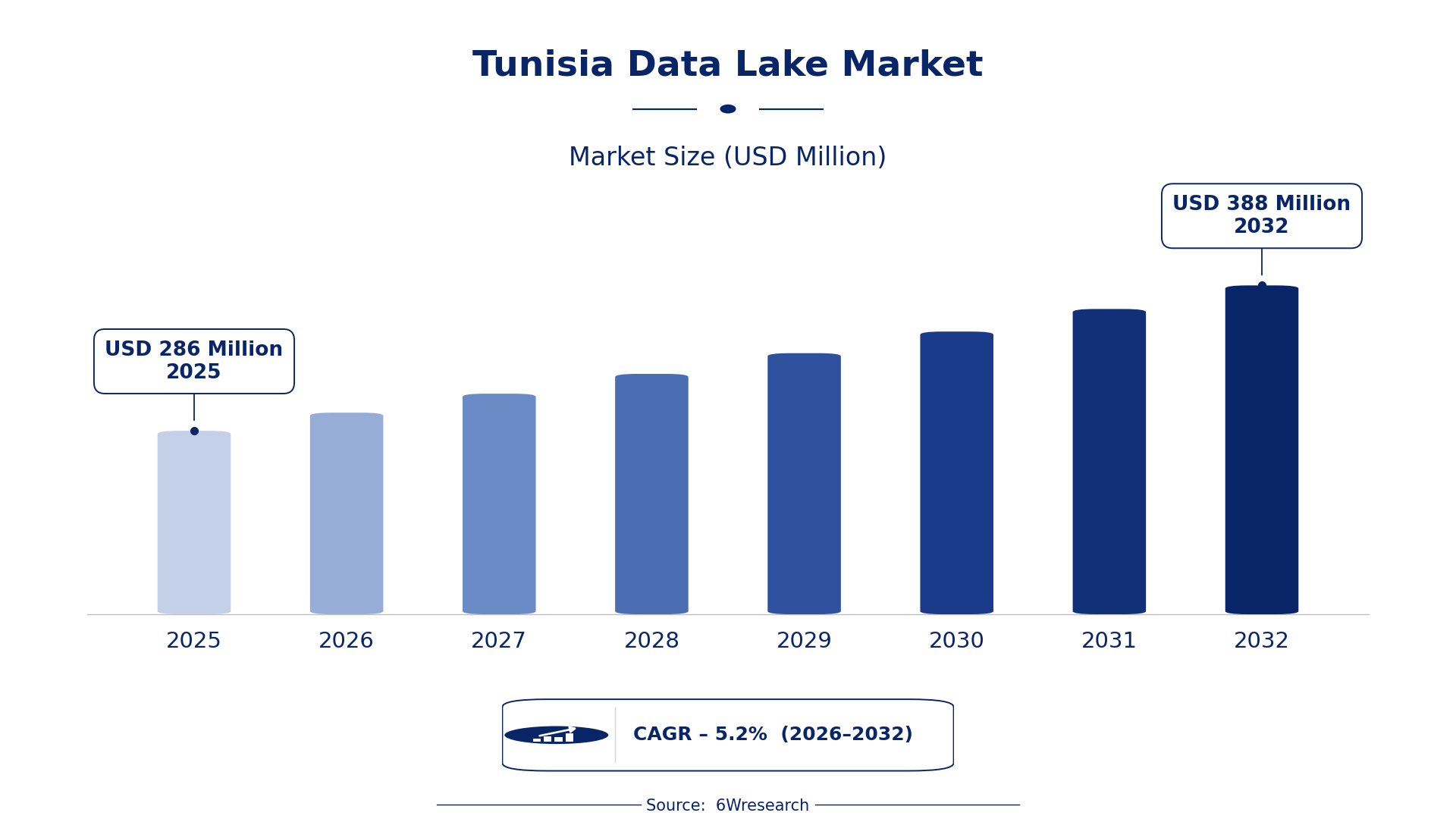
The Tunisia Data Lake Market was estimated at USD 286 Million in 2025 and is projected to reach USD 388 Million by 2032, growing at a CAGR of 5.2% from 2026 to 2032.
Tunisia Data Lake Market Synopsis
The driving force behind the Tunisia Data Lake Market is the rapid adoption of big data analytics across various sectors. Organizations are increasingly recognizing the need to harness vast amounts of structured and unstructured data, fueling demand for scalable data storage solutions.
As businesses in finance, healthcare, and retail look for ways to gain a competitive edge, data lakes have emerged as essential tools. They not only centralize data storage but also support advanced analytics and machine learning initiatives, making them invaluable for data-driven decision-making.
Tunisia Data Lake Market Year-wise Growth Rate and Key Drivers
This graph illustrates the annual growth rates of the Tunisia Data Lake Market from 2021 to 2032, highlighting a steady upward trajectory and projected expansion over the forecast period.
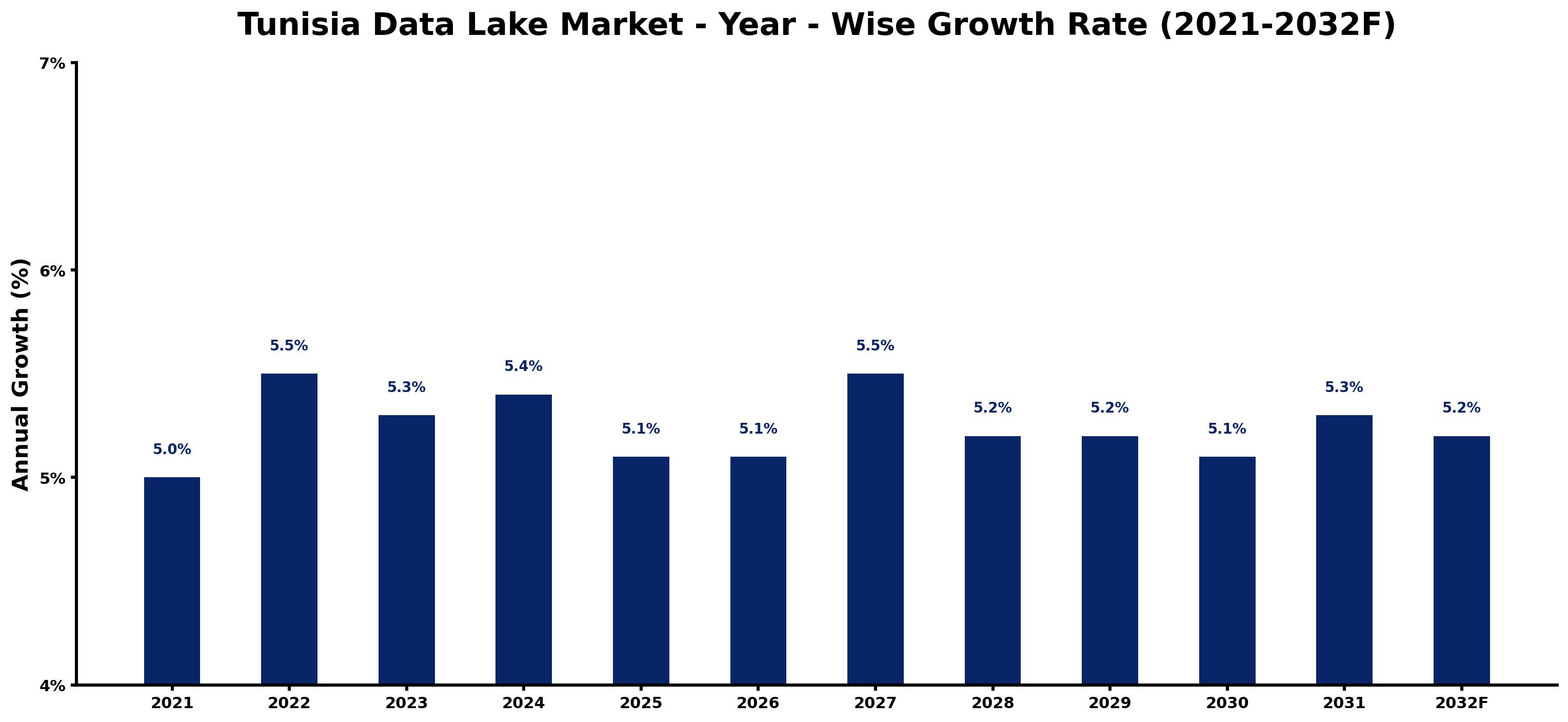
The table below presents the year‑wise growth rates along with the key drivers influencing the market
| Year | Growth Rate | Major Drivers |
| 2021 | 5.0% | Increased focus on data-driven decision making initiatives. |
| 2022 | 5.5% | Growing investment in AI and big data technologies. |
| 2023 | 5.3% | Boost from Tunisia's national cybersecurity strategy implementation. |
| 2024 | 5.4% | Surge in online business models requiring advanced data management. |
| 2025 | 5.1% | Local universities promoting data engineering degree programs. |
| 2026 | 5.1% | Increased collaboration with European tech firms for data solutions. |
| 2027 | 5.5% | Enhanced mobile penetration leading to more data generation. |
| 2028 | 5.2% | Adoption of innovative data storage solutions by startups. |
| 2029 | 5.2% | Rise in e-commerce driving demand for data lakes. |
| 2030 | 5.1% | Emerging fintech sector needing robust data analytics support. |
| 2031 | 5.3% | Implementation of digital identity legislation by government authorities. |
| 2032 | 5.2% | Rising digital literacy boosting usage of analytics tools. |
Note: Market size estimations and growth projections presented in this report are based on 6Wresearch's proprietary forecasting methodology, utilizing the latest available industry data, government publications, and primary research inputs.
Tunisia Data Lake Market Key Takeaways
Below are some of the specific key takeaways from the market, including:
- The Tunisia Data Lake Market is growing due to the increasing volume of data generated by IoT and digital transformation initiatives.
- Data lakes facilitate the storage and analysis of diverse datasets, enhancing decision-making capabilities for organizations.
- Challenges in data ingestion and governance remain critical considerations for businesses adopting data lake technologies.
- Government regulations are evolving to ensure data security and compliance, shaping the operational environment for data lake solutions.
- Investment in scalable storage solutions is essential for providers to meet the demands of data-driven enterprises.
Evaluation of Restraints in Tunisia Data Lake Market
Despite its growth potential, the Tunisia Data Lake Market faces notable restraints. One major issue is the scalability of data ingestion processes, which can hinder the efficient integration of new data sources. Additionally, effective metadata management is crucial for maintaining data quality and accessibility, yet many organizations struggle in this area. on top of that, data governance poses a challenge, as companies need to implement stringent security measures to comply with local regulations. These factors collectively influence the speed of adoption and operational efficiency within the market.
Tunisia Data Lake Market Trends
Several trends are shaping the future of the Tunisia Data Lake Market. The rise of machine learning applications is driving organizations to seek advanced analytics capabilities. As companies become increasingly data-centric, there is a growing focus on integrating data lakes with existing analytics platforms to enhance their functionality. on top of that, the adoption of hybrid cloud solutions is becoming more common, allowing organizations to store data both on-premises and in the cloud, thus offering flexibility and scalability.
Tunisia Data Lake Market Opportunities
The Tunisia Data Lake Market presents various growth opportunities. As enterprises continue to generate massive volumes of data, the demand for efficient and cost-effective data storage solutions will only increase. Organizations looking to optimize their data strategies can invest in partnerships with technology providers to develop tailored solutions. Additionally, sectors like healthcare and finance are ripe for innovation, as their data requirements evolve. Companies that can navigate regulatory challenges while providing robust data lake solutions will find significant market potential.
Government Initiatives in the Tunisia Data Lake Market
Government policy in Tunisia is increasingly oriented towards enhancing data management and security frameworks, reflecting a commitment to supporting the growth of the data lake market. These initiatives aim to ensure that data storage solutions comply with emerging regulations and meet the evolving needs of the digital economy.
- A regulatory framework introduced in early 2025 mandates data accessibility and security standards for data lake solutions.
- A national digital infrastructure upgrade programme is currently underway, focusing on enhancing data storage capabilities across public and private sectors.
- Plans for a new initiative aimed at promoting research and development in big data analytics are expected to be launched by late 2026.
- In 2024, a public-private partnership was established to foster innovation in data management technologies.
- Ongoing workshops and training sessions are being conducted to educate stakeholders about best practices in data governance and lake management.
Future Insights of the Tunisia Data Lake Market
Looking ahead to 2026-2032, the Tunisia Data Lake Market is expected to evolve significantly. As organizations increasingly prioritize data-driven strategies, the demand for advanced analytics will drive innovation in data lake technologies. The market will see a shift towards more integrated solutions that combine data lakes with machine learning tools, enabling organizations to derive actionable insights from their data. This transition will be supported by government initiatives aimed at fostering a secure and compliant data environment.
Tunisia Data Lake Market Latest Developments
In the past year, the Tunisia Data Lake Market has experienced notable activity, with organizations actively pursuing strategies to enhance their data capabilities. The focus has been on integrating more sophisticated analytics tools and expanding data storage solutions to meet the increasing demands of various sectors.
- A leading technology vendor launched a new data lake solution in Q1 2025, aimed at simplifying data ingestion processes for enterprises.
- An initiative focused on improving data interoperability began in mid-2025 and remains underway, enhancing the integration of various data sources.
- A major telecom operator announced plans for a data lake infrastructure expansion project expected to start in early 2026.
- In late 2024, a collaboration between local universities and tech firms was established to promote research in data management practices.
- A new training programme for data scientists is planned to launch by mid-2026, addressing the skills gap in data analytics.
Tunisia Data Lake Market - Key Attractiveness of the Report
- 10 Years of Market Numbers
- Historical Data Starting from 2022 to 2025
- Base Year: 2025
- Forecast Data until 2032
- Key Performance Indicators Impacting the Market
- Major Upcoming Developments and Projects
Key Highlights of the Report:
- Tunisia Data Lake Market Outlook
- Market Size of Tunisia Data Lake Market, 2025
- Forecast of Tunisia Data Lake Market, 2032
- Historical Data and Forecast of Tunisia Data Lake Revenues & Volume for the Period 2022-2032F
- Tunisia Data Lake Market Trend Evolution
- Tunisia Data Lake Market Drivers and Challenges
- Tunisia Data Lake Price Trends
- Tunisia Data Lake Porter's Five Forces
- Tunisia Data Lake Industry Life Cycle
- Historical Data and Forecast of Tunisia Data Lake Market Revenues & Volume By Business Function for the Period 2022-2032F
- Historical Data and Forecast of Tunisia Data Lake Market Revenues & Volume By Marketing for the Period 2022-2032F
- Historical Data and Forecast of Tunisia Data Lake Market Revenues & Volume By Sales for the Period 2022-2032F
- Historical Data and Forecast of Tunisia Data Lake Market Revenues & Volume By Operations for the Period 2022-2032F
- Historical Data and Forecast of Tunisia Data Lake Market Revenues & Volume By Finance for the Period 2022-2032F
- Historical Data and Forecast of Tunisia Data Lake Market Revenues & Volume By Human Resources for the Period 2022-2032F
- Historical Data and Forecast of Tunisia Data Lake Market Revenues & Volume By Industry Vertical for the Period 2022-2032F
- Historical Data and Forecast of Tunisia Data Lake Market Revenues & Volume By Banking, Financial Services and Insurance (BFSI) for the Period 2022-2032F
- Historical Data and Forecast of Tunisia Data Lake Market Revenues & Volume By Telecommunication and Information Technology (IT) for the Period 2022-2032F
- Historical Data and Forecast of Tunisia Data Lake Market Revenues & Volume By Retail and eCommerce for the Period 2022-2032F
- Historical Data and Forecast of Tunisia Data Lake Market Revenues & Volume By Healthcare and Life Sciences for the Period 2022-2032F
- Historical Data and Forecast of Tunisia Data Lake Market Revenues & Volume By Manufacturing for the Period 2022-2032F
- Historical Data and Forecast of Tunisia Data Lake Market Revenues & Volume By Energy and Utilities for the Period 2022-2032F
- Historical Data and Forecast of Tunisia Data Lake Market Revenues & Volume By Media and Entertainment for the Period 2022-2032F
- Historical Data and Forecast of Tunisia Data Lake Market Revenues & Volume By Government for the Period 2022-2032F
- Historical Data and Forecast of Tunisia Data Lake Market Revenues & Volume By Component for the Period 2022-2032F
- Historical Data and Forecast of Tunisia Data Lake Market Revenues & Volume By Solutions for the Period 2022-2032F
- Historical Data and Forecast of Tunisia Data Lake Market Revenues & Volume By Services for the Period 2022-2032F
- Historical Data and Forecast of Tunisia Data Lake Market Revenues & Volume By Deployment Mode for the Period 2022-2032F
- Historical Data and Forecast of Tunisia Data Lake Market Revenues & Volume By On-premises for the Period 2022-2032F
- Historical Data and Forecast of Tunisia Data Lake Market Revenues & Volume By Cloud for the Period 2022-2032F
- Historical Data and Forecast of Tunisia Data Lake Market Revenues & Volume By Organization Size for the Period 2022-2032F
- Historical Data and Forecast of Tunisia Data Lake Market Revenues & Volume By Small and Medium-sized Enterprises for the Period 2022-2032F
- Historical Data and Forecast of Tunisia Data Lake Market Revenues & Volume By Large Enterprises for the Period 2022-2032F
- Tunisia Data Lake Import Export Trade Statistics
- Market Opportunity Assessment By Business Function
- Market Opportunity Assessment By Industry Vertical
- Market Opportunity Assessment By Component
- Market Opportunity Assessment By Deployment Mode
- Market Opportunity Assessment By Organization Size
- Tunisia Data Lake Top Companies Market Share
- Tunisia Data Lake Competitive Benchmarking By Technical and Operational Parameters
- Tunisia Data Lake Company Profiles
- Tunisia Data Lake Key Strategic Recommendations






































