Tunisia Decaffeinated Coffee Market Size Growth Rate
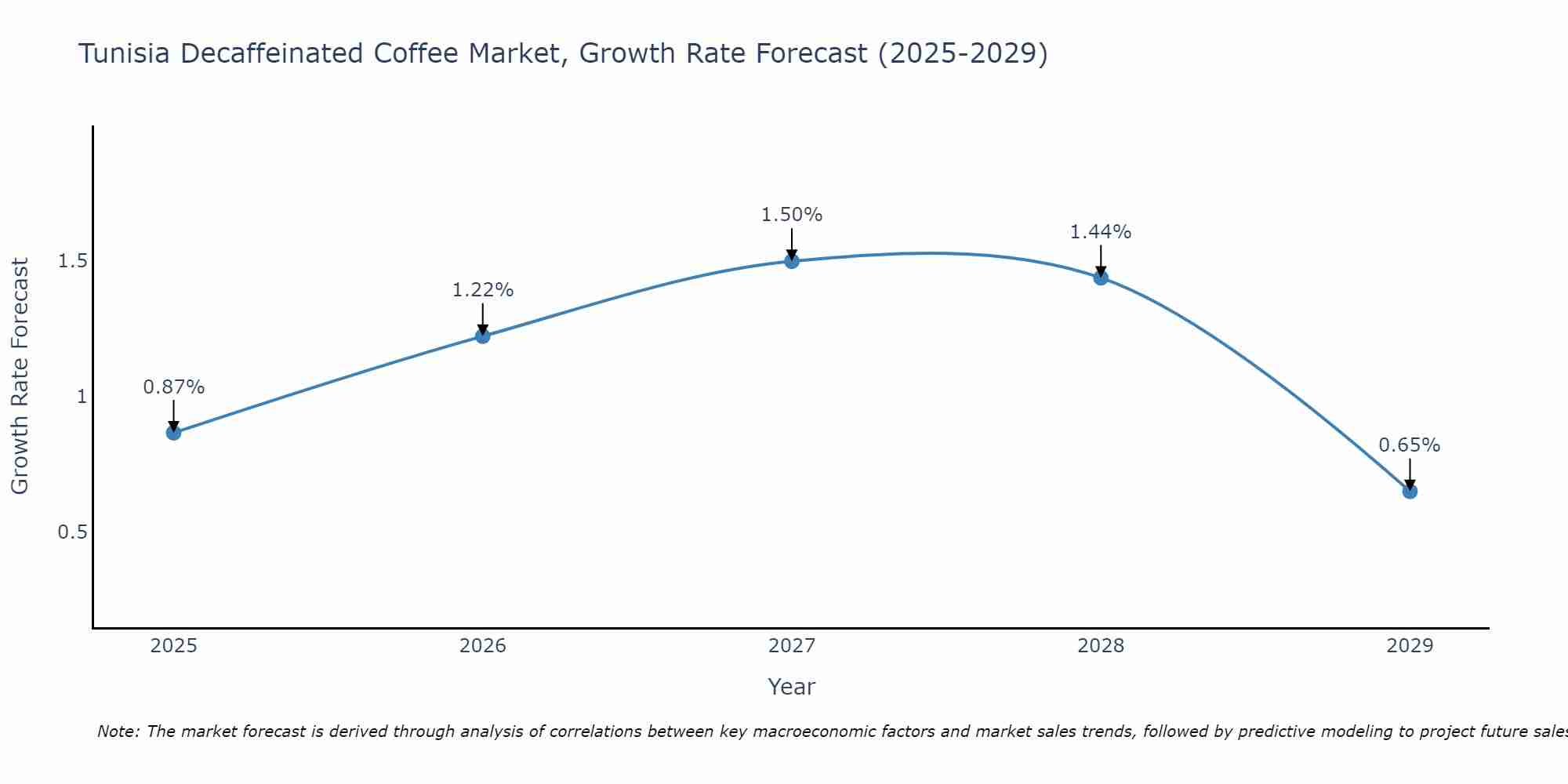
The Tunisia Decaffeinated Coffee Market is projected to witness mixed growth rate patterns during 2025 to 2029. Growth accelerates to 1.50% in 2027, following an initial rate of 0.87%, before easing to 0.65% at the end of the period.
Decaffeinated Coffee Market: Tunisia vs Top 5 Major Economies in 2027 (Africa)
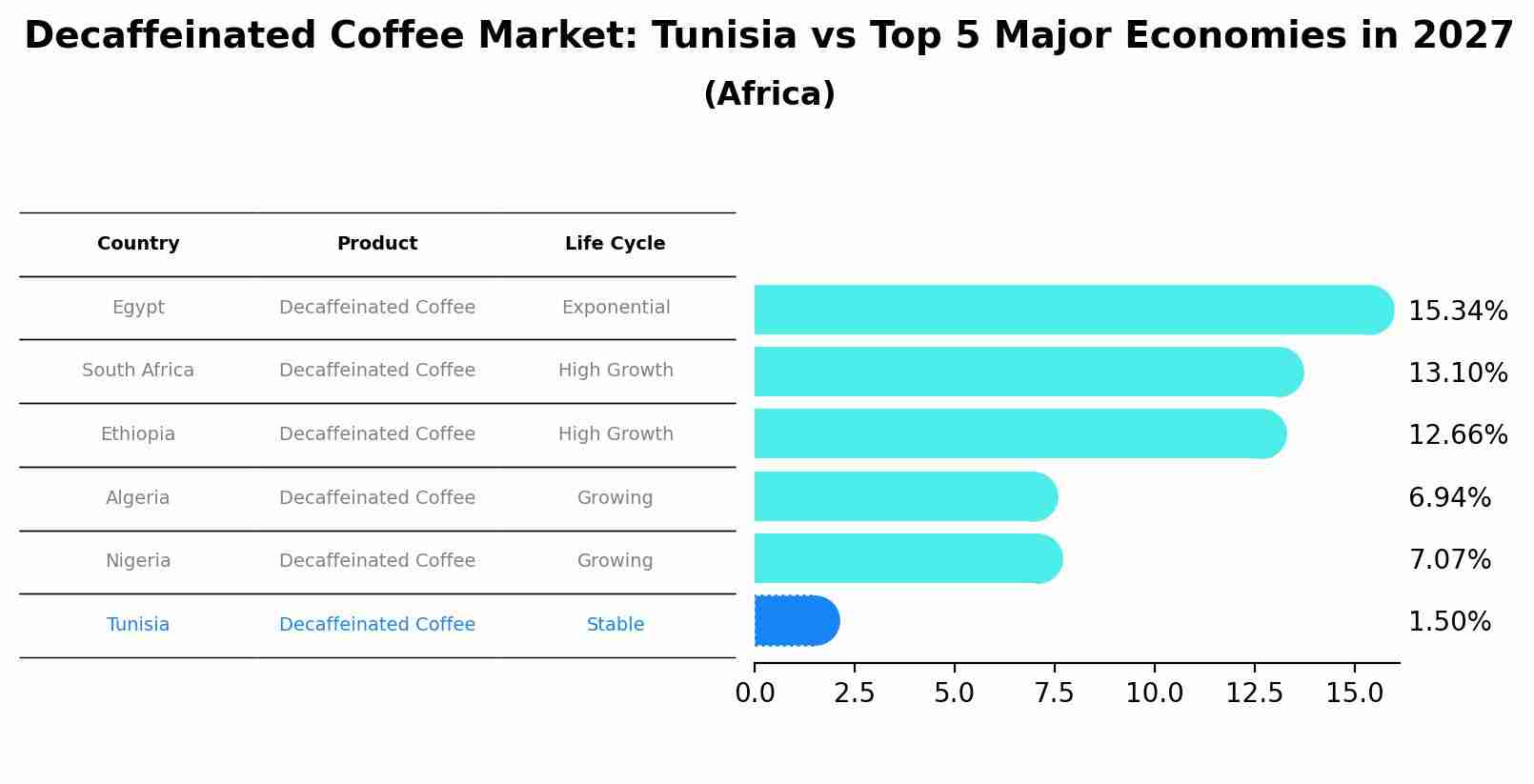
In the Africa region, the Decaffeinated Coffee market in Tunisia is projected to expand at a stable growth rate of 1.50% by 2027. The largest economy is Egypt, followed by South Africa, Ethiopia, Algeria and Nigeria.
Tunisia Decaffeinated Coffee Market Overview
The Tunisia decaffeinated coffee market is experiencing steady growth due to increasing awareness about the health benefits of consuming decaffeinated beverages. With a growing trend towards healthier lifestyles, consumers are seeking decaffeinated coffee as a way to enjoy the taste and aroma of coffee without the stimulating effects of caffeine. The market is primarily driven by urban areas where consumers are more health-conscious and willing to pay a premium for decaffeinated coffee products. Key players in the market are focusing on offering a variety of decaffeinated coffee options to cater to different consumer preferences, such as decaf espresso, decaf instant coffee, and decaf coffee beans. Additionally, the market is witnessing a rise in online retail channels, making it easier for consumers to access a wide range of decaffeinated coffee products.
Tunisia Decaffeinated Coffee Market Trends
In the Tunisia Decaffeinated Coffee Market, there is a growing trend towards increased consumer awareness and interest in health-conscious choices. This has led to a rise in demand for decaffeinated coffee options that offer a healthier alternative to traditional caffeinated beverages. Consumers are seeking decaffeinated coffee products that are not only free from caffeine but also emphasize organic, natural, and sustainably sourced ingredients. Additionally, there is a shift towards innovative decaffeination methods, such as Swiss Water Process and CO2 extraction, to preserve the flavor profile of the coffee beans. As a result, companies in the Tunisia Decaffeinated Coffee Market are focusing on promoting transparency in sourcing, highlighting health benefits, and offering a diverse range of decaffeinated coffee products to cater to the evolving preferences of health-conscious consumers.
Tunisia Decaffeinated Coffee Market Challenges
In the Tunisia decaffeinated coffee market, one of the main challenges faced is the limited consumer awareness and understanding of decaffeinated coffee products. The concept of decaffeinated coffee is still relatively new in Tunisia, and consumers may be hesitant to try these products due to a lack of knowledge about the decaffeination process and its benefits. Additionally, there is a shortage of marketing efforts and education campaigns by companies to promote decaffeinated coffee in the Tunisian market, further hindering consumer adoption. Furthermore, the availability of a variety of decaffeinated coffee options is limited in comparison to regular coffee products, which may also deter consumers from making the switch. Overall, increasing consumer awareness, improving marketing strategies, and expanding product offerings are key challenges that need to be addressed to grow the decaffeinated coffee market in Tunisia.
Tunisia Decaffeinated Coffee Market Investment Opportunities
In the Tunisia Decaffeinated Coffee Market, there are promising investment opportunities for companies looking to capitalize on the growing trend towards healthier lifestyles and increased awareness of the negative effects of caffeine. Investing in decaffeinated coffee production facilities or partnering with existing coffee producers to introduce decaf options can be lucrative. Additionally, there is potential for investment in marketing and distribution channels to promote decaffeinated coffee products to health-conscious consumers. With a rising demand for decaf coffee among a segment of the population seeking to reduce caffeine intake, investing in this niche market can lead to long-term growth and profitability for savvy investors.
Tunisia Decaffeinated Coffee Market Government Policy
The Tunisian government has implemented various policies to regulate and support the decaffeinated coffee market. These policies include quality control measures to ensure that decaffeinated coffee meets specific standards, such as limits on caffeine content. Additionally, the government has put in place import tariffs and regulations to protect domestic decaffeinated coffee producers and promote local industry growth. Furthermore, subsidies and financial support may be available to encourage farmers to grow coffee beans suitable for decaffeination processes. Overall, the government aims to create a competitive and sustainable decaffeinated coffee market in Tunisia through a combination of quality control, trade regulations, and support for local producers.
Tunisia Decaffeinated Coffee Market Future Outlook
The future outlook for the Tunisia Decaffeinated Coffee Market appears promising as consumers are increasingly seeking healthier alternatives and specialty coffee options. With growing awareness about the health benefits of decaffeinated coffee and the rising trend of premium coffee consumption, the market is expected to experience steady growth. The demand for decaffeinated coffee is likely to be driven by factors such as the rising prevalence of health-conscious consumers, changing lifestyles, and a preference for specialty coffee blends. Additionally, as the coffee culture in Tunisia continues to evolve, there is potential for new product innovations and marketing strategies to further boost the growth of the decaffeinated coffee market in the country.
Key Highlights of the Report:
- Tunisia Decaffeinated Coffee Market Outlook
- Market Size of Tunisia Decaffeinated Coffee Market, 2024
- Forecast of Tunisia Decaffeinated Coffee Market, 2031
- Historical Data and Forecast of Tunisia Decaffeinated Coffee Revenues & Volume for the Period 2021 - 2031
- Tunisia Decaffeinated Coffee Market Trend Evolution
- Tunisia Decaffeinated Coffee Market Drivers and Challenges
- Tunisia Decaffeinated Coffee Price Trends
- Tunisia Decaffeinated Coffee Porter's Five Forces
- Tunisia Decaffeinated Coffee Industry Life Cycle
- Historical Data and Forecast of Tunisia Decaffeinated Coffee Market Revenues & Volume By Product for the Period 2021 - 2031
- Historical Data and Forecast of Tunisia Decaffeinated Coffee Market Revenues & Volume By Roasted for the Period 2021 - 2031
- Historical Data and Forecast of Tunisia Decaffeinated Coffee Market Revenues & Volume By Raw for the Period 2021 - 2031
- Historical Data and Forecast of Tunisia Decaffeinated Coffee Market Revenues & Volume By Species for the Period 2021 - 2031
- Historical Data and Forecast of Tunisia Decaffeinated Coffee Market Revenues & Volume By Arabica for the Period 2021 - 2031
- Historical Data and Forecast of Tunisia Decaffeinated Coffee Market Revenues & Volume By Robusta for the Period 2021 - 2031
- Historical Data and Forecast of Tunisia Decaffeinated Coffee Market Revenues & Volume By Distribution Channel for the Period 2021 - 2031
- Historical Data and Forecast of Tunisia Decaffeinated Coffee Market Revenues & Volume By Online for the Period 2021 - 2031
- Historical Data and Forecast of Tunisia Decaffeinated Coffee Market Revenues & Volume By Offline for the Period 2021 - 2031
- Tunisia Decaffeinated Coffee Import Export Trade Statistics
- Market Opportunity Assessment By Product
- Market Opportunity Assessment By Species
- Market Opportunity Assessment By Distribution Channel
- Tunisia Decaffeinated Coffee Top Companies Market Share
- Tunisia Decaffeinated Coffee Competitive Benchmarking By Technical and Operational Parameters
- Tunisia Decaffeinated Coffee Company Profiles
- Tunisia Decaffeinated Coffee Key Strategic Recommendations






































