Tunisia Decorative tile Market Summary
The tunisia decorative tile market was estimated at USD 262 Million in 2025 and is projected to reach USD 363 Million by 2032, growing at a CAGR of 5.7% from 2026 to 2032.
Tunisia Decorative tile Market Year-wise Growth Rate and Key Drivers
This graph highlights how the Tunisia Decorative tile Market has steadily grown over the past five years, supported by major growth factors.
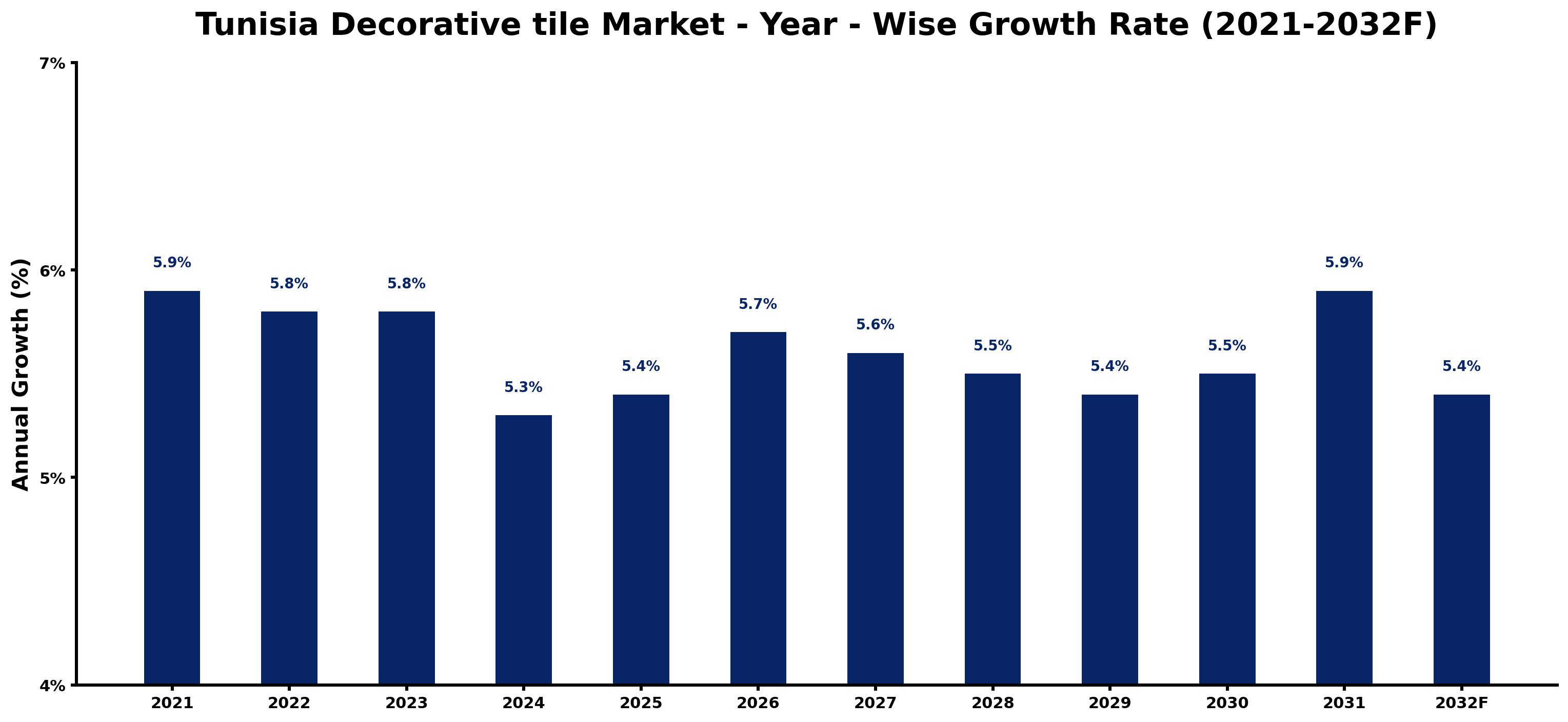
The table below presents the year wise growth rates along with the key drivers influencing the market
| Year | Growth Rate | Major Drivers |
| 2021 | 5.9% | Post-COVID construction projects sparked renewed focus on home renovations and aesthetics. |
| 2022 | 5.8% | Cultural affinity for ornamental design strengthened demand for unique decorative tiles. |
| 2023 | 5.8% | Emergence of e-commerce platforms simplified access to diverse tile selections for consumers. |
| 2024 | 5.3% | Increased tourism led to higher demand for aesthetically pleasing accommodation interiors. |
| 2025 | 5.4% | Architectural trends favoring traditional and modern fusion boosted decorative tile popularity. |
| 2026 | 5.7% | Local artisans became pivotal in enhancing creative offerings in the tile market. |
| 2027 | 5.6% | Investments in hospitality infrastructure resulted in an uptick in commercial decorative tile projects. |
| 2028 | 5.5% | Environmental considerations pushed manufacturers towards sustainable tile production methods. |
| 2029 | 5.4% | Rising disposable incomes allowed consumers to invest in luxury home improvement projects. |
| 2030 | 5.5% | Urbanization trends prompted the development of stylish residential complexes featuring decorative tiles. |
| 2031 | 5.9% | Collaborations between designers and tile manufacturers yielded innovative product collections. |
| 2032 | 5.4% | The expansion of design schools nurtured emerging talent in the decorative tile sector. |
Note - Market size estimations and growth projections presented in this report are based on 6Wresearch's advanced forecasting approach, validated with industry datasets as of June 2026.
Tunisia Decorative tile Market Synopsis
The Tunisia Decorative tile Market is projected to reach 5.7% and witness significant growth during the forecast period (2026-2032). This market is characterized by a rising demand for visually appealing and high-quality decorative tiles, which serve to enhance both residential and commercial environments. Manufacturers are innovating continuously, incorporating a variety of colors, patterns, and sizes that reflect the diverse preferences of Tunisian consumers. The blend of traditional Tunisian motifs with modern designs is becoming more prevalent, as manufacturers leverage advanced technologies to improve product durability and aesthetics.
Tunisia Decorative tile Market Trends
The evolving landscape of the Tunisia Decorative tile Market reveals several key trends that influence consumer choice and demand. Notably:
- There is an increasing preference for intricate geometric patterns and vibrant colors, heavily inspired by Tunisia's rich cultural heritage.
- Customization is becoming a vital factor, with consumers seeking unique and personalized tile designs tailored to their aesthetic preferences.
- Sustainability is gaining traction as consumers show interest in eco-friendly materials and production processes, leading to a rise in demand for tiles made from locally sourced resources.
- The fusion of modern design elements with traditional aesthetics is appealing to a broader audience, allowing manufacturers to cater to diverse consumer segments.
- A notable rise in the popularity of decorative tiles within hospitality and commercial sectors is further fueling market expansion.
Tunisia Decorative tile Market Challenges and Restraints
While the Tunisia Decorative tile Market shows promising growth potential, it is also fraught with challenges that stakeholders must navigate effectively:
- Intense competition among domestic and foreign manufacturers results in pricing pressures, influencing profit margins.
- Fluctuating raw material costs can disrupt production processes and impact pricing strategies, creating uncertainty for manufacturers.
- Economic instability in the region poses challenges in consumer spending and investment, potentially stifling market growth.
- Rapidly changing consumer preferences necessitate constant innovation, compelling companies to invest in research and development.
- Limitations in skilled labor and access to advanced technologies can hinder operational efficiency and product quality.
Tunisia Decorative tile Market Investment Opportunities
The Tunisia Decorative tile Market presents a myriad of investment opportunities, especially as the demand for decorative tiles surges within residential and commercial sectors:
- Manufacturing processes can be optimized for efficiency and quality, providing investors with avenues to enhance production capabilities.
- Distribution networks can be expanded to capitalize on growing market demands, particularly in urban areas undergoing development.
- There is a burgeoning market for eco-friendly and customizable decorative tiles, which investors can leverage to establish a competitive edge.
- Strategic partnerships within the supply chain can enhance market entry capabilities, particularly in emerging sectors like hospitality.
- Investments in technology aimed at improving tile production methods and designs can significantly elevate market positioning.
Tunisia Decorative tile Market Government Investment and Initiatives
The Tunisian government is actively fostering the growth of the decorative tile market through various supportive policies and initiatives:
- Financial incentives and subsidies are provided to local manufacturers to stimulate production capabilities and encourage innovation.
- The government promotes the use of decorative tiles in public infrastructure projects, thereby enhancing the visibility and usage of local products.
- Trade agreements are established to facilitate access to export markets, allowing Tunisian decorative tiles to penetrate international markets more effectively.
- Regulatory improvements aimed at streamlining licensing processes and enforcing quality standards help to boost the overall competitiveness of the industry.
- Investment in urban development initiatives reflects the government's commitment to promoting growth within the construction sector, indirectly benefiting decorative tile manufacturing.
Tunisia Decorative tile Market Latest Developments (May 2025 - June 2026)
In the period spanning from May 2025 to June 2026, the Tunisia Decorative tile Market has seen significant developments reflecting its dynamic nature:
- Several manufacturers have focused on integrating cutting-edge technology to enhance production efficiency and improve tile durability.
- The trend towards sustainable production practices has become more pronounced, with manufacturers seeking eco-friendly materials.
- A notable increase in collaboration between local artisans and manufacturers has resulted in a resurgence of traditional designs and craftsmanship.
- Market stakeholders are hosting exhibitions and trade shows to showcase innovations in decorative tile design, fostering an environment of creativity.
- The overall sentiment within the industry indicates a commitment to adapting to evolving consumer preferences and sustainability trends.
Tunisia Decorative tile Market - Key Attractiveness of the Report
- 10 Years of Market Numbers
- Historical Data Starting from 2022 to 2025
- Base Year: 2025
- Forecast Data until 2032
- Key Performance Indicators Impacting the Market
- Major Upcoming Developments and Projects
Key Highlights of the Report:
- Tunisia Decorative tile Market Outlook
- Market Size of Tunisia Decorative tile Market, 2025
- Forecast of Tunisia Decorative tile Market, 2032F
- Historical Data and Forecast of Tunisia Decorative tile Revenues & Volume for the Period 2022-2032F
- Tunisia Decorative tile Market Trend Evolution
- Tunisia Decorative tile Market Drivers and Challenges
- Tunisia Decorative tile Price Trends
- Tunisia Decorative tile Porter's Five Forces
- Tunisia Decorative tile Industry Life Cycle
- Historical Data and Forecast of Tunisia Decorative tile Market Revenues & Volume By Type for the Period 2022-2032F
- Historical Data and Forecast of Tunisia Decorative tile Market Revenues & Volume By Ceramic Wall Tiles for the Period 2022-2032F
- Historical Data and Forecast of Tunisia Decorative tile Market Revenues & Volume By Vinyl Wall Tiles for the Period 2022-2032F
- Historical Data and Forecast of Tunisia Decorative tile Market Revenues & Volume By Stone Wall Tiles for the Period 2022-2032F
- Historical Data and Forecast of Tunisia Decorative tile Market Revenues & Volume By Other Types for the Period 2022-2032F
- Historical Data and Forecast of Tunisia Decorative tile Market Revenues & Volume By End-users for the Period 2022-2032F
- Historical Data and Forecast of Tunisia Decorative tile Market Revenues & Volume By Residential for the Period 2022-2032F
- Historical Data and Forecast of Tunisia Decorative tile Market Revenues & Volume By Commercial for the Period 2022-2032F
- Historical Data and Forecast of Tunisia Decorative tile Market Revenues & Volume By Application for the Period 2022-2032F
- Historical Data and Forecast of Tunisia Decorative tile Market Revenues & Volume By Flooring for the Period 2022-2032F
- Historical Data and Forecast of Tunisia Decorative tile Market Revenues & Volume By Wall Coverings for the Period 2022-2032F
- Historical Data and Forecast of Tunisia Decorative tile Market Revenues & Volume By Other Applications for the Period 2022-2032F
- Tunisia Decorative tile Import Export Trade Statistics
- Market Opportunity Assessment By Type
- Market Opportunity Assessment By End-users
- Market Opportunity Assessment By Application
- Tunisia Decorative tile Top Companies Market Share
- Tunisia Decorative tile Competitive Benchmarking By Technical and Operational Parameters
- Tunisia Decorative tile Company Profiles
- Tunisia Decorative tile Key Strategic Recommendations






































