Tunisia Deli Meat Market Size, Share & Growth Rate
The Tunisia Deli Meat Market was estimated at USD 456 Million in 2025 and is projected to reach USD 627 Million by 2032, growing at a CAGR of 4.7% from 2026 to 2032. This growth trajectory is primarily fueled by the rising demand for convenient and ready-to-eat food options among Tunisian consumers. The burgeoning food retail industry, alongside a growing awareness of the nutritional benefits of high-protein diets, is further catalyzing this market's expansion. Additionally, advancements in food processing technologies are enhancing product offerings, making deli meats increasingly accessible.
Tunisia Deli Meat Market Year-wise Growth Rate and Key Drivers
This graph highlights how the Tunisia Deli Meat Market has steadily grown over the years, supported by major growth factors.
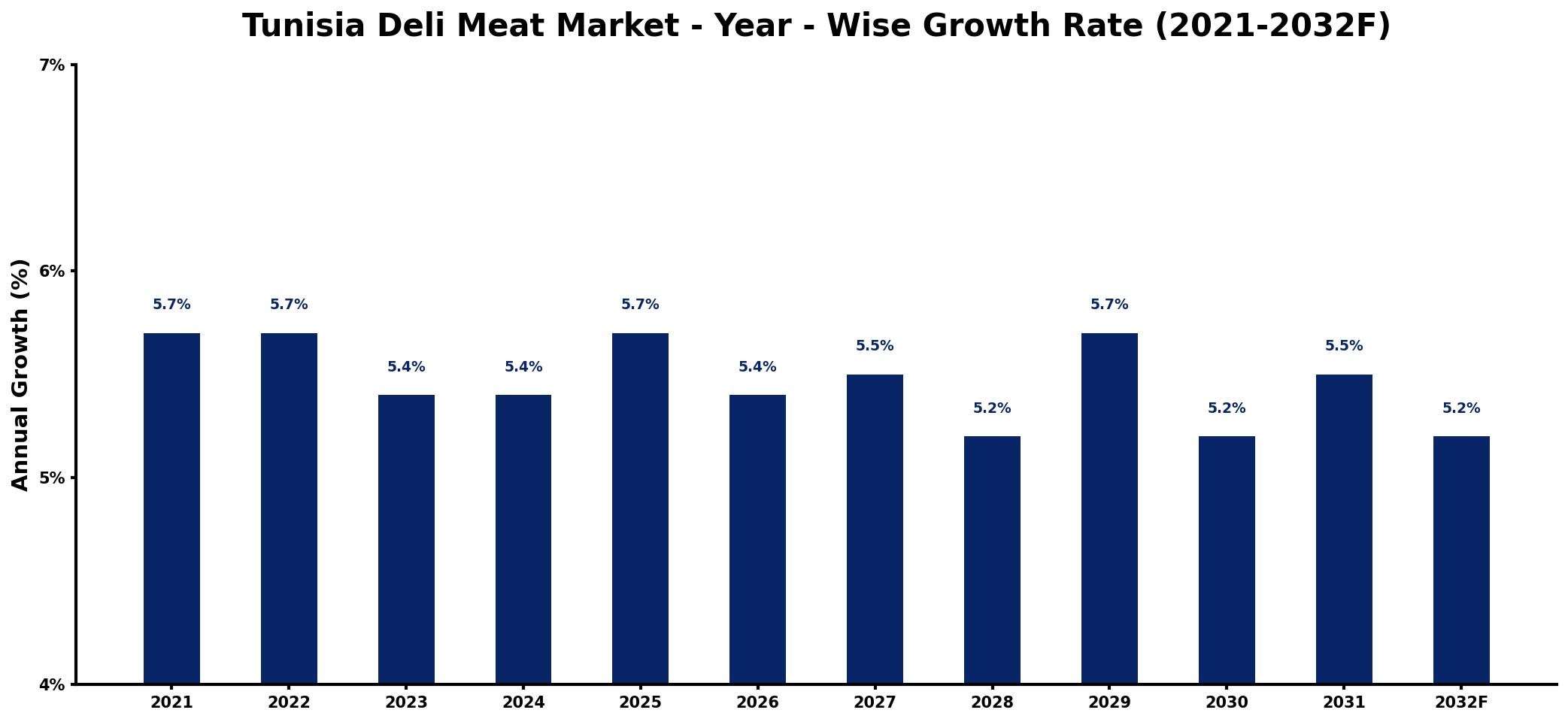
The table below presents the year‑wise growth rates along with the key drivers influencing the market
| Year | Growth Rate | Major Drivers |
| 2021 | 5.7% | Rising consumer health consciousness |
| 2022 | 5.7% | Growing demand for convenience foods |
| 2023 | 5.4% | Expansion of retail distribution channels |
| 2024 | 5.4% | Increased focus on sustainable sourcing |
| 2025 | 5.7% | Growth in online grocery shopping |
| 2026 | 5.4% | Innovation in flavor profiles |
| 2027 | 5.5% | Rising popularity of snacking options |
| 2028 | 5.2% | Increase in premium product offerings |
| 2029 | 5.7% | growing regional consumption patterns |
| 2030 | 5.2% | Growing interest in organic alternatives |
| 2031 | 5.5% | Increased marketing and promotions |
| 2032 | 5.2% | Expansion into new market segments |
Note: Market size estimations and growth projections presented in this report are based on 6Wresearch's proprietary forecasting methodology, utilizing the latest available industry data, government publications, and primary research inputs.
Tunisia Deli Meat Market Synopsis
The current market dynamics are being shaped by an increasing consumer preference for convenience and diverse meal options. Tunisian consumers are gravitating towards ready-to-eat deli meats like ham and salami, largely due to their suitability for modern lifestyles.
Moreover, the heightened focus on protein-rich diets is aligning perfectly with the nutritional value offered by deli meats. As retailers expand their deli meat selections, they are also embracing innovative packaging solutions that enhance product longevity and appeal.
Tunisia Deli Meat Market Key Takeaways
- The market is anticipated to reach USD 627 Million by 2032, reflecting strong consumer demand.
- Convenience and a variety of meat options are pivotal in driving market growth.
- Advancements in processing technology are improving the quality and safety of deli meats.
- Government regulations ensure hygiene and safety standards, fostering consumer confidence.
- Increasing health consciousness is steering consumers toward protein-rich deli meat products.
Evaluation of Restraints in Tunisia Deli Meat Market
While the Tunisia Deli Meat Market showcases promising growth, it is not without challenges. The primary concern revolves around ensuring stringent food safety and hygiene standards throughout the processing and packaging stages. As consumer awareness around health and nutrition increases, so does the expectation for ethically sourced and healthier meat options. Supply chain logistics also pose a significant restraint, as maintaining product freshness and quality is critical to customer satisfaction. The industry must continuously adapt to these changing consumer preferences while navigating the complexities of the supply chain.
Tunisia Deli Meat Market Trends
Key trends are emerging in the Tunisia Deli Meat Market, particularly the growing interest in artisanal and specialty deli products. Consumers are increasingly attracted to unique flavors and premium ingredients, leading to a rise in demand for gourmet deli meats. Additionally, sustainable sourcing and eco-friendly packaging solutions are becoming more important to consumers, prompting producers to innovate and adapt. The shift toward online retailing is another noteworthy trend, providing consumers with convenient access to a wider range of deli meat products.
Tunisia Deli Meat Market Opportunities
The Tunisian deli meat market holds numerous growth and investment opportunities. The increasing urbanization and evolving lifestyles present a prime avenue for expanding distribution channels, particularly in urban centers. Moreover, introducing health-oriented deli meat options, such as low-sodium or nitrate-free varieties, can cater to the rising demand for healthier food choices. Collaborations between producers and retailers to innovate product lines could further enhance market presence and consumer engagement.
Government Initiatives in the Tunisia Deli Meat Market
Government initiatives play a pivotal role in shaping the deli meat market in Tunisia. Policies focusing on food safety and hygiene standards are designed to protect consumers and promote high-quality production practices. Regulatory frameworks are in place to oversee meat processing operations, ensuring compliance with stringent health protocols. Additionally, government support for inspection programs and certification processes aligns with Halal standards, catering to the diverse dietary preferences of the population and enhancing consumer trust in deli meat products.
Future Insights of the Tunisia Deli Meat Market
Looking ahead to 2026-2032, the Tunisia Deli Meat Market is poised for substantial growth, driven by evolving consumer behaviors and preferences. The anticipated rise in health consciousness among consumers will likely steer more demand toward high-protein and nutritious deli options. As technology continues to advance, food safety and processing techniques will improve, ensuring better quality products. Furthermore, as market players innovate to meet consumer demands for variety and convenience, the sector is expected to witness a broader array of offerings, enhancing overall consumer satisfaction.
Tunisia Deli Meat Market Latest Developments (2025 - 2026)
Recent developments in the Tunisia Deli Meat Market reflect a strong focus on product innovation and consumer engagement. Companies are increasingly exploring gourmet and artisanal options to cater to a discerning clientele seeking unique flavors and premium quality. Additionally, there has been a noticeable uptick in collaborations between producers and retailers aimed at enhancing product visibility and accessibility in the retail space. Consumer feedback mechanisms are becoming more sophisticated, allowing businesses to tailor their offerings more closely to market demand.
Tunisia Deli Meat Market - Key Attractiveness of the Report
- 10 Years of Market Numbers
- Historical Data Starting from 2022 to 2025
- Base Year: 2025
- Forecast Data until 2032
- Key Performance Indicators Impacting the Market
- Major Upcoming Developments and Projects
Key Highlights of the Report:
- Tunisia Deli Meat Market Outlook
- Market Size of Tunisia Deli Meat Market, 2025
- Forecast of Tunisia Deli Meat Market, 2032
- Historical Data and Forecast of Tunisia Deli Meat Revenues & Volume for the Period 2022-2032F
- Tunisia Deli Meat Market Trend Evolution
- Tunisia Deli Meat Market Drivers and Challenges
- Tunisia Deli Meat Price Trends
- Tunisia Deli Meat Porter's Five Forces
- Tunisia Deli Meat Industry Life Cycle
- Historical Data and Forecast of Tunisia Deli Meat Market Revenues & Volume By Source for the Period 2022-2032F
- Historical Data and Forecast of Tunisia Deli Meat Market Revenues & Volume By Beef for the Period 2022-2032F
- Historical Data and Forecast of Tunisia Deli Meat Market Revenues & Volume By Pork for the Period 2022-2032F
- Historical Data and Forecast of Tunisia Deli Meat Market Revenues & Volume By Chicken for the Period 2022-2032F
- Historical Data and Forecast of Tunisia Deli Meat Market Revenues & Volume By Others for the Period 2022-2032F
- Historical Data and Forecast of Tunisia Deli Meat Market Revenues & Volume By Product Type for the Period 2022-2032F
- Historical Data and Forecast of Tunisia Deli Meat Market Revenues & Volume By Cured Meat for the Period 2022-2032F
- Historical Data and Forecast of Tunisia Deli Meat Market Revenues & Volume By Uncured Meat for the Period 2022-2032F
- Historical Data and Forecast of Tunisia Deli Meat Market Revenues & Volume By Sales Channel for the Period 2022-2032F
- Historical Data and Forecast of Tunisia Deli Meat Market Revenues & Volume By Hypermarkets/Supermarkets for the Period 2022-2032F
- Historical Data and Forecast of Tunisia Deli Meat Market Revenues & Volume By Specialty Stores for the Period 2022-2032F
- Historical Data and Forecast of Tunisia Deli Meat Market Revenues & Volume By Convenience Stores for the Period 2022-2032F
- Historical Data and Forecast of Tunisia Deli Meat Market Revenues & Volume By Online Channels for the Period 2022-2032F
- Historical Data and Forecast of Tunisia Deli Meat Market Revenues & Volume By Others for the Period 2022-2032F
- Tunisia Deli Meat Import Export Trade Statistics
- Market Opportunity Assessment By Source
- Market Opportunity Assessment By Product Type
- Market Opportunity Assessment By Sales Channel
- Tunisia Deli Meat Top Companies Market Share
- Tunisia Deli Meat Competitive Benchmarking By Technical and Operational Parameters
- Tunisia Deli Meat Company Profiles
- Tunisia Deli Meat Key Strategic Recommendations






































