Tunisia Denture cleaning products Market Size, Share & Growth Rate
The Tunisia Denture cleaning products Market was estimated at USD 241 Million in 2025 and is projected to reach USD 333 Million by 2032, growing at a CAGR of 4.7% from 2026 to 2032. This growth is driven by an aging population increasingly reliant on dental prosthetics, as well as a heightened awareness of oral hygiene among consumers. Furthermore, advancements in product formulation and distribution channels are catering to the rising demand for effective and convenient denture care solutions.
Tunisia Denture cleaning products Market Year-wise Growth Rate and Key Drivers
This graph highlights how the Tunisia Denture cleaning products Market has steadily grown over the years, supported by major growth factors.
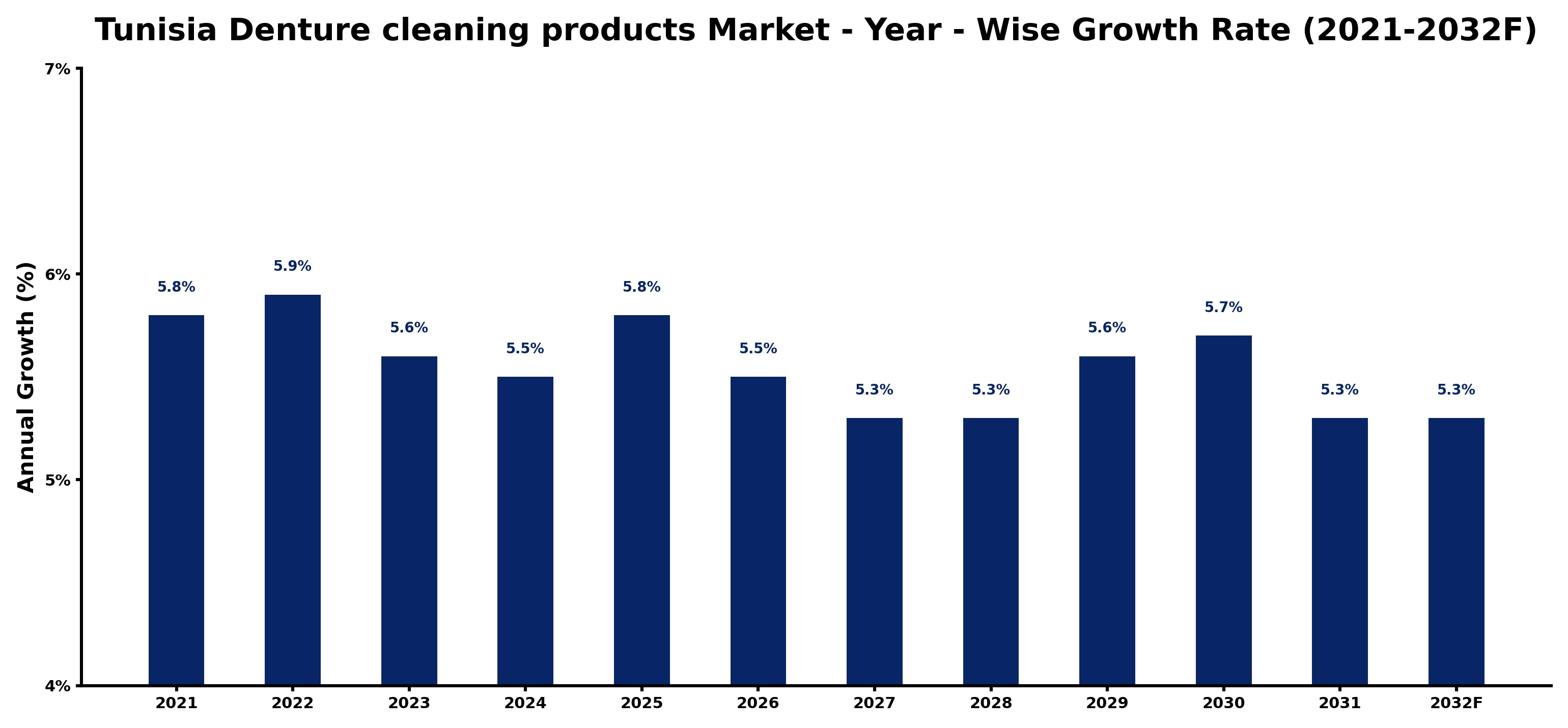
The table below presents the year‑wise growth rates along with the key drivers influencing the market
| Year | Growth Rate | Major Drivers |
| 2021 | 5.8% | Denture cleaning product manufacturing shifts to automated production lines |
| 2022 | 5.9% | Domestic production upgrades boost efficiency in denture cleaning formulations |
| 2023 | 5.6% | Domestic production scale up boosts denture cleaner market supply |
| 2024 | 5.5% | Innovative cleaning formulations boosted production capacity in dental manufacturing |
| 2025 | 5.8% | New manufacturing lines boost denture cleaner production capacity significantly |
| 2026 | 5.5% | Consumer preference shifts drove local denture cleaning product production |
| 2027 | 5.3% | Accelerated investments in manufacturing facilities boost denture cleaning output |
| 2028 | 5.3% | Domestic production of denture cleaning products supports export market growth |
| 2029 | 5.6% | Advanced manufacturing techniques boost denture cleaning product output efficiency |
| 2030 | 5.7% | Local manufacturers invest in new machinery for denture product scaling |
| 2031 | 5.3% | Technological advancements in manufacturing boost denture cleaner production efficiency |
| 2032 | 5.3% | Denture cleaning product manufacturing investments improved facility capacity utilization |
Note - Market size estimations and growth projections presented in this report are based on 6Wresearch's advanced forecasting approach, validated with industry datasets as of June 2026.
Tunisia Denture cleaning products Market Synopsis
Recently, the market for denture cleaning products in Tunisia has shown considerable momentum, propelled by both consumer demand and technological innovation. However, as we move forward, the market is poised for even more dynamic shifts with the potential for new entrants and innovative product offerings aimed at diverse consumer preferences.
With the increasing emphasis on oral health and hygiene, coupled with the expansion of retail channels—including online platforms—the Tunisia denture cleaning products market is transitioning from basic cleaning solutions to more sophisticated, user-friendly alternatives. This evolution not only addresses consumer needs but also enhances market accessibility.
Tunisia Denture cleaning products Market Key Takeaways
- Steady market growth driven by an aging population and enhanced oral hygiene awareness.
- Consumer preference shifting towards eco-friendly and convenient cleaning solutions.
- Technological advancements are enabling the introduction of specialized cleaning products.
- Widespread distribution through pharmacies, supermarkets, and digital platforms enhances market accessibility.
- Effective educational campaigns are essential for increasing consumer trust and product adoption.
Evaluation of Restraints in Tunisia Denture cleaning products Market
Despite the promising growth trajectory, the Tunisia denture cleaning products market faces several limitations. A significant barrier is the low level of awareness regarding the importance of denture hygiene, particularly among the elderly demographic. Furthermore, in rural areas, access to specialized products is often limited, hindering market penetration. Compounded by competition from traditional cleaning methods and consumer hesitancy to adopt newer products due to safety concerns, these factors necessitate targeted educational initiatives and expanded distribution strategies to build consumer confidence.
Tunisia Denture cleaning products Market Trends
Current trends in the Tunisia denture cleaning products market reveal a marked shift towards innovative and convenient cleaning solutions. Denture cleaning tablets and wipes are gaining popularity, particularly for their ease of use and portability. Additionally, there is a growing consumer interest in products formulated with natural ingredients, reflecting a broader trend towards sustainability and health-conscious choices. Manufacturers are also focusing on creating solutions tailored for specific dental needs, indicating a responsiveness to the evolving consumer landscape.
Tunisia Denture cleaning products Market Opportunities
Investment opportunities in the Tunisia denture cleaning products market are abundant, particularly in the realm of product innovation and sustainability. There is a burgeoning demand for effective yet easy-to-use cleaning solutions among the aging population, making it a lucrative area for development. By investing in advanced technologies such as ultrasonic cleaners and eco-friendly formulations, companies can gain a competitive edge. Collaborations with dental professionals, alongside robust marketing strategies leveraging digital channels, can further enhance market reach and consumer engagement.
Government Initiatives in the Tunisia Denture cleaning products Market
While there are no specific policies directly addressing the denture cleaning products market in Tunisia, businesses operate under a regulatory framework established by the Ministry of Health. This framework includes standards for product quality, safety, and labeling. Companies looking to enter this market must ensure compliance with import regulations, which necessitate obtaining appropriate permits and approvals. Additionally, adherence to consumer protection laws and general business regulations remains crucial for successful operation.
Future Insights of the Tunisia Denture cleaning products Market
The future outlook for the Tunisia denture cleaning products market is bright, as several factors will likely drive its expansion. An increasing number of older adults coupled with a rising awareness of oral hygiene will bolster demand for denture care products. Furthermore, technological advancements are expected to yield more efficient cleaning solutions, attracting a broader consumer base. However, manufacturers will need to navigate a competitive landscape and implement effective marketing strategies to educate consumers about the critical importance of denture care. The overall trajectory suggests steady growth from 2026 to 2032.
Tunisia Denture cleaning products Market Latest Developments (May 2025 - June 2026)
Recent developments within the Tunisia denture cleaning products market indicate a focus on enhancing product offerings with sustainable and effective cleaning solutions. Companies are introducing innovative products that cater to specific consumer needs, such as sensitivity and ease of use. Additionally, the growth of online retail platforms is facilitating wider product accessibility, while educational initiatives are increasingly being implemented to promote awareness of proper denture hygiene.
Tunisia Denture cleaning products Market - Key Attractiveness of the Report
- 10 Years of Market Numbers
- Historical Data Starting from 2022 to 2025
- Base Year: 2025
- Forecast Data until 2032
- Key Performance Indicators Impacting the Market
- Major Upcoming Developments and Projects
Key Highlights of the Report:
- Tunisia Denture cleaning products Market Outlook
- Market Size of Tunisia Denture cleaning products Market, 2025
- Forecast of Tunisia Denture cleaning products Market, 2032
- Historical Data and Forecast of Tunisia Denture cleaning products Revenues & Volume for the Period 2022-2032F
- Tunisia Denture cleaning products Market Trend Evolution
- Tunisia Denture cleaning products Market Drivers and Challenges
- Tunisia Denture cleaning products Price Trends
- Tunisia Denture cleaning products Porter's Five Forces
- Tunisia Denture cleaning products Industry Life Cycle
- Historical Data and Forecast of Tunisia Denture cleaning products Market Revenues & Volume By Type for the Period 2022-2032F
- Historical Data and Forecast of Tunisia Denture cleaning products Market Revenues & Volume By Tablet for the Period 2022-2032F
- Historical Data and Forecast of Tunisia Denture cleaning products Market Revenues & Volume By Liquid for the Period 2022-2032F
- Historical Data and Forecast of Tunisia Denture cleaning products Market Revenues & Volume By Others for the Period 2022-2032F
- Historical Data and Forecast of Tunisia Denture cleaning products Market Revenues & Volume By Applications for the Period 2022-2032F
- Historical Data and Forecast of Tunisia Denture cleaning products Market Revenues & Volume By Dental Hospital for the Period 2022-2032F
- Historical Data and Forecast of Tunisia Denture cleaning products Market Revenues & Volume By Home for the Period 2022-2032F
- Historical Data and Forecast of Tunisia Denture cleaning products Market Revenues & Volume By Others for the Period 2022-2032F
- Tunisia Denture cleaning products Import Export Trade Statistics
- Market Opportunity Assessment By Type
- Market Opportunity Assessment By Applications
- Tunisia Denture cleaning products Top Companies Market Share
- Tunisia Denture cleaning products Competitive Benchmarking By Technical and Operational Parameters
- Tunisia Denture cleaning products Company Profiles
- Tunisia Denture cleaning products Key Strategic Recommendations






































