Tunisia Dermatology Drugs Market Size, Share & Growth Rate
The Tunisia Dermatology Drugs Market was estimated at USD 558 Million in 2025 and is projected to reach USD 809 Million by 2032, growing at a CAGR of 5.4% from 2026 to 2032. This growth trajectory reflects a rising demand for effective treatment solutions, driven by increasing skin disease prevalence in the region. As patients and healthcare providers seek enhanced therapeutic options, the market is experiencing a notable shift toward advanced dermatological therapies and improved patient care outcomes.
Tunisia Dermatology Drugs Market Year-wise Growth Rate and Key Drivers
This graph highlights how the Tunisia Dermatology Drugs Market has steadily grown over the years, supported by major growth factors.
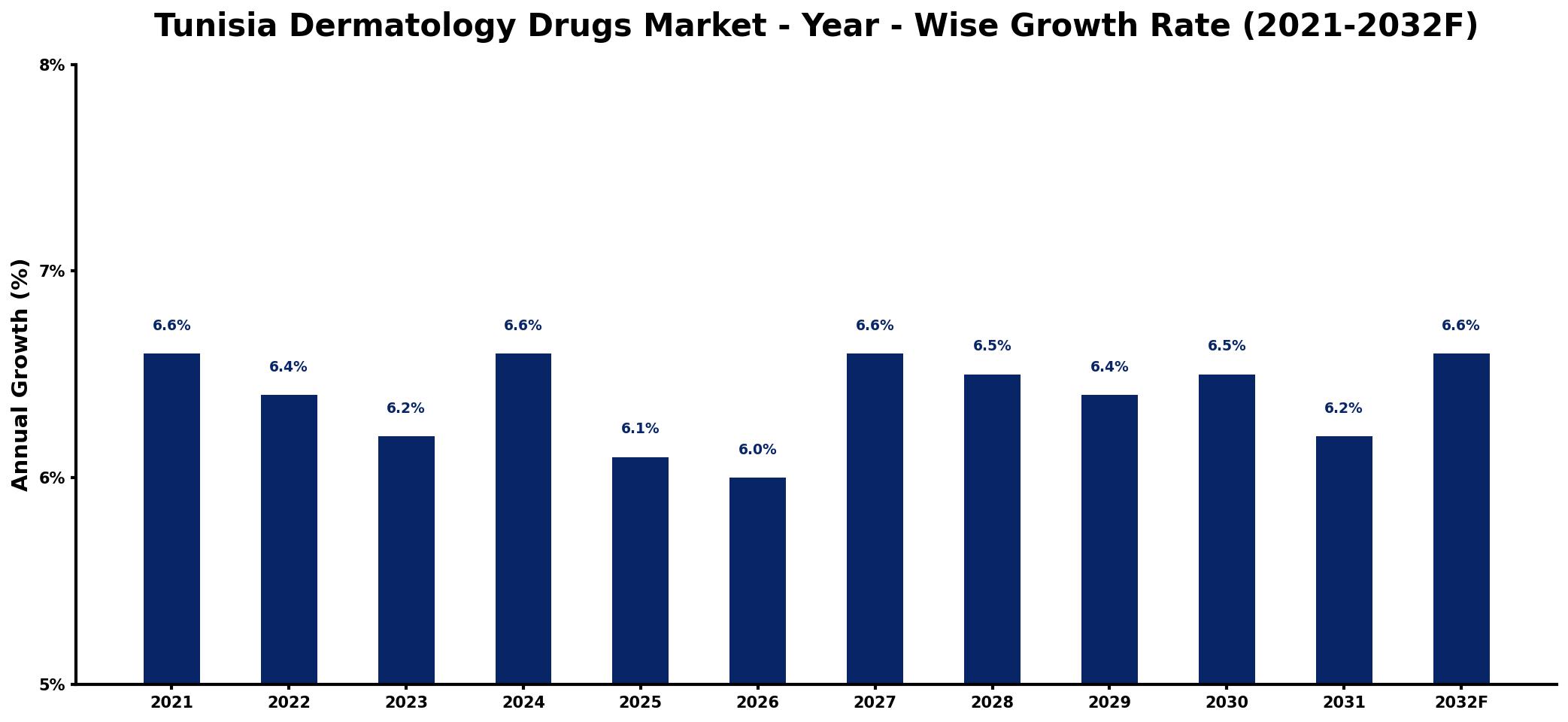
The table below presents the year‑wise growth rates along with the key drivers influencing the market
| Year | Growth Rate | Major Drivers |
| 2021 | 6.6% | Rising demand for skincare solutions |
| 2022 | 6.4% | Increased healthcare investment initiatives |
| 2023 | 6.2% | Growth in online health services |
| 2024 | 6.6% | Expansion of retail pharmacy networks |
| 2025 | 6.1% | Surge in cosmetic treatment popularity |
| 2026 | 6.0% | Growing awareness of skin health |
| 2027 | 6.6% | Increase in medical tourism opportunities |
| 2028 | 6.5% | Enhanced distribution channel efficiencies |
| 2029 | 6.4% | Development of innovative treatment options |
| 2030 | 6.5% | Strengthening of regulatory frameworks |
| 2031 | 6.2% | Collaboration among healthcare stakeholders |
| 2032 | 6.6% | Emergence of personalized treatment approaches |
Note: Market size estimations and growth projections presented in this report are based on 6Wresearch's proprietary forecasting methodology, utilizing the latest available industry data, government publications, and primary research inputs.
Tunisia Dermatology Drugs Market Synopsis
An alarming rise in skin-related ailments such as acne and psoriasis in Tunisia underscores a significant demand for dermatological drugs. Enhanced awareness around skin health is prompting patients to seek timely medical interventions, leading to a surge in product consumption.
Moreover, innovations in dermatology treatments, including biologics and targeted therapies, are becoming increasingly available. This, coupled with government policies promoting access to quality medicines, positions the market for robust future growth, allowing healthcare professionals to offer more effective treatment plans.
Tunisia Dermatology Drugs Market Key Takeaways
- The market shows strong growth potential, driven by rising skin disease incidences and increased treatment demand.
- Innovation in drug formulations and delivery methods is enhancing patient adherence to dermatological therapies.
- Government initiatives are reinforcing regulatory frameworks that ensure the safety and efficacy of dermatology drugs.
- The market is expanding due to improved patient awareness and access to advanced treatment options.
- Collaboration among stakeholders fosters research and development, leading to novel therapeutic solutions in dermatology.
Evaluation of Restraints in Tunisia Dermatology Drugs Market
While the market is poised for growth, several restraints hinder its full potential. High treatment costs remain a barrier for many patients, affecting access to necessary medications. Furthermore, navigating complex regulatory approval processes for new therapies can delay the availability of innovative treatments. In addition, evolving patient preferences demand a swift adaptation from healthcare providers, necessitating continuous education and adjustments in treatment protocols to ensure patient satisfaction and compliance.
Tunisia Dermatology Drugs Market Trends
Current trends indicate a shift towards personalized medicine within the Tunisia dermatology drugs market. Treatments tailored to individual patient profiles are gaining traction, reflecting broader global trends in healthcare. Additionally, there is a growing integration of teledermatology services, which facilitates remote consultations and follow-ups, thereby improving patient access and adherence to treatment.
Tunisia Dermatology Drugs Market Opportunities
The market presents substantial growth and investment opportunities, particularly in developing innovative therapies targeting chronic skin conditions. Research initiatives focused on biologics and combination therapies are expected to flourish, driven by unmet patient needs. Furthermore, investments in digital health technologies can enhance patient engagement, leading to improved adherence rates and treatment outcomes.
Government Initiatives in the Tunisia Dermatology Drugs Market
The Tunisian government plays a pivotal role in shaping the dermatology drugs market through various policies aimed at improving public health. Initiatives include promoting research and development in dermatology, ensuring drug safety through rigorous regulatory standards, and supporting patient access to treatments. Public health campaigns aimed at skin disease awareness further bolster demand for dermatological products, enhancing overall patient outcomes.
Future Insights of the Tunisia Dermatology Drugs Market
Looking ahead to 2026-2032, the Tunisia dermatology drugs market is anticipated to evolve significantly. As healthcare providers increasingly embrace advanced treatment modalities and personalized care approaches, patient outcomes are likely to improve. The ongoing collaboration between the government and pharmaceutical companies will be crucial in ensuring the availability of innovative therapies that meet the changing needs of the population. Overall, the market is set to experience steady expansion, driven by a commitment to enhancing skin health and addressing the dermatological challenges facing the Tunisian population.
Tunisia Dermatology Drugs Market Latest Developments (2025 - 2026)
Recent developments in the Tunisia dermatology drugs market indicate a growing focus on clinical trials for novel treatments. There has been an uptick in public-private partnerships aimed at accelerating research and development activities in dermatological innovations. Furthermore, regulatory frameworks are being refined to streamline the approval processes for new therapies, fostering a more dynamic market environment.
Tunisia Dermatology Drugs Market - Key Attractiveness of the Report
- 10 Years of Market Numbers
- Historical Data Starting from 2022 to 2025
- Base Year: 2025
- Forecast Data until 2032
- Key Performance Indicators Impacting the Market
- Major Upcoming Developments and Projects
Key Highlights of the Report:
- Tunisia Dermatology Drugs Market Outlook
- Market Size of Tunisia Dermatology Drugs Market, 2025
- Forecast of Tunisia Dermatology Drugs Market, 2032
- Historical Data and Forecast of Tunisia Dermatology Drugs Revenues & Volume for the Period 2022-2032F
- Tunisia Dermatology Drugs Market Trend Evolution
- Tunisia Dermatology Drugs Market Drivers and Challenges
- Tunisia Dermatology Drugs Price Trends
- Tunisia Dermatology Drugs Porter's Five Forces
- Tunisia Dermatology Drugs Industry Life Cycle
- Historical Data and Forecast of Tunisia Dermatology Drugs Market Revenues & Volume By Application for the Period 2022-2032F
- Historical Data and Forecast of Tunisia Dermatology Drugs Market Revenues & Volume By Acne for the Period 2022-2032F
- Historical Data and Forecast of Tunisia Dermatology Drugs Market Revenues & Volume By Atopic Dermatitis for the Period 2022-2032F
- Historical Data and Forecast of Tunisia Dermatology Drugs Market Revenues & Volume By Psoriasis for the Period 2022-2032F
- Historical Data and Forecast of Tunisia Dermatology Drugs Market Revenues & Volume By Others for the Period 2022-2032F
- Historical Data and Forecast of Tunisia Dermatology Drugs Market Revenues & Volume By Route of Administration for the Period 2022-2032F
- Historical Data and Forecast of Tunisia Dermatology Drugs Market Revenues & Volume By Oral for the Period 2022-2032F
- Historical Data and Forecast of Tunisia Dermatology Drugs Market Revenues & Volume By Parenteral for the Period 2022-2032F
- Historical Data and Forecast of Tunisia Dermatology Drugs Market Revenues & Volume By Topical for the Period 2022-2032F
- Historical Data and Forecast of Tunisia Dermatology Drugs Market Revenues & Volume By Distribution Channel for the Period 2022-2032F
- Historical Data and Forecast of Tunisia Dermatology Drugs Market Revenues & Volume By Hospital Pharmacy for the Period 2022-2032F
- Historical Data and Forecast of Tunisia Dermatology Drugs Market Revenues & Volume By Retail Pharmacy for the Period 2022-2032F
- Historical Data and Forecast of Tunisia Dermatology Drugs Market Revenues & Volume By Online Pharmacy for the Period 2022-2032F
- Tunisia Dermatology Drugs Import Export Trade Statistics
- Market Opportunity Assessment By Application
- Market Opportunity Assessment By Route of Administration
- Market Opportunity Assessment By Distribution Channel
- Tunisia Dermatology Drugs Top Companies Market Share
- Tunisia Dermatology Drugs Competitive Benchmarking By Technical and Operational Parameters
- Tunisia Dermatology Drugs Company Profiles
- Tunisia Dermatology Drugs Key Strategic Recommendations






































