Tunisia Dimension Stone Market Size, Share & Growth Rate
The Tunisia Dimension Stone Market was estimated at USD 397 Million in 2025 and is projected to reach USD 546 Million by 2032, growing at a CAGR of 4.7% from 2026 to 2032. This upward trajectory is largely driven by a resurgence in construction activities and an increasing consumer preference for natural stone materials known for their aesthetic appeal and durability. As urbanization continues to rise, the demand for locally sourced dimension stones, which support sustainability efforts, has further catalyzed market growth.
Tunisia Dimension Stone Market Year-wise Growth Rate and Key Drivers
This graph highlights how the Tunisia Dimension Stone Market has steadily grown over the years, supported by major growth factors.
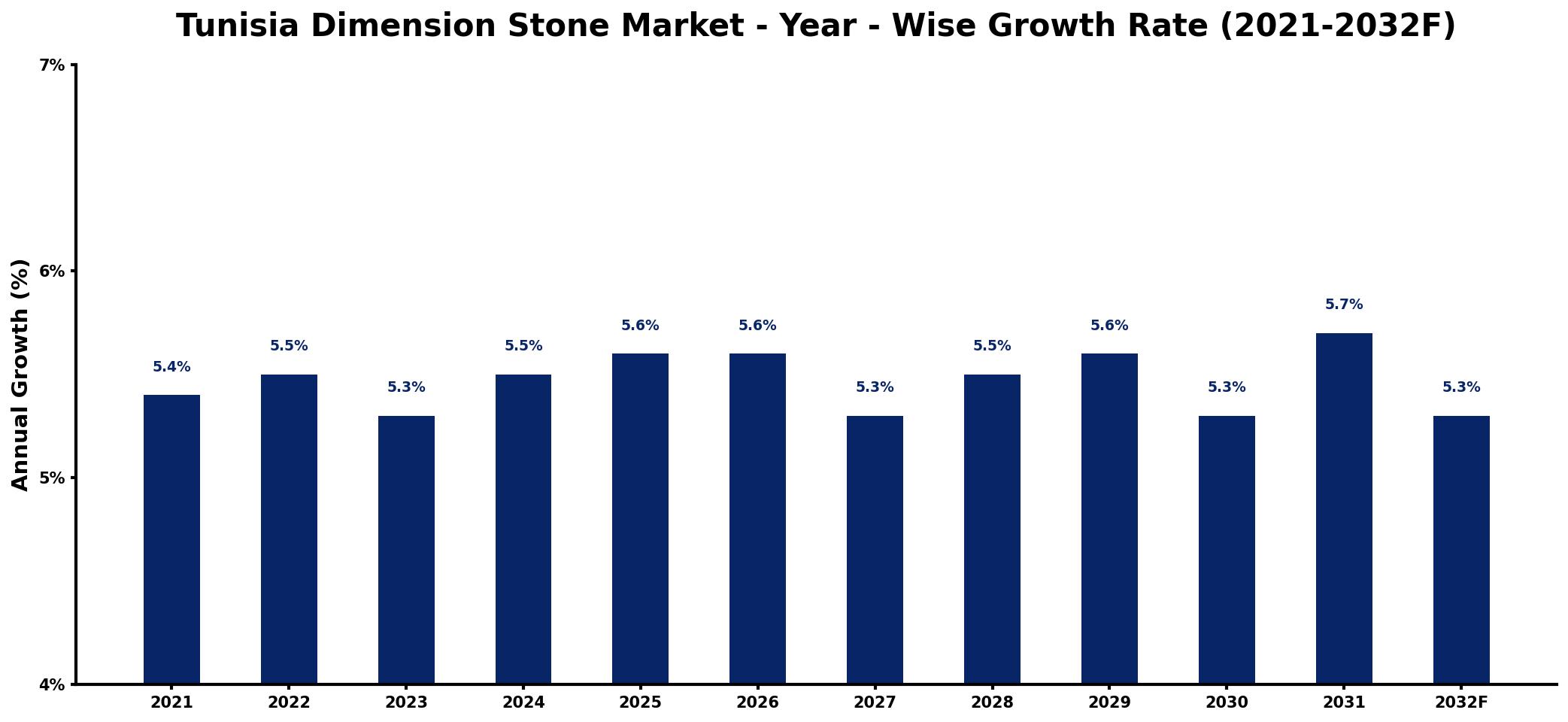
The table below presents the year‑wise growth rates along with the key drivers influencing the market
| Year | Growth Rate | Major Drivers |
| 2021 | 5.4% | Increased construction activities nationwide |
| 2022 | 5.5% | Growing tourism sector demands materials |
| 2023 | 5.3% | Rising domestic infrastructure investments |
| 2024 | 5.5% | Expansion of residential projects underway |
| 2025 | 5.6% | Urbanization trends driving material needs |
| 2026 | 5.6% | Heightened international market interest |
| 2027 | 5.3% | Emerging renewable energy projects planned |
| 2028 | 5.5% | Strengthened export opportunities identified |
| 2029 | 5.6% | increased domestic production output |
| 2030 | 5.3% | Innovative architectural designs gaining popularity |
| 2031 | 5.7% | Government incentives for construction projects |
| 2032 | 5.3% | Increased public-private partnerships formed |
Note: Market size estimations and growth projections presented in this report are based on 6Wresearch's proprietary forecasting methodology, utilizing the latest available industry data, government publications, and primary research inputs.
Tunisia Dimension Stone Market Synopsis
Currently, the Tunisia Dimension Stone Market is thriving, characterized by a rich geological diversity that offers an array of marble, limestone, and travertine options. These stones are highly sought after for both structural and decorative uses, thanks to their varied colors, textures, and patterns that cater to diverse architectural needs.
With a growing construction sector in Tunisia, the demand for high-quality dimension stones is seeing significant traction. Both domestic and international markets are increasingly interested in Tunisian stone products, leading to heightened competition among local quarries and processing companies to meet this rising demand.
Tunisia Dimension Stone Market Key Takeaways
- High-quality marble, limestone, and travertine dominate the market, meeting diverse architectural requirements.
- Urbanization and construction activities are pivotal in driving market demand and expansion.
- Increasing preference for sustainable, locally sourced dimension stones enhances market growth.
- Technological advancements in stone processing are improving product quality and market competitiveness.
- The governments supportive policies foster investment and development in the dimension stone sector.
Evaluation of Restraints in Tunisia Dimension Stone Market
Despite its potential, the Tunisia Dimension Stone Market faces notable constraints. Limited access to modern quarrying technology can lead to inefficiencies and lower productivity in extraction and processing. Furthermore, the absence of standardized quality control practices results in variations in product quality, which can impact buyer confidence. Compounded by competition from cheaper imported dimension stones, these factors create challenges for local producers striving to enhance their market share and profitability.
Tunisia Dimension Stone Market Trends
Emerging trends in the Tunisia Dimension Stone Market reflect a growing consumer inclination towards unique, high-quality stone products. As sustainable construction practices gain traction, there is an increasing demand for natural stones that contribute to environmental conservation. Additionally, innovative processing technologies are not only improving efficiency but also enhancing the aesthetic qualities of dimension stone products, solidifying their appeal in the competitive market.
Tunisia Dimension Stone Market Opportunities
Investment opportunities in the Tunisia Dimension Stone Market are on the rise, particularly due to the country's rich deposits of marble, limestone, and other high-quality natural stones. With the construction and interior design sectors expanding, ventures focusing on quarrying, processing, or exporting stone products stand to reap substantial rewards. Additionally, Tunisia's strategic location as a bridge to European and African markets opens further avenues for export and international collaborations.
Government Initiatives in the Tunisia Dimension Stone Market
The Tunisian government actively supports the dimension stone industry through various policies that promote sustainable extraction practices and enhance industry growth. Licensing requirements for quarry operations, environmental impact assessments, and initiatives aimed at local value addition all contribute to strengthening the markets structure. Additionally, financial incentives and technical assistance are provided to encourage investment and improve product quality, reflecting a balanced approach to economic development and environmental stewardship.
Future Insights of the Tunisia Dimension Stone Market
Looking ahead to 2026-2032, the Tunisia Dimension Stone Market is poised for continued growth, propelled by the ongoing expansion of the construction sector and infrastructure projects. As the demand for dimension stones like marble and limestone rises, driven by their essential role in modern architecture, Tunisia is set to establish itself as a key player in the regional stone market. However, stakeholders must navigate challenges such as price volatility and competition from alternative stone-producing regions to fully capitalize on emerging opportunities.
Tunisia Dimension Stone Market Latest Developments (2025 - 2026)
In recent months, the Tunisia Dimension Stone Market has witnessed an influx of investments aimed at modernizing quarrying and processing techniques. Industry players are increasingly adopting cutting-edge technologies to enhance product quality and efficiency. Additionally, there is a marked trend toward collaborative efforts between local businesses and international firms, focusing on expanding export capabilities and diversifying product offerings in response to global demand.
Tunisia Dimension Stone Market - Key Attractiveness of the Report
- 10 Years of Market Numbers
- Historical Data Starting from 2022 to 2025
- Base Year: 2025
- Forecast Data until 2032
- Key Performance Indicators Impacting the Market
- Major Upcoming Developments and Projects
Key Highlights of the Report:
- Tunisia Dimension Stone Market Outlook
- Market Size of Tunisia Dimension Stone Market, 2025
- Forecast of Tunisia Dimension Stone Market, 2032
- Historical Data and Forecast of Tunisia Dimension Stone Revenues & Volume for the Period 2022-2032F
- Tunisia Dimension Stone Market Trend Evolution
- Tunisia Dimension Stone Market Drivers and Challenges
- Tunisia Dimension Stone Price Trends
- Tunisia Dimension Stone Porter's Five Forces
- Tunisia Dimension Stone Industry Life Cycle
- Historical Data and Forecast of Tunisia Dimension Stone Market Revenues & Volume By Type for the Period 2022-2032F
- Historical Data and Forecast of Tunisia Dimension Stone Market Revenues & Volume By Granite for the Period 2022-2032F
- Historical Data and Forecast of Tunisia Dimension Stone Market Revenues & Volume By Limestone for the Period 2022-2032F
- Historical Data and Forecast of Tunisia Dimension Stone Market Revenues & Volume By Marble for the Period 2022-2032F
- Historical Data and Forecast of Tunisia Dimension Stone Market Revenues & Volume By Travertine for the Period 2022-2032F
- Historical Data and Forecast of Tunisia Dimension Stone Market Revenues & Volume By Other varieties for the Period 2022-2032F
- Historical Data and Forecast of Tunisia Dimension Stone Market Revenues & Volume By Application for the Period 2022-2032F
- Historical Data and Forecast of Tunisia Dimension Stone Market Revenues & Volume By Structural use for the Period 2022-2032F
- Historical Data and Forecast of Tunisia Dimension Stone Market Revenues & Volume By Decorative uses for the Period 2022-2032F
- Tunisia Dimension Stone Import Export Trade Statistics
- Market Opportunity Assessment By Type
- Market Opportunity Assessment By Application
- Tunisia Dimension Stone Top Companies Market Share
- Tunisia Dimension Stone Competitive Benchmarking By Technical and Operational Parameters
- Tunisia Dimension Stone Company Profiles
- Tunisia Dimension Stone Key Strategic Recommendations






































