Tunisia E-wallet Market Size, Share & Growth Rate
The Tunisia E-wallet Market was estimated at USD 292 Million in 2025 and is projected to reach USD 402 Million by 2032, growing at a CAGR of 4.7% from 2026 to 2032. This growth trajectory is propelled by an increasing shift towards digital payment solutions, which enhances convenience and security for consumers and businesses alike. The ongoing rise of mobile banking, coupled with a strong government emphasis on financial inclusion, underlines the urgency for innovative e-wallet solutions that cater to the evolving needs of the Tunisian population.
Tunisia E-wallet Market Year-wise Growth Rate and Key Drivers
This graph highlights how the Tunisia E-wallet Market has steadily grown over the years, supported by major growth factors.
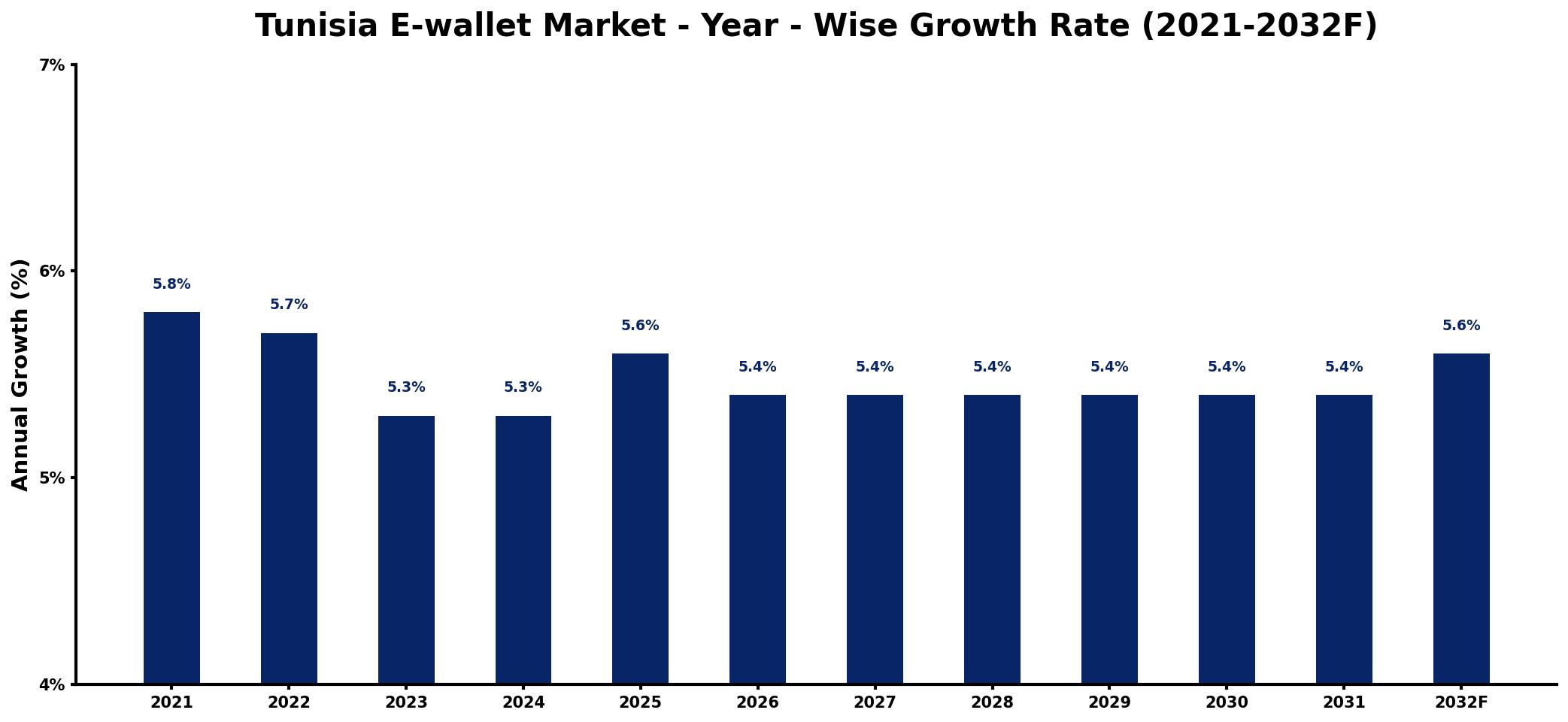
The table below presents the year‑wise growth rates along with the key drivers influencing the market
| Year | Growth Rate | Major Drivers |
| 2021 | 5.8% | Rising digital payment adoption |
| 2022 | 5.7% | Increase in smartphone penetration |
| 2023 | 5.3% | Growth of e-commerce platforms |
| 2024 | 5.3% | Expansion of fintech startups |
| 2025 | 5.6% | Increased regulatory support initiatives |
| 2026 | 5.4% | Adoption of contactless payment systems |
| 2027 | 5.4% | Investment in cybersecurity solutions |
| 2028 | 5.4% | Development of payment integration technologies |
| 2029 | 5.4% | Growth in cross-border transactions |
| 2030 | 5.4% | Emergence of blockchain applications |
| 2031 | 5.4% | Rise of loyalty reward programs |
| 2032 | 5.6% | rising end-use demand growth |
Note: Market size estimations and growth projections presented in this report are based on 6Wresearch's proprietary forecasting methodology, utilizing the latest available industry data, government publications, and primary research inputs.
Tunisia E-wallet Market Synopsis
In recent years, the adoption of e-wallets in Tunisia has surged, driven by the demand for cashless transactions. More consumers and retailers are recognizing the benefits of electronic wallets, such as ease of use, enhanced security, and efficient money management.
As the digital economy evolves, the necessity for robust e-wallet solutions becomes increasingly apparent. Tunisian consumers are moving towards a preference for digital transactions, indicating a significant shift in financial behaviors that e-wallet providers are well-positioned to capitalize on.
Tunisia E-wallet Market Key Takeaways
- The market is experiencing solid growth as consumers increasingly favor digital payment methods.
- Government policies are enhancing financial inclusion, promoting e-wallet adoption among diverse demographics.
- Technological advancements are improving the user experience and security features of e-wallets.
- Consumer education on digital payments is crucial for addressing skepticism and driving widespread adoption.
- Collaboration among financial institutions, telecom operators, and regulators is vital for expanding interoperability.
Evaluation of Restraints in Tunisia E-wallet Market
The Tunisia e-wallet market confronts several challenges that hinder its full potential. A primary concern is consumer trust, particularly regarding the security of digital transactions. Cybersecurity threats pose significant risks, necessitating a robust framework for data privacy. Additionally, regulatory compliance can complicate market penetration, especially for new entrants. There's also a pressing need to overcome interoperability issues between various e-wallet platforms, which is crucial for wider acceptance across both online and retail environments.
Tunisia E-wallet Market Trends
One significant trend shaping the Tunisia e-wallet landscape is the integration of advanced security features, such as biometric authentication and AI-driven fraud detection. These innovations are designed to enhance user confidence in digital payment systems. Furthermore, the growing reliance on smartphones and mobile applications is fostering a shift towards mobile-first payment solutions, making e-wallets more accessible to a broader audience.
Another trend is the increasing collaboration between fintech companies and traditional banking institutions, which is paving the way for enhanced services and offerings. As e-wallets become more integrated into the daily financial transactions of Tunisians, the potential for growth within this sector is vast, fueling ongoing innovations and partnerships.
Tunisia E-wallet Market Opportunities
Opportunities abound in the Tunisia e-wallet market, particularly for organizations that can effectively educate consumers about the benefits of cashless transactions. Expanding partnerships with retail and e-commerce platforms can significantly increase transaction volumes. Additionally, there is considerable potential for e-wallet providers to tailor services for underserved populations, leveraging mobile technology to promote financial inclusion. The emphasis on seamless user experiences presents further avenues for growth in service innovation.
Government Initiatives in the Tunisia E-wallet Market
The Tunisian government is actively promoting the use of e-wallets through a series of initiatives aimed at enhancing financial inclusion and digital payment methods. This includes the establishment of regulatory frameworks designed to bolster security and promote interoperability between different payment platforms. Furthermore, the government is incentivizing fintech innovation to encourage the development of cutting-edge solutions in the e-wallet sector. These initiatives are pivotal for increasing consumer adoption and establishing a robust digital economy.
Future Insights of the Tunisia E-wallet Market
Looking ahead to the period from 2026 to 2032, the Tunisia e-wallet market is poised for significant evolution. Continued technological advancements and regulatory support will likely enhance consumer trust and broaden the scope of e-wallet applications. The integration of e-wallets with other financial services, such as insurance and lending, could redefine customer experiences and expand market reach. As Tunisian society embraces digital solutions, the landscape will transform, marking a new era for financial transactions in the region.
Tunisia E-wallet Market Latest Developments (2025 - 2026)
Recent developments in the Tunisia e-wallet market indicate a growing focus on improving user experience and security. Several fintech companies are investing in advanced technologies to enhance their offerings, while collaborations between various stakeholders, including banks and telecom operators, are becoming more common. There's also a noticeable shift towards user education campaigns aimed at raising awareness about the benefits of digital transactions, ultimately supporting the markets growth.
Tunisia E-wallet Market - Key Attractiveness of the Report
- 10 Years of Market Numbers
- Historical Data Starting from 2022 to 2025
- Base Year: 2025
- Forecast Data until 2032
- Key Performance Indicators Impacting the Market
- Major Upcoming Developments and Projects
Key Highlights of the Report:
- Tunisia E-wallet Market Outlook
- Market Size of Tunisia E-wallet Market, 2025
- Forecast of Tunisia E-wallet Market, 2032
- Historical Data and Forecast of Tunisia E-wallet Revenues & Volume for the Period 2022-2032F
- Tunisia E-wallet Market Trend Evolution
- Tunisia E-wallet Market Drivers and Challenges
- Tunisia E-wallet Price Trends
- Tunisia E-wallet Porter's Five Forces
- Tunisia E-wallet Industry Life Cycle
- Historical Data and Forecast of Tunisia E-wallet Market Revenues & Volume By Application for the Period 2022-2032F
- Historical Data and Forecast of Tunisia E-wallet Market Revenues & Volume By Restaurants for the Period 2022-2032F
- Historical Data and Forecast of Tunisia E-wallet Market Revenues & Volume By Transportation for the Period 2022-2032F
- Historical Data and Forecast of Tunisia E-wallet Market Revenues & Volume By Banking for the Period 2022-2032F
- Historical Data and Forecast of Tunisia E-wallet Market Revenues & Volume By Retail for the Period 2022-2032F
- Historical Data and Forecast of Tunisia E-wallet Market Revenues & Volume By Type for the Period 2022-2032F
- Historical Data and Forecast of Tunisia E-wallet Market Revenues & Volume By Closed E Wallets for the Period 2022-2032F
- Historical Data and Forecast of Tunisia E-wallet Market Revenues & Volume By Semi Closed E Wallets for the Period 2022-2032F
- Historical Data and Forecast of Tunisia E-wallet Market Revenues & Volume By Open E Wallets for the Period 2022-2032F
- Historical Data and Forecast of Tunisia E-wallet Market Revenues & Volume By Mode for the Period 2022-2032F
- Historical Data and Forecast of Tunisia E-wallet Market Revenues & Volume By Online for the Period 2022-2032F
- Historical Data and Forecast of Tunisia E-wallet Market Revenues & Volume By M Wallet for the Period 2022-2032F
- Historical Data and Forecast of Tunisia E-wallet Market Revenues & Volume By Mode for the Period 2022-2032F
- Historical Data and Forecast of Tunisia E-wallet Market Revenues & Volume By Online for the Period 2022-2032F
- Historical Data and Forecast of Tunisia E-wallet Market Revenues & Volume By M Wallet for the Period 2022-2032F
- Tunisia E-wallet Import Export Trade Statistics
- Market Opportunity Assessment By Application
- Market Opportunity Assessment By Type
- Market Opportunity Assessment By Mode
- Tunisia E-wallet Top Companies Market Share
- Tunisia E-wallet Competitive Benchmarking By Technical and Operational Parameters
- Tunisia E-wallet Company Profiles
- Tunisia E-wallet Key Strategic Recommendations






































