Tunisia Electric Hair Clipper & Trimmer Market Size, Share & Growth Rate
The Tunisia Electric Hair Clipper & Trimmer Market was estimated at USD 1262 Million in 2025 and is projected to reach USD 2322 Million by 2032, growing at a CAGR of 9.1% from 2026 to 2032. This promising trajectory is fueled by a cultural shift toward personal grooming, with both men and women increasingly prioritizing their appearance. Additionally, the rising acceptance of DIY grooming solutions, coupled with an influx of innovative and user-friendly products, is driving demand across the nation.
Tunisia Electric Hair Clipper & Trimmer Market Year-wise Growth Rate and Key Drivers
This graph highlights how the Tunisia Electric Hair Clipper & Trimmer Market has steadily grown over the years, supported by major growth factors.
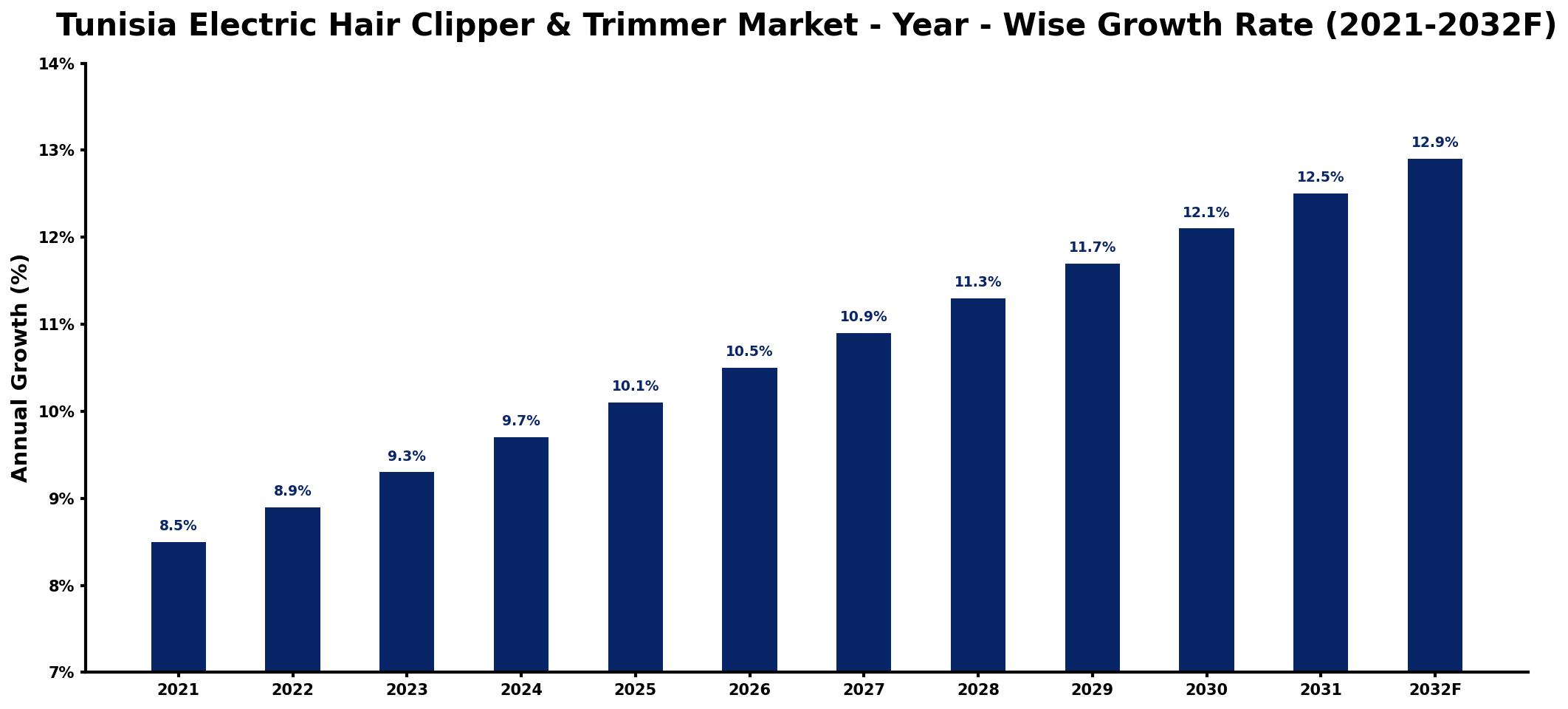
The table below presents the year‑wise growth rates along with the key drivers influencing the market
| Year | Growth Rate | Major Drivers |
| 2021 | 8.5% | Rising consumer grooming awareness |
| 2022 | 8.9% | Increased disposable income levels |
| 2023 | 9.3% | E-commerce market expansion growth |
| 2024 | 9.7% | Growing demand for personal care |
| 2025 | 10.1% | Technological advancements in devices |
| 2026 | 10.5% | Shifts towards home grooming solutions |
| 2027 | 10.9% | Increased penetration of online retail |
| 2028 | 11.3% | Rising popularity of grooming trends |
| 2029 | 11.7% | Expansion of beauty service industry |
| 2030 | 12.1% | Growing influence of social media |
| 2031 | 12.5% | Increased focus on self-care |
| 2032 | 12.9% | increased overall sector activity |
Note: Market size estimations and growth projections presented in this report are based on 6Wresearch's proprietary forecasting methodology, utilizing the latest available industry data, government publications, and primary research inputs.
Tunisia Electric Hair Clipper & Trimmer Market Synopsis
The Tunisia Electric Hair Clipper & Trimmer Market has recently gained momentum, propelled by heightened consumer interest in personal grooming. However, as the market evolves, expectations are shifting towards multifunctional devices that deliver quality performance. Industry players must adapt to this changing landscape to maintain relevance and capitalize on the growing demand.
While established brands dominate the market, emerging local manufacturers are beginning to carve out niches by focusing on affordability and tailored offerings. The future looks bright as trends evolve, and companies that prioritize innovation and user-centric design will likely succeed in the competitive environment.
- The market is projected to grow significantly, driven by increasing grooming habits.
- Consumer preferences are shifting towards advanced, multifunctional grooming tools.
- Demand for cordless and rechargeable options is on the rise, enhancing portability.
- Local manufacturers are gaining traction by offering cost-effective solutions.
- Government policies are supporting local production and product quality standards.
Despite the favorable growth prospects, the Tunisia Electric Hair Clipper & Trimmer Market faces certain restraints that can hinder its potential. One of the most pressing challenges is the prevalence of counterfeit products, which can damage brand reputation and consumer trust. Additionally, pricing pressures from low-cost alternatives and competition from unbranded items complicate market dynamics. The need for constant innovation to keep pace with consumer expectations also demands significant investment, while underdeveloped distribution networks may limit companies' ability to reach customers effectively.
The current market is marked by a notable trend toward multifunctional grooming tools designed to provide precision and versatility. Consumers increasingly seek products that accommodate a variety of hair types and styles. Additionally, there is a strong inclination towards cordless and rechargeable devices that offer enhanced convenience. Emerging technologies, such as adjustable blade settings and ergonomic designs, are becoming standard features that enhance the user experience and further stimulate demand.
The Tunisia Electric Hair Clipper & Trimmer market is ripe with investment opportunities, driven by the ongoing demand for personal grooming solutions. As consumers become more health-conscious and emphasize hygiene, there is an increasing appetite for at-home grooming products. This presents avenues for innovation in design and functionality, catering specifically to local consumer needs. New entrants can explore niche markets and develop customized products that cater to diverse customer segments, positioning themselves favorably within this expanding sector.
The Tunisian government is actively promoting the growth of the Electric Hair Clipper & Trimmer Market through a range of supportive policies. By reducing import tariffs on related products, authorities aim to encourage market expansion while facilitating competitive pricing for consumers. Additionally, initiatives to bolster local manufacturing efforts are underway, providing incentives and support programs designed to enhance domestic production. These measures are coupled with regulations to ensure product quality and safety standards, ultimately aiming to stimulate the market and protect consumers.
Looking ahead to 2026-2032, the Tunisia Electric Hair Clipper & Trimmer Market is poised for continued growth as consumer grooming habits solidify. Technological advancements will drive the introduction of innovative products that cater to evolving preferences, reinforcing the trend toward DIY grooming solutions. Moreover, as brands focus on affordability and performance, they will likely capture a larger share of this burgeoning market. Thus, stakeholders who remain adaptable and forward-thinking will be well-positioned for success in this vibrant sector.
In recent months, the Tunisia Electric Hair Clipper & Trimmer Market has experienced notable shifts as brands introduce new product lines catering to both professional and at-home users. Companies are focusing on enhancing their marketing strategies to better resonate with the growing consumer base. There is also an observable push towards integrating advanced features into grooming tools, ensuring that offerings meet contemporary demands for functionality and style.
- 10 Years of Market Numbers
- Historical Data Starting from 2022 to 2025
- Base Year: 2025
- Forecast Data until 2032
- Key Performance Indicators Impacting the Market
- Major Upcoming Developments and Projects
Key Highlights of the Report:
- Tunisia Electric Hair Clipper & Trimmer Market Outlook
- Market Size of Tunisia Electric Hair Clipper & Trimmer Market, 2025
- Forecast of Tunisia Electric Hair Clipper & Trimmer Market, 2032
- Historical Data and Forecast of Tunisia Electric Hair Clipper & Trimmer Revenues & Volume for the Period 2022-2032F
- Tunisia Electric Hair Clipper & Trimmer Market Trend Evolution
- Tunisia Electric Hair Clipper & Trimmer Market Drivers and Challenges
- Tunisia Electric Hair Clipper & Trimmer Price Trends
- Tunisia Electric Hair Clipper & Trimmer Porter's Five Forces
- Tunisia Electric Hair Clipper & Trimmer Industry Life Cycle
- Historical Data and Forecast of Tunisia Electric Hair Clipper & Trimmer Market Revenues & Volume By Product for the Period 2022-2032F
- Historical Data and Forecast of Tunisia Electric Hair Clipper & Trimmer Market Revenues & Volume By Corded for the Period 2022-2032F
- Historical Data and Forecast of Tunisia Electric Hair Clipper & Trimmer Market Revenues & Volume By Cordless for the Period 2022-2032F
- Historical Data and Forecast of Tunisia Electric Hair Clipper & Trimmer Market Revenues & Volume By Distribution Channel for the Period 2022-2032F
- Historical Data and Forecast of Tunisia Electric Hair Clipper & Trimmer Market Revenues & Volume By Offline for the Period 2022-2032F
- Historical Data and Forecast of Tunisia Electric Hair Clipper & Trimmer Market Revenues & Volume By Online for the Period 2022-2032F
- Tunisia Electric Hair Clipper & Trimmer Import Export Trade Statistics
- Market Opportunity Assessment By Product
- Market Opportunity Assessment By Distribution Channel
- Tunisia Electric Hair Clipper & Trimmer Top Companies Market Share
- Tunisia Electric Hair Clipper & Trimmer Competitive Benchmarking By Technical and Operational Parameters
- Tunisia Electric Hair Clipper & Trimmer Company Profiles
- Tunisia Electric Hair Clipper & Trimmer Key Strategic Recommendations






































