Tunisia Electrical Conduit Market Size Growth Rate
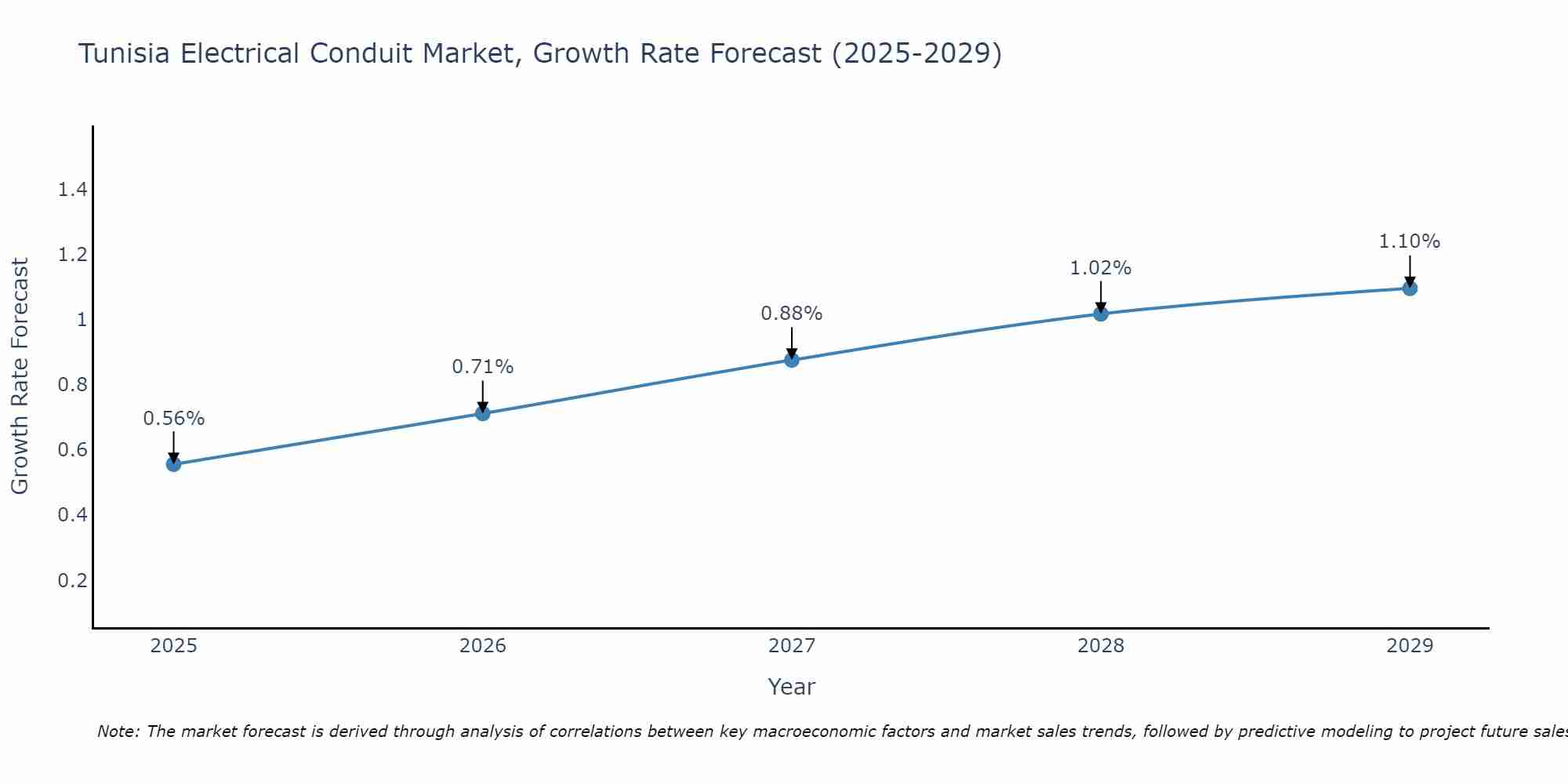
The Tunisia Electrical Conduit Market is likely to experience consistent growth rate gains over the period 2025 to 2029. The growth rate starts at 0.56% in 2025 and reaches 1.10% by 2029.
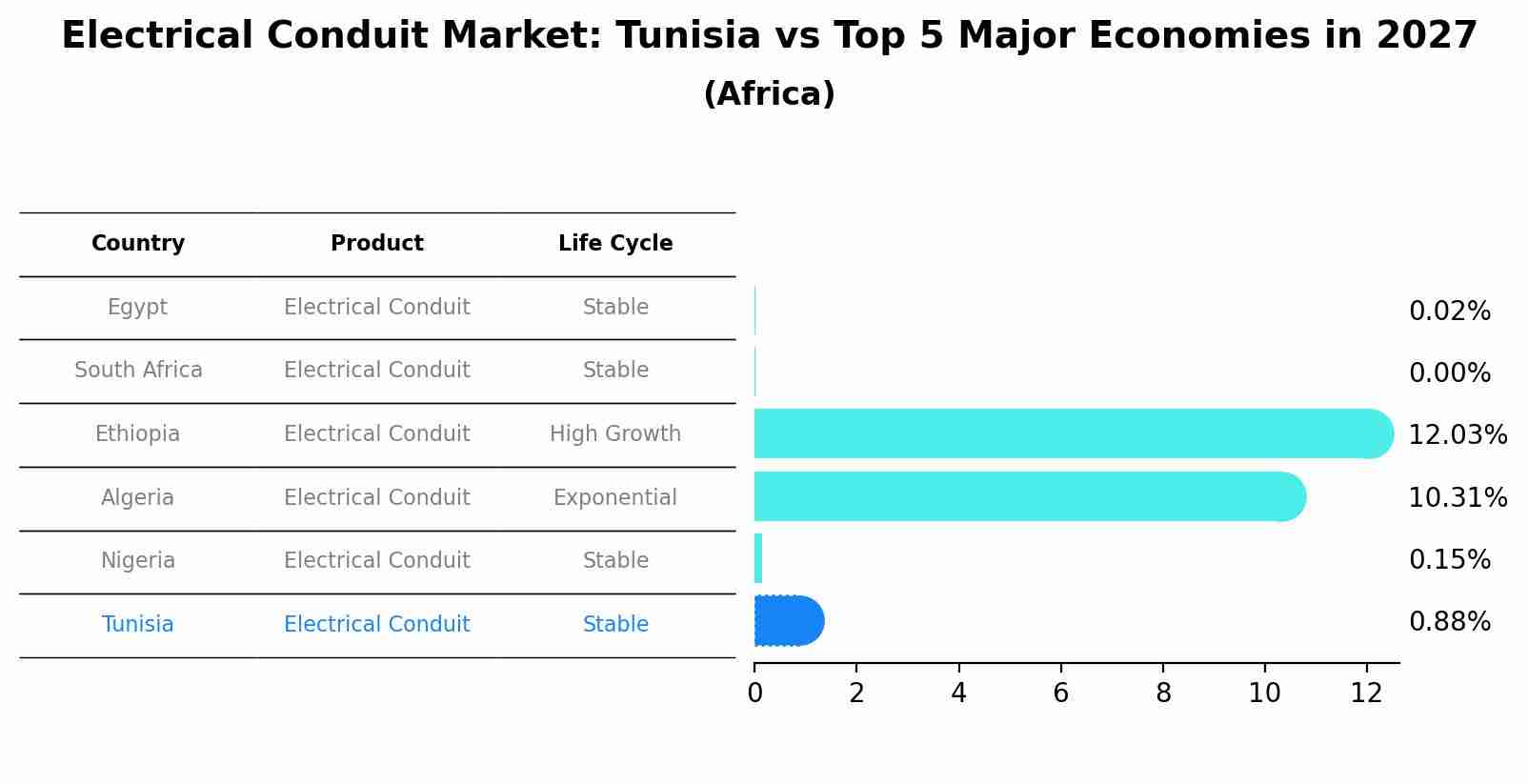
Electrical Conduit Market: Tunisia vs Top 5 Major Economies in 2027 (Africa)
Tunisia's Electrical Conduit market is anticipated to experience a stable growth rate of 0.88% by 2027, reflecting trends observed in the largest economy Egypt, followed by South Africa, Ethiopia, Algeria and Nigeria.
Tunisia Electrical Conduit Market Overview
The Tunisia Electrical Conduit Market is witnessing steady growth driven by increasing construction activities in residential, commercial, and industrial sectors. The demand for electrical conduits is rising due to the expansion of infrastructure projects, urbanization, and government initiatives to improve electricity access across the country. PVC conduits are the most commonly used type due to their cost-effectiveness and durability, while metal conduits are preferred for heavy-duty applications. Key players in the market include Tunisie Cables, Ouedkniss, and Sotemec, among others. The market is characterized by intense competition, technological advancements, and a focus on product innovation to meet the evolving needs of customers. Regulatory support for energy efficiency and safety standards is also influencing market dynamics.
Tunisia Electrical Conduit Market Trends
The Tunisia Electrical Conduit Market is experiencing a trend towards the adoption of more advanced and durable materials for conduit systems, such as PVC, steel, and aluminum, to meet the growing demand for reliable and long-lasting electrical infrastructure. Additionally, there is a shift towards the use of flexible conduit solutions to accommodate complex installation requirements in both residential and commercial construction projects. As the construction sector in Tunisia continues to grow, the demand for electrical conduit systems is also increasing, driving manufacturers to innovate and offer more efficient and cost-effective solutions. Furthermore, sustainability and energy efficiency are becoming key considerations, leading to the development of eco-friendly conduit materials and systems in line with global environmental standards and regulations.
Tunisia Electrical Conduit Market Challenges
In the Tunisia Electrical Conduit Market, some challenges faced include inconsistent government regulations and standards, which can create uncertainty for manufacturers and distributors. Additionally, the market is highly fragmented with numerous small and medium-sized players, leading to intense competition and pricing pressures. Limited awareness and adoption of advanced conduit technologies and materials also pose a challenge in the market. Moreover, the economic instability in the region can impact overall investment in infrastructure projects, affecting the demand for electrical conduit products. Addressing these challenges will require industry players to focus on innovation, compliance with evolving regulations, enhancing product quality, and educating customers on the benefits of modern conduit solutions.
Tunisia Electrical Conduit Market Investment Opportunities
The Tunisia Electrical Conduit Market presents promising investment opportunities due to the country`s increasing focus on infrastructure development and construction projects. With the growing demand for electricity and the need for safe and efficient electrical wiring systems, there is a rising demand for electrical conduits in Tunisia. Investors can explore opportunities in manufacturing and supplying electrical conduits to meet this demand, as well as investing in distribution channels to reach a wider customer base. Additionally, there is potential for innovation and the introduction of advanced technologies in the sector to enhance product quality and efficiency. Overall, investing in the Tunisia Electrical Conduit Market can be a strategic move for those looking to capitalize on the country`s infrastructure development and growing electrical industry.
Tunisia Electrical Conduit Market Government Policy
Government policies related to the Tunisia Electrical Conduit Market include adherence to safety and quality standards set by regulatory bodies, such as the Tunisian Standards Institute (INNORPI). These regulations aim to ensure that electrical conduits meet specific requirements for durability, fire resistance, and performance. Additionally, the government has implemented initiatives to promote the use of sustainable and energy-efficient materials in construction projects, which may impact the demand for eco-friendly conduit materials. Import regulations and tariffs are also in place to regulate the importation of electrical conduits, with a focus on supporting local manufacturers and ensuring product quality. Overall, the government`s policies in Tunisia aim to promote a competitive market while ensuring the safety and quality of electrical conduit products.
Tunisia Electrical Conduit Market Future Outlook
The Tunisia Electrical Conduit Market is expected to witness steady growth in the coming years due to increasing urbanization, infrastructure development, and rising demand for electricity. The market is likely to be driven by ongoing government initiatives to improve the country`s electrical infrastructure, as well as investments in renewable energy projects. Additionally, the growing awareness about the importance of electrical safety and regulations mandating the use of conduits in construction projects will further boost market growth. However, factors such as economic uncertainties and fluctuations in raw material prices may pose challenges to market expansion. Overall, with the construction sector continuing to grow and modernize, the Tunisia Electrical Conduit Market is anticipated to experience positive growth prospects in the foreseeable future.
Key Highlights of the Report:
- Tunisia Electrical Conduit Market Outlook
- Market Size of Tunisia Electrical Conduit Market, 2021
- Forecast of Tunisia Electrical Conduit Market, 2031
- Historical Data and Forecast of Tunisia Electrical Conduit Revenues & Volume for the Period 2018 - 2031
- Tunisia Electrical Conduit Market Trend Evolution
- Tunisia Electrical Conduit Market Drivers and Challenges
- Tunisia Electrical Conduit Price Trends
- Tunisia Electrical Conduit Porter's Five Forces
- Tunisia Electrical Conduit Industry Life Cycle
- Historical Data and Forecast of Tunisia Electrical Conduit Market Revenues & Volume By Type for the Period 2018 - 2031
- Historical Data and Forecast of Tunisia Electrical Conduit Market Revenues & Volume By Rigid for the Period 2018 - 2031
- Historical Data and Forecast of Tunisia Electrical Conduit Market Revenues & Volume By Flexible for the Period 2018 - 2031
- Historical Data and Forecast of Tunisia Electrical Conduit Market Revenues & Volume By Material for the Period 2018 - 2031
- Historical Data and Forecast of Tunisia Electrical Conduit Market Revenues & Volume By Metallic for the Period 2018 - 2031
- Historical Data and Forecast of Tunisia Electrical Conduit Market Revenues & Volume By Non-metallic for the Period 2018 - 2031
- Historical Data and Forecast of Tunisia Electrical Conduit Market Revenues & Volume By End-Use Industry for the Period 2018 - 2031
- Historical Data and Forecast of Tunisia Electrical Conduit Market Revenues & Volume By Building & Construction for the Period 2018 - 2031
- Historical Data and Forecast of Tunisia Electrical Conduit Market Revenues & Volume By Industrial Manufacturing for the Period 2018 - 2031
- Historical Data and Forecast of Tunisia Electrical Conduit Market Revenues & Volume By IT & Telecommunication for the Period 2018 - 2031
- Historical Data and Forecast of Tunisia Electrical Conduit Market Revenues & Volume By Oil & Gas for the Period 2018 - 2031
- Historical Data and Forecast of Tunisia Electrical Conduit Market Revenues & Volume By Energy & Utility for the Period 2018 - 2031
- Historical Data and Forecast of Tunisia Electrical Conduit Market Revenues & Volume By Others for the Period 2018 - 2031
- Tunisia Electrical Conduit Import Export Trade Statistics
- Market Opportunity Assessment By Type
- Market Opportunity Assessment By Material
- Market Opportunity Assessment By End-Use Industry
- Tunisia Electrical Conduit Top Companies Market Share
- Tunisia Electrical Conduit Competitive Benchmarking By Technical and Operational Parameters
- Tunisia Electrical Conduit Company Profiles
- Tunisia Electrical Conduit Key Strategic Recommendations






































