Tunisia Energy Security Market Size & Growth Rate (2026-2032)
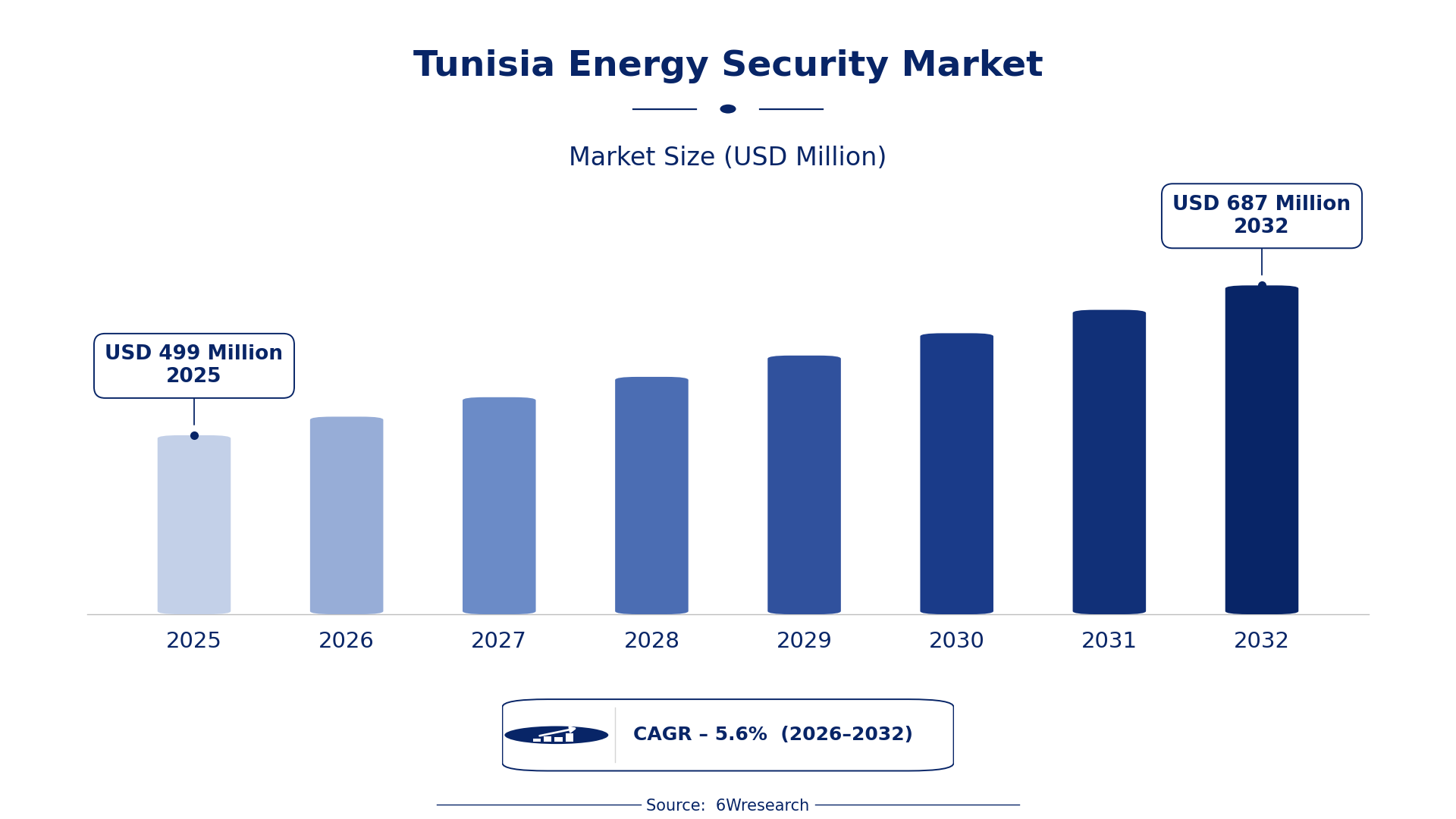
The Tunisia Energy Security Market was estimated at USD 499 Million in 2025 and is projected to reach USD 687 Million by 2032, growing at a CAGR of 5.6% from 2026 to 2032.
Tunisia Energy Security Market Synopsis
The pressing need for energy diversification stands at the forefront of the Tunisia Energy Security Market. With heavy reliance on imported resources, the country is actively seeking alternatives to bolster its energy independence and resilience against external shocks.
Government initiatives aimed at promoting renewable energy sources are reshaping market dynamics. Investments in solar and wind power are rising, as Tunisia aims to not only meet its growing energy demand but also enhance sustainability and environmental responsibility.
Tunisia Energy Security Market Year-wise Growth Rate and Key Drivers
This graph illustrates the annual growth rates of the Tunisia Energy Security Market from 2021 to 2032, highlighting a steady upward trajectory and projected expansion over the forecast period.
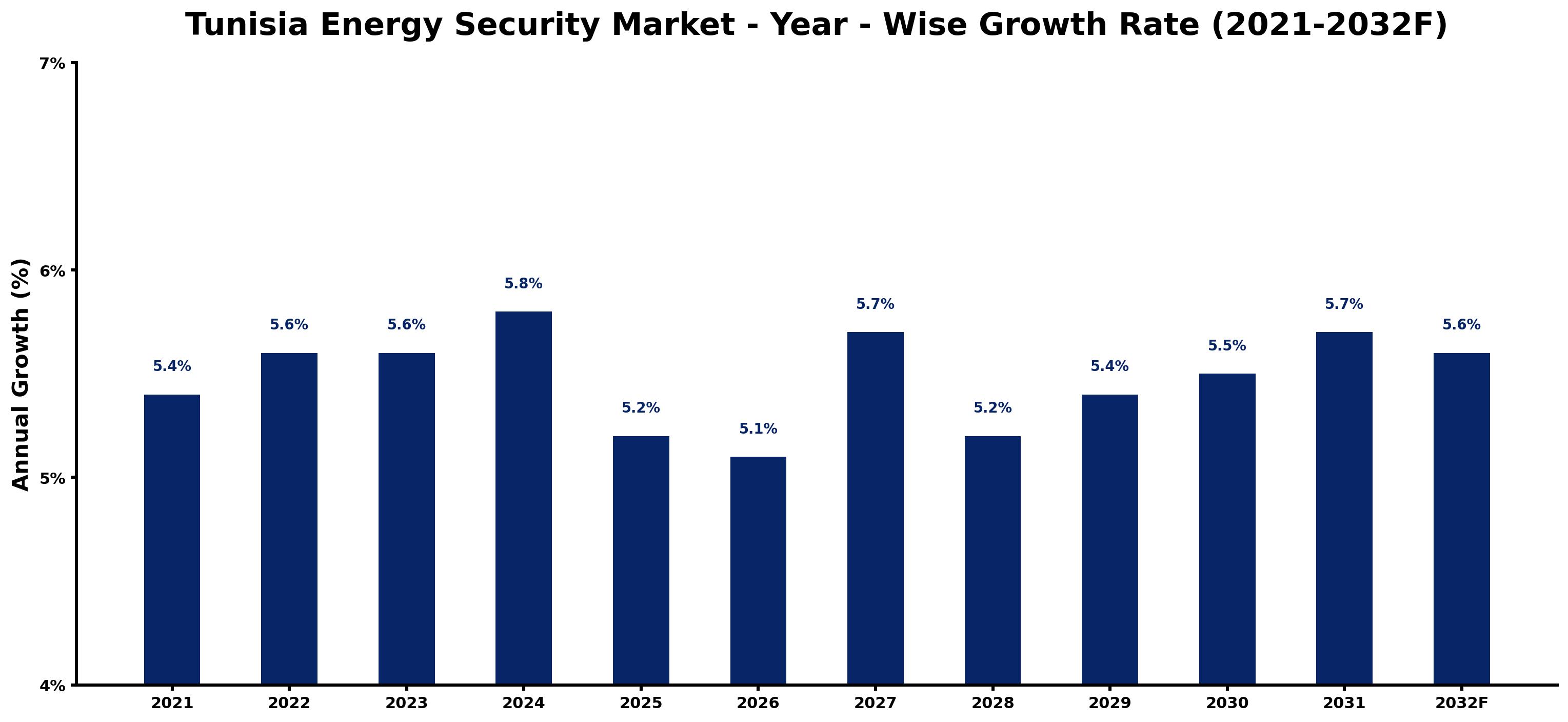
The table below presents the year‑wise growth rates along with the key drivers influencing the market
| Year | Growth Rate | Major Drivers |
| 2021 | 5.4% | Increased investments in solar energy by local startups. |
| 2022 | 5.6% | Government incentives for renewable energy technology adoption. |
| 2023 | 5.6% | Enhanced regulations on energy efficiency standards implementation. |
| 2024 | 5.8% | Launch of national energy strategy promoting diversification. |
| 2025 | 5.2% | Rising consumer awareness about sustainable energy sources. |
| 2026 | 5.1% | Promotion of energy-efficient appliances by local brands. |
| 2027 | 5.7% | Implementation of new tariffs encouraging local energy production. |
| 2028 | 5.2% | Growing collaboration with international renewable energy firms. |
| 2029 | 5.4% | Increased energy security due to geopolitical stability. |
| 2030 | 5.5% | Government's commitment to reducing dependence on fossil fuels. |
| 2031 | 5.7% | Growth in local energy storage technology innovation. |
| 2032 | 5.6% | Favorable conditions for private sector investment in renewables. |
Note: Market size estimations and growth projections presented in this report are based on 6Wresearch's proprietary forecasting methodology, utilizing the latest available industry data, government publications, and primary research inputs.
Tunisia Energy Security Market Key Takeaways
Below are some of the specific key takeaways from the market, including:
- Renewable energy sources are becoming the primary focus for future investments.
- Energy efficiency measures are increasingly recognized as essential for sustainability.
- Government policies are actively encouraging the development of domestic energy production capabilities.
- There is a growing trend towards smart grid technologies to optimize energy distribution.
- Opportunities for foreign direct investment are expanding through supportive regulations.
Evaluation of Restraints in Tunisia Energy Security Market
Despite the positive developments, the Tunisia Energy Security Market grapples with significant challenges. High dependence on imported energy sources makes the nation vulnerable to market fluctuations and geopolitical tensions. Aging infrastructure further complicates matters, stifling efficiency and reliability in energy distribution. To achieve a stable energy future, Tunisia must address these systemic weaknesses through substantial investment and regulatory reform.
Tunisia Energy Security Market Trends
Current trends highlight a vigorous shift towards renewable energy, particularly solar and wind power, with the government spearheading initiatives to attract investments in these sectors. Concurrently, advancements in energy efficiency technologies and smart grid implementations are gaining traction. on top of that, exploration efforts for domestic natural gas reserves may further diversify the energy mix and enhance energy security.
Tunisia Energy Security Market Opportunities
The market presents significant investment opportunities, especially in renewable energy sectors. As Tunisia commits to increasing its renewable energy share, avenues for investment in infrastructure development, such as smart grid technology and energy storage systems, are expanding. Foreign investors may find lucrative options through public-private partnerships aimed at enhancing energy independence and efficiency.
Government Initiatives in the Tunisia Energy Security Market
Government policy in Tunisia is actively directed towards reducing energy imports and fostering domestic energy production. With regulations designed to stimulate renewable energy projects and bolster energy efficiency, the government emphasizes sustainability as a core priority. This regulatory framework is crucial in attracting investment and shaping a resilient energy future for the country.
- A recently completed initiative includes the launch of a solar energy project aimed at generating 1 GW of capacity, enhancing local energy production.
- A current initiative is the rollout of smart grid technology, expected to optimize energy distribution efficiency and reliability, ongoing since early 2025.
- A planned public-private partnership initiative aims to develop a comprehensive wind farm project set for 2027, increasing the renewable energy share.
- Current government incentives promote energy efficiency upgrades across residential and commercial sectors, implemented since late 2024.
- The regulatory framework introduced in 2025 focuses on billing transparency and supports renewable energy integration into the grid.
Future Insights of the Tunisia Energy Security Market
Looking ahead to 2026-2032, the Tunisia Energy Security Market is set to transform. A steadfast commitment to renewable energy development will redefine the energy mix, gradually decreasing dependence on fossil fuels. The government's ongoing reforms and increased infrastructure investments will pave the way for a more sustainable and secure energy future, while also addressing vulnerabilities in the current system.
Tunisia Energy Security Market Latest Developments
Over the past 12-14 months, the Tunisia Energy Security Market has witnessed considerable activity, reflecting an urgency to enhance energy independence and sustainability. Various initiatives have emerged, showcasing a collective push towards renewable energy and modernization of existing infrastructure.
- A major initiative that began in early 2025 focuses on upgrading existing electricity transmission lines to improve reliability and capacity.
- A partnership between local energy firms was established in Q2 2025 to fund the construction of new solar parks, currently in the development phase.
- Ongoing discussions are underway for a planned geothermal energy project expected to kick off in mid-2026, diversifying energy sources.
- A service upgrade initiative that began in late 2024 aims to enhance smart metering across residential areas, currently being rolled out.
- A recent policy amendment in Q1 2025 streamlines the licensing process for renewable energy projects, simplifying market entry for investors.
Tunisia Energy Security Market - Key Attractiveness of the Report
- 10 Years of Market Numbers
- Historical Data Starting from 2022 to 2025
- Base Year: 2025
- Forecast Data until 2032
- Key Performance Indicators Impacting the Market
- Major Upcoming Developments and Projects
Key Highlights of the Report:
- Tunisia Energy Security Market Outlook
- Market Size of Tunisia Energy Security Market, 2025
- Forecast of Tunisia Energy Security Market, 2032
- Historical Data and Forecast of Tunisia Energy Security Revenues & Volume for the Period 2022-2032F
- Tunisia Energy Security Market Trend Evolution
- Tunisia Energy Security Market Drivers and Challenges
- Tunisia Energy Security Price Trends
- Tunisia Energy Security Porter's Five Forces
- Tunisia Energy Security Industry Life Cycle
- Historical Data and Forecast of Tunisia Energy Security Market Revenues & Volume By Power Plants for the Period 2022-2032F
- Historical Data and Forecast of Tunisia Energy Security Market Revenues & Volume By Nuclear for the Period 2022-2032F
- Historical Data and Forecast of Tunisia Energy Security Market Revenues & Volume By Thermal for the Period 2022-2032F
- Historical Data and Forecast of Tunisia Energy Security Market Revenues & Volume By Hydro for the Period 2022-2032F
- Historical Data and Forecast of Tunisia Energy Security Market Revenues & Volume By Oil for the Period 2022-2032F
- Historical Data and Forecast of Tunisia Energy Security Market Revenues & Volume By Gas for the Period 2022-2032F
- Historical Data and Forecast of Tunisia Energy Security Market Revenues & Volume By Renewable Energy for the Period 2022-2032F
- Historical Data and Forecast of Tunisia Energy Security Market Revenues & Volume By Technologies for the Period 2022-2032F
- Historical Data and Forecast of Tunisia Energy Security Market Revenues & Volume By Physical for the Period 2022-2032F
- Historical Data and Forecast of Tunisia Energy Security Market Revenues & Volume By Network Security for the Period 2022-2032F
- Tunisia Energy Security Import Export Trade Statistics
- Market Opportunity Assessment By Power Plants
- Market Opportunity Assessment By Technologies
- Tunisia Energy Security Top Companies Market Share
- Tunisia Energy Security Competitive Benchmarking By Technical and Operational Parameters
- Tunisia Energy Security Company Profiles
- Tunisia Energy Security Key Strategic Recommendations






































