Tunisia Fans and Ventilators Market Summary
The tunisia fans and ventilators market was estimated at USD 150 Million in 2025 and is projected to reach USD 202 Million by 2032, growing at a CAGR of 4.9% from 2026 to 2032.
Tunisia Fans and Ventilators Market Year-wise Growth Rate and Key Drivers
This graph highlights how the Tunisia Fans and Ventilators Market has steadily grown over the past five years, supported by major growth factors.
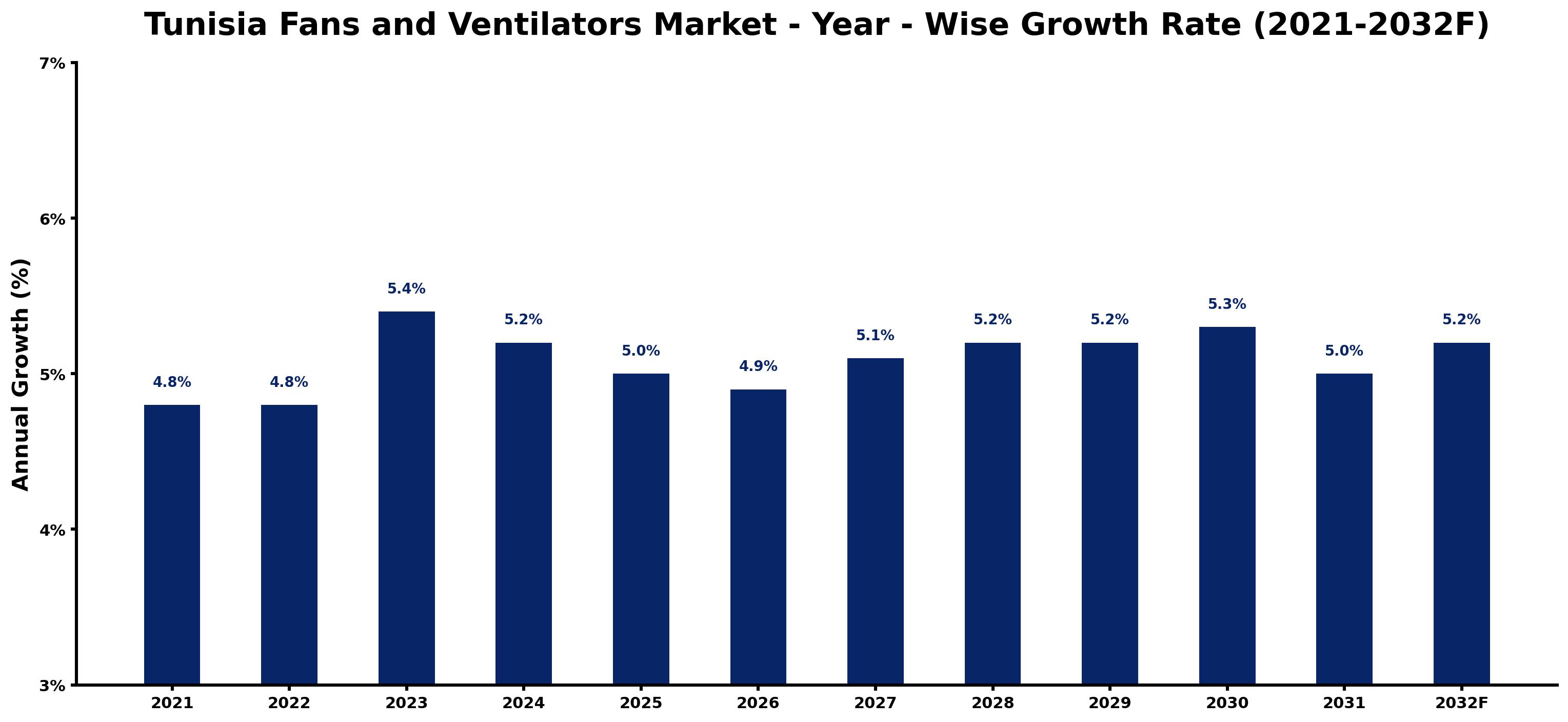
The table below presents the year wise growth rates along with the key drivers influencing the market
| Year | Growth Rate | Major Drivers |
| 2021 | 4.8% | Post-lockdown retail projects boosted consumer spending, enhancing ventilation system needs. |
| 2022 | 4.8% | Weather patterns emphasized the necessity for better indoor climate control solutions. |
| 2023 | 5.4% | Technological enhancements in energy efficiency attracted eco-conscious consumers towards ventilators. |
| 2024 | 5.2% | Infrastructure investments are expected to expand distribution networks for better market access. |
| 2025 | 5.0% | Local manufacturers began optimizing production processes, improving product availability and pricing. |
| 2026 | 4.9% | Consumer preferences shifted towards smart home integration, influencing ventilator functionalities. |
| 2027 | 5.1% | Health awareness campaigns highlighted air quality, driving ventilator demand for households. |
| 2028 | 5.2% | Economic recovery post-pandemic created a favorable environment for home renovation projects. |
| 2029 | 5.2% | Rising temperatures prompted discussions around sustainable cooling solutions in urban areas. |
| 2030 | 5.3% | Increased real estate developments necessitated modern ventilation solutions for new constructions. |
| 2031 | 5.0% | Urban migration trends heightened the demand for efficient cooling in densely populated zones. |
| 2032 | 5.2% | Technological collaborations are likely to introduce innovative features in traditional ventilators. |
Note - Market size estimations and growth projections presented in this report are based on 6Wresearch's advanced forecasting approach, validated with industry datasets as of June 2026.
Tunisia Fans and Ventilators Market Synopsis
The Tunisia Fans and Ventilators Market is projected to reach 4.9% and witness significant growth during the forecast period (2026-2032). This sector comprises a diverse range of devices designed to circulate air and improve ventilation across residential, commercial, and industrial environments. As urbanization intensifies and the demand for effective air quality management rises, the market is evolving to meet the needs of end users seeking efficient air circulation solutions.
Tunisia Fans and Ventilators Market Growth Drivers
The growth of the Tunisia Fans and Ventilators Market is primarily driven by several interrelated factors. Firstly, the increasing urbanization and population density in cities create a pressing need for improved indoor air quality. Secondly, the rising awareness of health and comfort in residential and commercial spaces propels the demand for advanced ventilation systems. Thirdly, technological advancements focused on energy efficiency and reduced noise levels are significantly enhancing the appeal of modern fans and ventilators. Fourthly, rising construction activities in both residential and commercial sectors are providing a solid foundation for market expansion. Lastly, the cooling needs during the hot summer months drive consistent sales within this market.
Tunisia Fans and Ventilators Market Trends and Opportunities
Several trends are shaping the Tunisia Fans and Ventilators Market landscape. One notable trend is the growing preference for smart ventilation systems that integrate with home automation technologies, offering consumers enhanced control over their environments. Furthermore, environmentally-friendly and energy-efficient models are gaining traction as consumers become more conscious of their carbon footprint. There is also an increasing trend towards multifunctional appliances, where fans and ventilators are designed not only for circulation but also for air purification. Additionally, the expansion of e-commerce platforms is providing easy access to a broader range of products, catering to the diverse needs of consumers across Tunisia. The convergence of these trends creates substantial opportunities for growth and innovation within the market.
Tunisia Fans and Ventilators Market Challenges and Restraints
Despite its growth potential, the Tunisia Fans and Ventilators Market faces several challenges. Energy efficiency standards pose a significant hurdle for manufacturers, requiring constant innovation to comply with regulations while maintaining performance. Additionally, noise regulations dictate the design and functionality of products, compelling companies to invest in quieter technologies. The need for sustainable designs that do not compromise performance can strain resources and increase operational costs. Furthermore, addressing consumer concerns regarding the durability and reliability of products is critical for retaining market trust. Finally, fluctuating material costs can impact pricing strategies and affect profitability across the supply chain.
Tunisia Fans and Ventilators Market Government Investment and Initiatives
Government policy plays a crucial role in shaping the Tunisia Fans and Ventilators Market. Initiatives aimed at promoting energy-efficient products include stringent regulations to enforce performance standards and investment incentives for local manufacturing. Such policies encourage manufacturers to develop and introduce innovative, energy-saving solutions to the market. Additionally, public awareness campaigns on energy conservation are vital for educating consumers about the advantages of selecting energy-efficient fans and ventilators. By fostering a conducive environment for innovation and compliance, the government aims to enhance the overall market landscape and drive sustainable economic growth in this sector.
Tunisia Fans and Ventilators Market Latest Developments (May 2025 - June 2026)
The Tunisia Fans and Ventilators Market is witnessing dynamic changes, particularly in the wake of technological advancements and evolving consumer preferences. During the period from May 2025 to June 2026, there has been a noticeable shift towards eco-friendly products, with manufacturers increasingly focusing on energy-efficient solutions that align with global sustainability goals. Moreover, the advent of smart home technologies is driving the integration of advanced monitoring systems in ventilation products. Concurrently, ongoing research and development efforts are enhancing the performance and efficiency of existing models. Additionally, collaborations among industry stakeholders are fostering innovation, enabling faster adaptation to market demands and regulatory changes.
Tunisia Fans and Ventilators Market - Key Attractiveness of the Report
- 10 Years of Market Numbers
- Historical Data Starting from 2022 to 2025
- Base Year: 2025
- Forecast Data until 2032
- Key Performance Indicators Impacting the Market
- Major Upcoming Developments and Projects
Q1: What are the primary factors driving the growth of the Tunisia Fans and Ventilators Market?
Q2: What challenges does the Tunisia Fans and Ventilators Market face?
Q3: How is the government influencing the Tunisia Fans and Ventilators Market?
Q4: What trends are currently shaping the Tunisia Fans and Ventilators Market?
Key Highlights of the Report:
- Tunisia Fans and Ventilators Market Outlook
- Market Size of Tunisia Fans and Ventilators Market, 2025
- Forecast of Tunisia Fans and Ventilators Market, 2032
- Historical Data and Forecast of Tunisia Fans and Ventilators Revenues & Volume for the Period 2022-2032F
- Tunisia Fans and Ventilators Market Trend Evolution
- Tunisia Fans and Ventilators Market Drivers and Challenges
- Tunisia Fans and Ventilators Price Trends
- Tunisia Fans and Ventilators Porter's Five Forces
- Tunisia Fans and Ventilators Industry Life Cycle
- Historical Data and Forecast of Tunisia Fans and Ventilators Market Revenues & Volume By Material for the Period 2022-2032F
- Historical Data and Forecast of Tunisia Fans and Ventilators Market Revenues & Volume By Metal for the Period 2022-2032F
- Historical Data and Forecast of Tunisia Fans and Ventilators Market Revenues & Volume By Composite for the Period 2022-2032F
- Historical Data and Forecast of Tunisia Fans and Ventilators Market Revenues & Volume By Rubber for the Period 2022-2032F
- Historical Data and Forecast of Tunisia Fans and Ventilators Market Revenues & Volume By Plastic for the Period 2022-2032F
- Historical Data and Forecast of Tunisia Fans and Ventilators Market Revenues & Volume By Application for the Period 2022-2032F
- Historical Data and Forecast of Tunisia Fans and Ventilators Market Revenues & Volume By Interior for the Period 2022-2032F
- Historical Data and Forecast of Tunisia Fans and Ventilators Market Revenues & Volume By Exterior for the Period 2022-2032F
- Historical Data and Forecast of Tunisia Fans and Ventilators Market Revenues & Volume By Structural for the Period 2022-2032F
- Historical Data and Forecast of Tunisia Fans and Ventilators Market Revenues & Volume By Powertrain for the Period 2022-2032F
- Historical Data and Forecast of Tunisia Fans and Ventilators Market Revenues & Volume By Vehicle Types for the Period 2022-2032F
- Historical Data and Forecast of Tunisia Fans and Ventilators Market Revenues & Volume By Passenger Vehicles for the Period 2022-2032F
- Historical Data and Forecast of Tunisia Fans and Ventilators Market Revenues & Volume By Light Commercial Vehicles for the Period 2022-2032F
- Historical Data and Forecast of Tunisia Fans and Ventilators Market Revenues & Volume By Heavy Commercial Vehicles for the Period 2022-2032F
- Tunisia Fans and Ventilators Import Export Trade Statistics
- Market Opportunity Assessment By Material
- Market Opportunity Assessment By Application
- Market Opportunity Assessment By Vehicle Types
- Tunisia Fans and Ventilators Top Companies Market Share
- Tunisia Fans and Ventilators Competitive Benchmarking By Technical and Operational Parameters
- Tunisia Fans and Ventilators Company Profiles
- Tunisia Fans and Ventilators Key Strategic Recommendations






































