Tunisia Food & Grocery Retail Market Size, Share & Growth Rate
The Tunisia Food & Grocery Retail Market was estimated at USD 861 Million in 2025 and is projected to reach USD 1525 Million by 2032, growing at a CAGR of 8.5% from 2026 to 2032. This growth trajectory is largely supported by a combination of rising disposable incomes, increasing urbanization, and a shift in consumer preferences towards convenience and quality. As the middle class expands and consumers become more health-conscious, the demand for a diverse range of food and grocery products continues to flourish.
Tunisia Food & Grocery Retail Market Year-wise Growth Rate and Key Drivers
This graph highlights how the Tunisia Food & Grocery Retail Market has steadily grown over the years, supported by major growth factors.
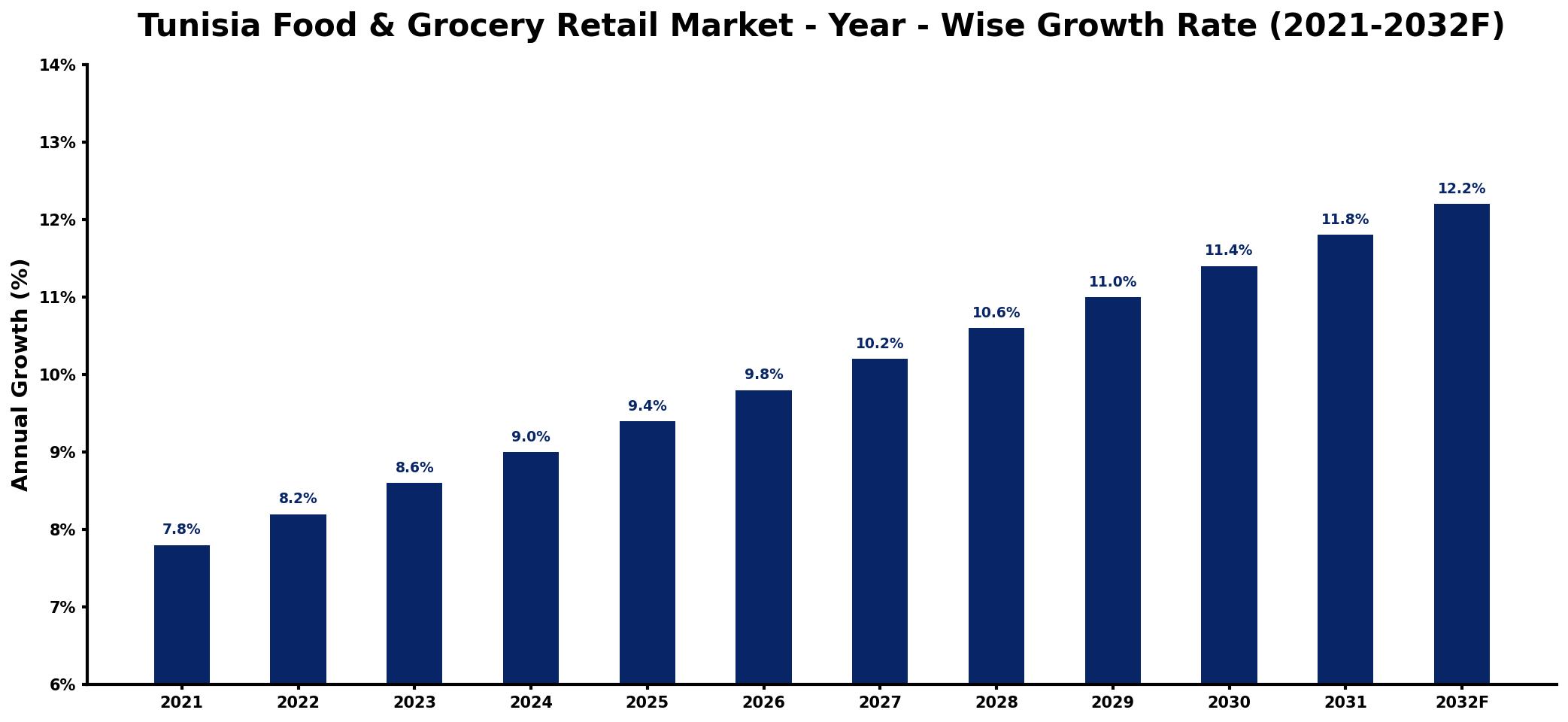
The table below presents the year‑wise growth rates along with the key drivers influencing the market
| Year | Growth Rate | Major Drivers |
| 2021 | 7.8% | Rising consumer spending habits |
| 2022 | 8.2% | Increased urban population growth |
| 2023 | 8.6% | Expansion of modern distribution channels |
| 2024 | 9.0% | Growing health consciousness among consumers |
| 2025 | 9.4% | Investment in local production capabilities |
| 2026 | 9.8% | Emergence of e-commerce platforms |
| 2027 | 10.2% | Adoption of sustainable practices |
| 2028 | 10.6% | Diversification of product offerings |
| 2029 | 11.0% | Strengthening of supply chain networks |
| 2030 | 11.4% | Enhancement of digital payment solutions |
| 2031 | 11.8% | Improvement in logistics infrastructure |
| 2032 | 12.2% | Growth of private label brands |
Note: Market size estimations and growth projections presented in this report are based on 6Wresearch's proprietary forecasting methodology, utilizing the latest available industry data, government publications, and primary research inputs.
Tunisia Food & Grocery Retail Market Synopsis
Recent momentum in the Tunisia Food & Grocery Retail Market reflects a dynamic shift towards modern retail formats and an appetite for healthier options. As traditional markets coexist with expanding supermarkets and convenience stores, consumers are increasingly drawn to the variety and convenience that modern retail channels offer.
Looking ahead, the market is expected to evolve further, with digital channels and online grocery shopping becoming increasingly relevant. This transition indicates a move towards a more tech-savvy consumer base, which retailers must cater to in order to remain competitive.
- The market is characterized by a diverse product range, including fresh produce and packaged foods.
- Growing urbanization and rising disposable incomes are key drivers of market expansion.
- Consumer preferences are shifting towards healthier, organic, and sustainable products.
- Competition among retailers is intensifying, leading to innovations in customer experience and product offerings.
- Investments in technology and logistics are essential for enhancing supply chain efficiency.
Despite the growth prospects, the Tunisia Food & Grocery Retail Market faces notable challenges that could hinder its momentum. Intense competition from both local and international retailers has resulted in price wars, straining profit margins and creating a tough environment for smaller players. Furthermore, fluctuations in food prices driven by external factors can destabilize retailers' revenues, particularly when combined with logistical inefficiencies inherent in reaching rural markets. Regulatory hurdles add another layer of complexity, potentially slowing down market entry and expansion efforts for ambitious retailers.
A few key trends are currently shaping the landscape of the Tunisia Food & Grocery Retail Market. There is a notable increase in consumer demand for healthier and organic products, driven by heightened health consciousness. This trend is complemented by a growing preference for convenience, leading to a surge in popularity for ready-to-eat meals and on-the-go snacks. Additionally, the rise of online grocery shopping reflects a significant shift towards digital retail channels, prompting retailers to enhance their e-commerce capabilities.
The Tunisia Food & Grocery Retail Market presents numerous investment opportunities, particularly in modern retail formats such as supermarkets and convenience stores. These formats are well-positioned to meet the rising consumer demand for quality and variety. Specialty stores focused on organic and health-oriented products are also gaining traction, as are online grocery platforms that cater to tech-savvy consumers. Furthermore, improving logistics and supply chain efficiency through technological investments could provide a strategic advantage, capitalizing on the market's growth potential.
The Tunisian government has introduced several policies aimed at regulating the Food & Grocery Retail Market. These initiatives focus on enforcing food safety standards and licensing requirements, ensuring that consumers have access to high-quality products. There are also programs designed to support local producers and promote healthy eating habits. Additionally, the government encourages innovation and the adoption of technology within the sector, reinforcing its commitment to fostering a competitive market environment.
Looking ahead to 2026-2032, the Tunisia Food & Grocery Retail Market is poised for significant growth fueled by urbanization, rising incomes, and a shift towards online retailing. As digital adoption continues to accelerate, traditional shopping paradigms are expected to evolve, creating new touchpoints for consumers. Retailers will need to be agile, focusing on product innovation and sustainability to thrive in this changing landscape. With the government supporting sector growth through favorable policies, the market is well-positioned for steady expansion.
Recent developments in the Tunisia Food & Grocery Retail Market highlight a growing emphasis on sustainability and ethical sourcing. Retailers are increasingly adopting practices aimed at reducing their environmental impact, responding to consumer demand for responsible products. Furthermore, partnerships between local producers and retailers are on the rise, fostering a sense of community and supporting the local economy. These trends indicate a shift toward a more collaborative and conscious retail environment.
- 10 Years of Market Numbers
- Historical Data Starting from 2022 to 2025
- Base Year: 2025
- Forecast Data until 2032
- Key Performance Indicators Impacting the Market
- Major Upcoming Developments and Projects
Key Highlights of the Report:
- Tunisia Food & Grocery Retail Market Outlook
- Market Size of Tunisia Food & Grocery Retail Market, 2025
- Forecast of Tunisia Food & Grocery Retail Market, 2032
- Historical Data and Forecast of Tunisia Food & Grocery Retail Revenues & Volume for the Period 2022-2032F
- Tunisia Food & Grocery Retail Market Trend Evolution
- Tunisia Food & Grocery Retail Market Drivers and Challenges
- Tunisia Food & Grocery Retail Price Trends
- Tunisia Food & Grocery Retail Porter's Five Forces
- Tunisia Food & Grocery Retail Industry Life Cycle
- Historical Data and Forecast of Tunisia Food & Grocery Retail Market Revenues & Volume By Product for the Period 2022-2032F
- Historical Data and Forecast of Tunisia Food & Grocery Retail Market Revenues & Volume By Fresh Food for the Period 2022-2032F
- Historical Data and Forecast of Tunisia Food & Grocery Retail Market Revenues & Volume By Frozen Food for the Period 2022-2032F
- Historical Data and Forecast of Tunisia Food & Grocery Retail Market Revenues & Volume By Food Cupboard for the Period 2022-2032F
- Historical Data and Forecast of Tunisia Food & Grocery Retail Market Revenues & Volume By Beverages for the Period 2022-2032F
- Historical Data and Forecast of Tunisia Food & Grocery Retail Market Revenues & Volume By Cleaning & Household for the Period 2022-2032F
- Historical Data and Forecast of Tunisia Food & Grocery Retail Market Revenues & Volume By Others for the Period 2022-2032F
- Historical Data and Forecast of Tunisia Food & Grocery Retail Market Revenues & Volume By Distribution Channel for the Period 2022-2032F
- Historical Data and Forecast of Tunisia Food & Grocery Retail Market Revenues & Volume By Supermarkets & Hypermarkets for the Period 2022-2032F
- Historical Data and Forecast of Tunisia Food & Grocery Retail Market Revenues & Volume By Convenience Stores for the Period 2022-2032F
- Historical Data and Forecast of Tunisia Food & Grocery Retail Market Revenues & Volume By Departmental Stores & Clubs for the Period 2022-2032F
- Historical Data and Forecast of Tunisia Food & Grocery Retail Market Revenues & Volume By Online for the Period 2022-2032F
- Tunisia Food & Grocery Retail Import Export Trade Statistics
- Market Opportunity Assessment By Product
- Market Opportunity Assessment By Distribution Channel
- Tunisia Food & Grocery Retail Top Companies Market Share
- Tunisia Food & Grocery Retail Competitive Benchmarking By Technical and Operational Parameters
- Tunisia Food & Grocery Retail Company Profiles
- Tunisia Food & Grocery Retail Key Strategic Recommendations






































