Tunisia Gas Sensors Market Size, Share & Growth Rate
The Tunisia Gas Sensors Market was estimated at USD 163 Million in 2025 and is projected to reach USD 225 Million by 2032, growing at a CAGR of 4.7% from 2026 to 2032. This growth trajectory is fueled by an escalating need for emissions control, particularly within the automotive industry, as well as heightened regulatory compliance mandates. Furthermore, the oil and gas sector's reliance on advanced gas sensing technologies is significantly contributing to market expansion.
Tunisia Gas Sensors Market Year-wise Growth Rate and Key Drivers
This graph highlights how the Tunisia Gas Sensors Market has steadily grown over the years, supported by major growth factors.
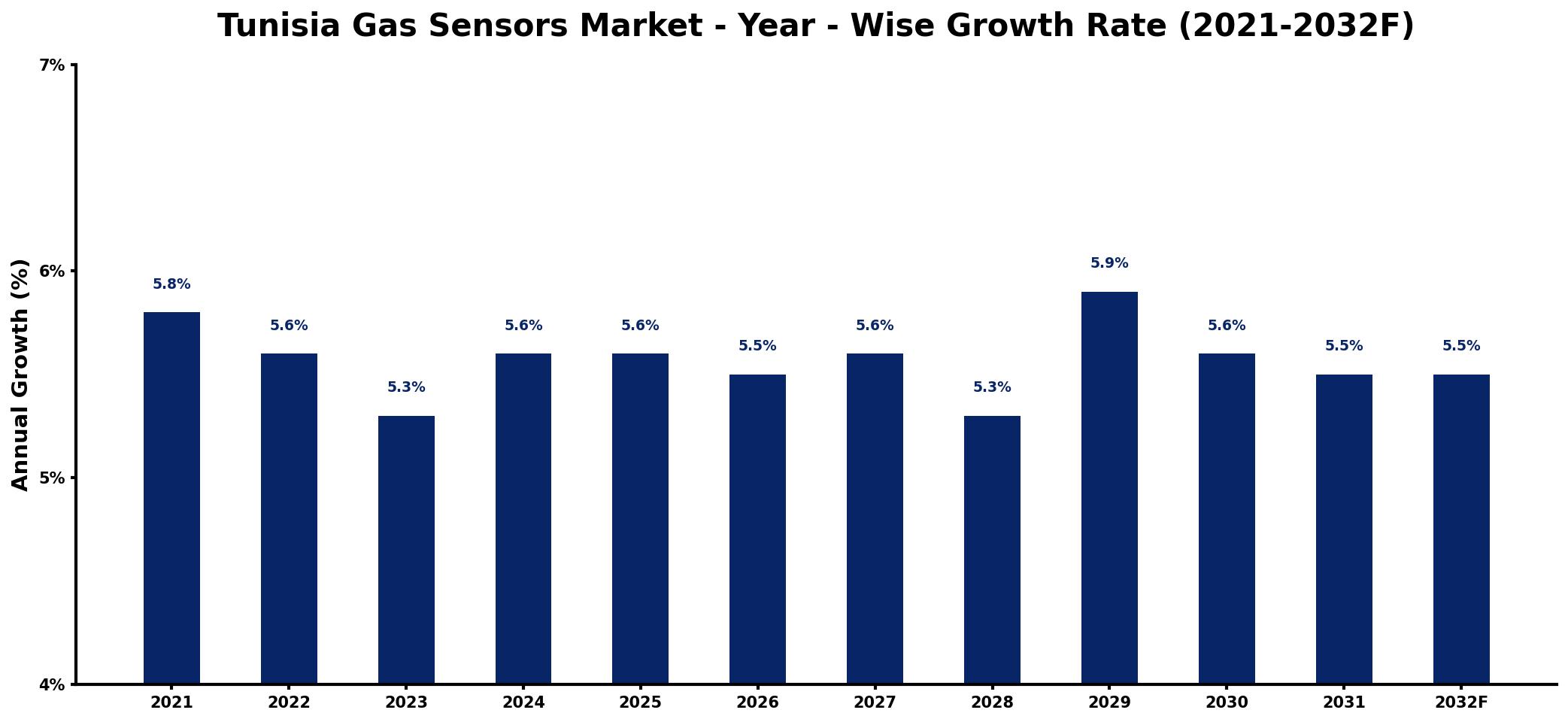
The table below presents the year‑wise growth rates along with the key drivers influencing the market
| Year | Growth Rate | Major Drivers |
| 2021 | 5.8% | Increased industrial safety regulations |
| 2022 | 5.6% | Growth in environmental monitoring initiatives |
| 2023 | 5.3% | Expansion of renewable energy projects |
| 2024 | 5.6% | Rising demand for smart technologies |
| 2025 | 5.6% | Investment in urban infrastructure development |
| 2026 | 5.5% | Enhancements in public health standards |
| 2027 | 5.6% | Focus on industrial automation trends |
| 2028 | 5.3% | Emergence of new industrial sectors |
| 2029 | 5.9% | Growing awareness of air quality |
| 2030 | 5.6% | Development of transportation networks |
| 2031 | 5.5% | Increased governmental funding programs |
| 2032 | 5.5% | Advancements in research and innovation |
Note: Market size estimations and growth projections presented in this report are based on 6Wresearch's proprietary forecasting methodology, utilizing the latest available industry data, government publications, and primary research inputs.
Tunisia Gas Sensors Market Synopsis
The demand for gas sensors in Tunisia is increasingly driven by industrialization and a focus on environmental monitoring. The automotive sector is witnessing a surge in the adoption of gas sensors, highlighting their vital role in safety features and emissions control technologies.
Moreover, as Tunisia pursues smart city initiatives, there is a growing integration of Internet of Things (IoT) applications, further enhancing the relevance and necessity of advanced gas sensors across diverse industries. This trend is set to play a pivotal role in shaping the future landscape of the market.
Tunisia Gas Sensors Market Key Takeaways
- The market is anticipated to grow steadily, with a notable contribution from the automotive and oil & gas sectors.
- Adoption of advanced sensing technologies is crucial for accurate and real-time detection of various gases.
- Integration with IoT technology is enhancing remote monitoring and control capabilities.
- Regulatory pressures are propelling the demand for enhanced workplace safety and environmental compliance.
- Innovative solutions focusing on miniaturization and low-power consumption are increasingly entering the market.
Evaluation of Restraints in Tunisia Gas Sensors Market
Despite the promising outlook, the Tunisia Gas Sensors Market faces several restraints that may impede growth. Limited awareness regarding the importance and application of gas sensors in various industries leads to slow adoption rates. Additionally, the absence of standardized regulations complicates compliance efforts for manufacturers and can undermine market confidence. Technical constraints in accuracy and reliability present challenges in fulfilling the diverse requirements of industries, while intense competition from both local and international players puts pressure on pricing and innovation.
Tunisia Gas Sensors Market Trends
A significant trend is the growing interest in advanced gas sensing technologies, particularly electrochemical and semiconductor sensors that provide real-time gas monitoring. The market is also witnessing a trend towards the miniaturization of devices, catering to the need for portable and wearable gas detection solutions. Additionally, the rise of smart cities and the IoT revolution are leading to innovative sensor applications, positioning the Tunisia Gas Sensors Market for transformative growth.
Tunisia Gas Sensors Market Opportunities
Investment opportunities in the Tunisia Gas Sensors Market are becoming increasingly attractive. As various sectors such as healthcare, oil & gas, and automotive emphasize the importance of environmental monitoring and workplace safety, the demand for advanced gas sensors is surging. Investors are encouraged to focus on innovative gas sensor technologies that promise improved accuracy and reliability. Moreover, the push for smart city developments opens doors for innovative solutions that leverage IoT capabilities, promising lucrative growth potential in the market.
Government Initiatives in the Tunisia Gas Sensors Market
The Tunisian government is actively promoting the adoption of gas sensors as part of broader environmental and safety regulations. Initiatives aimed at enhancing workplace safety and reducing pollution are shaping a conducive environment for market growth. Furthermore, there are measures to encourage research and development in gas sensor technology, fostering innovation and improving detection systems across industries. This regulatory support serves to bolster the market while emphasizing the importance of safety and environmental stewardship.
Future Insights of the Tunisia Gas Sensors Market
Looking ahead, the Tunisia Gas Sensors Market is expected to continue its growth momentum from 2026 to 2032. Key drivers will include heightened demand for gas detection technologies in the oil and gas, chemical, and automotive sectors, underscored by growing awareness of safety practices and stringent environmental regulations. As advancements in sensor technology emerge, including miniaturized and wireless solutions, these developments will likely stimulate further market expansion. However, challenges like initial device costs and the proliferation of counterfeit products may require ongoing vigilance and strategic market positioning.
Tunisia Gas Sensors Market Latest Developments (2025 - 2026)
Recent developments within the Tunisia Gas Sensors Market indicate a strong push towards enhancing sensor technologies, with an emphasis on accuracy and efficiency. Companies are increasingly collaborating on research initiatives to innovate in gas detection solutions. Additionally, there is a noticeable trend towards integrating smart technologies into existing gas sensor frameworks, enabling better connectivity and data analysis for end-users. This direction is expected to play a significant role in the evolution of the market landscape.
Tunisia Gas Sensors Market - Key Attractiveness of the Report
- 10 Years of Market Numbers
- Historical Data Starting from 2022 to 2025
- Base Year: 2025
- Forecast Data until 2032
- Key Performance Indicators Impacting the Market
- Major Upcoming Developments and Projects
Key Highlights of the Report:
- Tunisia Gas Sensors Market Outlook
- Market Size of Tunisia Gas Sensors Market, 2025
- Forecast of Tunisia Gas Sensors Market, 2032
- Historical Data and Forecast of Tunisia Gas Sensors Revenues & Volume for the Period 2022-2032F
- Tunisia Gas Sensors Market Trend Evolution
- Tunisia Gas Sensors Market Drivers and Challenges
- Tunisia Gas Sensors Price Trends
- Tunisia Gas Sensors Porter's Five Forces
- Tunisia Gas Sensors Industry Life Cycle
- Historical Data and Forecast of Tunisia Gas Sensors Market Revenues & Volume By Product for the Period 2022-2032F
- Historical Data and Forecast of Tunisia Gas Sensors Market Revenues & Volume By Hydrogen for the Period 2022-2032F
- Historical Data and Forecast of Tunisia Gas Sensors Market Revenues & Volume By Ammonia for the Period 2022-2032F
- Historical Data and Forecast of Tunisia Gas Sensors Market Revenues & Volume By Hydrogen Sulfide for the Period 2022-2032F
- Historical Data and Forecast of Tunisia Gas Sensors Market Revenues & Volume By Methyl Mercaptan Sensor for the Period 2022-2032F
- Historical Data and Forecast of Tunisia Gas Sensors Market Revenues & Volume By NOx Sensor for the Period 2022-2032F
- Historical Data and Forecast of Tunisia Gas Sensors Market Revenues & Volume By Carbon Monoxide Sensor for the Period 2022-2032F
- Historical Data and Forecast of Tunisia Gas Sensors Market Revenues & Volume By Carbon Dioxide Sensor for the Period 2022-2032F
- Historical Data and Forecast of Tunisia Hydrogen Gas Sensors Market Revenues & Volume By Oxygen/Lambda Sensor for the Period 2022-2032F
- Historical Data and Forecast of Tunisia Gas Sensors Market Revenues & Volume By Technology for the Period 2022-2032F
- Historical Data and Forecast of Tunisia Gas Sensors Market Revenues & Volume By Infrared for the Period 2022-2032F
- Historical Data and Forecast of Tunisia Gas Sensors Market Revenues & Volume By Catalytic for the Period 2022-2032F
- Historical Data and Forecast of Tunisia Gas Sensors Market Revenues & Volume By Photo-Ionization Detector for the Period 2022-2032F
- Historical Data and Forecast of Tunisia Gas Sensors Market Revenues & Volume By Solid State/MOS for the Period 2022-2032F
- Historical Data and Forecast of Tunisia Gas Sensors Market Revenues & Volume By Semiconductor for the Period 2022-2032F
- Historical Data and Forecast of Tunisia Gas Sensors Market Revenues & Volume By Electrochemical for the Period 2022-2032F
- Tunisia Gas Sensors Import Export Trade Statistics
- Market Opportunity Assessment By Product
- Market Opportunity Assessment By Technology
- Tunisia Gas Sensors Top Companies Market Share
- Tunisia Gas Sensors Competitive Benchmarking By Technical and Operational Parameters
- Tunisia Gas Sensors Company Profiles
- Tunisia Gas Sensors Key Strategic Recommendations






































