Tunisia Glass Tiles Market Size, Share & Growth Rate
The Tunisia Glass Tiles Market was estimated at USD 441 Million in 2025 and is projected to reach USD 600 Million by 2032, growing at a CAGR of 4.5% from 2026 to 2032. This growth trajectory is driven by a heightened interest in high-performance materials that combine aesthetic appeal with sustainability. The increasing volume of construction and renovation projects across Tunisia, coupled with a focus on modern design and environmental considerations, is fueling demand for glass tiles in both residential and commercial sectors.
Tunisia Glass Tiles Market Year-wise Growth Rate and Key Drivers
This graph highlights how the Tunisia Glass Tiles Market has steadily grown over the years, supported by major growth factors.
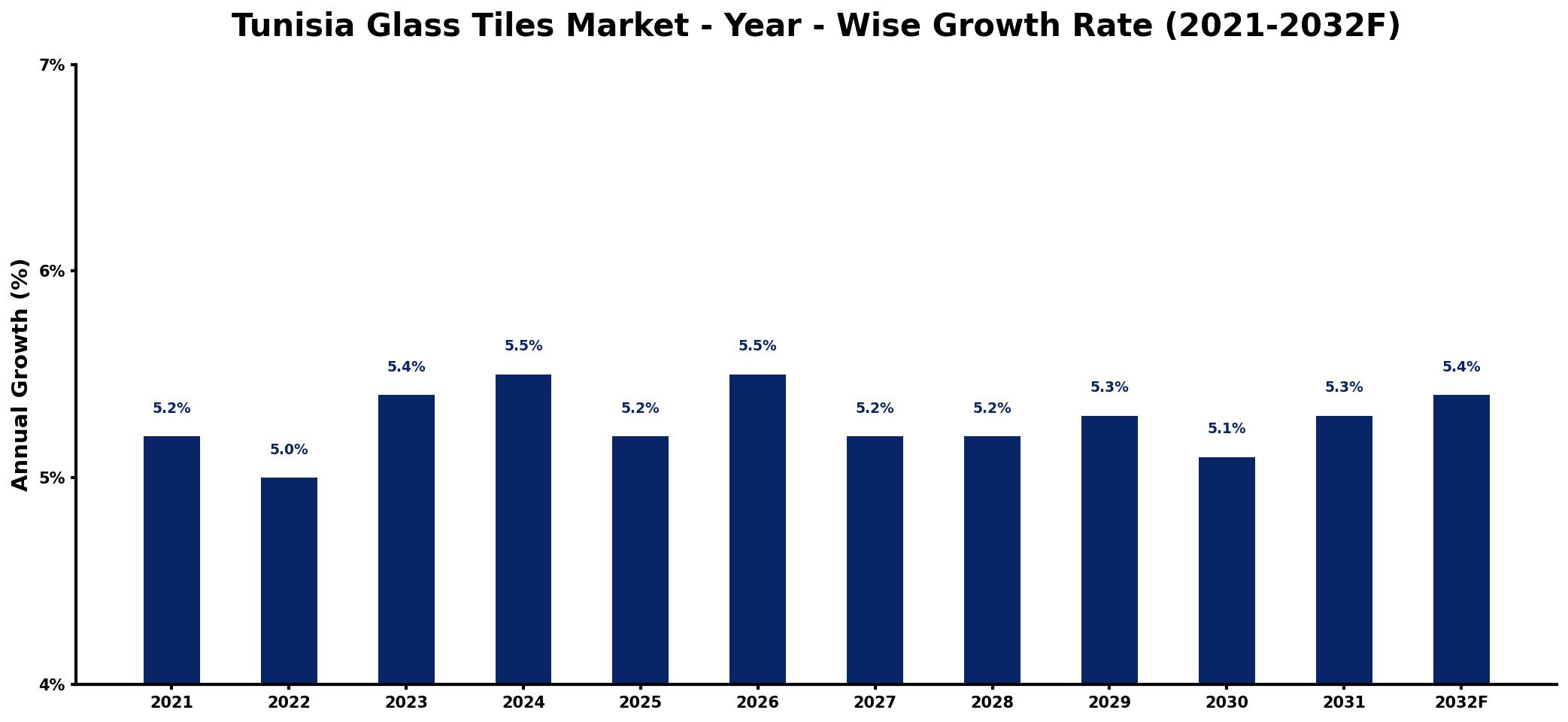
The table below presents the year‑wise growth rates along with the key drivers influencing the market
| Year | Growth Rate | Major Drivers |
| 2021 | 5.2% | Rising consumer renovation projects |
| 2022 | 5.0% | Increased demand for aesthetics |
| 2023 | 5.4% | Growth in construction sector investments |
| 2024 | 5.5% | Expansion of home improvement trends |
| 2025 | 5.2% | Surge in luxury interior designs |
| 2026 | 5.5% | Growing popularity of sustainable materials |
| 2027 | 5.2% | Increase in commercial property developments |
| 2028 | 5.2% | Boost in residential building permits |
| 2029 | 5.3% | Higher demand for eco-friendly options |
| 2030 | 5.1% | expanding healthcare application demand |
| 2031 | 5.3% | Rising interest in innovative designs |
| 2032 | 5.4% | rising demand from electronics |
Note: Market size estimations and growth projections presented in this report are based on 6Wresearch's proprietary forecasting methodology, utilizing the latest available industry data, government publications, and primary research inputs.
Tunisia Glass Tiles Market Synopsis
Recent years have witnessed a noticeable surge in the use of glass tiles across various applications in Tunisia. Their unique properties such as durability, low maintenance, and aesthetic versatility make them a preferred choice for architects and interior designers alike.
Furthermore, as the market becomes more competitive, innovations in manufacturing techniques are leading to enhanced product offerings. This evolution not only supports existing demand but also expands the potential for glass tiles in new applications within the construction industry.
Tunisia Glass Tiles Market Key Takeaways
- Robust growth expected due to rising demand for aesthetically pleasing and sustainable building materials.
- Investment in advanced manufacturing technologies is crucial for enhancing product quality and design options.
- Increasing awareness of the benefits of glass tiles among designers and builders drives market acceptance.
- Government incentives for promoting local manufacturing and sustainability are boosting industry growth.
- Challenges related to production costs necessitate continued innovation and efficiency improvements.
Evaluation of Restraints in Tunisia Glass Tiles Market
Despite the positive outlook, the Tunisia Glass Tiles Market faces several constraints that could impede growth. The high production costs associated with advanced manufacturing processes pose significant challenges for local producers. Additionally, the need for broader market acceptance remains a hurdle; many potential customers are still unfamiliar with the advantages of glass tiles compared to traditional materials. Ongoing efforts to educate stakeholders on the benefits of glass tiles and to promote their diverse applications will be essential for overcoming these barriers.
Tunisia Glass Tiles Market Trends
Currently, a trend towards sustainability is shaping the Tunisia Glass Tiles Market, with increasing interest in eco-friendly materials. Consumers are seeking products that not only look good but also contribute positively to the environment. Moreover, advances in design and technology are enabling the production of more sophisticated glass tile designs, expanding their applicability.
Additionally, the market is seeing a shift towards customization, as clients are increasingly interested in tailored solutions that meet specific aesthetic and functional requirements. These trends are setting the stage for a vibrant and evolving market landscape.
Tunisia Glass Tiles Market Opportunities
The future presents numerous opportunities for growth in the Tunisia Glass Tiles Market. Investment in local production facilities could mitigate import costs and boost the domestic economy. There is also a significant opportunity for collaborations with architects and designers to develop innovative tile solutions tailored for specific projects. Furthermore, as the global demand for sustainable building materials continues to rise, Tunisian manufacturers can position themselves favorably within regional and international markets by emphasizing their eco-friendly production processes.
Government Initiatives in the Tunisia Glass Tiles Market
The Tunisian government is actively promoting sustainable building practices and supporting local manufacturing initiatives within the glass tiles sector. Policies are being implemented that offer incentives for adopting advanced technologies, which can help reduce production costs and improve product quality. Additionally, there is a commitment to funding research and innovation in the building materials sector, fostering an environment conducive to growth and development. Regulations ensuring compliance with international standards further enhance the market's credibility and competitiveness.
Future Insights of the Tunisia Glass Tiles Market
Looking ahead to the period from 2026 to 2032, the Tunisia Glass Tiles Market is poised for significant transformation. The anticipated increase in construction and renovation activities will drive demand for glass tiles, supported by ongoing advancements in manufacturing and design technology. Furthermore, as consumer preferences continue to lean towards sustainable and high-performance materials, glass tiles are likely to gain greater acceptance and visibility in both commercial and residential applications. This alignment of market dynamics with consumer preferences and government support positions the industry for promising growth.
Tunisia Glass Tiles Market Latest Developments (2025 - 2026)
Recent developments in the Tunisia Glass Tiles Market indicate a positive shift towards innovation and sustainability. Industry stakeholders are increasingly adopting advanced production techniques that enhance the durability and aesthetic properties of glass tiles. Additionally, there has been a growing focus on fostering collaborations between manufacturers and designers to explore new applications. The commitment to sustainability has also led to initiatives aimed at reducing the environmental impact of production processes, further aligning the market with global trends.
Tunisia Glass Tiles Market - Key Attractiveness of the Report
- 10 Years of Market Numbers
- Historical Data Starting from 2022 to 2025
- Base Year: 2025
- Forecast Data until 2032
- Key Performance Indicators Impacting the Market
- Major Upcoming Developments and Projects
Key Highlights of the Report:
- Tunisia Glass Tiles Market Outlook
- Market Size of Tunisia Glass Tiles Market, 2025
- Forecast of Tunisia Glass Tiles Market, 2032
- Historical Data and Forecast of Tunisia Glass Tiles Revenues & Volume for the Period 2022-2032F
- Tunisia Glass Tiles Market Trend Evolution
- Tunisia Glass Tiles Market Drivers and Challenges
- Tunisia Glass Tiles Price Trends
- Tunisia Glass Tiles Porter's Five Forces
- Tunisia Glass Tiles Industry Life Cycle
- Historical Data and Forecast of Tunisia Glass Tiles Market Revenues & Volume By Manufacturing Process for the Period 2022-2032F
- Historical Data and Forecast of Tunisia Glass Tiles Market Revenues & Volume By Smalti Tiles for the Period 2022-2032F
- Historical Data and Forecast of Tunisia Glass Tiles Market Revenues & Volume By Fused Tiles for the Period 2022-2032F
- Historical Data and Forecast of Tunisia Glass Tiles Market Revenues & Volume By Sintered Tiles for the Period 2022-2032F
- Historical Data and Forecast of Tunisia Glass Tiles Market Revenues & Volume By Cast Tiles for the Period 2022-2032F
- Historical Data and Forecast of Tunisia Glass Tiles Market Revenues & Volume By Other for the Period 2022-2032F
- Historical Data and Forecast of Tunisia Glass Tiles Market Revenues & Volume By Product Type for the Period 2022-2032F
- Historical Data and Forecast of Tunisia Glass Tiles Market Revenues & Volume By Matte-finished Glass Tile for the Period 2022-2032F
- Historical Data and Forecast of Tunisia Glass Tiles Market Revenues & Volume By Smooth Glass Tile for the Period 2022-2032F
- Historical Data and Forecast of Tunisia Glass Tiles Market Revenues & Volume By End-User Industry for the Period 2022-2032F
- Historical Data and Forecast of Tunisia Glass Tiles Market Revenues & Volume By Residential for the Period 2022-2032F
- Historical Data and Forecast of Tunisia Glass Tiles Market Revenues & Volume By Commercial for the Period 2022-2032F
- Historical Data and Forecast of Tunisia Glass Tiles Market Revenues & Volume By Infrastructure for the Period 2022-2032F
- Tunisia Glass Tiles Import Export Trade Statistics
- Market Opportunity Assessment By Manufacturing Process
- Market Opportunity Assessment By Product Type
- Market Opportunity Assessment By End-User Industry
- Tunisia Glass Tiles Top Companies Market Share
- Tunisia Glass Tiles Competitive Benchmarking By Technical and Operational Parameters
- Tunisia Glass Tiles Company Profiles
- Tunisia Glass Tiles Key Strategic Recommendations






































