Tunisia Hiking Gear & Equipment Market Size, Share & Growth Rate
The Tunisia Hiking Gear & Equipment Market was estimated at USD 467 Million in 2025 and is projected to reach USD 645 Million by 2032, growing at a CAGR of 4.7% from 2026 to 2032. This growth is propelled by an increasing interest in outdoor activities, particularly among younger demographics who are seeking adventure tourism opportunities. The rising disposable incomes among Tunisians are further enhancing this trend, enabling greater accessibility to quality hiking gear and experiences.
Tunisia Hiking Gear & Equipment Market Year-wise Growth Rate and Key Drivers
This graph highlights how the Tunisia Hiking Gear & Equipment Market has steadily grown over the years, supported by major growth factors.
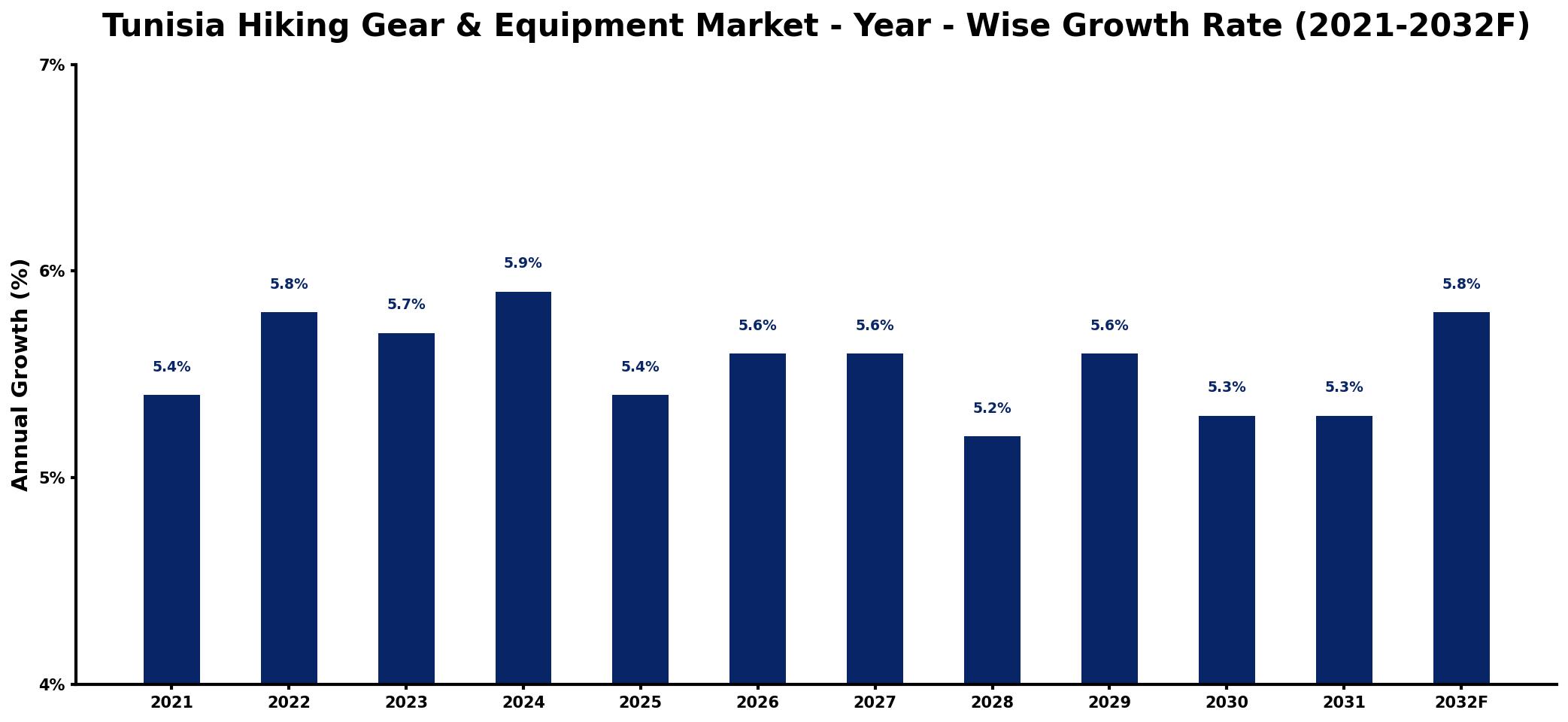
The table below presents the year‑wise growth rates along with the key drivers influencing the market
| Year | Growth Rate | Major Drivers |
| 2021 | 5.4% | Rising outdoor recreational activities |
| 2022 | 5.8% | Increased tourism in natural parks |
| 2023 | 5.7% | Growing interest in wellness travel |
| 2024 | 5.9% | Expansion of eco-friendly tourism initiatives |
| 2025 | 5.4% | Surge in local adventure companies |
| 2026 | 5.6% | Increase in social media promotions |
| 2027 | 5.6% | Growth in youth adventure programs |
| 2028 | 5.2% | increased pharmaceutical industry usage |
| 2029 | 5.6% | Investment in national park infrastructure |
| 2030 | 5.3% | Popularity of guided nature tours |
| 2031 | 5.3% | Development of urban green spaces |
| 2032 | 5.8% | Enhanced marketing for outdoor activities |
Note: Market size estimations and growth projections presented in this report are based on 6Wresearch's proprietary forecasting methodology, utilizing the latest available industry data, government publications, and primary research inputs.
Tunisia Hiking Gear & Equipment Market Synopsis
Interest in hiking is burgeoning in Tunisia, driven by the country's diverse natural landscapes and the accessibility of scenic trails. This has fostered a vibrant market for hiking gear, which is seeing a noteworthy uptick in both local and international brand participation.
In response to growing consumer awareness of health benefits linked to outdoor activities, the demand for high-quality hiking equipment is on the rise. This has created a favorable environment for innovation and sustainability, as companies strive to meet the preferences of a more environmentally-conscious consumer base.
- The market is poised for steady growth driven by adventure tourism and outdoor activity interest.
- Demand for eco-friendly and sustainable hiking gear is influencing product development.
- Technological advancements in hiking equipment are enhancing user experience and safety.
- Government initiatives are supporting the growth of hiking infrastructure and eco-tourism.
- Local and international brands are increasingly competing, enriching product diversity.
Despite the optimistic growth outlook, the Tunisia Hiking Gear & Equipment Market is challenged by limited awareness of hiking among the general population, which restricts the target market for specialized products. Additionally, the availability of high-quality, affordable hiking gear remains a concern, particularly in rural areas where hiking trails are prominent. Distribution hurdles further complicate market reach, especially in less developed regions. Economic variables like fluctuating exchange rates can affect consumer purchasing power, making high-end gear less accessible to the average hiker. Competing against established international brands and e-commerce platforms poses further challenges for local entities trying to carve out their niche.
The market is witnessing a pronounced shift towards lightweight and durable hiking gear, reflecting the preferences of a new generation of outdoor enthusiasts. An increasing consumer preference for multifunctional equipment also highlights a demand for versatile products that cater to various outdoor activities.
Moreover, advancements in technology are making their mark; gear that incorporates moisture-wicking fabrics and GPS capabilities are gaining traction. The growing trend of eco-consciousness has prompted manufacturers to explore sustainable materials, further aligning products with the values of their target consumers.
Investment opportunities in the Tunisia Hiking Gear & Equipment Market are ripe, driven by the increasing popularity of outdoor pursuits and adventure tourism. The demand for reliable and high-quality hiking equipment creates a robust avenue for distribution and retail operations. Additionally, the rising interest in eco-friendly products provides a strategic opportunity for brands to develop sustainable gear options, tapping into a growing segment of environmentally-conscious consumers.
Collaborating with local artisans to create unique, locally-made hiking gear can further enhance market presence and appeal, attracting both domestic and international tourists eager for authentic experiences.
The Tunisian government has implemented policies aimed at promoting outdoor activities like hiking, which has positively influenced the hiking gear market. Notably, initiatives to boost eco-tourism and sustainable development encourage the use of environmentally-friendly equipment. Infrastructure improvements in rural and mountainous regions further enhance the appeal of hiking trails, subsequently driving demand for related gear. Additionally, incentives for local manufacturers aim to increase domestic production, fostering a supportive environment for market growth.
Looking ahead to 2026-2032, the Tunisia Hiking Gear & Equipment Market is expected to thrive, with a convergence of factors such as the expanding tourism sector and a heightened focus on health and wellness. As more individuals seek adventure and physical fitness opportunities, demand for hiking gear is likely to surge. The continuing trend toward sustainable and innovative products will further shape consumer preferences, ensuring that the market not only grows but evolves in line with the expectations of modern adventurers.
Recent developments in the Tunisia Hiking Gear & Equipment Market reveal a strong push towards enhancing product sustainability and functionality. Manufacturers are increasingly adopting eco-friendly materials, while new technological features are being integrated into hiking equipment to improve user experiences. Additionally, partnerships with local tourism organizations have emerged, promoting outdoor activities and encouraging greater participation in hiking events across the country.
- 10 Years of Market Numbers
- Historical Data Starting from 2022 to 2025
- Base Year: 2025
- Forecast Data until 2032
- Key Performance Indicators Impacting the Market
- Major Upcoming Developments and Projects
Key Highlights of the Report:
- Tunisia Hiking Gear & Equipment Market Outlook
- Market Size of Tunisia Hiking Gear & Equipment Market, 2025
- Forecast of Tunisia Hiking Gear & Equipment Market, 2032
- Historical Data and Forecast of Tunisia Hiking Gear & Equipment Revenues & Volume for the Period 2022-2032F
- Tunisia Hiking Gear & Equipment Market Trend Evolution
- Tunisia Hiking Gear & Equipment Market Drivers and Challenges
- Tunisia Hiking Gear & Equipment Price Trends
- Tunisia Hiking Gear & Equipment Porter's Five Forces
- Tunisia Hiking Gear & Equipment Industry Life Cycle
- Historical Data and Forecast of Tunisia Hiking Gear & Equipment Market Revenues & Volume By Product for the Period 2022-2032F
- Historical Data and Forecast of Tunisia Hiking Gear & Equipment Market Revenues & Volume By Clothes for the Period 2022-2032F
- Historical Data and Forecast of Tunisia Hiking Gear & Equipment Market Revenues & Volume By Footwear for the Period 2022-2032F
- Historical Data and Forecast of Tunisia Hiking Gear & Equipment Market Revenues & Volume By Backpack for the Period 2022-2032F
- Historical Data and Forecast of Tunisia Hiking Gear & Equipment Market Revenues & Volume By Equipment for the Period 2022-2032F
- Historical Data and Forecast of Tunisia Hiking Gear & Equipment Market Revenues & Volume By Others for the Period 2022-2032F
- Historical Data and Forecast of Tunisia Hiking Gear & Equipment Market Revenues & Volume By Distribution Channel for the Period 2022-2032F
- Historical Data and Forecast of Tunisia Hiking Gear & Equipment Market Revenues & Volume By Specialty stores for the Period 2022-2032F
- Historical Data and Forecast of Tunisia Hiking Gear & Equipment Market Revenues & Volume By Retail stores for the Period 2022-2032F
- Historical Data and Forecast of Tunisia Hiking Gear & Equipment Market Revenues & Volume By Online for the Period 2022-2032F
- Tunisia Hiking Gear & Equipment Import Export Trade Statistics
- Market Opportunity Assessment By Product
- Market Opportunity Assessment By Distribution Channel
- Tunisia Hiking Gear & Equipment Top Companies Market Share
- Tunisia Hiking Gear & Equipment Competitive Benchmarking By Technical and Operational Parameters
- Tunisia Hiking Gear & Equipment Company Profiles
- Tunisia Hiking Gear & Equipment Key Strategic Recommendations






































