Tunisia Home Appliances Market Summary
The tunisia home appliances market was estimated at USD 1304 Million in 2025 and is projected to reach USD 1860 Million by 2032, growing at a CAGR of 5.8% from 2026 to 2032.
Tunisia Home Appliances Market Year-wise Growth Rate and Key Drivers
This graph highlights how the Tunisia Home Appliances Market has steadily grown over the past five years, supported by major growth factors.
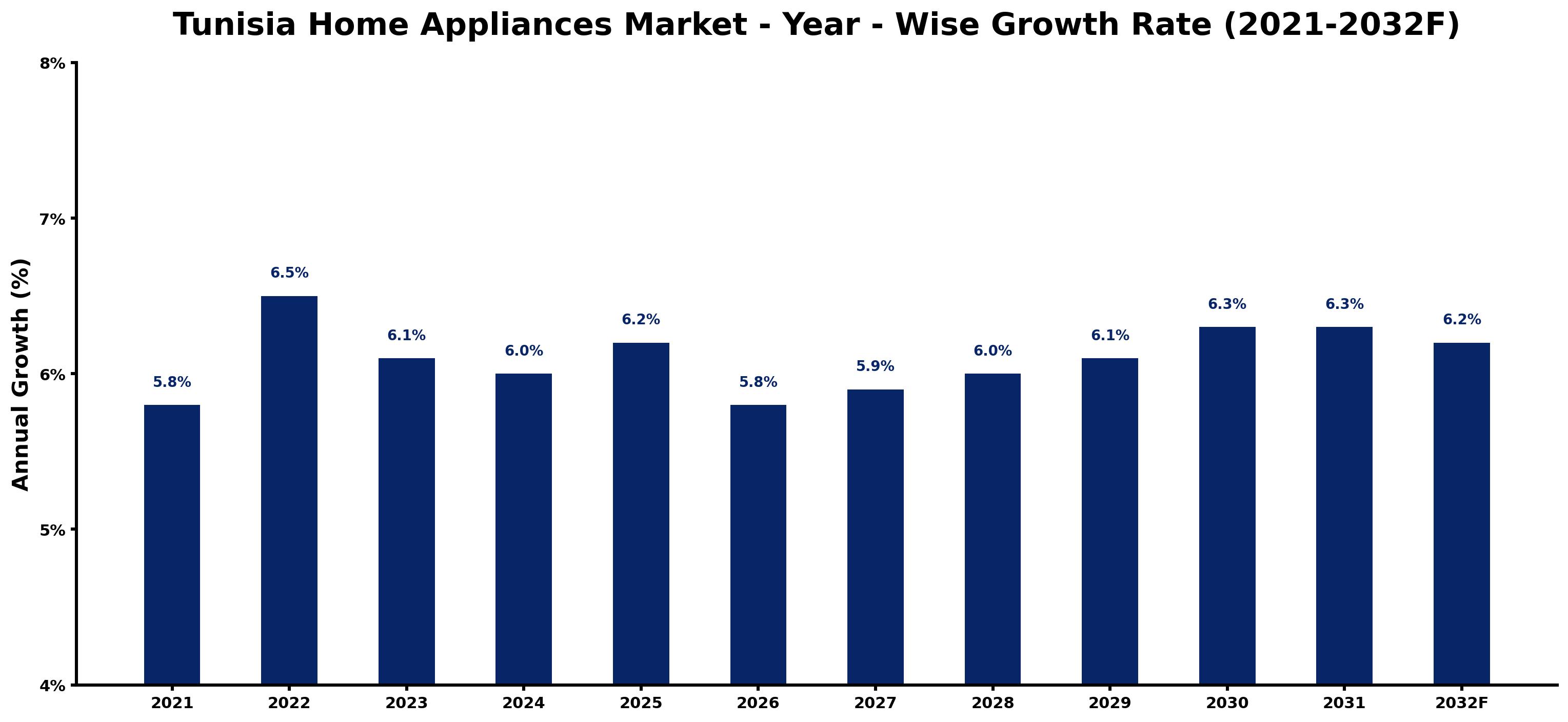
The table below presents the year wise growth rates along with the key drivers influencing the market
| Year | Growth Rate | Major Drivers |
| 2021 | 5.8% | Consumer preference shifted towards energy-efficient home appliances amidst rising utility costs. |
| 2022 | 6.5% | E-commerce platforms gained traction, simplifying appliance purchases for urban populations. |
| 2023 | 6.1% | Local manufacturers expanded product lines to meet diverse consumer needs and preferences. |
| 2024 | 6.0% | Home improvement trends fueled investments in modernizing appliance technology and design. |
| 2025 | 6.2% | Increased foreign direct investment enhanced production capabilities and market competitiveness. |
| 2026 | 5.8% | Rural electrification efforts spurred demand for essential home appliances in underserved areas. |
| 2027 | 5.9% | Smart home technology integration captured consumer interest and elevated appliance functionality. |
| 2028 | 6.0% | Urbanization trends indicated higher disposable incomes, enabling larger appliance purchases. |
| 2029 | 6.1% | Sustainability concerns prompted consumers to seek eco-friendly appliance options and brands. |
| 2030 | 6.3% | Supply chain improvements allowed quicker access to international brands and innovations. |
| 2031 | 6.3% | Trade agreements with regional partners diversified available appliance brands and models. |
| 2032 | 6.2% | Enhanced consumer education on appliance maintenance extended product life and satisfaction. |
Note - Market size estimations and growth projections presented in this report are based on 6Wresearch's advanced forecasting approach, validated with industry datasets as of June 2026.
Tunisia Home Appliances Market Synopsis
The Tunisia Home Appliances Market is projected to reach 5.8% and witness significant growth during the forecast period (2026-2032). This market is characterized by a dynamic environment, driven primarily by robust consumer demand and an expanding population. The compound annual growth rate (CAGR) is anticipated to be 7.2%, contributing to a market value that is expected to reach USD 1 billion by the end of the forecast period. This growth is underpinned by several factors, including a rise in the number of households, increasing disposable income levels, and substantial government support aimed at bolstering consumer electronics products. Additionally, technological advancements are paving the way for the introduction of innovative products like smart refrigerators and advanced washing machines that cater to the modern consumer's need for convenience and efficiency.
Tunisia Home Appliances Market Growth Drivers
Several key drivers are propelling the Tunisia Home Appliances Market forward:
- The increasing number of households in Tunisia is a principal factor. As urbanization continues to rise, more families are seeking modern home appliances to enhance their living conditions.
- Rising disposable income levels are allowing consumers to invest in high-quality home appliances. As economic conditions improve, households are prioritizing convenience and efficiency in their purchasing decisions.
- Government initiatives and support for the consumer electronics sector are encouraging investments. These include favorable tariffs and incentives aimed at manufacturing and importing home appliances.
- Technological innovation is fueling product development. The introduction of smart appliances has attracted tech-savvy consumers, elevating the standards of home living.
- A growing awareness of energy efficiency among consumers is shaping purchasing habits. As people become more environmentally conscious, there is a rising demand for appliances that save energy, further driving market growth.
Tunisia Home Appliances Market Trends and Opportunities
The Tunisia Home Appliances Market is witnessing several trends that present unique opportunities for growth:
- Increased consumer interest in smart home technologies is reshaping demand. Products that offer integrated technology are becoming more appealing as consumers look for enhanced functionality.
- Sustainability is becoming a critical factor in purchasing decisions. Eco-friendly appliances that minimize environmental impact are gaining traction among eco-conscious consumers.
- Online retailing is on the rise, driven by increased internet penetration and consumer preference for convenience. E-commerce platforms are likely to expand their offerings in home appliances significantly.
- The demand for localized products is increasing. As consumers seek appliances that cater to their specific needs and preferences, opportunities emerge for manufacturers to tailor their offerings to the Tunisian market.
- Collaborations between manufacturers and technology firms are fostering innovation in the sector. These partnerships enable the development of advanced home appliances with cutting-edge features.
Tunisia Home Appliances Market Government Investment and Initiatives
The Tunisian government plays a crucial role in the development of the home appliances sector through various policies and initiatives aimed at stimulating growth. Investments in infrastructure and manufacturing capabilities are being prioritized to support local production and reduce dependency on imports. Additionally, government incentives for energy-efficient appliances are encouraging consumers to upgrade their existing products. Programs promoting technological innovation in manufacturing are also being introduced, facilitating the adoption of modern production techniques and practices. Public spending on consumer electronics is expected to rise, further enhancing the market landscape.
Tunisia Home Appliances Market Latest Developments (May 2025 - June 2026)
Recent developments in the Tunisia Home Appliances Market indicate a continued push towards innovation and sustainability. Manufacturers are increasingly launching new product lines featuring smart technology to meet consumer demand. There is a noticeable trend towards energy-efficient models, as companies respond to rising consumer awareness regarding environmental impacts. Furthermore, partnerships with local distributors are being announced to expand market reach and improve supply chain efficiencies. Trade fairs and exhibitions have showcased the increasing prominence of smart appliances, highlighting a growing consumer preference for integrated technologies.
Tunisia Home Appliances Market - Key Attractiveness of the Report
- 10 Years of Market Numbers
- Historical Data Starting from 2022 to 2025
- Base Year: 2025
- Forecast Data until 2032
- Key Performance Indicators Impacting the Market
- Major Upcoming Developments and Projects
Key Highlights of the Report:
- Tunisia Home Appliances Market Outlook
- Market Size of Tunisia Home Appliances Market, 2025
- Forecast of Tunisia Home Appliances Market, 2032
- Historical Data and Forecast of Tunisia Home Appliances Revenues & Volume for the Period 2022-2032
- Tunisia Home Appliances Market Trend Evolution
- Tunisia Home Appliances Market Drivers and Challenges
- Tunisia Home Appliances Price Trends
- Tunisia Home Appliances Porter's Five Forces
- Tunisia Home Appliances Industry Life Cycle
- Historical Data and Forecast of Tunisia Home Appliances Market Revenues & Volume By Product Types for the Period 2022-2032
- Historical Data and Forecast of Tunisia Home Appliances Market Revenues & Volume By Kitchen Appliances for the Period 2022-2032
- Historical Data and Forecast of Tunisia Home Appliances Market Revenues & Volume By Washing Appliances for the Period 2022-2032
- Historical Data and Forecast of Tunisia Home Appliances Market Revenues & Volume By Entertainment Appliances for the Period 2022-2032
- Historical Data and Forecast of Tunisia Home Appliances Market Revenues & Volume By Air Conditioner for the Period 2022-2032
- Historical Data and Forecast of Tunisia Home Appliances Market Revenues & Volume By Others for the Period 2022-2032
- Historical Data and Forecast of Tunisia Home Appliances Market Revenues & Volume By Technology for the Period 2022-2032
- Historical Data and Forecast of Tunisia Home Appliances Market Revenues & Volume By Wi-Fi for the Period 2022-2032
- Historical Data and Forecast of Tunisia Home Appliances Market Revenues & Volume By Bluetooth for the Period 2022-2032
- Historical Data and Forecast of Tunisia Home Appliances Market Revenues & Volume By ZigBee for the Period 2022-2032
- Historical Data and Forecast of Tunisia Home Appliances Market Revenues & Volume By Radio Frequency Identification for the Period 2022-2032
- Historical Data and Forecast of Tunisia Home Appliances Market Revenues & Volume By Cellular Technology for the Period 2022-2032
- Historical Data and Forecast of Tunisia Home Appliances Market Revenues & Volume By IoT for the Period 2022-2032
- Historical Data and Forecast of Tunisia Home Appliances Market Revenues & Volume By Distribution Channel for the Period 2022-2032
- Historical Data and Forecast of Tunisia Home Appliances Market Revenues & Volume By Retail for the Period 2022-2032
- Historical Data and Forecast of Tunisia Home Appliances Market Revenues & Volume By E-commerce for the Period 2022-2032
- Historical Data and Forecast of Tunisia Home Appliances Market Revenues & Volume By Others for the Period 2022-2032
- Tunisia Home Appliances Import Export Trade Statistics
- Market Opportunity Assessment By Product Types
- Market Opportunity Assessment By Technology
- Market Opportunity Assessment By Distribution Channel
- Tunisia Home Appliances Top Companies Market Share
- Tunisia Home Appliances Competitive Benchmarking By Technical and Operational Parameters
- Tunisia Home Appliances Company Profiles
- Tunisia Home Appliances Key Strategic Recommendations






































