Tunisia Hotel Furniture Market Summary
The tunisia hotel furniture market was estimated at USD 281 Million in 2025 and is projected to reach USD 378 Million by 2032, growing at a CAGR of 5.3% from 2026 to 2032.
Tunisia Hotel Furniture Market Year-wise Growth Rate and Key Drivers
This graph highlights how the Tunisia Hotel Furniture Market has steadily grown over the past five years, supported by major growth factors.
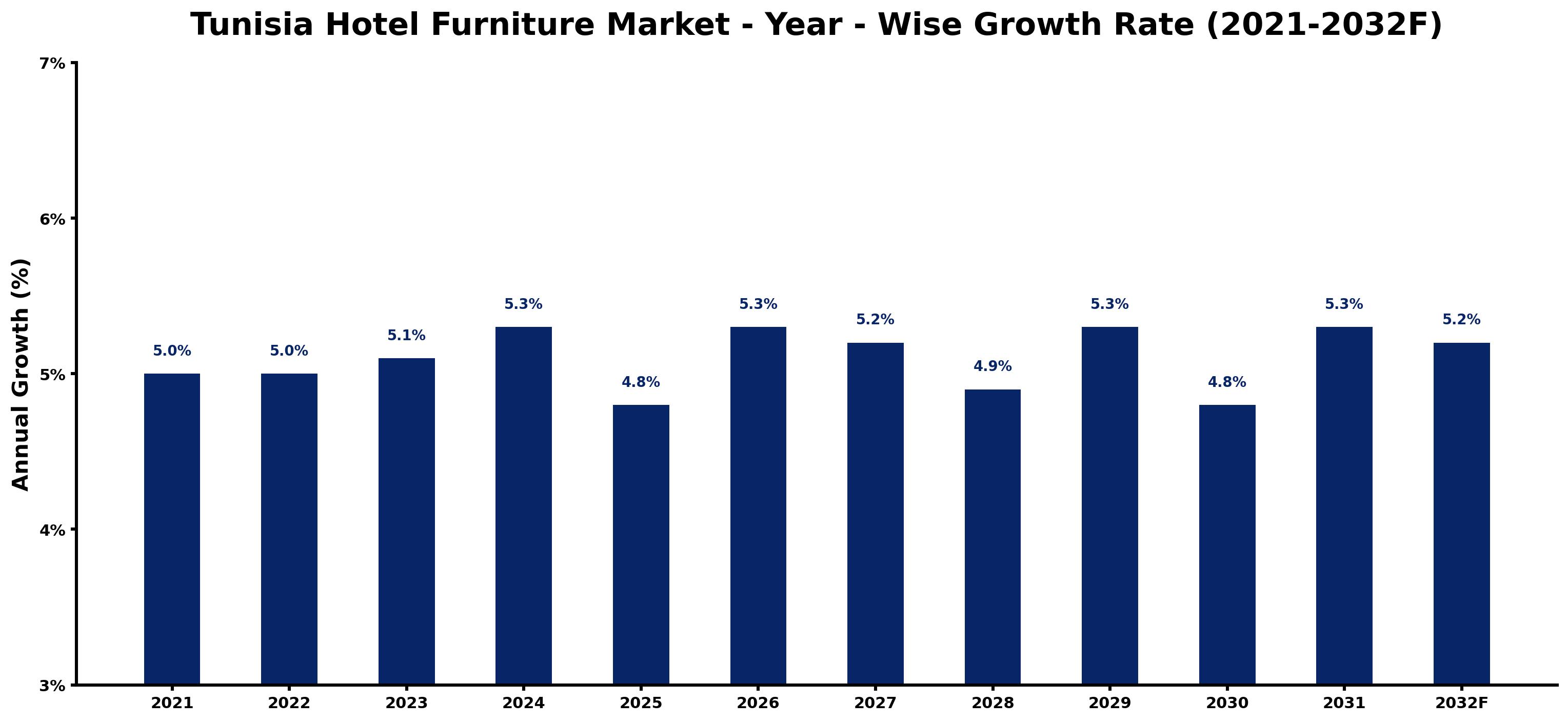
The table below presents the year wise growth rates along with the key drivers influencing the market
| Year | Growth Rate | Major Drivers |
| 2021 | 5.0% | Hotel refurbishments began to prioritize sustainable materials and local craftsmanship. |
| 2022 | 5.0% | Tourism recovery spurred demand for innovative and durable hotel furniture solutions. |
| 2023 | 5.1% | Investments in boutique hotels increased focus on unique design and quality furniture. |
| 2024 | 5.3% | The influx of international brands required high-end, custom-designed hotel furnishings. |
| 2025 | 4.8% | Local manufacturers expanded production capabilities to meet rising market expectations. |
| 2026 | 5.3% | Health and safety trends prompted hotels to seek easily cleanable furniture options. |
| 2027 | 5.2% | Technological integration in hotel settings increased the need for smart furniture solutions. |
| 2028 | 4.9% | Growth in eco-tourism drove demand for environmentally friendly hotel furniture choices. |
| 2029 | 5.3% | Strong competition among hotels led to enhanced guest experience through innovative furniture. |
| 2030 | 4.8% | Collaborations with local artisans became essential for unique hotel ambiance and charm. |
| 2031 | 5.3% | Increased investment in hospitality sector fueled expansion of boutique and luxury hotels. |
| 2032 | 5.2% | Regional economic stability ensured ongoing projects, boosting hotel furniture demand significantly. |
Note - Market size estimations and growth projections presented in this report are based on 6Wresearch's advanced forecasting approach, validated with industry datasets as of June 2026.
Tunisia Hotel Furniture Market Synopsis
The Tunisia Hotel Furniture Market is projected to reach 5.3% and witness significant growth during the forecast period (2026-2032). This growth trajectory is primarily driven by the robust expansion of the hospitality sector in Tunisia, which is characterized by an increasing influx of tourists and business professionals who require high-quality accommodations. The demand for aesthetically pleasing and functional furniture across various hotel settings is on the rise, with hotels seeking diverse product offerings that include bedroom sets, lobby arrangements, dining solutions, and outdoor furnishings.
Tunisia Hotel Furniture Market Growth Drivers
Several factors are propelling the growth of the Tunisia Hotel Furniture Market. Firstly, the steady increase in tourism, bolstered by government initiatives to position Tunisia as a prime travel destination, has led to a higher occupancy rate in hotels. This surge in demand necessitates the acquisition of modern furniture that meets guest expectations.
- The hospitality sector is witnessing a rise in boutique hotels and eco-resorts, which emphasize the need for unique furniture designs that align with their branding and aesthetic goals.
- Investment in infrastructure, such as airports and transport networks, has enhanced accessibility for travelers, further stimulating the hotel industry and, consequently, the furniture market.
- Consumers are gravitating towards furniture that boasts both functionality and design, compelling manufacturers to innovate with trendy and space-saving solutions.
- Increased disposable incomes among travelers have led to higher spending on premium hotel experiences, encouraging hotels to invest in superior furnishings.
- Renovation and refurbishment of older establishments to enhance guest experiences have created additional demand for quality hotel furniture.
Tunisia Hotel Furniture Market Trends and Opportunities
The market is currently experiencing notable trends that indicate a shift towards sustainability and innovative design. Hoteliers are increasingly opting for eco-friendly furniture choices, reflecting a broader awareness of environmental impact.
- Minimalist and modular furniture designs are gaining traction, enabling hoteliers to maximize space while providing comfort and style.
- Customization options are becoming more prevalent, allowing hotels to tailor furniture solutions to reflect their unique identity and guest expectations.
- A growing emphasis on incorporating local craftsmanship into furniture design is fostering a sense of authenticity, appealing to culturally inclined travelers.
- Technological advancements are influencing furniture design, with smart furniture solutions being integrated into hotel environments to enhance guest experiences.
- Collaboration between local artisans and furniture manufacturers is becoming increasingly common, promoting regional craft while meeting modern design standards.
Tunisia Hotel Furniture Market Challenges and Restraints
Despite the growth prospects, the Tunisia Hotel Furniture Market faces several challenges. Economic fluctuations can impact consumer spending on hospitality services, leading to budget constraints for hotel renovations and upgrades.
- Intense competition from imported furniture brands, which often offer lower prices, poses a threat to local manufacturers aiming for market share.
- Sustainability challenges arise as hotels strive to maintain eco-friendly practices while managing cost implications associated with sustainable materials.
- The evolving preferences of guests necessitate ongoing innovation from furniture manufacturers, demanding agility in adapting to shifting market dynamics.
- Compliance with quality and safety standards is crucial; lapses can damage a hotel's reputation and affect customer satisfaction.
- Potential supply chain disruptions, particularly for raw materials, can hinder production capabilities and delay project completions in the furniture sector.
Tunisia Hotel Furniture Market Investment Opportunities
The landscape of the Tunisia Hotel Furniture Market offers a range of investment opportunities to capitalize on the burgeoning tourism sector. As the country continues to attract tourists, the demand for high-quality hotel furnishings is on the rise, creating avenues for various stakeholders.
- Investors can explore supplying durable and stylish furniture to new hotel developments, catering to contemporary market demands.
- There is potential for offering renovation and refurbishment services to existing hotels, aligning with trends in upgrading guest experiences through better furnishings.
- Partnerships with local manufacturers can be fruitful in producing customized furniture that resonates with specific hotel branding and decor themes.
- Exploring eco-friendly materials and designs can create a niche market segment, appealing to environmentally conscious hoteliers.
- Engaging in market research and customer feedback can guide product development, ensuring that offerings align with evolving guest preferences.
Tunisia Hotel Furniture Market Government Investment and Initiatives
Government policies in Tunisia play a pivotal role in shaping the hotel furniture sector, with initiatives aimed at fostering local manufacturing and enhancing the hospitality industry.
- Public spending on infrastructure, including hotel developments, is being prioritized to create an attractive environment for domestic and international tourism.
- Incentives and subsidies are provided to businesses that prioritize locally produced furniture, thereby stimulating the local economy and encouraging job creation.
- Regulatory frameworks ensure that quality and safety standards are upheld in furniture production, with regular inspections reinforcing compliance.
- The government collaborates with industry stakeholders to identify challenges and develop strategies that promote sustained growth within the sector.
- Investments in vocational training programs are designed to enhance local craftsmanship, ensuring that the furniture market has skilled professionals capable of meeting industry standards.
Tunisia Hotel Furniture Market Latest Developments (May 2025 - June 2026)
Recent industry developments between May 2025 and June 2026 have indicated a continuing push towards modernization and sustainability within the Tunisia Hotel Furniture Market. Numerous hotel establishments have embarked on renovation projects aimed at refreshing their interiors, leading to increased demand for contemporary and eco-friendly furniture solutions. The emphasis on local craftsmanship has also gained momentum, with initiatives aimed at promoting the use of handmade furniture that reflects Tunisian culture. Furthermore, various collaborations between hoteliers and local furniture designers have emerged, facilitating unique offers that differentiate hotels in a competitive market.
Tunisia Hotel Furniture Market - Key Attractiveness of the Report
- 10 Years of Market Numbers
- Historical Data Starting from 2022 to 2025
- Base Year: 2025
- Forecast Data until 2032
- Key Performance Indicators Impacting the Market
- Major Upcoming Developments and Projects
Key Highlights of the Report:
- Tunisia Hotel Furniture Market Outlook
- Market Size of Tunisia Hotel Furniture Market, 2025
- Forecast of Tunisia Hotel Furniture Market, 2032F
- Historical Data and Forecast of Tunisia Hotel Furniture Revenues & Volume for the Period 2022-2032F
- Tunisia Hotel Furniture Market Trend Evolution
- Tunisia Hotel Furniture Market Drivers and Challenges
- Tunisia Hotel Furniture Price Trends
- Tunisia Hotel Furniture Porter's Five Forces
- Tunisia Hotel Furniture Industry Life Cycle
- Historical Data and Forecast of Tunisia Hotel Furniture Market Revenues & Volume By Product Types for the Period 2022-2032F
- Historical Data and Forecast of Tunisia Hotel Furniture Market Revenues & Volume By Table and Chairs for the Period 2022-2032F
- Historical Data and Forecast of Tunisia Hotel Furniture Market Revenues & Volume By Hotel Beds for the Period 2022-2032F
- Historical Data and Forecast of Tunisia Hotel Furniture Market Revenues & Volume By Hotel Casegoods for the Period 2022-2032F
- Historical Data and Forecast of Tunisia Hotel Furniture Market Revenues & Volume By Other for the Period 2022-2032F
- Historical Data and Forecast of Tunisia Hotel Furniture Market Revenues & Volume By Applications for the Period 2022-2032F
- Historical Data and Forecast of Tunisia Hotel Furniture Market Revenues & Volume By Business Hotel for the Period 2022-2032F
- Historical Data and Forecast of Tunisia Hotel Furniture Market Revenues & Volume By Luxury Hotel for the Period 2022-2032F
- Historical Data and Forecast of Tunisia Hotel Furniture Market Revenues & Volume By Boutique Hotel for the Period 2022-2032F
- Historical Data and Forecast of Tunisia Hotel Furniture Market Revenues & Volume By Other for the Period 2022-2032F
- Tunisia Hotel Furniture Import Export Trade Statistics
- Market Opportunity Assessment By Product Types
- Market Opportunity Assessment By Applications
- Tunisia Hotel Furniture Top Companies Market Share
- Tunisia Hotel Furniture Competitive Benchmarking By Technical and Operational Parameters
- Tunisia Hotel Furniture Company Profiles
- Tunisia Hotel Furniture Key Strategic Recommendations






































