Tunisia Industrial Computers Market Summary
The tunisia industrial computers market was estimated at USD 132 Million in 2025 and is projected to reach USD 144 Million by 2032, growing at a CAGR of 1.4% from 2026 to 2032.
Tunisia Industrial Computers Market Year-wise Growth Rate and Key Drivers
This graph highlights how the Tunisia Industrial Computers Market has steadily grown over the past five years, supported by major growth factors.
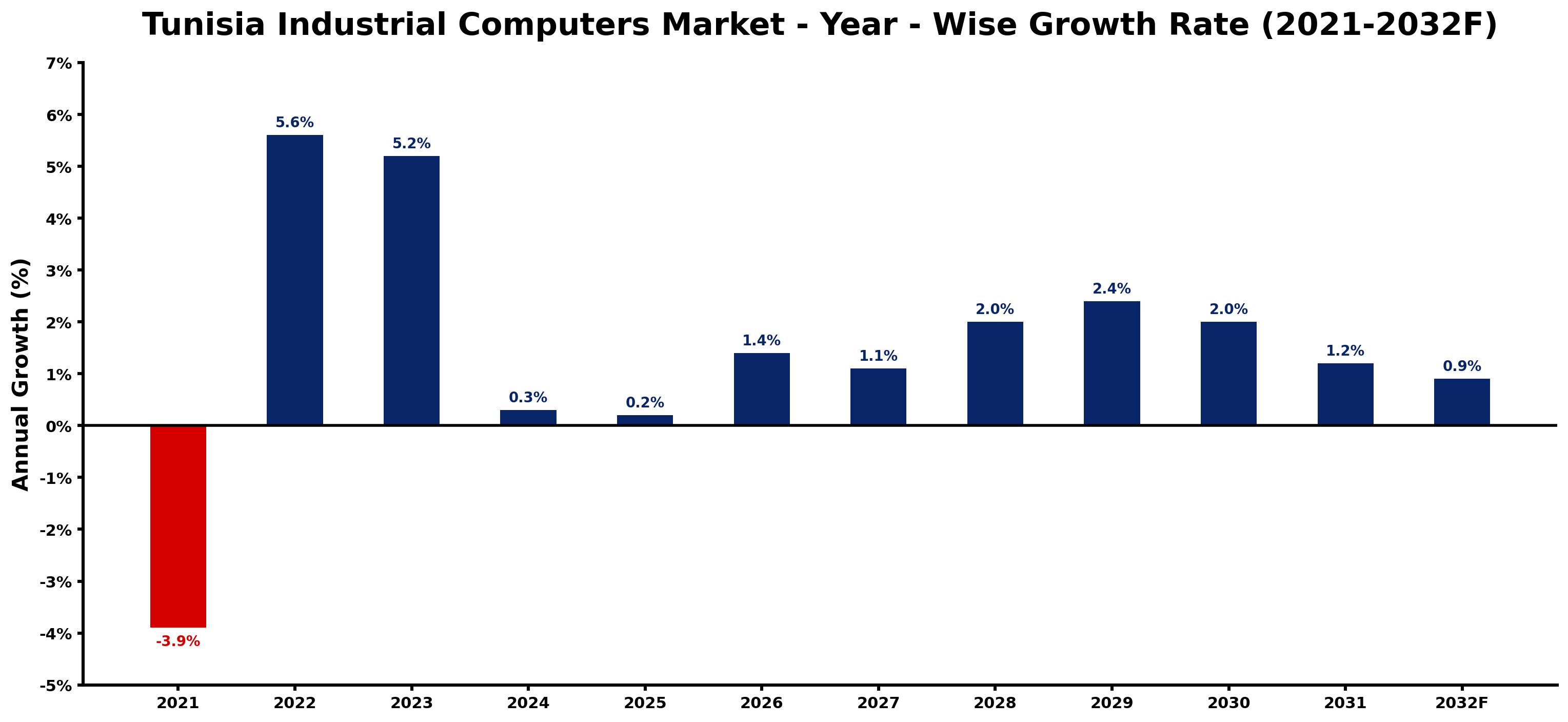
The table below presents the year wise growth rates along with the key drivers influencing the market
| Year | Growth Rate | Major Drivers |
| 2021 | -3.9% | Supply chain disruptions caused by global shipping delays hindered timely production and delivery of industrial computers. |
| 2022 | 5.6% | Investments in smart factories highlighted the importance of efficiency and automation. |
| 2023 | 5.2% | Industrial sectors faced challenges from supply chain disruptions, urging technological upgrades. |
| 2024 | 0.3% | Emerging startups entered the market, enhancing competition and innovation capabilities. |
| 2025 | 0.2% | Collaborations between tech companies and industries focused on tailored computing solutions. |
| 2026 | 1.4% | Demands for real-time data analytics fueled the need for advanced industrial computers. |
| 2027 | 1.1% | Infrastructure projects across Tunisia increased, boosting the requirement for robust computing systems. |
| 2028 | 2.0% | Existing manufacturers sought partnerships to diversify product offerings and enhance solutions. |
| 2029 | 2.4% | Cybersecurity threats prompted industries to invest in secure industrial computing technologies. |
| 2030 | 2.0% | Sustainability initiatives motivated companies to leverage energy-efficient computing alternatives. |
| 2031 | 1.2% | Integration of IoT applications in factories expanded the market for advanced computing devices. |
| 2032 | 0.9% | Technological convergence pushed industries towards comprehensive automation and data management solutions. |
Note - Market size estimations and growth projections presented in this report are based on 6Wresearch's advanced forecasting approach, validated with industry datasets as of June 2026.
Tunisia Industrial Computers Market Synopsis
The Tunisia Industrial Computers Market is projected to reach 1.4% and witness significant growth during the forecast period (2026-2032). This market is experiencing a notable transformation driven by the increasing automation in key sectors such as manufacturing, energy, and transportation. As industries strive to enhance operational efficiency and productivity, the demand for ruggedized industrial computers that can withstand challenging environments continues to grow. The market is characterized by a strong focus on innovation, with advancements in processing power and connectivity options catering to the evolving needs of the industrial landscape.
Tunisia Industrial Computers Market Growth Drivers
Several factors are contributing to the growth of the Tunisia Industrial Computers Market. First, there is a notable shift towards automation in industries that require reliable computing solutions to improve operational efficiency. Second, the evolving landscape of Industry 4.0 emphasizes the integration of digital technologies into industrial processes, prompting businesses to invest in industrial computers equipped with specialized features. Third, the increasing complexity of operations in sectors like oil and gas and transportation necessitates computers that can deliver high processing power and connectivity capabilities. Fourth, heightened awareness regarding cybersecurity in industrial environments is driving demand for robust computing solutions. Lastly, government initiatives aimed at promoting technological advancements are creating a favorable atmosphere for market expansion.
Tunisia Industrial Computers Market Trends and Opportunities
The current trends in the Tunisia Industrial Computers Market indicate a clear move towards advanced computing solutions that are not only ruggedized but also capable of delivering higher performance. With the advent of IoT devices, there is a growing need for industrial PCs that can handle real-time data processing and remote monitoring functionalities. Furthermore, the market is witnessing an emphasis on the development of modular, scalable solutions that can be easily integrated into existing operations. This presents numerous opportunities for vendors to innovate and deliver tailored products that address the specific requirements of industries such as manufacturing, energy, and healthcare.
Tunisia Industrial Computers Market Challenges and Restraints
Despite the promising growth, the Tunisia Industrial Computers Market faces several challenges. Limited access to advanced technological infrastructure hampers the adoption of high-end industrial computing solutions. Additionally, the high costs associated with importing specialized equipment pose a significant barrier for many businesses. Furthermore, a shortage of skilled professionals familiar with industrial computing technologies can hinder the effective implementation and maintenance of these systems. Regulatory hurdles and political instability may also create an uncertain business environment, affecting investment and development in this sector. Consequently, companies must focus on building strategic partnerships and investing in workforce training to navigate these challenges successfully.
Tunisia Industrial Computers Market Investment Opportunities
As the Tunisia Industrial Computers Market expands, numerous investment opportunities are emerging. The rising demand for ruggedized industrial computers and embedded systems creates a compelling case for investors looking to enter this market. Additionally, sectors such as manufacturing and transportation are experiencing heightened demand for advanced computing solutions aimed at boosting productivity. Opportunities also exist in providing maintenance and support services for industrial computer systems, offering potential recurring revenue streams. With the government's commitment to fostering technological advancement and industrialization, investors can find a conducive environment for exploring new ventures in this evolving landscape.
Tunisia Industrial Computers Market Government Investment and Initiatives
The Tunisian government is actively implementing policies to bolster the growth of the Industrial Computers Market. These policies include offering tax incentives and subsidies designed to attract investment into the sector. Furthermore, the government is promoting research and development initiatives to stimulate innovation within the industrial computing space. Collaboration between local businesses and international firms is also encouraged to enhance technological capabilities and foster knowledge transfer. In addition to these measures, the government's focus on developing critical infrastructure, such as reliable electricity supply and high-speed internet, is vital for creating a favorable environment for companies involved in industrial computing.
Tunisia Industrial Computers Market Latest Developments (May 2025 - June 2026)
Between May 2025 and June 2026, the Tunisia Industrial Computers Market has seen several developments reflective of the changing dynamics within the sector. During this period, there has been a pronounced emphasis on advancing digital transformation initiatives across various industries. Companies have increasingly sought innovative computing solutions to meet the demands of automation and data analytics. Furthermore, the adoption of remote monitoring technologies has accelerated, propelled by the need for efficiency and real-time operational insights. Additionally, initiatives aimed at enhancing cybersecurity measures have gained traction as businesses prioritize the protection of sensitive industrial data. Overall, this timeline has highlighted the ongoing evolution of the market as enterprises adapt to technological advancements and market demands.
Tunisia Industrial Computers Market - Key Attractiveness of the Report
- 10 Years of Market Numbers
- Historical Data Starting from 2022 to 2025
- Base Year: 2025
- Forecast Data until 2032
- Key Performance Indicators Impacting the Market
- Major Upcoming Developments and Projects
Key Highlights of the Report:
- Tunisia Industrial Computers Market Outlook
- Market Size of Tunisia Industrial Computers Market, 2025
- Forecast of Tunisia Industrial Computers Market, 2032F
- Historical Data and Forecast of Tunisia Industrial Computers Revenues & Volume for the Period 2022-2032F
- Tunisia Industrial Computers Market Trend Evolution
- Tunisia Industrial Computers Market Drivers and Challenges
- Tunisia Industrial Computers Price Trends
- Tunisia Industrial Computers Porter's Five Forces
- Tunisia Industrial Computers Industry Life Cycle
- Historical Data and Forecast of Tunisia Industrial Computers Market Revenues & Volume By Type for the Period 2022-2032F
- Historical Data and Forecast of Tunisia Industrial Computers Market Revenues & Volume By Panel for the Period 2022-2032F
- Historical Data and Forecast of Tunisia Industrial Computers Market Revenues & Volume By Box for the Period 2022-2032F
- Historical Data and Forecast of Tunisia Industrial Computers Market Revenues & Volume By Embedded for the Period 2022-2032F
- Historical Data and Forecast of Tunisia Industrial Computers Market Revenues & Volume By Din Rail for the Period 2022-2032F
- Historical Data and Forecast of Tunisia Industrial Computers Market Revenues & Volume By Rack Mount for the Period 2022-2032F
- Historical Data and Forecast of Tunisia Industrial Computers Market Revenues & Volume By Thin Client for the Period 2022-2032F
- Historical Data and Forecast of Tunisia Industrial Computers Market Revenues & Volume By Technology for the Period 2022-2032F
- Historical Data and Forecast of Tunisia Industrial Computers Market Revenues & Volume By Resistive for the Period 2022-2032F
- Historical Data and Forecast of Tunisia Industrial Computers Market Revenues & Volume By Capacitive for the Period 2022-2032F
- Historical Data and Forecast of Tunisia Industrial Computers Market Revenues & Volume By Others for the Period 2022-2032F
- Historical Data and Forecast of Tunisia Industrial Computers Market Revenues & Volume By ?End Use for the Period 2022-2032F
- Historical Data and Forecast of Tunisia Industrial Computers Market Revenues & Volume By Automotive for the Period 2022-2032F
- Historical Data and Forecast of Tunisia Industrial Computers Market Revenues & Volume By Chemicals for the Period 2022-2032F
- Historical Data and Forecast of Tunisia Industrial Computers Market Revenues & Volume By Electronics for the Period 2022-2032F
- Historical Data and Forecast of Tunisia Industrial Computers Market Revenues & Volume By Oil & Gas for the Period 2022-2032F
- Historical Data and Forecast of Tunisia Industrial Computers Market Revenues & Volume By Food & Beverages for the Period 2022-2032F
- Historical Data and Forecast of Tunisia Industrial Computers Market Revenues & Volume By Pharmaceuticals for the Period 2022-2032F
- Historical Data and Forecast of Tunisia Industrial Computers Market Revenues & Volume By Others for the Period 2022-2032F
- Tunisia Industrial Computers Import Export Trade Statistics
- Market Opportunity Assessment By Type
- Market Opportunity Assessment By Technology
- Market Opportunity Assessment By ?End Use
- Tunisia Industrial Computers Top Companies Market Share
- Tunisia Industrial Computers Competitive Benchmarking By Technical and Operational Parameters
- Tunisia Industrial Computers Company Profiles
- Tunisia Industrial Computers Key Strategic Recommendations






































