Tunisia Industrial vacuum cleaners Market Summary
The tunisia industrial vacuum cleaners market was estimated at USD 213 Million in 2025 and is projected to reach USD 233 Million by 2032, growing at a CAGR of 0.9% from 2026 to 2032.
Tunisia Industrial vacuum cleaners Market Year-wise Growth Rate and Key Drivers
This graph highlights how the Tunisia Industrial vacuum cleaners Market has steadily grown over the past five years, supported by major growth factors.
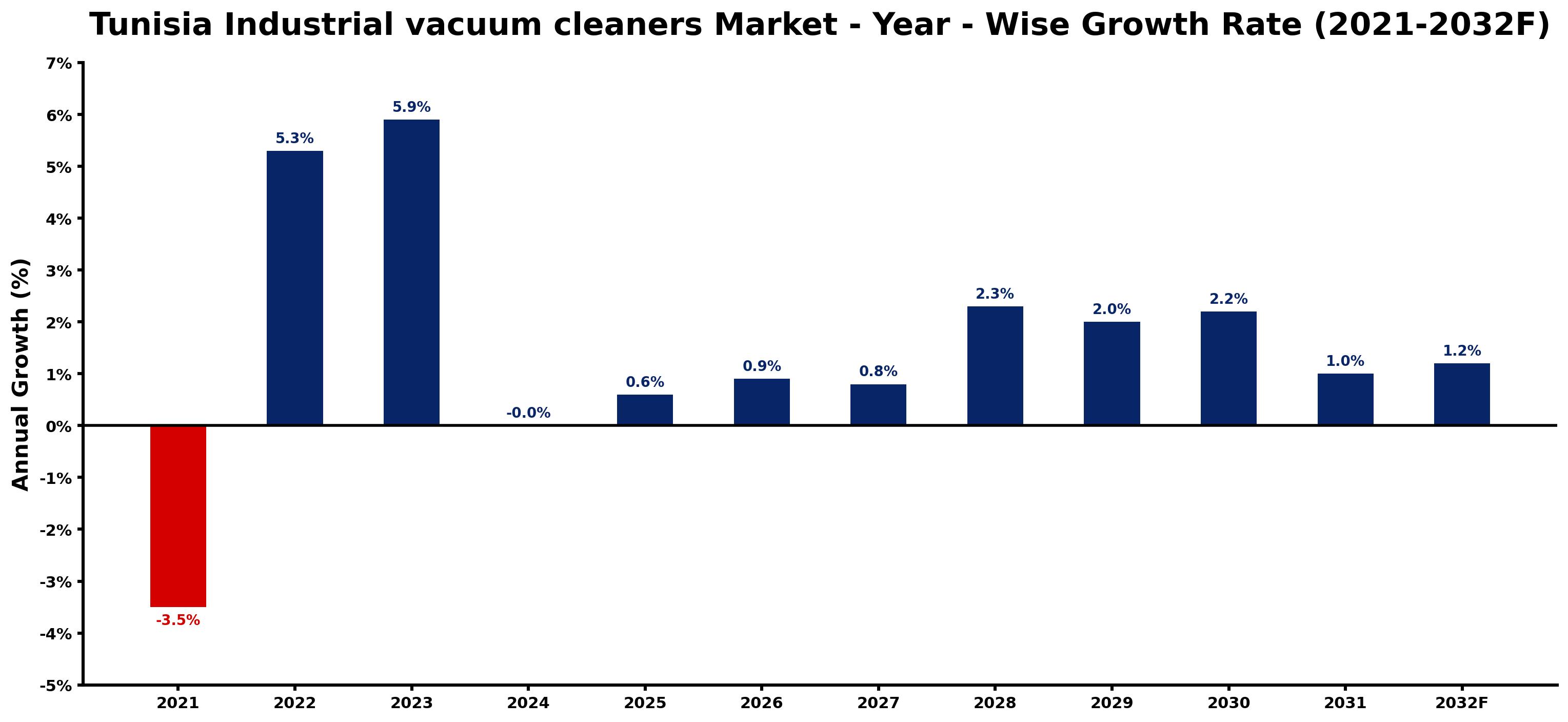
The table below presents the year wise growth rates along with the key drivers influencing the market
| Year | Growth Rate | Major Drivers |
| 2021 | -3.5% | Decreased manufacturing output due to supply chain disruptions led to reduced demand for industrial vacuum cleaners. |
| 2022 | 5.3% | Investment in infrastructure revitalization projects enhances the need for industrial cleaning equipment. |
| 2023 | 5.9% | Emerging local manufacturers begin producing affordable vacuum cleaner alternatives, diversifying market options. |
| 2024 | -0.0% | Integration of smart technologies into industrial cleaning solutions attracts tech-savvy enterprises. |
| 2025 | 0.6% | Environmental regulations push industries to seek sustainable cleaning technologies and practices. |
| 2026 | 0.9% | Expansion of the tourism sector necessitates improved sanitation in hospitality and service industries. |
| 2027 | 0.8% | Increased awareness of workplace hygiene standards drives demand for specialized cleaning equipment. |
| 2028 | 2.3% | Local assembly plants reduce costs, enhancing accessibility to industrial vacuum cleaners in Tunisia. |
| 2029 | 2.0% | Partnerships between international brands and local distributors strengthen market presence and reach. |
| 2030 | 2.2% | Investment in renewable energy industries creates new cleaning requirements for manufacturing facilities. |
| 2031 | 1.0% | Technological advancements lead to more efficient vacuum cleaners with lower energy consumption. |
| 2032 | 1.2% | Enhanced training programs for cleaning staff improve operational efficiency and equipment utilization. |
Note - Market size estimations and growth projections presented in this report are based on 6Wresearch's advanced forecasting approach, validated with industry datasets as of June 2026.
Tunisia Industrial vacuum cleaners Market Synopsis
The Tunisia Industrial vacuum cleaners Market is projected to reach 0.9% and witness significant growth during the forecast period (2026-2032). This market is positioned at the intersection of advancing industrial practices and increasing demand for efficient cleaning solutions across various sectors such as manufacturing, healthcare, and hospitality. As industries continue to evolve, the need for reliable and energy-efficient vacuum cleaning technology becomes paramount, driving the market's expansion.
Tunisia Industrial vacuum cleaners Market Growth Drivers
Several factors are contributing to the growth of the Tunisia Industrial vacuum cleaners Market. Among the most significant are:
- The expansion of manufacturing sectors in Tunisia, particularly in textiles and food processing, necessitates the adoption of advanced cleaning technologies to maintain operational efficiency and hygiene.
- Increasing environmental regulations are compelling industries to switch to energy-efficient vacuum cleaners, as they help reduce carbon footprints and comply with sustainability goals.
- Technological advancements in vacuum cleaner designs, such as enhanced suction power and filtration systems, are boosting demand among industrial users seeking superior performance and reliability.
- The growth of the healthcare industry, especially following the global health crisis, emphasizes stringent cleanliness protocols that require high-performance vacuum solutions in hospitals and clinics.
- A rising focus on ergonomic designs and user-friendly features is facilitating the adoption of industrial vacuum cleaners, making them more accessible for workforce utilization in various settings.
Tunisia Industrial vacuum cleaners Market Challenges and Restraints
Despite its promising outlook, the Tunisia Industrial vacuum cleaners Market faces several challenges that could impede growth:
- High production costs associated with sourcing quality components and advanced manufacturing processes can limit market entry for new players and the expansion of existing companies.
- The requirement for continuous innovation in vacuum technology to meet evolving industry standards necessitates substantial investment in research and development.
- Competition from low-cost, imported cleaning equipment can pressure local manufacturers, potentially affecting market share and profit margins.
- Limited consumer awareness regarding the advantages of high-end industrial vacuum cleaners may slow down adoption rates among potential users.
- Economic fluctuations and uncertainties can lead to reduced capital investments in industrial equipment, including vacuum technologies, hampering market growth.
Tunisia Industrial vacuum cleaners Market Government Investment and Initiatives
The government of Tunisia plays a pivotal role in fostering the Tunisia Industrial vacuum cleaners Market through various initiatives aimed at promoting efficiency and sustainability. These initiatives include:
- Financial incentives for companies involved in producing energy-efficient vacuum cleaning technologies, aimed at reducing operational costs and encouraging sustainable practices.
- Support for public and private sector collaborations to enhance research and development efforts for innovative cleaning solutions, thus boosting competitiveness in the market.
- Establishment of regulatory frameworks to ensure that industrial vacuum cleaners meet international performance and safety standards, promoting trust and adoption among users.
- Investment in vocational training programs to develop skilled labor capable of operating and maintaining advanced industrial vacuum technologies.
- Promotion of sustainable industrial practices through grants and subsidies to encourage the transition to green technologies, including high-efficiency vacuum cleaners.
Tunisia Industrial vacuum cleaners Market Latest Developments (May 2025 - June 2026)
Recent developments in the Tunisia Industrial vacuum cleaners Market reflect a growing emphasis on innovation and sustainability. During the period from May 2025 to June 2026, key trends include:
- A noticeable uptick in the adoption of IoT-enabled industrial vacuum cleaners that offer real-time monitoring and data analytics, enhancing operational efficiency for users.
- Collaborations between local manufacturers and international technology firms to advance product offerings, focusing on energy efficiency and advanced cleaning capabilities.
- Strengthened regulatory measures aimed at ensuring sustainability in cleaning technologies, pushing companies to innovate while adhering to environmental standards.
- Increased participation in trade shows and industry expos to showcase innovations and foster networking among key stakeholders in the industrial cleaning sector.
- Rising demand for customized cleaning solutions tailored to specific industry needs, allowing businesses to enhance operational efficiency and cleanliness.
Tunisia Industrial vacuum cleaners Market - Key Attractiveness of the Report
- 10 Years of Market Numbers
- Historical Data Starting from 2022 to 2025
- Base Year: 2025
- Forecast Data until 2032
- Key Performance Indicators Impacting the Market
- Major Upcoming Developments and Projects
Key Highlights of the Report:
- Tunisia Industrial vacuum cleaners Market Outlook
- Market Size of Tunisia Industrial vacuum cleaners Market, 2025
- Forecast of Tunisia Industrial vacuum cleaners Market, 2032
- Historical Data and Forecast of Tunisia Industrial vacuum cleaners Revenues & Volume for the Period 2022-2032F
- Tunisia Industrial vacuum cleaners Market Trend Evolution
- Tunisia Industrial vacuum cleaners Market Drivers and Challenges
- Tunisia Industrial vacuum cleaners Price Trends
- Tunisia Industrial vacuum cleaners Porter's Five Forces
- Tunisia Industrial vacuum cleaners Industry Life Cycle
- Historical Data and Forecast of Tunisia Industrial vacuum cleaners Market Revenues & Volume By Type for the Period 2022-2032F
- Historical Data and Forecast of Tunisia Industrial vacuum cleaners Market Revenues & Volume By Dry for the Period 2022-2032F
- Historical Data and Forecast of Tunisia Industrial vacuum cleaners Market Revenues & Volume By Wet & Dry for the Period 2022-2032F
- Historical Data and Forecast of Tunisia Industrial vacuum cleaners Market Revenues & Volume By Power Source for the Period 2022-2032F
- Historical Data and Forecast of Tunisia Industrial vacuum cleaners Market Revenues & Volume By Electric for the Period 2022-2032F
- Historical Data and Forecast of Tunisia Industrial vacuum cleaners Market Revenues & Volume By Pneumatic for the Period 2022-2032F
- Historical Data and Forecast of Tunisia Industrial vacuum cleaners Market Revenues & Volume By Industry for the Period 2022-2032F
- Historical Data and Forecast of Tunisia Industrial vacuum cleaners Market Revenues & Volume By Food & Beverages for the Period 2022-2032F
- Historical Data and Forecast of Tunisia Industrial vacuum cleaners Market Revenues & Volume By Metalworking for the Period 2022-2032F
- Historical Data and Forecast of Tunisia Industrial vacuum cleaners Market Revenues & Volume By Pharmaceuticals for the Period 2022-2032F
- Historical Data and Forecast of Tunisia Industrial vacuum cleaners Market Revenues & Volume By Manufacturing for the Period 2022-2032F
- Historical Data and Forecast of Tunisia Industrial vacuum cleaners Market Revenues & Volume By Building & Construction for the Period 2022-2032F
- Historical Data and Forecast of Tunisia Industrial vacuum cleaners Market Revenues & Volume By Others for the Period 2022-2032F
- Tunisia Industrial vacuum cleaners Import Export Trade Statistics
- Market Opportunity Assessment By Type
- Market Opportunity Assessment By Power Source
- Market Opportunity Assessment By Industry
- Tunisia Industrial vacuum cleaners Top Companies Market Share
- Tunisia Industrial vacuum cleaners Competitive Benchmarking By Technical and Operational Parameters
- Tunisia Industrial vacuum cleaners Company Profiles
- Tunisia Industrial vacuum cleaners Key Strategic Recommendations






































