Tunisia Kaolin Market Size Growth Rate
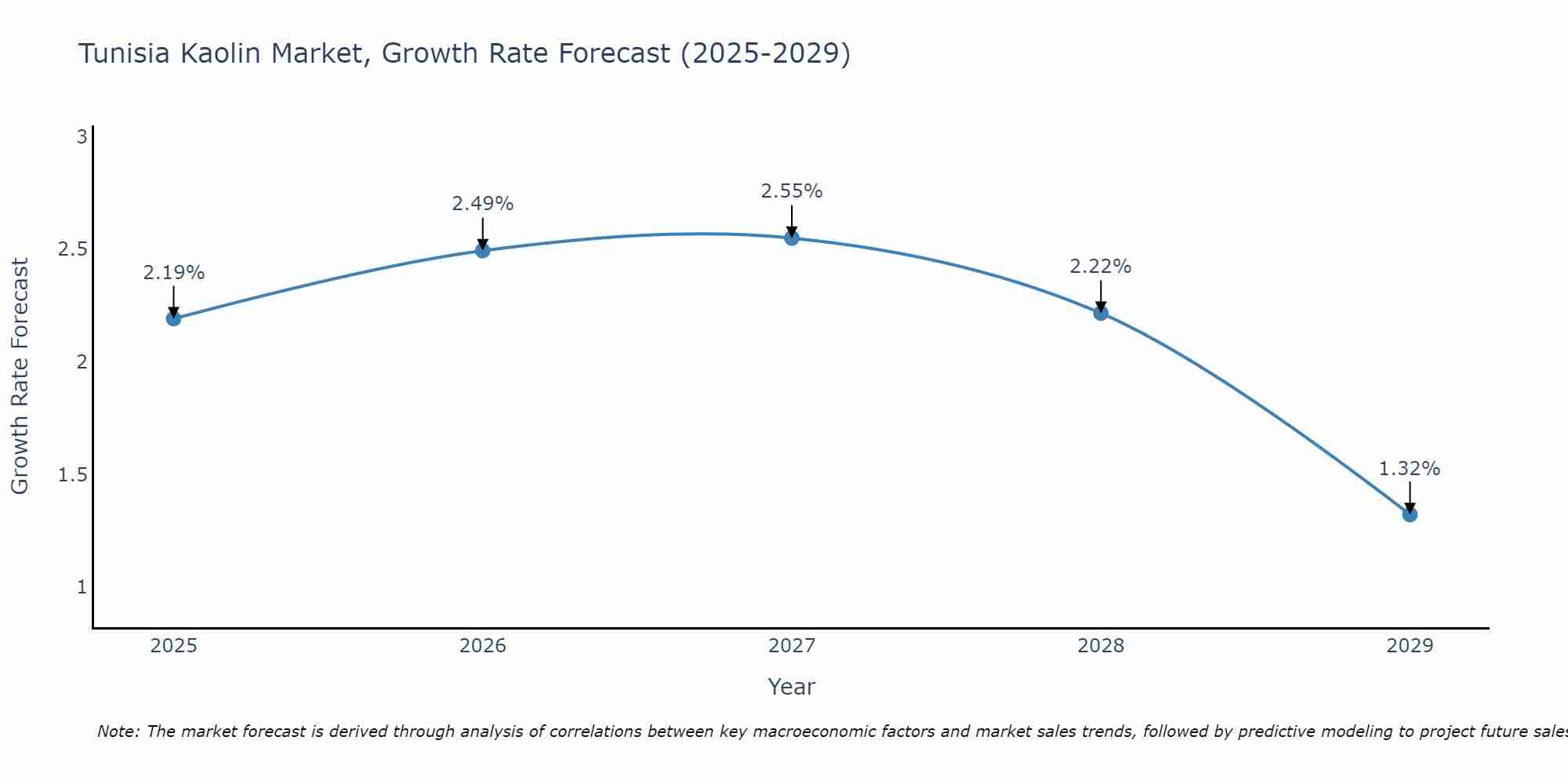
The Tunisia Kaolin Market is projected to witness mixed growth rate patterns during 2025 to 2029. The growth rate begins at 2.19% in 2025, climbs to a high of 2.55% in 2027, and moderates to 1.32% by 2029.
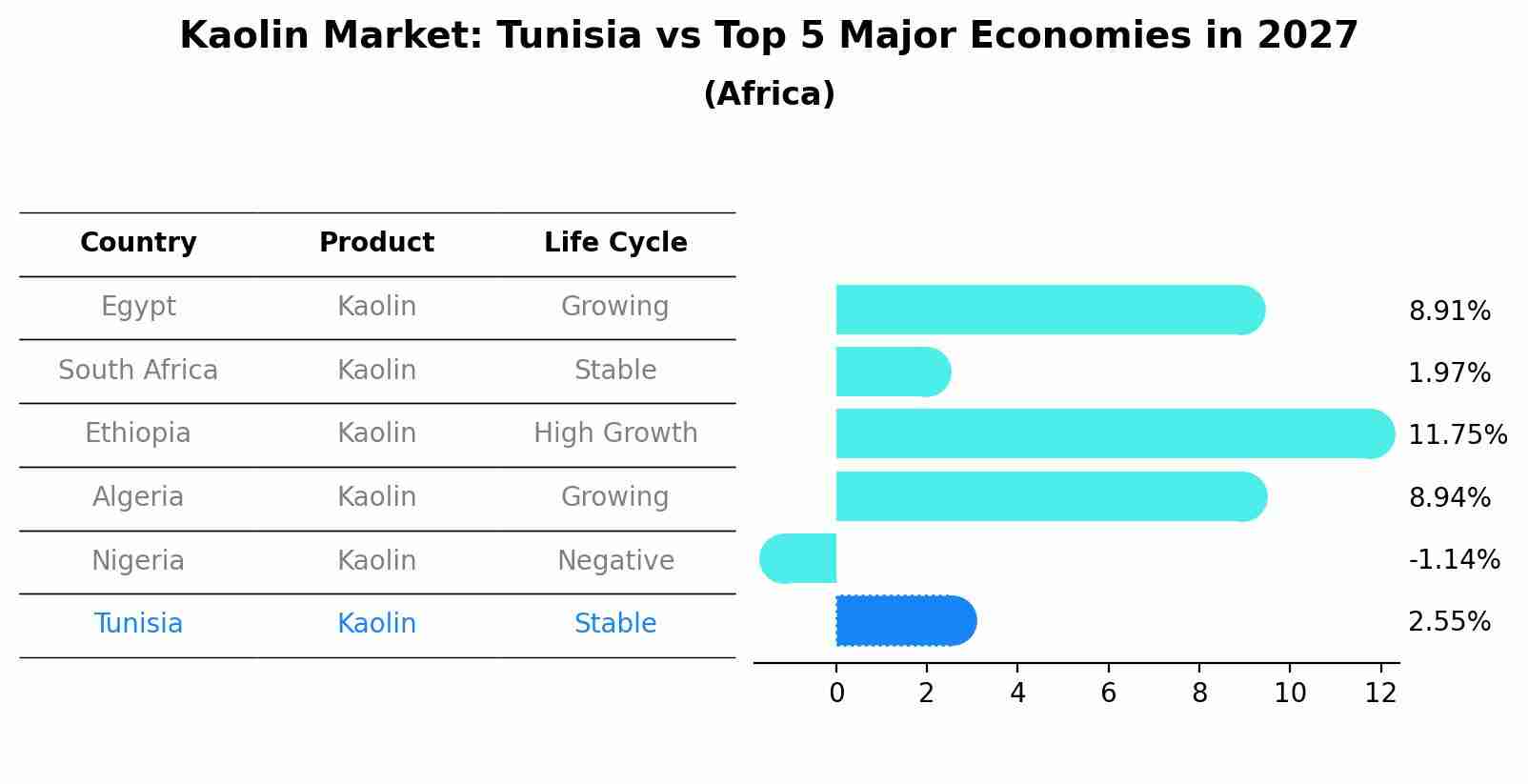
Kaolin Market: Tunisia vs Top 5 Major Economies in 2027 (Africa)
Tunisia's Kaolin market is anticipated to experience a stable growth rate of 2.55% by 2027, reflecting trends observed in the largest economy Egypt, followed by South Africa, Ethiopia, Algeria and Nigeria.
Tunisia Kaolin Market Overview
Tunisia`s kaolin market is evolving with industrial applications in ceramics, paper coatings, and pharmaceutical formulations, focusing on whiteness, viscosity control, and inert properties of kaolin minerals. Market growth is driven by mineral mining activities, export opportunities, and research on kaolin`s applications in advanced materials and environmental technologies.
Drivers of the market
The kaolin market in Tunisia is expanding with ceramics, papermaking, and demand for white clay minerals in paints, coatings, and pharmaceuticals. Kaolin offers opacity, gloss enhancement, and suspension properties in various applications, including porcelain production, industrial coatings, and pharmaceutical formulations. Demand for high-quality pigments, engineered materials, and sustainable production practices drives kaolin consumption, supporting market growth and technological advancements in Tunisia`s mineral processing and industrial sectors.
Challenges of the market
The Kaolin market in Tunisia confronts challenges related to mineral extraction and market competitiveness. Mining and processing kaolin for ceramics, paper, and cosmetics industries require overcoming geological complexities and environmental impact assessments. Moreover, addressing market fluctuations and industrial demand influence kaolin production and export opportunities in the global market.
Government Policy of the market
Policies encourage sustainable mining practices and value-added processing of kaolin, supporting industrial applications in ceramics, paper, and pharmaceuticals while ensuring environmental protection and community benefits.
Key Highlights of the Report:
- Tunisia Kaolin Market Outlook
- Market Size of Tunisia Kaolin Market, 2024
- Forecast of Tunisia Kaolin Market, 2031
- Historical Data and Forecast of Tunisia Kaolin Revenues & Volume for the Period 2018 - 2031
- Tunisia Kaolin Market Trend Evolution
- Tunisia Kaolin Market Drivers and Challenges
- Tunisia Kaolin Price Trends
- Tunisia Kaolin Porter's Five Forces
- Tunisia Kaolin Industry Life Cycle
- Historical Data and Forecast of Tunisia Kaolin Market Revenues & Volume By Process for the Period 2018 - 2031
- Historical Data and Forecast of Tunisia Kaolin Market Revenues & Volume By Water-washed for the Period 2018 - 2031
- Historical Data and Forecast of Tunisia Kaolin Market Revenues & Volume By Airfloat for the Period 2018 - 2031
- Historical Data and Forecast of Tunisia Kaolin Market Revenues & Volume By Calcined for the Period 2018 - 2031
- Historical Data and Forecast of Tunisia Kaolin Market Revenues & Volume By Delaminated for the Period 2018 - 2031
- Historical Data and Forecast of Tunisia Kaolin Market Revenues & Volume By Surface-modified & Unprocessed for the Period 2018 - 2031
- Historical Data and Forecast of Tunisia Kaolin Market Revenues & Volume By End-users for the Period 2018 - 2031
- Historical Data and Forecast of Tunisia Kaolin Market Revenues & Volume By Ceramics & Sanitarywares for the Period 2018 - 2031
- Historical Data and Forecast of Tunisia Kaolin Market Revenues & Volume By Fiberglass for the Period 2018 - 2031
- Historical Data and Forecast of Tunisia Kaolin Market Revenues & Volume By Paints & Coatings for the Period 2018 - 2031
- Historical Data and Forecast of Tunisia Kaolin Market Revenues & Volume By Rubber for the Period 2018 - 2031
- Historical Data and Forecast of Tunisia Kaolin Market Revenues & Volume By Adhesives & Sealants for the Period 2018 - 2031
- Historical Data and Forecast of Tunisia Kaolin Market Revenues & Volume By Plastics for the Period 2018 - 2031
- Historical Data and Forecast of Tunisia Kaolin Market Revenues & Volume By Others for the Period 2018 - 2031
- Tunisia Kaolin Import Export Trade Statistics
- Market Opportunity Assessment By Process
- Market Opportunity Assessment By End-users
- Tunisia Kaolin Top Companies Market Share
- Tunisia Kaolin Competitive Benchmarking By Technical and Operational Parameters
- Tunisia Kaolin Company Profiles
- Tunisia Kaolin Key Strategic Recommendations






































