Tunisia Letterpress Printing Machinery Market Size, Share & Growth Rate
The Tunisia Letterpress Printing Machinery Market was estimated at USD 1218 Million in 2025 and is projected to reach USD 1738 Million by 2032, growing at a CAGR of 5.2% from 2026 to 2032. This growth trajectory is largely fueled by the escalating demand for high-quality, customizable printing solutions among businesses. As brands increasingly recognize the power of distinctive printed materials in marketing and packaging, the letterpress segment stands to benefit significantly from this trend.
Tunisia Letterpress Printing Machinery Market Year-wise Growth Rate and Key Drivers
This graph highlights how the Tunisia Letterpress Printing Machinery Market has steadily grown over the years, supported by major growth factors.
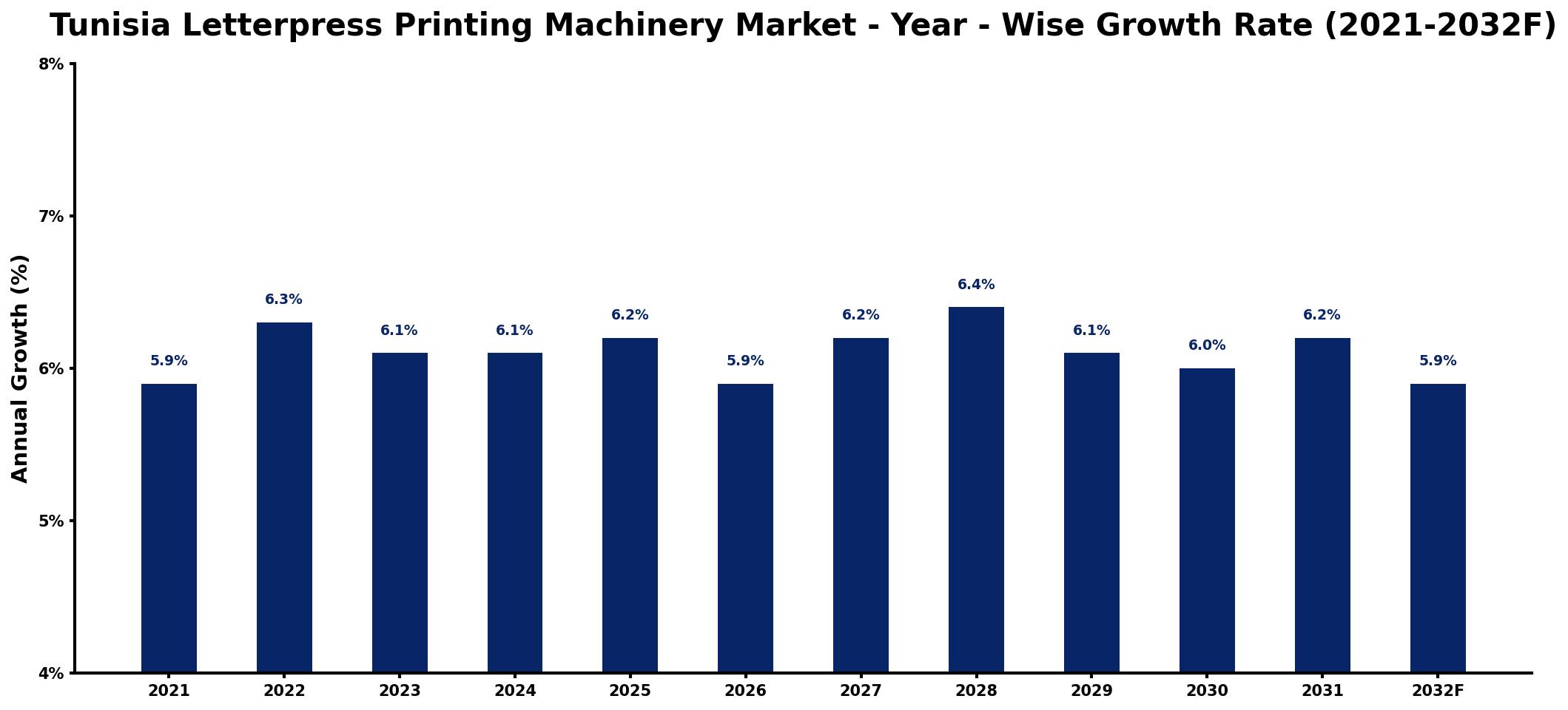
The table below presents the year‑wise growth rates along with the key drivers influencing the market
| Year | Growth Rate | Major Drivers |
| 2021 | 5.9% | rising demand from packaging sector |
| 2022 | 6.3% | growth in local advertising spend |
| 2023 | 6.1% | expansion of small businesses market |
| 2024 | 6.1% | increased investments in technology |
| 2025 | 6.2% | higher consumer interest in customization |
| 2026 | 5.9% | growing eco-friendly product trends |
| 2027 | 6.2% | emergence of online retail platforms |
| 2028 | 6.4% | advancements in digital integration solutions |
| 2029 | 6.1% | increased production capacity requirements |
| 2030 | 6.0% | strengthening regional trade agreements |
| 2031 | 6.2% | enhanced focus on artisanal products |
| 2032 | 5.9% | rising popularity of local crafts |
Note: Market size estimations and growth projections presented in this report are based on 6Wresearch's proprietary forecasting methodology, utilizing the latest available industry data, government publications, and primary research inputs.
Tunisia Letterpress Printing Machinery Market Synopsis
The Tunisia Letterpress Printing Machinery Market has shown promising momentum recently, driven by technological advancements and a shift in consumer preferences towards bespoke printing solutions. As traditional methods blend with modern technology, the market is poised for dynamic evolution, catering to the unique needs of various sectors.
Looking ahead, the market is expected to embrace increased automation and eco-friendly practices, further enhancing its appeal. This progressive outlook is bolstered by growing consumer interest in personalized products, which will likely stimulate demand for letterpress machinery that offers exceptional craftsmanship.
Tunisia Letterpress Printing Machinery Market Key Takeaways
- The market is expanding due to the increasing focus on customized printing solutions.
- Technological innovations are enhancing operational efficiencies in letterpress printing.
- Sustainable practices are becoming essential in attracting environmentally-conscious clients.
- Investment opportunities are emerging in response to rising demand across various sectors.
- The supportive government policies are fostering growth and innovation within the industry.
Evaluation of Restraints in Tunisia Letterpress Printing Machinery Market
Despite the promising outlook, the Tunisia Letterpress Printing Machinery Market faces certain constraints. The rapid rise of digital printing technologies poses a challenge, as these options often provide quicker and more cost-effective solutions for businesses. Additionally, the initial investment required for letterpress machinery can be substantial, which may deter smaller enterprises from entering the market. The scarcity of skilled operators further compounds these issues, as businesses struggle to find personnel capable of operating and maintaining traditional letterpress equipment.
Tunisia Letterpress Printing Machinery Market Trends
Several current and emerging trends are shaping the landscape of the Tunisia Letterpress Printing Machinery Market. A notable shift is the increasing preference for digital letterpress printing equipment, which allows for faster turnaround times and greater design flexibility. Furthermore, the emphasis on eco-friendly printing practices is prompting demand for machinery that minimizes waste and uses sustainable materials. This focus on environmental responsibility is resonating with consumers and businesses alike, driving innovation in the sector.
Tunisia Letterpress Printing Machinery Market Opportunities
The market presents a wealth of investment opportunities, primarily due to the rising demand for sophisticated printing solutions across packaging, branding, and publishing. By investing in cutting-edge letterpress machinery, businesses can significantly enhance their printing capabilities, thereby meeting the diverse requirements of their clients. Additionally, as governmental support for the manufacturing sector intensifies, investors are encouraged to explore the advantageous landscape of Tunisia's printing industry.
Government Initiatives in the Tunisia Letterpress Printing Machinery Market
The Tunisian government has adopted various policies aimed at bolstering the Letterpress Printing Machinery Market. Measures include import restrictions and tariffs to safeguard local manufacturers while encouraging domestic production. The government also offers incentives, such as tax breaks and subsidies, to stimulate investment in the sector. Furthermore, stringent regulations are in place to ensure compliance with quality and environmental standards, promoting sustainable practices among local businesses.
Future Insights of the Tunisia Letterpress Printing Machinery Market
The future of the Tunisia Letterpress Printing Machinery Market appears bright, driven by the increasing demand for high-quality printed materials in various sectors. Anticipated technological advancements are likely to improve efficiency, drawing more businesses toward adopting modern letterpress solutions. Additionally, the ongoing trend of personalization in printed products will further propel market growth, as the unique attributes of letterpress printing cater to consumer desires for distinctiveness and quality. Overall, the market is set for steady growth, presenting numerous opportunities for stakeholders.
Tunisia Letterpress Printing Machinery Market Latest Developments (2025 - 2026)
Recent industry developments indicate a progressive move towards enhancing automation in letterpress printing processes. Companies are increasingly integrating advanced technologies to streamline production and reduce turnaround times. Furthermore, there is growing awareness among businesses about the benefits of incorporating sustainable practices, leading to increased demand for machinery that aligns with eco-friendly principles. As these trends continue, the landscape of the Tunisia Letterpress Printing Machinery Market is likely to evolve significantly.
Tunisia Letterpress Printing Machinery Market - Key Attractiveness of the Report
- 10 Years of Market Numbers
- Historical Data Starting from 2022 to 2025
- Base Year: 2025
- Forecast Data until 2032
- Key Performance Indicators Impacting the Market
- Major Upcoming Developments and Projects
Key Highlights of the Report:
- Tunisia Letterpress Printing Machinery Market Outlook
- Market Size of Tunisia Letterpress Printing Machinery Market, 2025
- Forecast of Tunisia Letterpress Printing Machinery Market, 2032
- Historical Data and Forecast of Tunisia Letterpress Printing Machinery Revenues & Volume for the Period 2022-2032F
- Tunisia Letterpress Printing Machinery Market Trend Evolution
- Tunisia Letterpress Printing Machinery Market Drivers and Challenges
- Tunisia Letterpress Printing Machinery Price Trends
- Tunisia Letterpress Printing Machinery Porter's Five Forces
- Tunisia Letterpress Printing Machinery Industry Life Cycle
- Historical Data and Forecast of Tunisia Letterpress Printing Machinery Market Revenues & Volume By Type for the Period 2022-2032F
- Historical Data and Forecast of Tunisia Letterpress Printing Machinery Market Revenues & Volume By Rotary Letterpress Machine for the Period 2022-2032F
- Historical Data and Forecast of Tunisia Letterpress Printing Machinery Market Revenues & Volume By Other for the Period 2022-2032F
- Historical Data and Forecast of Tunisia Letterpress Printing Machinery Market Revenues & Volume By Application for the Period 2022-2032F
- Historical Data and Forecast of Tunisia Letterpress Printing Machinery Market Revenues & Volume By Securities for the Period 2022-2032F
- Historical Data and Forecast of Tunisia Letterpress Printing Machinery Market Revenues & Volume By Invitation Card for the Period 2022-2032F
- Historical Data and Forecast of Tunisia Letterpress Printing Machinery Market Revenues & Volume By Other for the Period 2022-2032F
- Tunisia Letterpress Printing Machinery Import Export Trade Statistics
- Market Opportunity Assessment By Type
- Market Opportunity Assessment By Application
- Tunisia Letterpress Printing Machinery Top Companies Market Share
- Tunisia Letterpress Printing Machinery Competitive Benchmarking By Technical and Operational Parameters
- Tunisia Letterpress Printing Machinery Company Profiles
- Tunisia Letterpress Printing Machinery Key Strategic Recommendations






































