Tunisia Licensed Merchandise Market Size, Share & Growth Rate
The Tunisia Licensed Merchandise Market was estimated at USD 459 Million in 2025 and is projected to reach USD 665 Million by 2032, growing at a CAGR of 5.4% from 2026 to 2032. This growth trajectory is primarily fueled by an increasing disposable income among consumers, allowing for greater expenditure on branded products. Additionally, the rising influence of international entertainment franchises and local collaborations adds to the appeal of licensed merchandise, driving consumer demand across diverse demographics.
Tunisia Licensed Merchandise Market Year-wise Growth Rate and Key Drivers
This graph highlights how the Tunisia Licensed Merchandise Market has steadily grown over the years, supported by major growth factors.
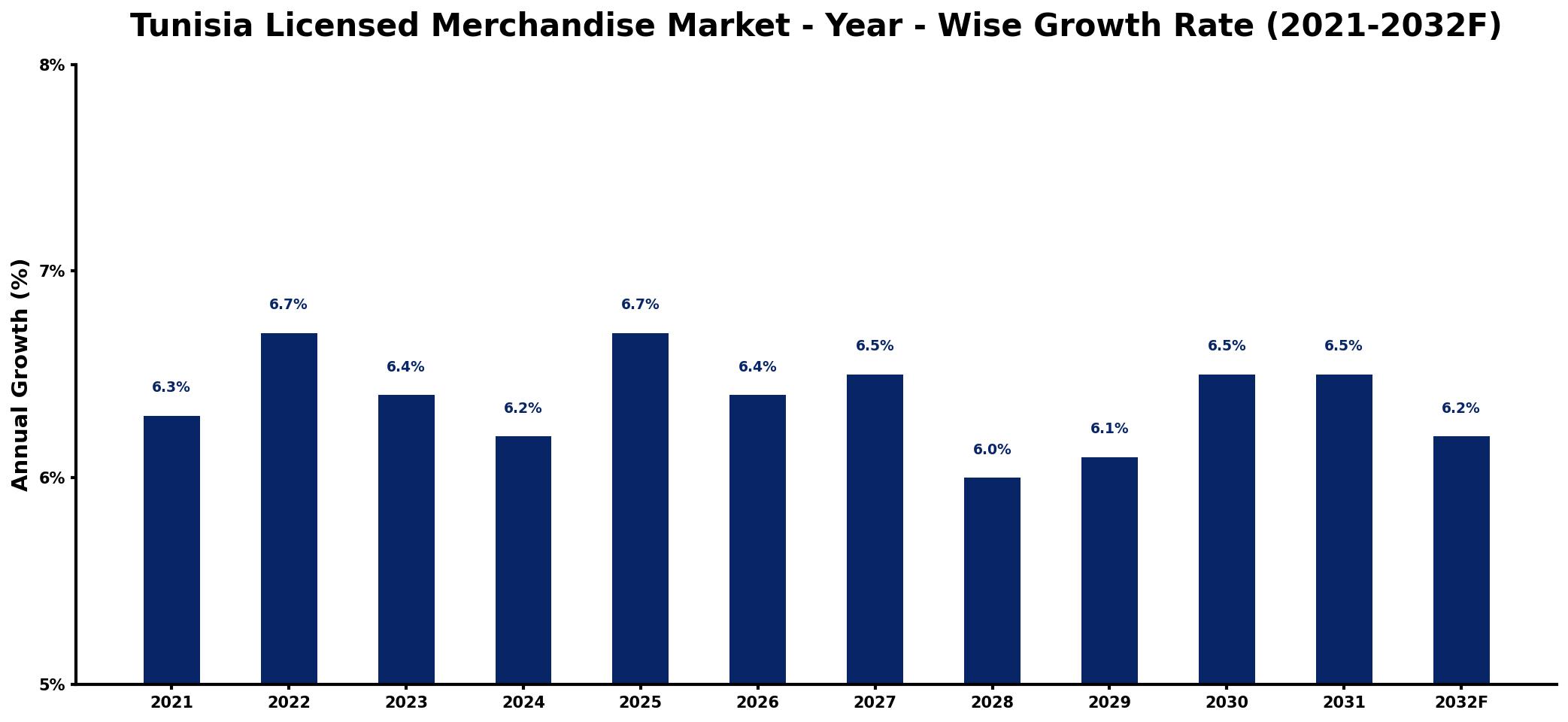
The table below presents the year‑wise growth rates along with the key drivers influencing the market
| Year | Growth Rate | Major Drivers |
| 2021 | 6.3% | increased consumer spending habits |
| 2022 | 6.7% | growing popularity of collectibles |
| 2023 | 6.4% | expansion in retail partnerships |
| 2024 | 6.2% | rising interest in branded apparel |
| 2025 | 6.7% | enhanced digital marketing strategies |
| 2026 | 6.4% | growth in youth engagement initiatives |
| 2027 | 6.5% | increased sponsorship and endorsements |
| 2028 | 6.0% | expansion of online sales channels |
| 2029 | 6.1% | increased collaboration with influencers |
| 2030 | 6.5% | growing demand for unique experiences |
| 2031 | 6.5% | rising trend of personalization services |
| 2032 | 6.2% | increased investment in innovative designs |
Note: Market size estimations and growth projections presented in this report are based on 6Wresearch's proprietary forecasting methodology, utilizing the latest available industry data, government publications, and primary research inputs.
Tunisia Licensed Merchandise Market Synopsis
In recent years, Tunisia has witnessed a notable shift in consumer behavior towards licensed merchandise, with a growing appetite for products that showcase beloved characters and brands. This trend is significantly bolstered by the proliferation of e-commerce platforms, which have made licensed items more accessible than ever before.
Furthermore, the market is characterized by an increasing number of collaborations between local artisans and global licensors. These partnerships facilitate the creation of culturally resonant merchandise, aligning global trends with local tastes, thus enhancing the market's appeal.
Tunisia Licensed Merchandise Market Key Takeaways
- The market is expanding rapidly due to heightened consumer interest in branded products.
- Collaboration between local and international brands is fostering innovative merchandise solutions.
- Increasing awareness of licensed products is being driven by social media influencers and digital marketing.
- Investment opportunities exist in various sectors, including fashion, entertainment, and sports licensing.
- Government initiatives are aimed at strengthening intellectual property protections to combat counterfeiting.
Evaluation of Restraints in Tunisia Licensed Merchandise Market
Despite its growth potential, the Tunisia Licensed Merchandise Market faces significant challenges. A major concern is the rampant presence of counterfeit products, which undermines legitimate brands and revenues. This is compounded by the weak enforcement of intellectual property rights in the country, making it increasingly difficult for brands to protect their identities. Additionally, some consumers still prioritize lower-cost generic items over licensed merchandise, which can stifle market expansion. Addressing these issues will be crucial for fostering a healthy, competitive environment.
Tunisia Licensed Merchandise Market Trends
The licensed merchandise market in Tunisia is undergoing significant transformation, influenced by contemporary consumer preferences. One notable trend is the increasing focus on sustainability; consumers are gravitating towards eco-friendly and ethically produced licensed products. Moreover, the rise of digital platforms and social media has enabled brands to engage directly with fans, driving personalized marketing initiatives. Collaborations with local culture icons and events are also gaining traction, enhancing the cultural relevance of licensed merchandise.
Tunisia Licensed Merchandise Market Opportunities
Investment opportunities abound within the Tunisia Licensed Merchandise Market, particularly in sectors like fashion and entertainment. Local manufacturers can forge partnerships with international licensors to introduce popular global brands to Tunisian consumers. There is also potential for creating unique products that reflect Tunisian culture, thus appealing to national pride. Licensing agreements tied to major events and local heritage sites offer avenues for further growth, tapping into a burgeoning market eager for culturally significant merchandise.
Government Initiatives in the Tunisia Licensed Merchandise Market
The Tunisian government is actively working to enhance the licensing landscape through initiatives aimed at bolstering intellectual property rights. Legislative measures are in place to protect trademarks, copyrights, and patents, thereby ensuring that licensed merchandise is produced and marketed legally. Additionally, government support for partnerships between local businesses and international licensors aims to increase the range of available licensed products, stimulating innovation and economic growth in this sector.
Future Insights of the Tunisia Licensed Merchandise Market
Looking ahead to 2026-2032, the Tunisia Licensed Merchandise Market is poised for continued expansion. The increasing popularity of licensed products, especially in entertainment and sports, will be a key growth driver. Companies are expected to invest significantly in licensing agreements as they seek to leverage well-known intellectual properties. The growth of the middle-class population and the rise of e-commerce will further catalyze consumer spending on licensed merchandise, indicating a favorable environment for both domestic and international players.
Tunisia Licensed Merchandise Market Latest Developments (2025 - 2026)
Recent developments within the Tunisia Licensed Merchandise Market indicate a marked increase in collaboration among local designers and international licensors. Additionally, several events focused on promoting licensed products have been organized, enhancing consumer engagement and awareness. The market is also witnessing an influx of new eco-friendly product lines, aligning with the increasing consumer demand for sustainability and ethical sourcing.
Tunisia Licensed Merchandise Market - Key Attractiveness of the Report
- 10 Years of Market Numbers
- Historical Data Starting from 2022 to 2025
- Base Year: 2025
- Forecast Data until 2032
- Key Performance Indicators Impacting the Market
- Major Upcoming Developments and Projects
Key Highlights of the Report:
- Tunisia Licensed Merchandise Market Outlook
- Market Size of Tunisia Licensed Merchandise Market, 2025
- Forecast of Tunisia Licensed Merchandise Market, 2032
- Historical Data and Forecast of Tunisia Licensed Merchandise Revenues & Volume for the Period 2022-2032F
- Tunisia Licensed Merchandise Market Trend Evolution
- Tunisia Licensed Merchandise Market Drivers and Challenges
- Tunisia Licensed Merchandise Price Trends
- Tunisia Licensed Merchandise Porter's Five Forces
- Tunisia Licensed Merchandise Industry Life Cycle
- Historical Data and Forecast of Tunisia Licensed Merchandise Market Revenues & Volume By Product Type for the Period 2022-2032F
- Historical Data and Forecast of Tunisia Licensed Merchandise Market Revenues & Volume By Apparel and Footwear for the Period 2022-2032F
- Historical Data and Forecast of Tunisia Licensed Merchandise Market Revenues & Volume By Accessories and Gifts for the Period 2022-2032F
- Historical Data and Forecast of Tunisia Licensed Merchandise Market Revenues & Volume By Toys and Games for the Period 2022-2032F
- Historical Data and Forecast of Tunisia Licensed Merchandise Market Revenues & Volume By Others for the Period 2022-2032F
- Historical Data and Forecast of Tunisia Licensed Merchandise Market Revenues & Volume By for the Period 2022-2032F
- Historical Data and Forecast of Tunisia Licensed Merchandise Market Revenues & Volume By Distribution Channel for the Period 2022-2032F
- Historical Data and Forecast of Tunisia Licensed Merchandise Market Revenues & Volume By Online Stores for the Period 2022-2032F
- Historical Data and Forecast of Tunisia Licensed Merchandise Market Revenues & Volume By Supermarkets and Hypermarkets for the Period 2022-2032F
- Historical Data and Forecast of Tunisia Licensed Merchandise Market Revenues & Volume By Departmental Stores for the Period 2022-2032F
- Historical Data and Forecast of Tunisia Licensed Merchandise Market Revenues & Volume By Specialty Stores for the Period 2022-2032F
- Historical Data and Forecast of Tunisia Licensed Merchandise Market Revenues & Volume By Others for the Period 2022-2032F
- Historical Data and Forecast of Tunisia Licensed Merchandise Market Revenues & Volume By for the Period 2022-2032F
- Historical Data and Forecast of Tunisia Licensed Merchandise Market Revenues & Volume By Price Range for the Period 2022-2032F
- Historical Data and Forecast of Tunisia Licensed Merchandise Market Revenues & Volume By Premium for the Period 2022-2032F
- Historical Data and Forecast of Tunisia Licensed Merchandise Market Revenues & Volume By Economic for the Period 2022-2032F
- Historical Data and Forecast of Tunisia Licensed Merchandise Market Revenues & Volume By for the Period 2022-2032F
- Historical Data and Forecast of Tunisia Licensed Merchandise Market Revenues & Volume By End-User for the Period 2022-2032F
- Historical Data and Forecast of Tunisia Licensed Merchandise Market Revenues & Volume By Men for the Period 2022-2032F
- Historical Data and Forecast of Tunisia Licensed Merchandise Market Revenues & Volume By Women for the Period 2022-2032F
- Historical Data and Forecast of Tunisia Licensed Merchandise Market Revenues & Volume By Children for the Period 2022-2032F
- Tunisia Licensed Merchandise Import Export Trade Statistics
- Market Opportunity Assessment By Product Type
- Market Opportunity Assessment By Distribution Channel
- Market Opportunity Assessment By Price Range
- Market Opportunity Assessment By End-User
- Tunisia Licensed Merchandise Top Companies Market Share
- Tunisia Licensed Merchandise Competitive Benchmarking By Technical and Operational Parameters
- Tunisia Licensed Merchandise Company Profiles
- Tunisia Licensed Merchandise Key Strategic Recommendations






































