Tunisia LTE IoT Market Size & Growth Rate (2026-2032)
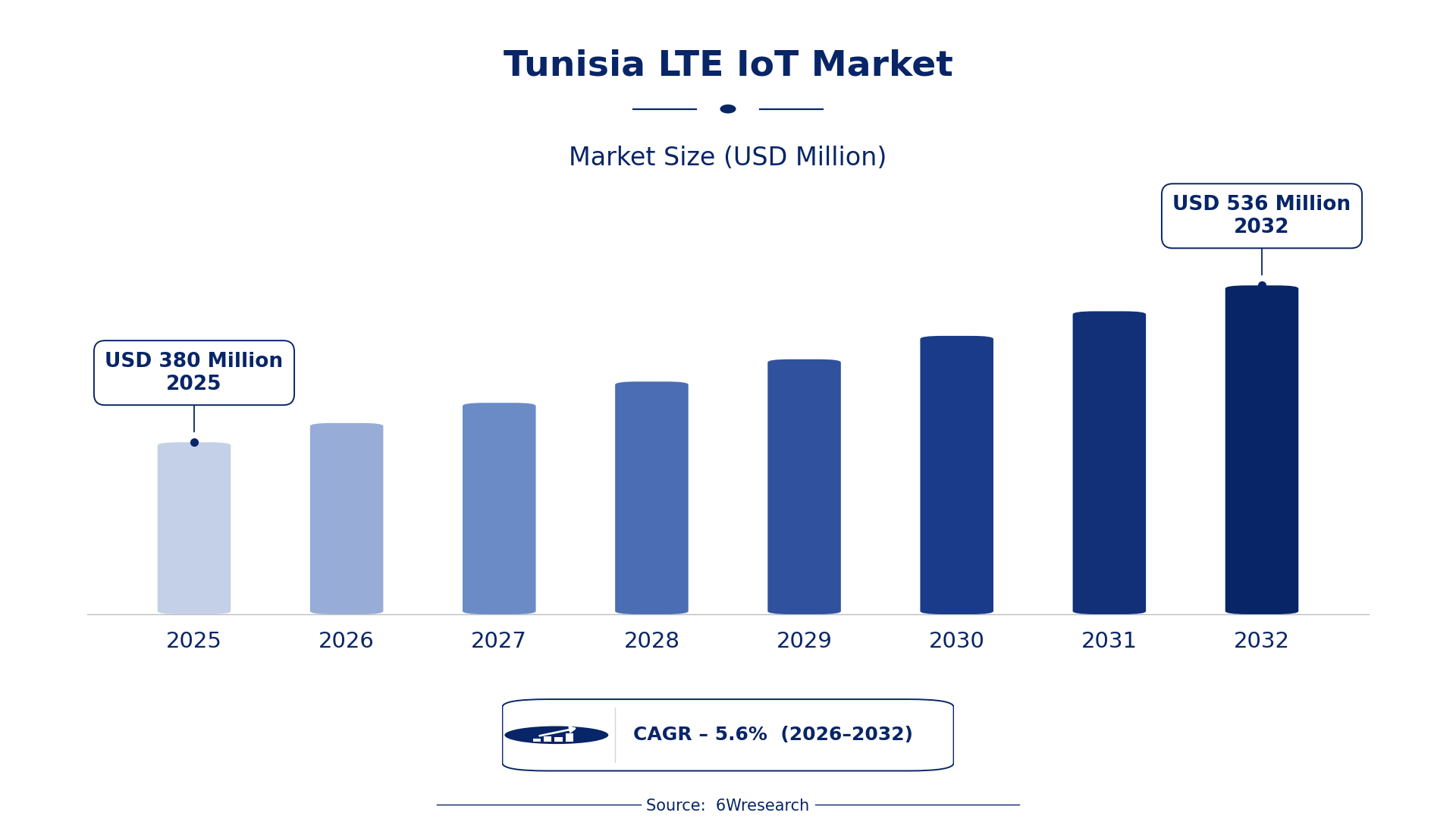
The Tunisia LTE IoT Market was estimated at USD 380 Million in 2025 and is projected to reach USD 536 Million by 2032, growing at a CAGR of 5.6% from 2026 to 2032.
Tunisia LTE IoT Market Synopsis
The primary driver for the Tunisia LTE IoT market is the increasing adoption of IoT applications across diverse industries. Sectors like agriculture, healthcare, and transportation are actively embracing LTE technology, enhancing their operational efficiencies and connectivity.
As telecom operators invest heavily in LTE infrastructure, the market gains momentum. Smart city initiatives and industrial IoT solutions are significant contributors to this growth, indicating a vital shift toward digital transformation in Tunisia's economic landscape.
Tunisia LTE IoT Market Year-wise Growth Rate and Key Drivers
This graph illustrates the annual growth rates of the Tunisia LTE IoT Market from 2021 to 2032, highlighting a steady upward trajectory and projected expansion over the forecast period.
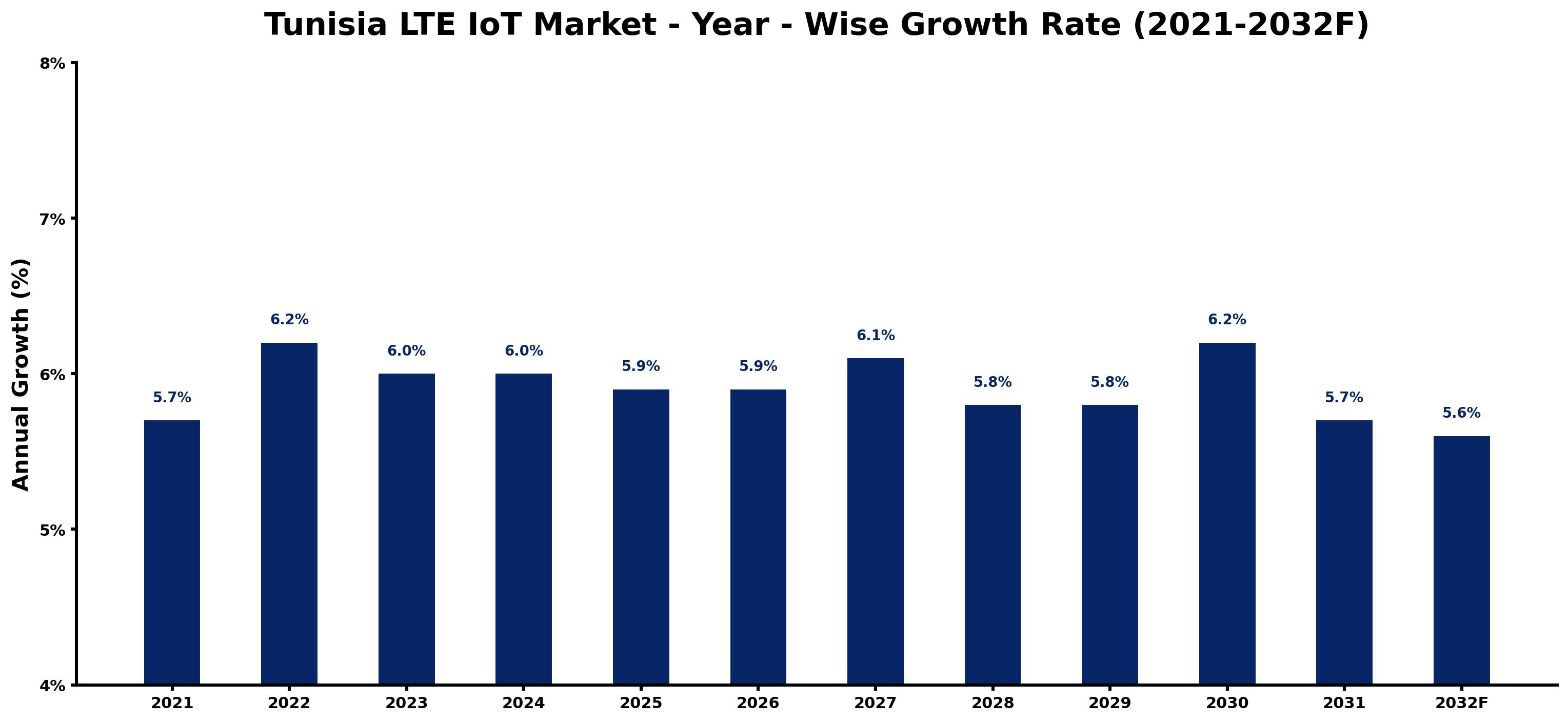
The table below presents the year‑wise growth rates along with the key drivers influencing the market
| Year | Growth Rate | Major Drivers |
| 2021 | 5.7% | Launch of Tunisia's national IoT strategy by ATT. |
| 2022 | 6.2% | Increased demand for smart agriculture IoT solutions. |
| 2023 | 6.0% | Regulatory support for IoT-enabled smart city initiatives. |
| 2024 | 6.0% | Government investment in digital health IoT applications. |
| 2025 | 5.9% | Growing adoption of connected logistics in transportation. |
| 2026 | 5.9% | Rise in mobile connectivity fostering IoT development. |
| 2027 | 6.1% | Corporate partnerships enhancing IoT deployment in retail. |
| 2028 | 5.8% | Focus on renewable energy IoT solutions for efficiency. |
| 2029 | 5.8% | Increased penetration of LTE networks facilitating IoT growth. |
| 2030 | 6.2% | Enhanced cybersecurity regulations supporting IoT market confidence. |
| 2031 | 5.7% | Emerging telecommunication infrastructure boosting IoT access. |
| 2032 | 5.6% | Rising local tech startups focusing on IoT innovations. |
Note: Market size estimations and growth projections presented in this report are based on 6Wresearch's proprietary forecasting methodology, utilizing the latest available industry data, government publications, and primary research inputs.
Tunisia LTE IoT Market Key Takeaways
Below are some of the specific key takeaways from the market, including:
- The market is expanding rapidly, with substantial investment in IoT infrastructure.
- Key sectors like healthcare and agriculture are pioneering the adoption of LTE IoT solutions.
- The government is supportive of digital initiatives, enhancing the regulatory environment.
- Security and privacy concerns are prompting a focus on robust IoT network measures.
- Emerging technologies, including LTE-M and NB-IoT, are improving deployment efficiency.
Evaluation of Restraints in Tunisia LTE IoT Market
Several factors currently limit the potential of the Tunisia LTE IoT market. Limited network coverage, particularly in rural regions, hampers widespread adoption. High initial deployment costs for IoT solutions deter potential investors and users alike. There is also a pressing need for skilled professionals who can effectively manage and maintain IoT infrastructures. Issues related to interoperability among different IoT devices often disrupt seamless connectivity, which is crucial for real-time data exchange. Lastly, data privacy and security vulnerabilities remain key concerns that need addressing to gain consumer trust and facilitate broader IoT integration.
Tunisia LTE IoT Market Trends
Currently, the demand for connected devices is on the rise, leading to increased deployment of LTE networks tailored to meet specific IoT application needs. Smart city projects are gaining traction, utilizing LTE technology for various urban solutions. There’s also a growing emphasis on enhancing security measures, driven by the need to protect data from rising cyber threats. Importantly, the advancement of technologies like LTE-M and NB-IoT is making IoT deployments more efficient and cost-effective for businesses across Tunisia.
Tunisia LTE IoT Market Opportunities
Significant investment opportunities lie within smart city projects that utilize LTE IoT technology to modernize urban infrastructure. Furthermore, sectors such as agriculture and healthcare stand to gain immensely from tailored IoT solutions aimed at boosting productivity. Other viable areas for investment include the expansion of LTE network infrastructure and the development of IoT devices and services specifically designed for local market needs. The supportive governmental initiatives pushing for digital transformation make this market particularly attractive for both local and international investors.
Government Initiatives in the Tunisia LTE IoT Market
The Tunisian government plays a crucial role in shaping the LTE IoT market by fostering a favorable regulatory environment. Focused on digital transformation, authorities are working to enhance infrastructure, allocate necessary spectrum, and encourage innovation. Recent cybersecurity measures are also gaining attention, as they seek to build consumer trust and ensure data privacy amid increasing technological integration.
- A national digital infrastructure upgrade program was recently completed, enhancing connectivity nationwide.
- The Ministry of Communication Technologies and Digital Economy is currently implementing initiatives to promote IoT innovation across various sectors.
- Planned regulations set to be introduced by 2026 aim to standardize IoT technology deployment and bolster security protocols.
- Ongoing public-private partnerships are focused on expanding network access and improving IoT service delivery in rural areas.
- The government is facilitating a national IoT conference in 2025 to encourage industry collaboration and knowledge sharing.
Future Insights of the Tunisia LTE IoT Market
As we look ahead to 2026-2032, the Tunisia LTE IoT market is set for remarkable growth. The expansion of LTE networks combined with an increasing demand for connected devices will drive this growth forward. Key sectors such as agriculture, healthcare, and smart cities will continue to be at the forefront of this transformation. Furthermore, ongoing government initiatives aimed at promoting digital innovation will play a pivotal role in shaping the future of the LTE IoT landscape in Tunisia, presenting lucrative opportunities for stakeholders.
Tunisia LTE IoT Market Latest Developments
In the last 12-14 months, the Tunisia LTE IoT market has witnessed several notable developments that highlight its dynamic nature. Increased investments in LTE infrastructure and emerging technologies are reshaping how businesses implement IoT solutions across various sectors. Telecom operators are actively expanding their networks to accommodate growing demand, and new partnerships are being forged to innovate IoT applications.
- A major telecom operator launched a nationwide LTE-M network in early 2025, enhancing connectivity for IoT devices.
- In Q2 2025, a collaboration was announced between tech firms aimed at developing smart agricultural solutions leveraging LTE IoT technology.
- A healthcare provider is currently implementing an IoT-based patient monitoring system, expected to be fully operational by late 2025.
- Plans are underway for a smart city pilot project set to begin in mid-2026, focusing on traffic management through IoT applications.
- Ongoing training initiatives to develop local talent in IoT management started in early 2025 and are designed to alleviate the skills gap in the sector.
Tunisia LTE IoT Market - Key Attractiveness of the Report
- 10 Years of Market Numbers
- Historical Data Starting from 2022 to 2025
- Base Year: 2025
- Forecast Data until 2032
- Key Performance Indicators Impacting the Market
- Major Upcoming Developments and Projects
Key Highlights of the Report:
- Tunisia LTE IoT Market Outlook
- Market Size of Tunisia LTE IoT Market, 2025
- Forecast of Tunisia LTE IoT Market, 2032
- Historical Data and Forecast of Tunisia LTE IoT Revenues & Volume for the Period 2022-2032F
- Tunisia LTE IoT Market Trend Evolution
- Tunisia LTE IoT Market Drivers and Challenges
- Tunisia LTE IoT Price Trends
- Tunisia LTE IoT Porter's Five Forces
- Tunisia LTE IoT Industry Life Cycle
- Historical Data and Forecast of Tunisia LTE IoT Market Revenues & Volume By Technology for the Period 2022-2032F
- Historical Data and Forecast of Tunisia LTE IoT Market Revenues & Volume By NB-IoT for the Period 2022-2032F
- Historical Data and Forecast of Tunisia LTE IoT Market Revenues & Volume By LTE-M for the Period 2022-2032F
- Historical Data and Forecast of Tunisia LTE IoT Market Revenues & Volume By Service for the Period 2022-2032F
- Historical Data and Forecast of Tunisia LTE IoT Market Revenues & Volume By Professional Services for the Period 2022-2032F
- Historical Data and Forecast of Tunisia LTE IoT Market Revenues & Volume By Managed Services for the Period 2022-2032F
- Historical Data and Forecast of Tunisia LTE IoT Market Revenues & Volume By Industry for the Period 2022-2032F
- Historical Data and Forecast of Tunisia LTE IoT Market Revenues & Volume By Manufacturing for the Period 2022-2032F
- Historical Data and Forecast of Tunisia LTE IoT Market Revenues & Volume By Energy and utilities for the Period 2022-2032F
- Historical Data and Forecast of Tunisia LTE IoT Market Revenues & Volume By Transportation and logistics for the Period 2022-2032F
- Historical Data and Forecast of Tunisia LTE IoT Market Revenues & Volume By Healthcare for the Period 2022-2032F
- Historical Data and Forecast of Tunisia LTE IoT Market Revenues & Volume By Agriculture for the Period 2022-2032F
- Tunisia LTE IoT Import Export Trade Statistics
- Market Opportunity Assessment By Technology
- Market Opportunity Assessment By Service
- Market Opportunity Assessment By Industry
- Tunisia LTE IoT Top Companies Market Share
- Tunisia LTE IoT Competitive Benchmarking By Technical and Operational Parameters
- Tunisia LTE IoT Company Profiles
- Tunisia LTE IoT Key Strategic Recommendations






































