Tunisia Magnesium Sulfate Market Size, Share & Growth Rate
The Tunisia Magnesium Sulfate Market was estimated at USD 295 Million in 2025 and is projected to reach USD 398 Million by 2032, growing at a CAGR of 4.4% from 2026 to 2032. This growth trajectory is largely attributed to the escalating demand for magnesium sulfate in the agricultural sector, where it serves as a vital fertilizer and soil conditioner. Additionally, the pharmaceutical industry is increasingly utilizing magnesium sulfate for its therapeutic benefits, further driving market dynamics.
Tunisia Magnesium Sulfate Market Year-wise Growth Rate and Key Drivers
This graph highlights how the Tunisia Magnesium Sulfate Market has steadily grown over the years, supported by major growth factors.
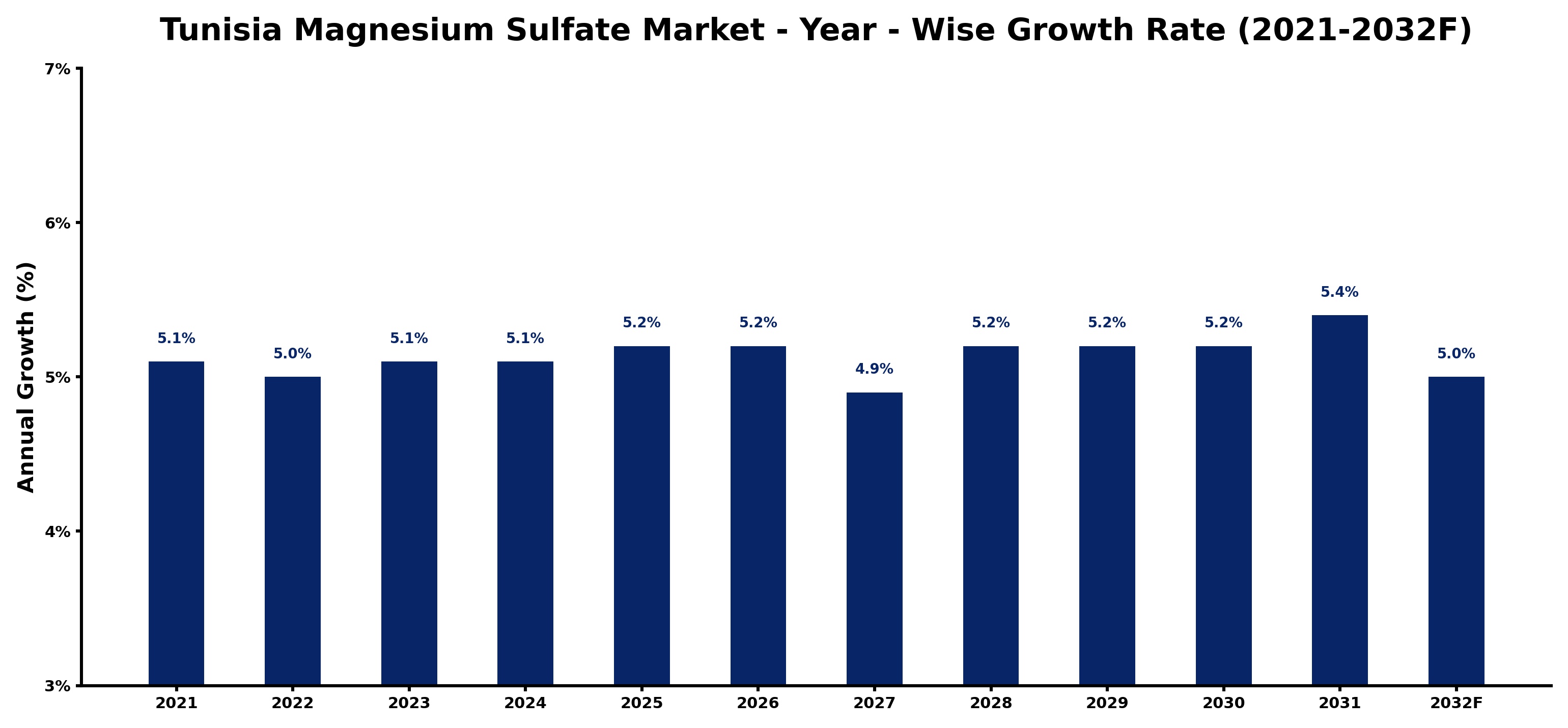
The table below presents the year‑wise growth rates along with the key drivers influencing the market
| Year | Growth Rate | Major Drivers |
| 2021 | 5.1% | Increasing smart city development projects |
| 2022 | 5.0% | Government infrastructure modernization initiatives |
| 2023 | 5.1% | Increasing adoption of advanced technologies |
| 2024 | 5.1% | Increasing industrial automation investments |
| 2025 | 5.2% | Rapid growth in telecom and data center sectors |
| 2026 | 5.2% | Increasing smart city development projects |
| 2027 | 4.9% | Growing renewable energy integration projects |
| 2028 | 5.2% | Expansion of commercial construction activities |
| 2029 | 5.2% | Increasing smart city development projects |
| 2030 | 5.2% | Expansion of manufacturing activities |
| 2031 | 5.4% | Rising electricity demand across industries |
| 2032 | 5.0% | Growing urbanization and commercial development |
Note - Market size estimations and growth projections presented in this report are based on 6Wresearch’s advanced forecasting approach, validated with industry datasets as of June 2026.
Tunisia Magnesium Sulfate Market Synopsis
In recent years, the Tunisia magnesium sulfate market has witnessed significant momentum, propelled by the diverse applications of this compound. However, as the market evolves, it is transitioning towards a more competitive landscape, influenced by both local production and import activities.
Looking forward, the growth forecast is promising, yet it is accompanied by challenges that could shape market dynamics. Stakeholders will need to navigate the complexities of production costs and regulatory environments while capitalizing on emerging trends and demands in both agriculture and pharmaceuticals.
Tunisia Magnesium Sulfate Market Key Takeaways
- The growing agricultural sector is a primary driver for magnesium sulfate demand in Tunisia.
- Pharmaceutical applications, especially in therapeutic treatments, are expanding rapidly.
- Market growth is supported by government incentives aimed at improving soil health.
- Production challenges and competition from alternative products pose potential risks.
- Limited awareness of magnesium sulfate's benefits hinders wider adoption across sectors.
Evaluation of Restraints in Tunisia Magnesium Sulfate Market
The Tunisia magnesium sulfate market faces several restraints that inhibit its growth potential. High production costs and the complexities of raw material procurement significantly impact pricing and profit margins. Furthermore, strict environmental regulations regarding the disposal of by-products from magnesium sulfate production create additional operational challenges. The market is also stifled by competition from alternative fertilizers and industrial chemicals, making it difficult for magnesium sulfate to maintain a dominant position. Finally, a general lack of awareness about its multifaceted benefits restricts broader application, particularly in sectors outside agriculture.
Tunisia Magnesium Sulfate Market Trends
Emerging trends in the Tunisia magnesium sulfate market include a rising focus on sustainable agriculture and environmentally friendly products. As farmers seek to improve crop yields while minimizing chemical usage, the demand for magnesium sulfate as an organic soil conditioner is gaining traction. Moreover, the pharmaceutical sector is exploring innovative applications for magnesium sulfate, highlighting its versatility as both a therapeutic agent and a necessary component in various formulations. In addition, advancements in production technology are expected to enhance efficiency and reduce costs over time.
Tunisia Magnesium Sulfate Market Opportunities
The Tunisia magnesium sulfate market holds several opportunities for growth and investment, particularly in the agricultural and healthcare sectors. With a strong emphasis on improving soil health and enhancing crop productivity, the market is ripe for initiatives that promote the use of magnesium sulfate fertilizers. Furthermore, expanding the awareness of its therapeutic benefits within the pharmaceutical industry can open new avenues for growth. Investments in research and development can also facilitate innovative uses of magnesium sulfate, thereby enhancing its market appeal.
Government Initiatives in the Tunisia Magnesium Sulfate Market
The Tunisian government actively supports the magnesium sulfate market through various initiatives and incentives aimed at bolstering agricultural and industrial applications. Subsidies for magnesium sulfate utilized in fertilizers are available, encouraging farmers to adopt this compound for soil enhancement. Additionally, research grants are provided to promote local production and innovation in magnesium sulfate applications, ensuring a steady supply chain and fostering growth across multiple sectors.
Future Insights of the Tunisia Magnesium Sulfate Market
Between 2026 and 2032, the Tunisia magnesium sulfate market is poised for significant transformation. As agricultural practices evolve and the demand for organic inputs rises, magnesium sulfate will likely gain prominence as a preferred choice among farmers. Coupled with ongoing governmental support, the pharmaceutical sector's expansion will further solidify its relevance. However, industry players must remain vigilant in addressing production challenges and increasing awareness of magnesium sulfate's multifaceted benefits to fully capitalize on growth opportunities.
Tunisia Magnesium Sulfate Market Latest Developments (May 2025 - June 2026)
Recent developments within the Tunisia magnesium sulfate market indicate a focus on enhancing production capabilities and expanding product offerings. Companies are exploring innovative production techniques aimed at reducing costs while adhering to environmental standards. Additionally, partnerships with agricultural organizations are being formed to educate farmers on the benefits of magnesium sulfate, which is expected to drive market penetration. The pharmaceutical sector is also witnessing heightened interest in the compound, especially for its applications in critical therapeutic contexts.
Tunisia Magnesium Sulfate Market - Key Attractiveness of the Report
- 10 Years of Market Numbers
- Historical Data Starting from 2022 to 2025
- Base Year: 2025
- Forecast Data until 2032
- Key Performance Indicators Impacting the Market
- Major Upcoming Developments and Projects
Key Highlights of the Report:
- Tunisia Magnesium Sulfate Market Outlook
- Market Size of Tunisia Magnesium Sulfate Market, 2025
- Forecast of Tunisia Magnesium Sulfate Market, 2032
- Historical Data and Forecast of Tunisia Magnesium Sulfate Revenues & Volume for the Period 2022-2032F
- Tunisia Magnesium Sulfate Market Trend Evolution
- Tunisia Magnesium Sulfate Market Drivers and Challenges
- Tunisia Magnesium Sulfate Price Trends
- Tunisia Magnesium Sulfate Porter's Five Forces
- Tunisia Magnesium Sulfate Industry Life Cycle
- Historical Data and Forecast of Tunisia Magnesium Sulfate Market Revenues & Volume By Form for the Period 2022-2032F
- Historical Data and Forecast of Tunisia Magnesium Sulfate Market Revenues & Volume By Crystal for the Period 2022-2032F
- Historical Data and Forecast of Tunisia Magnesium Sulfate Market Revenues & Volume By Powder for the Period 2022-2032F
- Historical Data and Forecast of Tunisia Magnesium Sulfate Market Revenues & Volume By Granules for the Period 2022-2032F
- Historical Data and Forecast of Tunisia Magnesium Sulfate Market Revenues & Volume By Types for the Period 2022-2032F
- Historical Data and Forecast of Tunisia Magnesium Sulfate Market Revenues & Volume By Heptahydrate for the Period 2022-2032F
- Historical Data and Forecast of Tunisia Magnesium Sulfate Market Revenues & Volume By Anhydrous for the Period 2022-2032F
- Historical Data and Forecast of Tunisia Magnesium Sulfate Market Revenues & Volume By Monohydrate for the Period 2022-2032F
- Historical Data and Forecast of Tunisia Magnesium Sulfate Market Revenues & Volume By Others for the Period 2022-2032F
- Historical Data and Forecast of Tunisia Magnesium Sulfate Market Revenues & Volume By Applications for the Period 2022-2032F
- Historical Data and Forecast of Tunisia Magnesium Sulfate Market Revenues & Volume By Fertilizer for the Period 2022-2032F
- Historical Data and Forecast of Tunisia Magnesium Sulfate Market Revenues & Volume By Medical for the Period 2022-2032F
- Historical Data and Forecast of Tunisia Magnesium Sulfate Market Revenues & Volume By Food Additive for the Period 2022-2032F
- Historical Data and Forecast of Tunisia Magnesium Sulfate Market Revenues & Volume By Industrial for the Period 2022-2032F
- Historical Data and Forecast of Tunisia Magnesium Sulfate Market Revenues & Volume By Chemical for the Period 2022-2032F
- Historical Data and Forecast of Tunisia Magnesium Sulfate Market Revenues & Volume By Others for the Period 2022-2032F
- Tunisia Magnesium Sulfate Import Export Trade Statistics
- Market Opportunity Assessment By Form
- Market Opportunity Assessment By Types
- Market Opportunity Assessment By Applications
- Tunisia Magnesium Sulfate Top Companies Market Share
- Tunisia Magnesium Sulfate Competitive Benchmarking By Technical and Operational Parameters
- Tunisia Magnesium Sulfate Company Profiles
- Tunisia Magnesium Sulfate Key Strategic Recommendations






































