Tunisia Manufacturing Analytics Market Size & Growth Rate (2026-2032)
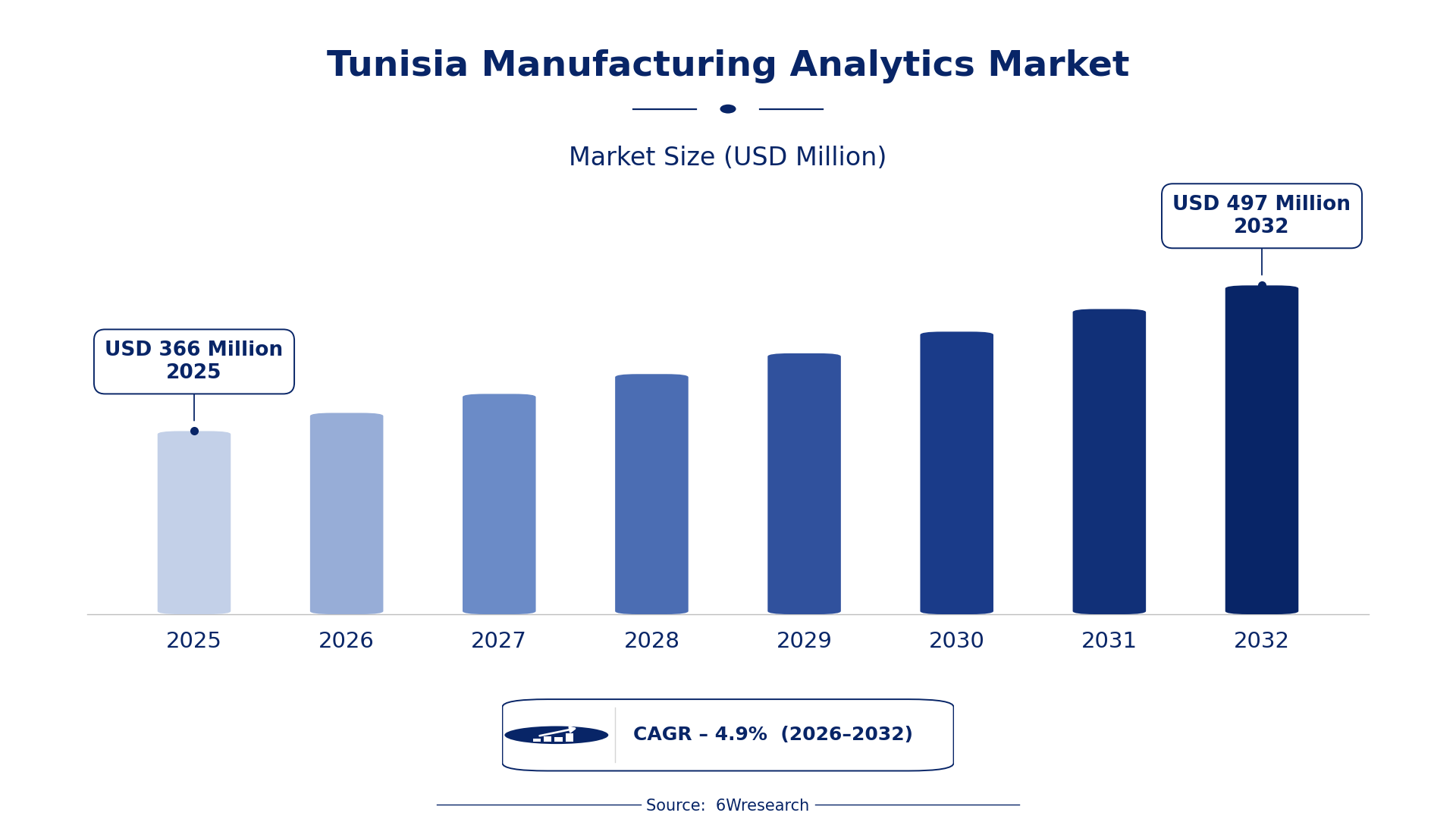
The Tunisia Manufacturing Analytics Market was estimated at USD 366 Million in 2025 and is projected to reach USD 497 Million by 2032, growing at a CAGR of 4.9% from 2026 to 2032.
Tunisia Manufacturing Analytics Market Synopsis
The manufacturing analytics market in Tunisia has gained traction as industries increasingly recognize the importance of data in decision-making. As manufacturers strive for efficiency, the integration of analytics solutions has become vital for optimizing production processes and improving product quality. However, the market's growth trajectory is at a crucial juncture as new technologies and methodologies are set to redefine operational standards.
Looking forward, the Tunisia Manufacturing Analytics Market is expected to experience heightened competition and innovation. Companies are leveraging advanced analytics, powered by IoT and AI, to stay ahead. This shift not only addresses immediate operational challenges but also prepares the sector for future demands, establishing a solid foundation for growth.
Tunisia Manufacturing Analytics Market Year-wise Growth Rate and Key Drivers
This graph illustrates the annual growth rates of the Tunisia Manufacturing Analytics Market from 2021 to 2032, highlighting a steady upward trajectory and projected expansion over the forecast period.
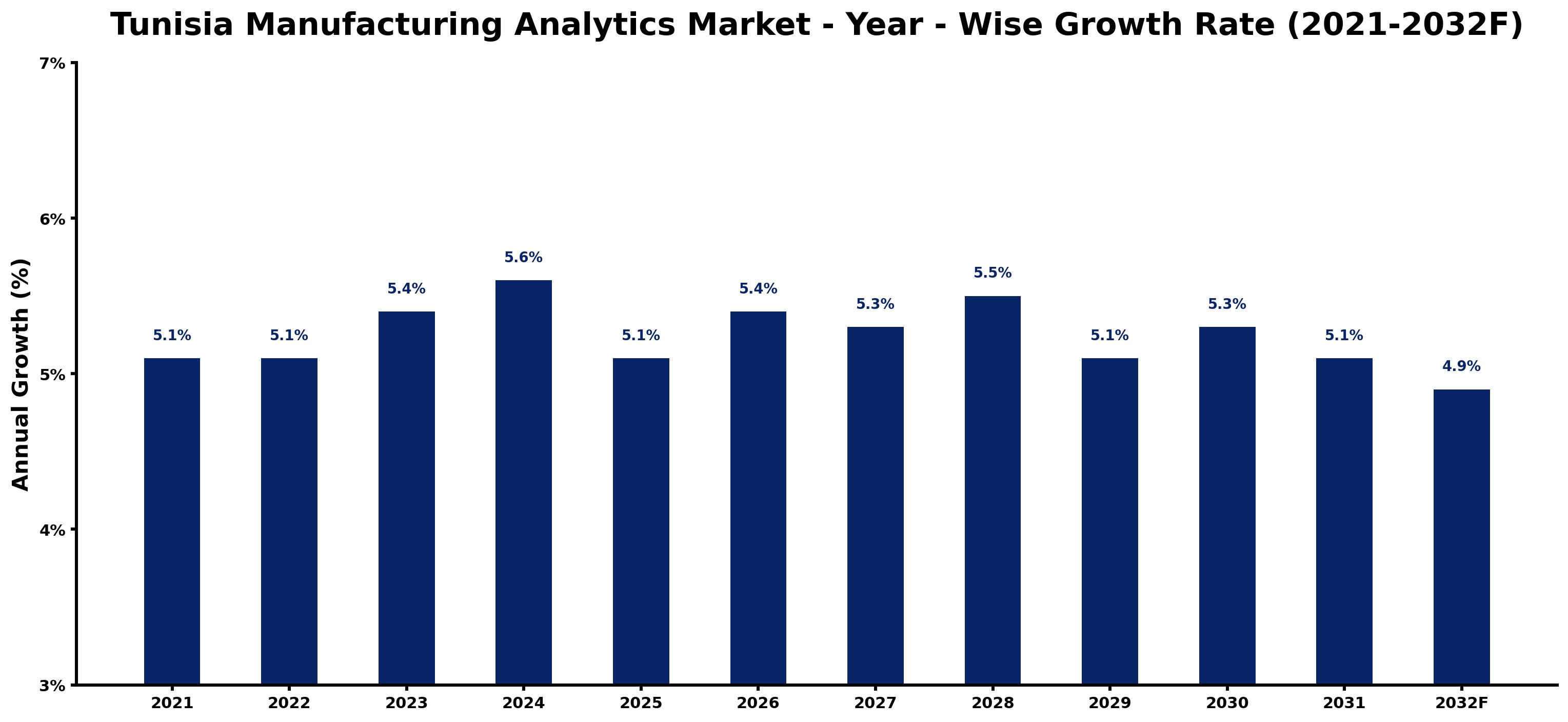
The table below presents the year‑wise growth rates along with the key drivers influencing the market
| Year | Growth Rate | Major Drivers |
| 2021 | 5.1% | Government incentives for digital transformation in manufacturing |
| 2022 | 5.1% | Increased adoption of IoT in local manufacturing facilities |
| 2023 | 5.4% | Growing emphasis on operational efficiency in textile production |
| 2024 | 5.6% | Support from Ministry of Industry for analytics training programs |
| 2025 | 5.1% | Surge in local startups offering analytics solutions |
| 2026 | 5.4% | Integration of AI tools in automotive sector analytics |
| 2027 | 5.3% | Focus on enhancing supply chain transparency and efficiency |
| 2028 | 5.5% | Investment in renewable energy for sustainable manufacturing processes |
| 2029 | 5.1% | Regional partnerships boosting analytics capabilities in Tunisian firms |
| 2030 | 5.3% | Increased collaborations with international manufacturing analytics providers |
| 2031 | 5.1% | Rising awareness of competitive advantages from analytics tools |
| 2032 | 4.9% | Demand for regulatory compliance driving analytics adoption |
Note: Market size estimations and growth projections presented in this report are based on 6Wresearch's proprietary forecasting methodology, utilizing the latest available industry data, government publications, and primary research inputs.
Tunisia Manufacturing Analytics Market Key Takeaways
Below are some of the specific key takeaways from the market, including:
- The market is driven by the adoption of Industry 4.0 technologies that enhance operational efficiency.
- Real-time insights and predictive analytics are increasingly sought after by manufacturers.
- Integration of IoT and AI technologies is a key factor influencing market dynamics.
- Data integration issues pose significant challenges for small and medium-sized enterprises.
- Government policies are actively promoting the adoption of advanced manufacturing analytics solutions.
Evaluation of Restraints in Tunisia Manufacturing Analytics Market
Despite the promising growth prospects, the Tunisia Manufacturing Analytics Market faces notable constraints. One of the primary issues is the complexity involved in integrating analytics solutions with existing manufacturing systems. This integration often requires significant time and resources, which can deter smaller manufacturers from adopting these technologies. on top of that, the high costs associated with implementation and ongoing maintenance serve as a barrier, particularly for small to medium enterprises that may not have the budget for extensive upgrades. As these challenges persist, they could slow the pace of innovation and adoption across the sector.
Tunisia Manufacturing Analytics Market Trends
Several trends are currently shaping the Tunisia Manufacturing Analytics Market. The push towards Industry 4.0 is paramount, with manufacturers increasingly adopting smart technologies to enhance their operational capabilities. There is a growing interest in cloud-based analytics solutions, allowing for greater flexibility and scalability. Additionally, predictive maintenance is gaining traction as companies look to minimize downtime and optimize asset management. The emphasis on sustainability is also influencing analytics, as firms seek data-driven insights to reduce waste and improve energy efficiency.
Tunisia Manufacturing Analytics Market Opportunities
Opportunities within the Tunisia Manufacturing Analytics Market are abundant, particularly for those willing to embrace new technologies. The increasing need for real-time data analytics presents a significant investment potential in software solutions that cater specifically to the manufacturing sector. Additionally, partnerships between technology providers and manufacturing firms can lead to innovative solutions tailored to meet specific operational challenges. As manufacturers continue to prioritize digital transformation, companies that offer comprehensive analytics tools and services stand to benefit immensely.
Government Initiatives in the Tunisia Manufacturing Analytics Market
The Tunisian government is actively fostering the growth of the manufacturing analytics market through various initiatives aimed at modernizing the industrial sector. These efforts are designed to enhance competitiveness and facilitate the adoption of advanced technologies. By prioritizing Industry 4.0, the government is not only encouraging investment but also ensuring that the workforce is adequately trained to handle new technologies.
- A recently completed initiative provided subsidies to manufacturers adopting advanced analytics tools to enhance productivity.
- A current training program is underway, focusing on equipping professionals with the skills necessary for Industry 4.0 technologies.
- A planned public-private partnership aims to develop a national framework for integrating IoT solutions into manufacturing processes by 2027.
- Ongoing efforts to streamline regulatory processes are expected to ease the implementation of manufacturing analytics solutions.
- A new strategic plan introduced in 2025 focuses on promoting collaboration between academia and industry to foster innovation.
Future Insights of the Tunisia Manufacturing Analytics Market
From 2026 to 2032, the Tunisia Manufacturing Analytics Market is likely to witness transformative changes. The emphasis on data-driven decision-making will continue to grow as manufacturers seek to leverage analytics for competitive advantage. As more companies invest in advanced analytics solutions, we can anticipate a shift in operational paradigms that favors agility and responsiveness. The integration of AI and machine learning into analytics will further refine data interpretation, leading to better-informed business strategies and operational efficiencies.
Tunisia Manufacturing Analytics Market Latest Developments
Recent developments in the Tunisia Manufacturing Analytics Market highlight an increasing commitment from industry players to adopt innovative solutions. Over the past year, manufacturers have begun prioritizing investments in analytics to meet growing market demands. This shift signals a broader recognition of the value that analytics bring to operational excellence.
- A major technology vendor launched a new suite of analytics tools tailored for the manufacturing sector, aimed at enhancing real-time data capabilities, in early 2025.
- An initiative that began in mid-2025 is currently underway to implement a nationwide IoT infrastructure to support manufacturing analytics.
- A collaborative project between academic institutions and the manufacturing sector was announced in late 2025, focusing on developing predictive maintenance solutions.
- A rollout expected to begin in the second half of 2026 aims to introduce cloud-based analytics platforms for small and medium-sized manufacturers.
- In Q4 2025, a leading regional operator announced the completion of a pilot program showcasing the benefits of advanced analytics in reducing production costs.
Tunisia Manufacturing Analytics Market - Key Attractiveness of the Report
- 10 Years of Market Numbers
- Historical Data Starting from 2022 to 2025
- Base Year: 2025
- Forecast Data until 2032
- Key Performance Indicators Impacting the Market
- Major Upcoming Developments and Projects
Key Highlights of the Report:
- Tunisia Manufacturing Analytics Market Outlook
- Market Size of Tunisia Manufacturing Analytics Market, 2025
- Forecast of Tunisia Manufacturing Analytics Market, 2032
- Historical Data and Forecast of Tunisia Manufacturing Analytics Revenues & Volume for the Period 2022-2032F
- Tunisia Manufacturing Analytics Market Trend Evolution
- Tunisia Manufacturing Analytics Market Drivers and Challenges
- Tunisia Manufacturing Analytics Price Trends
- Tunisia Manufacturing Analytics Porter's Five Forces
- Tunisia Manufacturing Analytics Industry Life Cycle
- Historical Data and Forecast of Tunisia Manufacturing Analytics Market Revenues & Volume By Type for the Period 2022-2032F
- Historical Data and Forecast of Tunisia Manufacturing Analytics Market Revenues & Volume By Software for the Period 2022-2032F
- Historical Data and Forecast of Tunisia Manufacturing Analytics Market Revenues & Volume By Service for the Period 2022-2032F
- Historical Data and Forecast of Tunisia Manufacturing Analytics Market Revenues & Volume By Deployment Models for the Period 2022-2032F
- Historical Data and Forecast of Tunisia Manufacturing Analytics Market Revenues & Volume By On-premises for the Period 2022-2032F
- Historical Data and Forecast of Tunisia Manufacturing Analytics Market Revenues & Volume By On-demand for the Period 2022-2032F
- Historical Data and Forecast of Tunisia Manufacturing Analytics Market Revenues & Volume By Applications for the Period 2022-2032F
- Historical Data and Forecast of Tunisia Manufacturing Analytics Market Revenues & Volume By Predictive maintenance & asset management for the Period 2022-2032F
- Historical Data and Forecast of Tunisia Manufacturing Analytics Market Revenues & Volume By Inventory management for the Period 2022-2032F
- Historical Data and Forecast of Tunisia Manufacturing Analytics Market Revenues & Volume By Supply chain planning & procurement for the Period 2022-2032F
- Historical Data and Forecast of Tunisia Manufacturing Analytics Market Revenues & Volume By Energy management for the Period 2022-2032F
- Historical Data and Forecast of Tunisia Manufacturing Analytics Market Revenues & Volume By Emergency management for the Period 2022-2032F
- Historical Data and Forecast of Tunisia Manufacturing Analytics Market Revenues & Volume By Sales & customer management for the Period 2022-2032F
- Historical Data and Forecast of Tunisia Manufacturing Analytics Market Revenues & Volume By Other applications for the Period 2022-2032F
- Historical Data and Forecast of Tunisia Manufacturing Analytics Market Revenues & Volume By Industry Vertical for the Period 2022-2032F
- Historical Data and Forecast of Tunisia Manufacturing Analytics Market Revenues & Volume By Automotive & aerospace manufacturing for the Period 2022-2032F
- Historical Data and Forecast of Tunisia Manufacturing Analytics Market Revenues & Volume By Electronics equipment manufacturing for the Period 2022-2032F
- Historical Data and Forecast of Tunisia Manufacturing Analytics Market Revenues & Volume By Food & beverages manufacturing for the Period 2022-2032F
- Historical Data and Forecast of Tunisia Manufacturing Analytics Market Revenues & Volume By Chemicals & materials manufacturing for the Period 2022-2032F
- Historical Data and Forecast of Tunisia Manufacturing Analytics Market Revenues & Volume By Machinery & industrial equipment manufacturing for the Period 2022-2032F
- Historical Data and Forecast of Tunisia Manufacturing Analytics Market Revenues & Volume By Pharma and life sciences for the Period 2022-2032F
- Historical Data and Forecast of Tunisia Manufacturing Analytics Market Revenues & Volume By Paper, pulp, plastic and rubber manufacturing for the Period 2022-2032F
- Historical Data and Forecast of Tunisia Manufacturing Analytics Market Revenues & Volume By Others for the Period 2022-2032F
- Tunisia Manufacturing Analytics Import Export Trade Statistics
- Market Opportunity Assessment By Type
- Market Opportunity Assessment By Deployment Models
- Market Opportunity Assessment By Applications
- Market Opportunity Assessment By Industry Vertical
- Tunisia Manufacturing Analytics Top Companies Market Share
- Tunisia Manufacturing Analytics Competitive Benchmarking By Technical and Operational Parameters
- Tunisia Manufacturing Analytics Company Profiles
- Tunisia Manufacturing Analytics Key Strategic Recommendations






































