Tunisia Medical Tubing Market Size, Share & Growth Rate
The Tunisia Medical Tubing Market was estimated at USD 266 Million in 2025 and is projected to reach USD 358 Million by 2032, growing at a CAGR of 4.3% from 2026 to 2032. This growth is predominantly driven by the rising demand for high-quality medical devices and equipment in the healthcare sector, coupled with increasing healthcare expenditure. Additionally, technological advancements in materials and manufacturing processes further support this upward trajectory, addressing the evolving needs of medical facilities in Tunisia.
Tunisia Medical Tubing Market Year-wise Growth Rate and Key Drivers
This graph highlights how the Tunisia Medical Tubing Market has steadily grown over the years, supported by major growth factors.
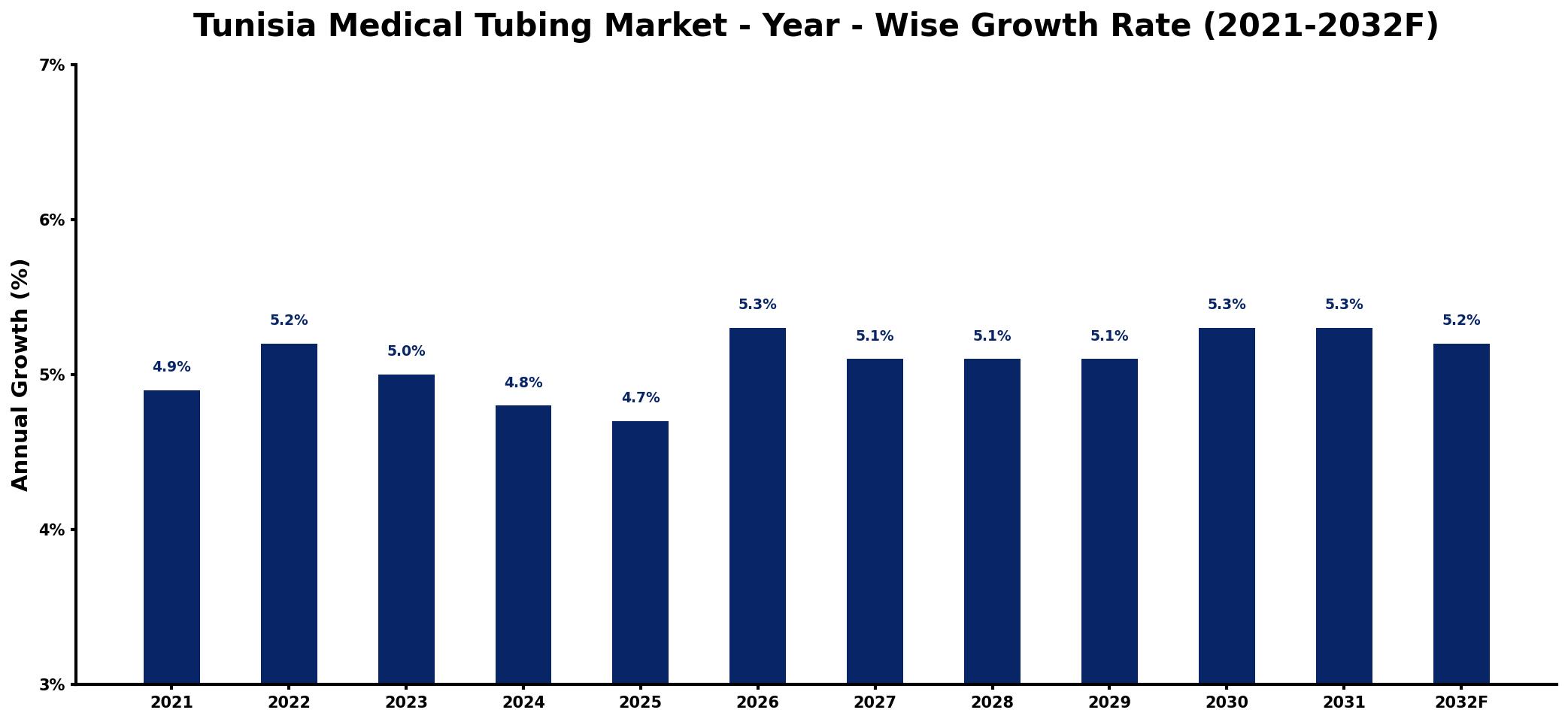
The table below presents the year‑wise growth rates along with the key drivers influencing the market
| Year | Growth Rate | Major Drivers |
| 2021 | 4.9% | Rising healthcare investments boost demand |
| 2022 | 5.2% | Increased regulatory support for innovation |
| 2023 | 5.0% | Growing population drives healthcare needs |
| 2024 | 4.8% | Expansion of healthcare infrastructure nationwide |
| 2025 | 4.7% | Surge in chronic disease prevalence |
| 2026 | 5.3% | Technological advancements enhance production |
| 2027 | 5.1% | Increased partnerships in healthcare sector |
| 2028 | 5.1% | Growth in outpatient care facilities |
| 2029 | 5.1% | Rising awareness of preventive healthcare |
| 2030 | 5.3% | Emerging markets attract foreign investments |
| 2031 | 5.3% | Focus on sustainable healthcare solutions |
| 2032 | 5.2% | Advancements in telehealth services utilization |
Note: Market size estimations and growth projections presented in this report are based on 6Wresearch's proprietary forecasting methodology, utilizing the latest available industry data, government publications, and primary research inputs.
Tunisia Medical Tubing Market Synopsis
The demand for medical tubing in Tunisia is significantly influenced by the increasing prevalence of chronic diseases and a growing aging population, which necessitate advanced medical interventions. This trend has led to a surge in the development and adoption of various medical tubing products, including PVC, silicone, and polyurethane options tailored to specific medical applications.
Moreover, manufacturers are increasingly focused on product innovation and customization to meet the distinct requirements of healthcare facilities. This strategic pivot towards higher quality and biocompatible materials not only enhances patient safety but also ensures adherence to stringent regulatory standards, a critical factor in this market.
Tunisia Medical Tubing Market Key Takeaways
- The market is projected to grow from USD 266 Million in 2025 to USD 358 Million by 2032.
- Technological advancements and an aging population are driving demand for innovative medical tubing solutions.
- Manufacturers are focusing on biocompatibility and customization to enhance product quality.
- Emerging trends include the development of antimicrobial coatings and specialized tubing for minimally invasive procedures.
- Regulatory compliance remains essential for manufacturers seeking to maintain market presence.
Evaluation of Restraints in Tunisia Medical Tubing Market
While the Tunisia Medical Tubing Market demonstrates promising growth, several restraints hinder its full potential. Regulatory hurdles impose challenges in meeting stringent quality standards, often resulting in delays and increased production costs. Additionally, limited domestic manufacturing capabilities create a reliance on imports, which can be a vulnerability amid fluctuating raw material prices. Ensuring sterile conditions during production and transportation adds further complexity, compelling manufacturers to navigate a labyrinth of quality assurance processes to comply with healthcare industry requirements.
Tunisia Medical Tubing Market Trends
The Tunisia Medical Tubing Market is witnessing a pronounced shift towards advanced materials such as silicone and PVC, celebrated for their flexibility, durability, and biocompatibility. This pivot is underscored by an increasing emphasis on innovative features like antimicrobial coatings, enhancing infection control measures. Furthermore, the rising adoption of minimally invasive procedures is fuelling demand for specialized tubing designed to cater to these complex medical applications. As manufacturers strive to remain competitive, their focus on product innovation, quality assurance, and strategic partnerships will prove critical in navigating this evolving landscape.
Tunisia Medical Tubing Market Opportunities
The market presents a wealth of investment opportunities, particularly given the ongoing development of healthcare infrastructure in Tunisia. As healthcare services expand, the need for high-quality medical tubing will inevitably rise, especially for critical applications such as intravenous therapy and respiratory care. Investors keen on capturing market share can explore avenues in manufacturing specialized tubing materials that align with international quality standards. Emphasizing technological advancements, such as the integration of antimicrobial properties, can also provide a significant competitive advantage.
Government Initiatives in the Tunisia Medical Tubing Market
In Tunisia, the Ministry of Health plays a pivotal role in regulating the medical tubing sector, ensuring that all products meet safety and quality standards. The government enforces stringent regulations requiring manufacturers to obtain necessary certifications prior to market distribution, fostering an environment that protects patient safety. Periodic inspections of manufacturing facilities and quality control checks are also implemented to uphold compliance with established standards, thereby enhancing the integrity of medical tubing utilized within healthcare settings.
Future Insights of the Tunisia Medical Tubing Market
Looking ahead to the 2026-2032 period, the Tunisia Medical Tubing Market is positioned for sustained growth, largely propelled by the increasing prevalence of chronic diseases and an aging demographic. Expansion in healthcare infrastructure and advancements in materials technology are set to drive demand for innovative medical tubing products. However, players in this market will need to remain vigilant, adapting to regulatory changes and price pressures while capitalizing on emerging opportunities to enhance their competitive standing.
Tunisia Medical Tubing Market Latest Developments (2025 - 2026)
Recent developments in the Tunisia Medical Tubing Market reflect a dynamic shift towards enhanced product offerings and manufacturing capabilities. Companies are increasingly investing in R&D to develop innovative tubing solutions that comply with international standards. There is a noticeable trend towards the incorporation of smart technologies and materials in product design, aimed at improving patient outcomes and ensuring regulatory compliance. As the healthcare landscape evolves, market participants are aligning their strategies to better serve the growing demand for high-quality medical tubing products.
Tunisia Medical Tubing Market - Key Attractiveness of the Report
- 10 Years of Market Numbers
- Historical Data Starting from 2022 to 2025
- Base Year: 2025
- Forecast Data until 2032
- Key Performance Indicators Impacting the Market
- Major Upcoming Developments and Projects
Key Highlights of the Report:
- Tunisia Medical Tubing Market Outlook
- Market Size of Tunisia Medical Tubing Market, 2025
- Forecast of Tunisia Medical Tubing Market, 2032
- Historical Data and Forecast of Tunisia Medical Tubing Revenues & Volume for the Period 2022-2032F
- Tunisia Medical Tubing Market Trend Evolution
- Tunisia Medical Tubing Market Drivers and Challenges
- Tunisia Medical Tubing Price Trends
- Tunisia Medical Tubing Porter's Five Forces
- Tunisia Medical Tubing Industry Life Cycle
- Historical Data and Forecast of Tunisia Medical Tubing Market Revenues & Volume By Material for the Period 2022-2032F
- Historical Data and Forecast of Tunisia Medical Tubing Market Revenues & Volume By Plastics for the Period 2022-2032F
- Historical Data and Forecast of Tunisia Medical Tubing Market Revenues & Volume By Rubbers for the Period 2022-2032F
- Historical Data and Forecast of Tunisia Medical Tubing Market Revenues & Volume By Specialty Polymers for the Period 2022-2032F
- Historical Data and Forecast of Tunisia Medical Tubing Market Revenues & Volume By Structure for the Period 2022-2032F
- Historical Data and Forecast of Tunisia Medical Tubing Market Revenues & Volume By Single-lumen for the Period 2022-2032F
- Historical Data and Forecast of Tunisia Medical Tubing Market Revenues & Volume By Co-extruded for the Period 2022-2032F
- Historical Data and Forecast of Tunisia Medical Tubing Market Revenues & Volume By Multi-lumen for the Period 2022-2032F
- Historical Data and Forecast of Tunisia Medical Tubing Market Revenues & Volume By Tapered Or Bump Tubing for the Period 2022-2032F
- Historical Data and Forecast of Tunisia Medical Tubing Market Revenues & Volume By Braided Tubing for the Period 2022-2032F
- Historical Data and Forecast of Tunisia Medical Tubing Market Revenues & Volume By Application for the Period 2022-2032F
- Historical Data and Forecast of Tunisia Medical Tubing Market Revenues & Volume By Bulk Disposable Tubing for the Period 2022-2032F
- Historical Data and Forecast of Tunisia Medical Tubing Market Revenues & Volume By Catheters & Cannulas for the Period 2022-2032F
- Historical Data and Forecast of Tunisia Medical Tubing Market Revenues & Volume By Drug Delivery System for the Period 2022-2032F
- Historical Data and Forecast of Tunisia Medical Tubing Market Revenues & Volume By Special Applications for the Period 2022-2032F
- Tunisia Medical Tubing Import Export Trade Statistics
- Market Opportunity Assessment By Material
- Market Opportunity Assessment By Structure
- Market Opportunity Assessment By Application
- Tunisia Medical Tubing Top Companies Market Share
- Tunisia Medical Tubing Competitive Benchmarking By Technical and Operational Parameters
- Tunisia Medical Tubing Company Profiles
- Tunisia Medical Tubing Key Strategic Recommendations






































