Tunisia Meningococcal Vaccines Market Size, Share & Growth Rate
The Tunisia Meningococcal Vaccines Market was estimated at USD 174 Million in 2025 and is projected to reach USD 231 Million by 2032, growing at a CAGR of 4.1% from 2026 to 2032. This positive trajectory is primarily driven by heightened awareness surrounding meningitis prevention and the strategic government initiatives aimed at bolstering public health. The ongoing vaccination programs, alongside advancements in vaccine technology and the engagement of international health organizations in local campaigns, further fuel the growth of this critical market.
Tunisia Meningococcal Vaccines Market Year-wise Growth Rate and Key Drivers
This graph highlights how the Tunisia Meningococcal Vaccines Market has steadily grown over the years, supported by major growth factors.
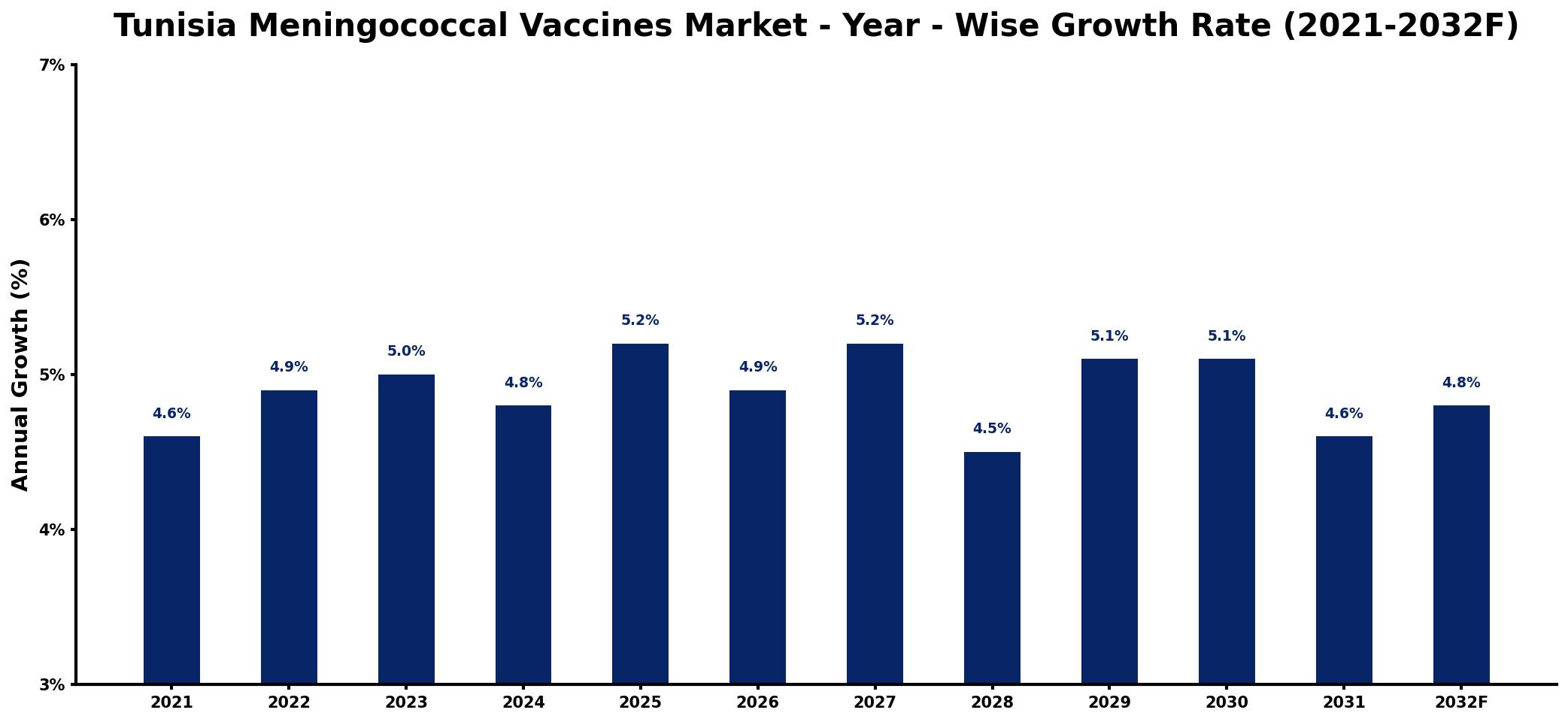
The table below presents the year‑wise growth rates along with the key drivers influencing the market
| Year | Growth Rate | Major Drivers |
| 2021 | 4.6% | Increased public health awareness |
| 2022 | 4.9% | Growth in healthcare infrastructure |
| 2023 | 5.0% | Rising vaccination program funding |
| 2024 | 4.8% | Expansion of healthcare access |
| 2025 | 5.2% | Increase in preventive healthcare initiatives |
| 2026 | 4.9% | Higher demand for immunization services |
| 2027 | 5.2% | Investment in healthcare technology |
| 2028 | 4.5% | Strengthening of disease surveillance systems |
| 2029 | 5.1% | Collaboration with international health organizations |
| 2030 | 5.1% | Enhanced training for healthcare professionals |
| 2031 | 4.6% | Focus on community health education |
| 2032 | 4.8% | Development of local manufacturing capabilities |
Note: Market size estimations and growth projections presented in this report are based on 6Wresearch's proprietary forecasting methodology, utilizing the latest available industry data, government publications, and primary research inputs.
Tunisia Meningococcal Vaccines Market Synopsis
The landscape of the Tunisia Meningococcal Vaccines Market is evolving, marked by increasing governmental support and public awareness campaigns emphasizing the importance of vaccination. These dynamics are essential in combating the rise in meningococcal infections, ensuring a proactive approach to public health.
Recent years have seen a concerted effort to improve vaccine accessibility through national immunization programs. The market's growth is further underpinned by technological advancements in vaccine development, which have introduced new options that appeal to both healthcare providers and the public.
Tunisia Meningococcal Vaccines Market Key Takeaways
- Growing public awareness and government initiatives are vital drivers of market expansion.
- The introduction of advanced vaccines has invigorated demand across various demographics.
- Healthcare expenditure in Tunisia is increasingly directed towards preventive measures, including vaccination programs.
- International health organizations are playing a significant role in local vaccination campaigns.
- Challenges related to cold chain logistics and vaccine hesitancy persist, requiring strategic focus.
Evaluation of Restraints in Tunisia Meningococcal Vaccines Market
Despite the optimistic outlook, several restraints impede the Tunisia Meningococcal Vaccines Market's growth potential. One prominent challenge is the cold chain logistics necessary for effective vaccine distribution, which can be cumbersome in certain regions. Additionally, vaccine hesitancy and public misinformation about the safety and necessity of vaccination remain significant hurdles. Continuous surveillance and prompt responses to meningococcal outbreaks are critical to maintaining momentum and addressing these issues in real-time.
Tunisia Meningococcal Vaccines Market Trends
Emerging trends in the Tunisia Meningococcal Vaccines Market include the adoption of new vaccine technologies and formulations tailored to address specific serogroups prevalent in the region. There is also a marked shift towards the integration of digital health solutions to improve vaccination outreach and education. Health authorities are increasingly employing data analytics to identify at-risk populations, enhancing targeted immunization efforts and ensuring optimal use of resources.
Tunisia Meningococcal Vaccines Market Opportunities
Significant growth opportunities lie within the expansion of immunization programs targeting adolescents and young adults, demographics often at higher risk for meningococcal disease. Public-private partnerships can also drive innovation and improve vaccine distribution channels, while enhancing public health education initiatives can help mitigate vaccine hesitancy. Moreover, ongoing collaborations with international health entities present avenues for funding and technical support.
Government Initiatives in the Tunisia Meningococcal Vaccines Market
The Tunisian government has implemented various policies aimed at enhancing the accessibility and affordability of meningococcal vaccines. National immunization programs focus on widespread distribution and public health campaigns designed to prevent outbreaks of meningococcal diseases. These initiatives are bolstered by strategic partnerships with international health organizations, ensuring that necessary resources are allocated effectively for public health advancements.
Future Insights of the Tunisia Meningococcal Vaccines Market
Looking ahead to the period from 2026 to 2032, the Tunisia Meningococcal Vaccines Market is poised for continued growth driven by proactive health strategies and an increasing emphasis on preventive healthcare. The anticipated advancements in vaccine technologies and sustained government support will likely create a robust framework for addressing meningococcal infections. Increased public engagement and education efforts will also play a crucial role in furthering vaccine acceptance and utilization.
Tunisia Meningococcal Vaccines Market Latest Developments (2025 - 2026)
Recent developments within the Tunisia Meningococcal Vaccines Market indicate a shift towards greater collaboration between healthcare authorities and international organizations. Initiatives have been launched to improve vaccine awareness among communities, highlighting the importance of immunization. Furthermore, discussions around policy enhancements aimed at simplifying vaccine procurement and distribution processes are gaining traction, positioning the market for future resilience against meningococcal disease outbreaks.
Tunisia Meningococcal Vaccines Market - Key Attractiveness of the Report
- 10 Years of Market Numbers
- Historical Data Starting from 2022 to 2025
- Base Year: 2025
- Forecast Data until 2032
- Key Performance Indicators Impacting the Market
- Major Upcoming Developments and Projects
Key Highlights of the Report:
- Tunisia Meningococcal Vaccines Market Outlook
- Market Size of Tunisia Meningococcal Vaccines Market, 2025
- Forecast of Tunisia Meningococcal Vaccines Market, 2032
- Historical Data and Forecast of Tunisia Meningococcal Vaccines Revenues & Volume for the Period 2022-2032F
- Tunisia Meningococcal Vaccines Market Trend Evolution
- Tunisia Meningococcal Vaccines Market Drivers and Challenges
- Tunisia Meningococcal Vaccines Price Trends
- Tunisia Meningococcal Vaccines Porter's Five Forces
- Tunisia Meningococcal Vaccines Industry Life Cycle
- Historical Data and Forecast of Tunisia Meningococcal Vaccines Market Revenues & Volume By Product for the Period 2022-2032F
- Historical Data and Forecast of Tunisia Meningococcal Vaccines Market Revenues & Volume By Polysaccharide for the Period 2022-2032F
- Historical Data and Forecast of Tunisia Meningococcal Vaccines Market Revenues & Volume By Conjugate for the Period 2022-2032F
- Historical Data and Forecast of Tunisia Meningococcal Vaccines Market Revenues & Volume By Age Group for the Period 2022-2032F
- Historical Data and Forecast of Tunisia Meningococcal Vaccines Market Revenues & Volume By Infants for the Period 2022-2032F
- Historical Data and Forecast of Tunisia Meningococcal Vaccines Market Revenues & Volume By Children for the Period 2022-2032F
- Historical Data and Forecast of Tunisia Meningococcal Vaccines Market Revenues & Volume By Adolescents & Young Adults for the Period 2022-2032F
- Historical Data and Forecast of Tunisia Meningococcal Vaccines Market Revenues & Volume By Adults for the Period 2022-2032F
- Historical Data and Forecast of Tunisia Meningococcal Vaccines Market Revenues & Volume By Distribution Channel for the Period 2022-2032F
- Historical Data and Forecast of Tunisia Meningococcal Vaccines Market Revenues & Volume By Pharmacies for the Period 2022-2032F
- Historical Data and Forecast of Tunisia Meningococcal Vaccines Market Revenues & Volume By Community Clinics for the Period 2022-2032F
- Historical Data and Forecast of Tunisia Meningococcal Vaccines Market Revenues & Volume By Public Health Agencies for the Period 2022-2032F
- Historical Data and Forecast of Tunisia Meningococcal Vaccines Market Revenues & Volume By Others for the Period 2022-2032F
- Tunisia Meningococcal Vaccines Import Export Trade Statistics
- Market Opportunity Assessment By Product
- Market Opportunity Assessment By Age Group
- Market Opportunity Assessment By Distribution Channel
- Tunisia Meningococcal Vaccines Top Companies Market Share
- Tunisia Meningococcal Vaccines Competitive Benchmarking By Technical and Operational Parameters
- Tunisia Meningococcal Vaccines Company Profiles
- Tunisia Meningococcal Vaccines Key Strategic Recommendations






































