Tunisia Metal Shredder Machine Market Size, Share & Growth Rate
The Tunisia Metal Shredder Machine Market was estimated at USD 1192 Million in 2025 and is projected to reach USD 1710 Million by 2032, growing at a CAGR of 5.3% from 2026 to 2032. This growth trajectory is driven by an increasing emphasis on recycling initiatives and the rising industrialization across various sectors such as automotive and construction. As businesses and government entities recognize the essential role of metal shredders in effective waste management and environmental sustainability, demand is set to grow steadily.
Tunisia Metal Shredder Machine Market Year-wise Growth Rate and Key Drivers
This graph highlights how the Tunisia Metal Shredder Machine Market has steadily grown over the years, supported by major growth factors.
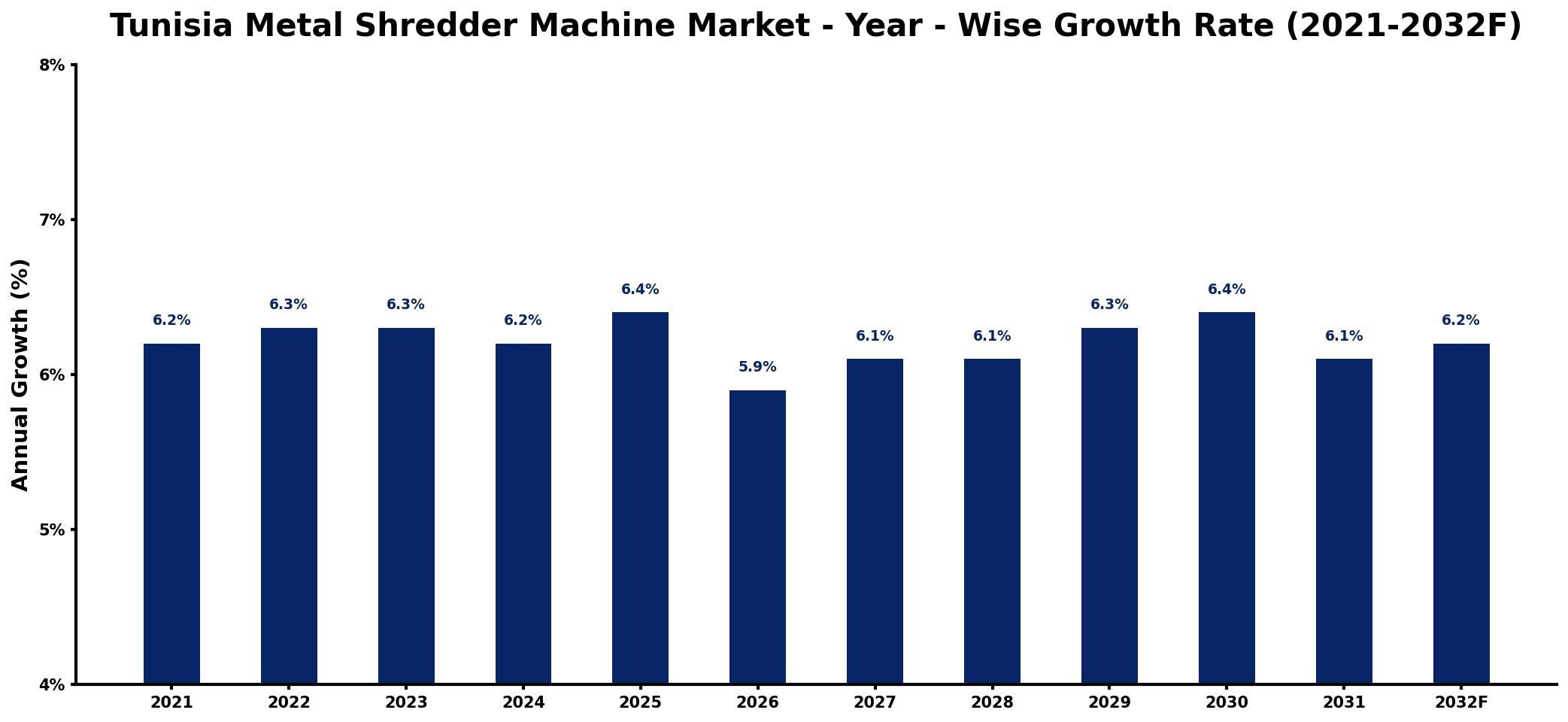
The table below presents the year‑wise growth rates along with the key drivers influencing the market
| Year | Growth Rate | Major Drivers |
| 2021 | 6.2% | Rising recycling industry investments |
| 2022 | 6.3% | Increased industrial waste management |
| 2023 | 6.3% | Growing demand for sustainable practices |
| 2024 | 6.2% | Enhanced environmental regulations compliance |
| 2025 | 6.4% | Expansion of automotive recycling facilities |
| 2026 | 5.9% | Emerging electronic waste processing |
| 2027 | 6.1% | Developments in circular economy initiatives |
| 2028 | 6.1% | Boost in construction material recovery |
| 2029 | 6.3% | Innovations in resource recovery technologies |
| 2030 | 6.4% | Strengthened government recycling policies |
| 2031 | 6.1% | Heightened public awareness campaigns |
| 2032 | 6.2% | Continued investment in green technologies |
Note: Market size estimations and growth projections presented in this report are based on 6Wresearch's proprietary forecasting methodology, utilizing the latest available industry data, government publications, and primary research inputs.
Tunisia Metal Shredder Machine Market Synopsis
The strongest force shaping the Tunisia Metal Shredder Machine Market is the heightened awareness surrounding the benefits of metal recycling. With the country's commitment to sustainable practices, industries are increasingly turning to advanced metal shredder machines to optimize their waste management processes.
Simultaneously, stringent government regulations promoting environmental conservation are further pushing organizations to adopt efficient shredding technologies. As the automotive and manufacturing sectors expand, the demand for innovative solutions to process scrap metal is likely to escalate.
Tunisia Metal Shredder Machine Market Key Takeaways
- Growing demand for recycling solutions is propelling the market forward.
- Technological innovations, such as automated and energy-efficient machines, are becoming increasingly popular.
- Government initiatives play a crucial role in promoting sustainable practices within industries.
- Challenges remain in the form of initial investment costs and limited awareness among small enterprises.
- Opportunities exist for tailored shredder solutions catering to specific industrial needs.
Evaluation of Restraints in Tunisia Metal Shredder Machine Market
Despite the positive market outlook, several restraints hinder growth in the Tunisia Metal Shredder Machine Market. A significant barrier is the initial investment cost of advanced shredder machines, which can deter small and medium-sized enterprises from upgrading their equipment. Furthermore, inconsistent government regulations regarding waste management create uncertainty, impacting potential investments. There is also a knowledge gap within smaller businesses regarding the advantages of adopting modern shredding technologies, which leads to reliance on more traditional, less efficient methods.
Tunisia Metal Shredder Machine Market Trends
Emerging trends in the Tunisia Metal Shredder Machine Market include the increasing shift toward automated shredding solutions. These machines offer enhanced control capabilities and remote monitoring features, significantly improving operational efficiency. Sustainability is also at the forefront, with manufacturers developing shredder machines that minimize energy consumption and emissions while effectively processing diverse metal scrap materials. Tailored shredder solutions are gaining traction, as companies look for equipment that meets their specific industry needs.
Tunisia Metal Shredder Machine Market Opportunities
Investment opportunities in the Tunisia Metal Shredder Machine Market are abundant, particularly for companies seeking to innovate in metal recycling technology. The rising need for efficient waste management solutions is prompting industries to invest in advanced shredders that can effectively process various metal types. Collaborating with local businesses and waste management firms provides a pathway for investors to establish themselves in the expanding recycling landscape. Moreover, as government policies increasingly favor sustainability, investors can leverage this momentum to promote high-quality shredder machines tailored to local conditions.
Government Initiatives in the Tunisia Metal Shredder Machine Market
The Tunisian government has introduced various initiatives to stimulate the Metal Shredder Machine Market, focusing on quality standards for imported machines to ensure safety and environmental compliance. Additionally, policies incentivize the use of metal shredders through subsidies aimed at enhancing recycling efforts. Regulatory frameworks are being put in place to streamline waste disposal processes, thereby reinforcing the government's commitment to promoting sustainable practices throughout the industry.
Future Insights of the Tunisia Metal Shredder Machine Market
Looking ahead to 2026-2032, the Tunisia Metal Shredder Machine Market is anticipated to continue its growth path. The focus on sustainable waste management practices and increasing industrial activity will drive demand for efficient shredding solutions. The evolving landscape of environmental regulations will further contribute to the need for advanced metal shredder machines. Technological advancements are expected to yield machines that offer improved efficiency and versatility, making it easier for industries to manage metal waste effectively.
Tunisia Metal Shredder Machine Market Latest Developments (2025 - 2026)
Recent developments in the Tunisia Metal Shredder Machine Market highlight a growing trend toward innovation and automation. Manufacturers are increasingly launching machines equipped with cutting-edge technology designed to enhance efficiency and environmental compliance. The focus on tailored solutions has resulted in a significant rise in partnerships between shredder manufacturers and local businesses, aimed at optimizing waste management practices across various sectors.
Tunisia Metal Shredder Machine Market - Key Attractiveness of the Report
- 10 Years of Market Numbers
- Historical Data Starting from 2022 to 2025
- Base Year: 2025
- Forecast Data until 2032
- Key Performance Indicators Impacting the Market
- Major Upcoming Developments and Projects
Key Highlights of the Report:
- Tunisia Metal Shredder Machine Market Outlook
- Market Size of Tunisia Metal Shredder Machine Market, 2025
- Forecast of Tunisia Metal Shredder Machine Market, 2032
- Historical Data and Forecast of Tunisia Metal Shredder Machine Revenues & Volume for the Period 2022-2032F
- Tunisia Metal Shredder Machine Market Trend Evolution
- Tunisia Metal Shredder Machine Market Drivers and Challenges
- Tunisia Metal Shredder Machine Price Trends
- Tunisia Metal Shredder Machine Porter's Five Forces
- Tunisia Metal Shredder Machine Industry Life Cycle
- Historical Data and Forecast of Tunisia Metal Shredder Machine Market Revenues & Volume By Type for the Period 2022-2032F
- Historical Data and Forecast of Tunisia Metal Shredder Machine Market Revenues & Volume By Mechanical Shredder Machine for the Period 2022-2032F
- Historical Data and Forecast of Tunisia Metal Shredder Machine Market Revenues & Volume By Shock Wave Shredder Machine for the Period 2022-2032F
- Historical Data and Forecast of Tunisia Metal Shredder Machine Market Revenues & Volume By Application for the Period 2022-2032F
- Historical Data and Forecast of Tunisia Metal Shredder Machine Market Revenues & Volume By Iron and Steel for the Period 2022-2032F
- Historical Data and Forecast of Tunisia Metal Shredder Machine Market Revenues & Volume By Aluminum and Copper for the Period 2022-2032F
- Historical Data and Forecast of Tunisia Metal Shredder Machine Market Revenues & Volume By Non-Ferrous Metals for the Period 2022-2032F
- Tunisia Metal Shredder Machine Import Export Trade Statistics
- Market Opportunity Assessment By Type
- Market Opportunity Assessment By Application
- Tunisia Metal Shredder Machine Top Companies Market Share
- Tunisia Metal Shredder Machine Competitive Benchmarking By Technical and Operational Parameters
- Tunisia Metal Shredder Machine Company Profiles
- Tunisia Metal Shredder Machine Key Strategic Recommendations






































