Tunisia Natural Extracts Market Size, Share & Growth Rate
The Tunisia Natural Extracts Market was estimated at USD 1151 Million in 2025 and is projected to reach USD 1636 Million by 2032, growing at a CAGR of 5.2% from 2026 to 2032. This growth trajectory is driven by an increasing consumer preference for natural ingredients across various sectors, including food and beverages, cosmetics, and pharmaceuticals. The unique biodiversity found in Tunisia provides ample raw materials, enabling innovation and the development of high-quality natural extracts.
Tunisia Natural Extracts Market Year-wise Growth Rate and Key Drivers
This graph highlights how the Tunisia Natural Extracts Market has steadily grown over the years, supported by major growth factors.
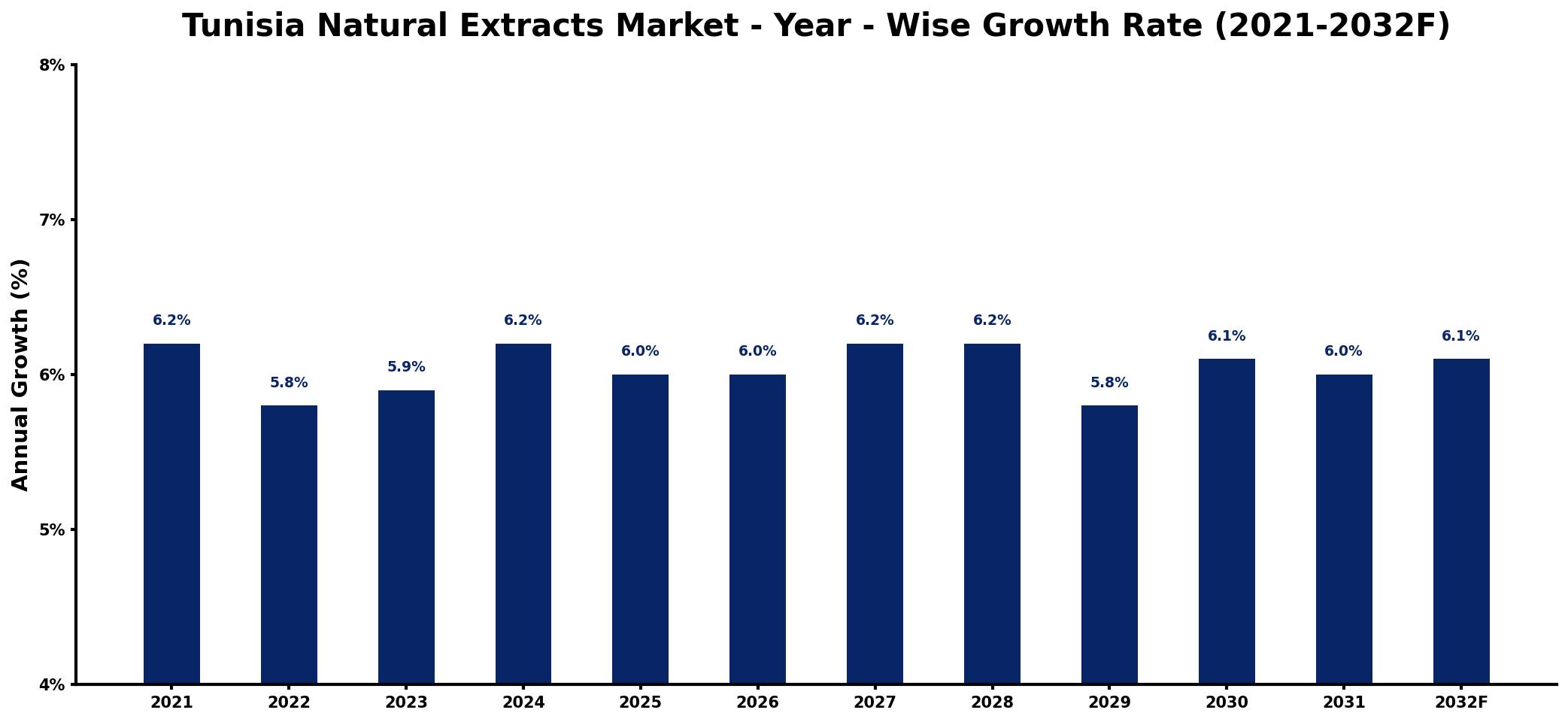
The table below presents the year‑wise growth rates along with the key drivers influencing the market
| Year | Growth Rate | Major Drivers |
| 2021 | 6.2% | Rising consumer health awareness |
| 2022 | 5.8% | Increased demand for organic ingredients |
| 2023 | 5.9% | Growth in wellness product sector |
| 2024 | 6.2% | Expansion of food industry applications |
| 2025 | 6.0% | Boost in e-commerce sales channels |
| 2026 | 6.0% | Surge in cosmetic industry usage |
| 2027 | 6.2% | Growing interest in sustainable sourcing |
| 2028 | 6.2% | Enhancement of research and development |
| 2029 | 5.8% | Popularity of herbal remedies rising |
| 2030 | 6.1% | Investment in innovative processing technologies |
| 2031 | 6.0% | Increased utilization in beverages market |
| 2032 | 6.1% | Development of new product formulations |
Note: Market size estimations and growth projections presented in this report are based on 6Wresearch's proprietary forecasting methodology, utilizing the latest available industry data, government publications, and primary research inputs.
Tunisia Natural Extracts Market Synopsis
Currently, the Tunisia Natural Extracts Market is thriving, bolstered by an upsurge in consumer awareness about the health benefits and ethical implications of natural products. With its rich inventory of botanicals such as olive oil, rose water, and prickly pear extract, Tunisia stands out as a significant player in the global arena.
Market players are increasingly committing to sustainable practices, emphasizing organic and ethically sourced products. This shift not only caters to domestic consumer demands but also positions Tunisia favorably in international markets that prioritize clean and eco-friendly ingredients.
Tunisia Natural Extracts Market Key Takeaways
- The market is characterized by a growing preference for organic and natural products.
- Investment in sustainable practices is becoming vital for competitive differentiation.
- Traditional ingredients are increasingly utilized in various applications, from cosmetics to gourmet foods.
- The government supports the natural extracts sector with incentives and regulations promoting biodiversity.
- Challenges such as regulatory inconsistencies and market access barriers need strategic solutions.
Evaluation of Restraints in Tunisia Natural Extracts Market
Despite its growth potential, the Tunisia Natural Extracts Market grapples with several critical challenges. Inconsistent regulatory frameworks can hinder the smooth operation of businesses, creating uncertainty around compliance and standards. Moreover, the lack of standardization in production processes often results in variability in product quality, which may affect consumer trust. Accessing international markets poses logistical difficulties, compounded by transportation barriers and fluctuating raw material prices, thereby limiting the expansion of local producers.
The impact of climate change on agriculture also presents a formidable challenge, potentially affecting crop yields and the availability of essential raw materials. Addressing these constraints requires a concerted effort among industry stakeholders, including collaboration with governmental bodies and investment in modern extraction technologies.
Tunisia Natural Extracts Market Trends
A notable trend within the Tunisia Natural Extracts Market is the increasing incorporation of traditional Tunisian botanicals into product formulations. Consumers are gravitating towards natural sources that embody cultural heritage and holistic benefits. Additionally, the rising demand for sustainably sourced extracts is prompting companies to prioritize environmentally friendly harvesting methods, which resonates well with a conscientious consumer base. The use of clean-label ingredients is becoming a focal point, further driving innovation within the sector.
Tunisia Natural Extracts Market Opportunities
The market offers substantial investment opportunities, particularly in organic and sustainable products, as consumer preferences continue to evolve. With the unique biodiversity of Tunisia, investors can explore new formulations in areas such as cosmetics, food, and pharmaceuticals. Collaborating with local farmers and producers can enhance access to quality raw materials while aligning with ethical sourcing standards. Furthermore, government initiatives aimed at promoting the natural products sector present additional avenues for growth, making Tunisia a lucrative landscape for investment.
Government Initiatives in the Tunisia Natural Extracts Market
The Tunisian government has adopted various policies to bolster the natural extracts market, emphasizing sustainable harvesting and biodiversity conservation. Initiatives include regulatory frameworks designed to ensure responsible extraction practices, as well as financial incentives aimed at fostering research and development in innovative extraction technologies. By encouraging participation in international trade agreements and exhibitions, the government actively seeks to enhance the visibility and competitiveness of Tunisian natural extracts on the global stage.
Future Insights of the Tunisia Natural Extracts Market
Looking ahead to 2026-2032, the Tunisia Natural Extracts Market is set for significant growth, driven by an increasing global demand for natural and organic products. With rising awareness around health and sustainability, there will likely be a sustained interest in the health benefits of natural extracts. Additionally, as product development focuses on innovation and distribution channel expansion, Tunisia's reputation for high-quality natural extracts will strengthen, attracting both local and international investments.
Tunisia Natural Extracts Market Latest Developments (2025 - 2026)
Recent developments within the Tunisia Natural Extracts Market have showcased an increased focus on technological advancements in extraction methods. Companies are investing in innovative techniques that enhance yield and purity of extracts while minimizing environmental impact. Furthermore, there has been a noticeable uptick in collaborative efforts among producers, suppliers, and government agencies to facilitate smoother market access and promote the export of Tunisian natural extracts. This momentum is expected to continue as the sector gears up to meet both domestic and international demand.
Tunisia Natural Extracts Market - Key Attractiveness of the Report
- 10 Years of Market Numbers
- Historical Data Starting from 2022 to 2025
- Base Year: 2025
- Forecast Data until 2032
- Key Performance Indicators Impacting the Market
- Major Upcoming Developments and Projects
Key Highlights of the Report:
- Tunisia Natural Extracts Market Outlook
- Market Size of Tunisia Natural Extracts Market, 2025
- Forecast of Tunisia Natural Extracts Market, 2032
- Historical Data and Forecast of Tunisia Natural Extracts Revenues & Volume for the Period 2022-2032F
- Tunisia Natural Extracts Market Trend Evolution
- Tunisia Natural Extracts Market Drivers and Challenges
- Tunisia Natural Extracts Price Trends
- Tunisia Natural Extracts Porter's Five Forces
- Tunisia Natural Extracts Industry Life Cycle
- Historical Data and Forecast of Tunisia Natural Extracts Market Revenues & Volume By Product for the Period 2022-2032F
- Historical Data and Forecast of Tunisia Natural Extracts Market Revenues & Volume By Essential Oils for the Period 2022-2032F
- Historical Data and Forecast of Tunisia Natural Extracts Market Revenues & Volume By Oleoresins for the Period 2022-2032F
- Historical Data and Forecast of Tunisia Natural Extracts Market Revenues & Volume By Herbal Extracts for the Period 2022-2032F
- Historical Data and Forecast of Tunisia Natural Extracts Market Revenues & Volume By Natural Colors for the Period 2022-2032F
- Historical Data and Forecast of Tunisia Natural Extracts Market Revenues & Volume By Dried Crops for the Period 2022-2032F
- Historical Data and Forecast of Tunisia Natural Extracts Market Revenues & Volume By Application for the Period 2022-2032F
- Historical Data and Forecast of Tunisia Natural Extracts Market Revenues & Volume By Personal Care & Cosmetics for the Period 2022-2032F
- Historical Data and Forecast of Tunisia Natural Extracts Market Revenues & Volume By Food & Beverage for the Period 2022-2032F
- Historical Data and Forecast of Tunisia Natural Extracts Market Revenues & Volume By Animal Feed for the Period 2022-2032F
- Historical Data and Forecast of Tunisia Natural Extracts Market Revenues & Volume By Pharmaceuticals for the Period 2022-2032F
- Historical Data and Forecast of Tunisia Natural Extracts Market Revenues & Volume By Nutraceuticals for the Period 2022-2032F
- Historical Data and Forecast of Tunisia Natural Extracts Market Revenues & Volume By Others for the Period 2022-2032F
- Tunisia Natural Extracts Import Export Trade Statistics
- Market Opportunity Assessment By Product
- Market Opportunity Assessment By Application
- Tunisia Natural Extracts Top Companies Market Share
- Tunisia Natural Extracts Competitive Benchmarking By Technical and Operational Parameters
- Tunisia Natural Extracts Company Profiles
- Tunisia Natural Extracts Key Strategic Recommendations






































