Tunisia Natural Fragrance Market Size, Share & Growth Rate
The Tunisia Natural Fragrance Market was estimated at USD 196 Million in 2025 and is projected to reach USD 276 Million by 2032, growing at a CAGR of 5.0% from 2026 to 2032. This growth trajectory is primarily fueled by an increasing consumer shift towards natural and organic personal care products, as well as a heightened awareness of the potential hazards associated with synthetic chemicals. Additionally, the integration of sustainable sourcing practices and a focus on cultural heritage are becoming essential factors influencing market positioning and consumer loyalty.
Tunisia Natural Fragrance Market Year-wise Growth Rate and Key Drivers
This graph highlights how the Tunisia Natural Fragrance Market has steadily grown over the years, supported by major growth factors.
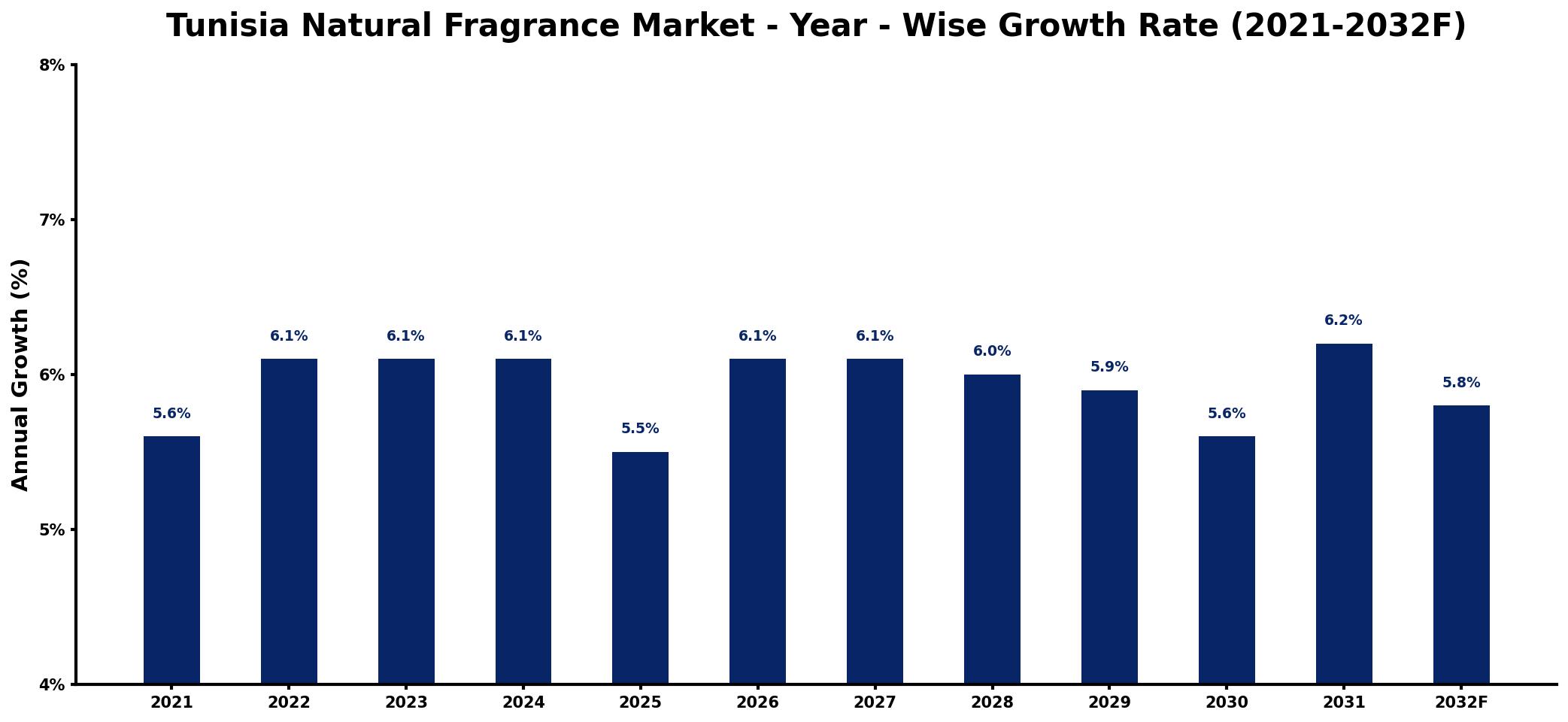
The table below presents the year‑wise growth rates along with the key drivers influencing the market
| Year | Growth Rate | Major Drivers |
| 2021 | 5.6% | Rising consumer interest wellness products |
| 2022 | 6.1% | Increased demand organic ingredients |
| 2023 | 6.1% | Growing popularity artisanal brands |
| 2024 | 6.1% | Expansion e-commerce distribution channels |
| 2025 | 5.5% | Emerging trends sustainable sourcing |
| 2026 | 6.1% | Investment in local production facilities |
| 2027 | 6.1% | Enhanced marketing digital platforms |
| 2028 | 6.0% | Stronger collaboration with retailers |
| 2029 | 5.9% | Diversification product offerings portfolio |
| 2030 | 5.6% | Focus on eco-friendly packaging solutions |
| 2031 | 6.2% | Growing awareness holistic lifestyle choices |
| 2032 | 5.8% | Increase in consumer loyalty programs |
Note: Market size estimations and growth projections presented in this report are based on 6Wresearch's proprietary forecasting methodology, utilizing the latest available industry data, government publications, and primary research inputs.
Tunisia Natural Fragrance Market Synopsis
The natural fragrance landscape in Tunisia is vibrant, characterized by an abundance of native botanical resources that lend themselves to the creation of unique aromatic compounds. As consumer preferences tilt towards eco-conscious and organic products, Tunisian producers are increasingly harnessing this rich biodiversity to meet both local and international demand.
Tunisian artisans and manufacturers are capitalizing on traditional practices while adopting modern techniques to enhance product quality. The intersection of cultural heritage and sustainable innovation not only differentiates the products in the market but also appeals to a global audience eager for authenticity and transparency in their fragrance choices.
Tunisia Natural Fragrance Market Key Takeaways
- The market leverages Tunisia's rich botanical resources to produce unique natural fragrances.
- Consumer demand is increasingly favoring natural and organic personal care products.
- Sustainable sourcing practices are critical in shaping consumer preferences and market dynamics.
- Government initiatives are supporting eco-friendly production methods and biodiversity conservation.
- Industry challenges include maintaining fragrance consistency without synthetic additives.
Evaluation of Restraints in Tunisia Natural Fragrance Market
While the Tunisia natural fragrance market is poised for growth, it faces significant constraints that hinder its full potential. The sustainable sourcing of raw materials poses a challenge, as fluctuating availability of natural ingredients can disrupt supply chains. Additionally, producers must navigate the complexities of ensuring fragrance consistency without resorting to synthetic additives, which complicates product formulation. Furthermore, the regulatory landscape surrounding fragrance labeling standards is evolving, requiring careful compliance to maintain consumer trust and market access.
Tunisia Natural Fragrance Market Trends
A notable trend within the Tunisia natural fragrance market is the increasing popularity of aromatherapy products, reflecting a broader consumer interest in wellness and holistic health. As people seek stress-relief and mood-enhancing solutions, products infused with essential oils are gaining traction. Moreover, the rise of eco-conscious consumerism is prompting brands to adopt transparency in sourcing and production practices, which in turn shapes their marketing strategies and product development.
Tunisia Natural Fragrance Market Opportunities
The market offers numerous opportunities for growth, particularly through international expansion. With global demand for natural fragrances on the rise, Tunisian producers can explore export markets where consumers prioritize organic and sustainable products. Furthermore, collaboration between local artisans and global brands presents an avenue to enhance product visibility and credibility, catering to a discerning consumer base eager for unique and culturally rich fragrance experiences.
Government Initiatives in the Tunisia Natural Fragrance Market
The Tunisian government is actively promoting the natural fragrance market through various initiatives aimed at sustainable sourcing practices and quality standards enforcement. Policies are designed to enhance the competitiveness of local producers, emphasizing eco-friendly production methods and the conservation of biodiversity. Additionally, government support for research and development in natural fragrance technologies bolsters the industrys potential to innovate and expand into new markets.
Future Insights of the Tunisia Natural Fragrance Market
Looking ahead to 2026-2032, the Tunisia natural fragrance market is set to experience significant advancements driven by technological innovation and evolving consumer preferences. As awareness of the benefits of natural ingredients continues to grow, there will be an increasing push towards developing novel formulations that combine traditional practices with modern sustainability. This convergence is expected to attract both investment and research, positioning Tunisia as a key player in the global natural fragrance sector.
Tunisia Natural Fragrance Market Latest Developments (2025 - 2026)
In recent months, the Tunisia natural fragrance market has witnessed a surge in collaborative projects aimed at enhancing product quality and sustainability. Industry players are increasingly engaging in partnerships with research institutions to explore innovative extraction techniques and new fragrance profiles. This collaborative spirit is also reflected in emerging brands that focus on storytelling and cultural heritage to appeal to a growing audience seeking authenticity in their fragrance choices.
Tunisia Natural Fragrance Market - Key Attractiveness of the Report
- 10 Years of Market Numbers
- Historical Data Starting from 2022 to 2025
- Base Year: 2025
- Forecast Data until 2032
- Key Performance Indicators Impacting the Market
- Major Upcoming Developments and Projects
Key Highlights of the Report:
- Tunisia Natural Fragrance Market Outlook
- Market Size of Tunisia Natural Fragrance Market, 2025
- Forecast of Tunisia Natural Fragrance Market, 2032
- Historical Data and Forecast of Tunisia Natural Fragrance Revenues & Volume for the Period 2022-2032F
- Tunisia Natural Fragrance Market Trend Evolution
- Tunisia Natural Fragrance Market Drivers and Challenges
- Tunisia Natural Fragrance Price Trends
- Tunisia Natural Fragrance Porter's Five Forces
- Tunisia Natural Fragrance Industry Life Cycle
- Historical Data and Forecast of Tunisia Natural Fragrance Market Revenues & Volume By Ingredient for the Period 2022-2032F
- Historical Data and Forecast of Tunisia Natural Fragrance Market Revenues & Volume By Essential Oils for the Period 2022-2032F
- Historical Data and Forecast of Tunisia Natural Fragrance Market Revenues & Volume By Natural Extracts for the Period 2022-2032F
- Historical Data and Forecast of Tunisia Natural Fragrance Market Revenues & Volume By Type for the Period 2022-2032F
- Historical Data and Forecast of Tunisia Natural Fragrance Market Revenues & Volume By Top note for the Period 2022-2032F
- Historical Data and Forecast of Tunisia Natural Fragrance Market Revenues & Volume By Middle Note for the Period 2022-2032F
- Historical Data and Forecast of Tunisia Natural Fragrance Market Revenues & Volume By Base Note for the Period 2022-2032F
- Historical Data and Forecast of Tunisia Natural Fragrance Market Revenues & Volume By Application for the Period 2022-2032F
- Historical Data and Forecast of Tunisia Natural Fragrance Market Revenues & Volume By Fine Fragrances for the Period 2022-2032F
- Historical Data and Forecast of Tunisia Natural Fragrance Market Revenues & Volume By Personal Care & Cosmetics for the Period 2022-2032F
- Historical Data and Forecast of Tunisia Natural Fragrance Market Revenues & Volume By Household Care for the Period 2022-2032F
- Tunisia Natural Fragrance Import Export Trade Statistics
- Market Opportunity Assessment By Ingredient
- Market Opportunity Assessment By Type
- Market Opportunity Assessment By Application
- Tunisia Natural Fragrance Top Companies Market Share
- Tunisia Natural Fragrance Competitive Benchmarking By Technical and Operational Parameters
- Tunisia Natural Fragrance Company Profiles
- Tunisia Natural Fragrance Key Strategic Recommendations






































