Tunisia Pallet Boxes Market Size, Share & Growth Rate
The Tunisia Pallet Boxes Market was estimated at USD 453 Million in 2025 and is projected to reach USD 630 Million by 2032, growing at a CAGR of 4.8% from 2026 to 2032. This upward trajectory is primarily fueled by the increasing demand for efficient storage solutions across diverse sectors, particularly agriculture and logistics. As Tunisia continues to strengthen its export capabilities, the need for durable and sustainable packaging options will further propel the adoption of pallet boxes.
Tunisia Pallet Boxes Market Year-wise Growth Rate and Key Drivers
This graph highlights how the Tunisia Pallet Boxes Market has steadily grown over the years, supported by major growth factors.
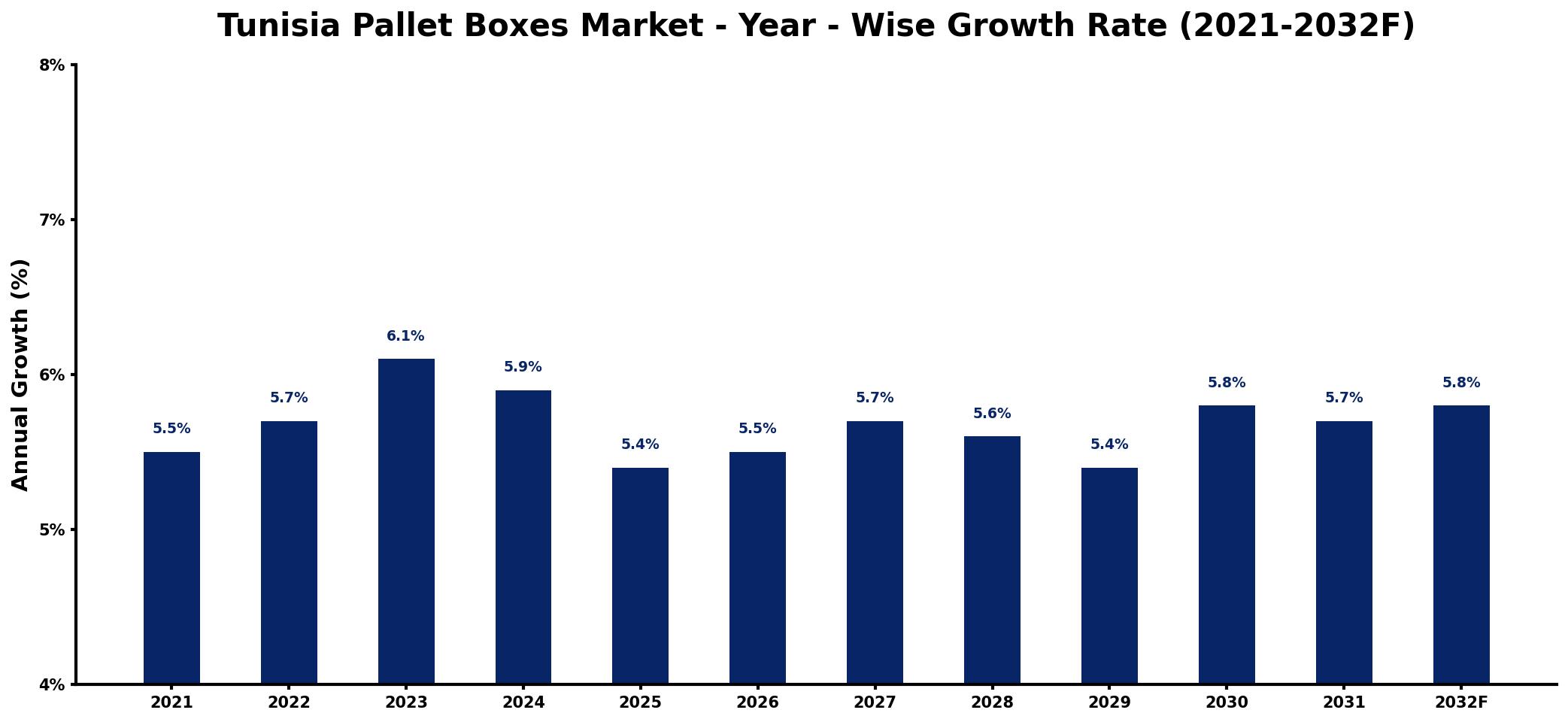
The table below presents the year‑wise growth rates along with the key drivers influencing the market
| Year | Growth Rate | Major Drivers |
| 2021 | 5.5% | Rising e-commerce logistics demand |
| 2022 | 5.7% | Expansion in agricultural exports |
| 2023 | 6.1% | Increased industrial production capacity |
| 2024 | 5.9% | Growing focus on sustainability practices |
| 2025 | 5.4% | Investment in supply chain efficiency |
| 2026 | 5.5% | Emerging markets increasing consumption |
| 2027 | 5.7% | Technological advancements in manufacturing |
| 2028 | 5.6% | Heightened demand for export compliance |
| 2029 | 5.4% | Strengthening regional trade agreements |
| 2030 | 5.8% | Diversification of transportation methods |
| 2031 | 5.7% | Growth in retail distribution networks |
| 2032 | 5.8% | Increased urbanization and logistics needs |
Note: Market size estimations and growth projections presented in this report are based on 6Wresearch's proprietary forecasting methodology, utilizing the latest available industry data, government publications, and primary research inputs.
Tunisia Pallet Boxes Market Synopsis
In recent years, the Tunisia Pallet Boxes Market has gained momentum, characterized by a shift towards sustainable packaging solutions. Local manufacturers are stepping up alongside international suppliers, offering a wide array of pallet box sizes and materials tailored to specific customer needs across various industries.
This growth is underpinned by a collective push towards sustainability, durability, and cost-effectiveness, resulting in an evolving market landscape. The increasing emphasis on efficient logistics and storage solutions, particularly in the agriculture and food and beverage sectors, is fostering an environment ripe for investment and innovation.
Tunisia Pallet Boxes Market Key Takeaways
- Significant growth driven by diverse sector demand for pallet boxes, notably agriculture and logistics.
- Growing emphasis on sustainability, leading to increased use of eco-friendly materials.
- Customizable pallet box solutions are becoming essential for brand visibility and market differentiation.
- Awareness and education about pallet box benefits are critical for broader market adoption.
- Government policies support local manufacturing, enhancing market stability and growth potential.
Evaluation of Restraints in Tunisia Pallet Boxes Market
Despite the promising growth trajectory, several factors present obstacles in the Tunisia Pallet Boxes Market. Limited awareness regarding the advantages of pallet boxes, particularly among smaller businesses, continues to hinder wider adoption. Traditional packaging methods remain deeply entrenched in many sectors, complicating the transition to pallet boxes. Additionally, the initial investment costs, coupled with inconsistencies in product quality due to the fragmented market landscape, create challenges for potential buyers seeking reliable and standardized solutions.
Tunisia Pallet Boxes Market Trends
The Tunisia Pallet Boxes Market is currently witnessing a surge in demand for environmentally sustainable packaging solutions. Manufacturers are increasingly utilizing recycled materials, aligning their products with the broader market trend towards eco-friendliness. Furthermore, collapsible and stackable pallet boxes are gaining traction for their space-saving benefits, catering to businesses focused on optimizing logistics costs. Customization options for branding are also becoming more prevalent, enhancing product visibility in competitive markets.
Tunisia Pallet Boxes Market Opportunities
The potential for investment in the Tunisia Pallet Boxes Market is considerable, particularly within the booming agricultural and logistics sectors. As the country positions itself as a strategic entry point into Africa, the demand for high-quality, durable pallet boxes is set to rise. Opportunities exist not only for manufacturers but also for distributors and suppliers who can leverage the growing need for innovative packaging solutions. The governments focus on industrial growth further amplifies these investment prospects, creating an attractive environment for stakeholders.
Government Initiatives in the Tunisia Pallet Boxes Market
The Tunisian government is actively promoting policies that benefit the pallet boxes market, including trade regulations that foster fair competition and the establishment of quality standards. Additionally, there are incentives designed to bolster local manufacturers, reducing reliance on imports. With a clear agenda for sustainable development, the government also encourages the use of recyclable materials and aims to minimize carbon emissions within the packaging industry, thereby aligning economic growth with environmental stewardship.
Future Insights of the Tunisia Pallet Boxes Market
Looking ahead to 2026-2032, the Tunisia Pallet Boxes Market is set for continuous expansion, driven by a heightened awareness of the benefits of pallet boxes in storage and logistics. As sustainability becomes a focal point in packaging solutions, innovations in material technology and design will likely enhance product offerings. Consequently, businesses will increasingly prioritize cost-effective and environmentally friendly packaging solutions, paving the way for a thriving market.
Tunisia Pallet Boxes Market Latest Developments (2025 - 2026)
In recent months, the Tunisia Pallet Boxes Market has seen notable advancements in sustainable packaging technology. Manufacturers are introducing new designs aimed at enhancing both functionality and eco-friendliness. Concurrently, there is a discernible trend among businesses to shift towards more customized pallet box solutions that cater to unique branding needs. These developments reflect the evolving landscape of the market, responding to changing consumer preferences and regulatory demands.
Tunisia Pallet Boxes Market - Key Attractiveness of the Report
- 10 Years of Market Numbers
- Historical Data Starting from 2022 to 2025
- Base Year: 2025
- Forecast Data until 2032
- Key Performance Indicators Impacting the Market
- Major Upcoming Developments and Projects
Key Highlights of the Report:
- Tunisia Pallet Boxes Market Outlook
- Market Size of Tunisia Pallet Boxes Market, 2025
- Forecast of Tunisia Pallet Boxes Market, 2032
- Historical Data and Forecast of Tunisia Pallet Boxes Revenues & Volume for the Period 2022-2032F
- Tunisia Pallet Boxes Market Trend Evolution
- Tunisia Pallet Boxes Market Drivers and Challenges
- Tunisia Pallet Boxes Price Trends
- Tunisia Pallet Boxes Porter's Five Forces
- Tunisia Pallet Boxes Industry Life Cycle
- Historical Data and Forecast of Tunisia Pallet Boxes Market Revenues & Volume By Material for the Period 2022-2032F
- Historical Data and Forecast of Tunisia Pallet Boxes Market Revenues & Volume By Wooden Pallet Box for the Period 2022-2032F
- Historical Data and Forecast of Tunisia Pallet Boxes Market Revenues & Volume By Plastic Pallet Box for the Period 2022-2032F
- Historical Data and Forecast of Tunisia Pallet Boxes Market Revenues & Volume By Metal Pallet Box for the Period 2022-2032F
- Historical Data and Forecast of Tunisia Pallet Boxes Market Revenues & Volume By Paper Pallet Box for the Period 2022-2032F
- Historical Data and Forecast of Tunisia Pallet Boxes Market Revenues & Volume By Pallet Type for the Period 2022-2032F
- Historical Data and Forecast of Tunisia Pallet Boxes Market Revenues & Volume By Block Pallet for the Period 2022-2032F
- Historical Data and Forecast of Tunisia Pallet Boxes Market Revenues & Volume By Stringer Pallet for the Period 2022-2032F
- Historical Data and Forecast of Tunisia Pallet Boxes Market Revenues & Volume By Customized Pallet for the Period 2022-2032F
- Historical Data and Forecast of Tunisia Pallet Boxes Market Revenues & Volume By End-use Industry for the Period 2022-2032F
- Historical Data and Forecast of Tunisia Pallet Boxes Market Revenues & Volume By Agriculture & Allied Industries for the Period 2022-2032F
- Historical Data and Forecast of Tunisia Pallet Boxes Market Revenues & Volume By Building & Construction for the Period 2022-2032F
- Historical Data and Forecast of Tunisia Pallet Boxes Market Revenues & Volume By Chemical & Pharmaceutical for the Period 2022-2032F
- Historical Data and Forecast of Tunisia Pallet Boxes Market Revenues & Volume By Food & Beverages for the Period 2022-2032F
- Historical Data and Forecast of Tunisia Pallet Boxes Market Revenues & Volume By Engineering Products for the Period 2022-2032F
- Historical Data and Forecast of Tunisia Pallet Boxes Market Revenues & Volume By Textile & Handicraft for the Period 2022-2032F
- Historical Data and Forecast of Tunisia Pallet Boxes Market Revenues & Volume By Automotive for the Period 2022-2032F
- Historical Data and Forecast of Tunisia Pallet Boxes Market Revenues & Volume By Other Industries for the Period 2022-2032F
- Tunisia Pallet Boxes Import Export Trade Statistics
- Market Opportunity Assessment By Material
- Market Opportunity Assessment By Pallet Type
- Market Opportunity Assessment By End-use Industry
- Tunisia Pallet Boxes Top Companies Market Share
- Tunisia Pallet Boxes Competitive Benchmarking By Technical and Operational Parameters
- Tunisia Pallet Boxes Company Profiles
- Tunisia Pallet Boxes Key Strategic Recommendations






































