Tunisia Personal Computers Market Size, Share & Growth Rate
The Tunisia Personal Computers Market was estimated at USD 263 Million in 2025 and is projected to reach USD 358 Million by 2032, growing at a CAGR of 4.5% from 2026 to 2032. This growth trajectory is primarily driven by a burgeoning digital literacy among the population and ongoing government initiatives aimed at promoting technological integration across various sectors. Additionally, the surge in remote work and online education, catalyzed by the COVID-19 pandemic, is solidifying the demand for personal computers.
Tunisia Personal Computers Market Year-wise Growth Rate and Key Drivers
This graph highlights how the Tunisia Personal Computers Market has steadily grown over the years, supported by major growth factors.
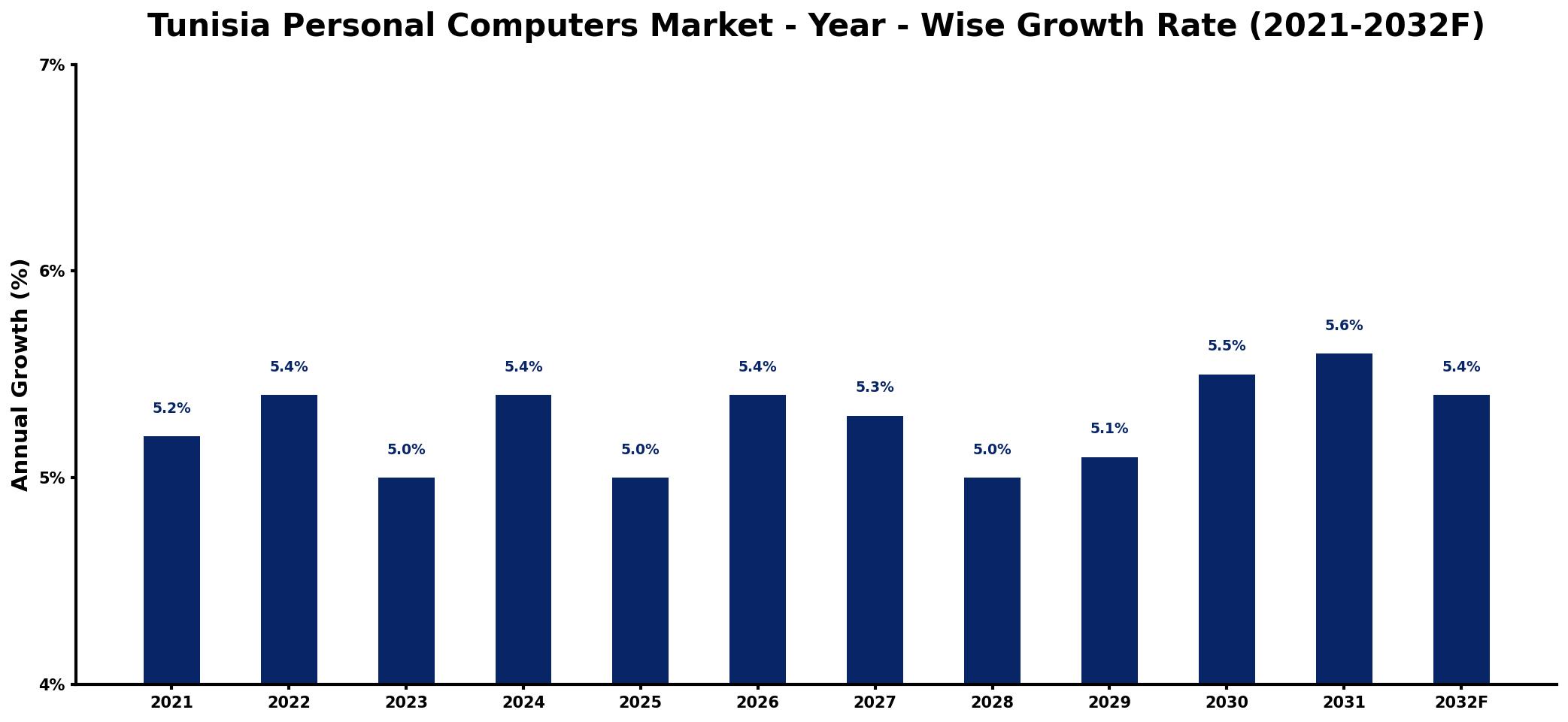
The table below presents the year‑wise growth rates along with the key drivers influencing the market
| Year | Growth Rate | Major Drivers |
| 2021 | 5.2% | Rising digital education initiatives |
| 2022 | 5.4% | Increased remote work adoption |
| 2023 | 5.0% | Growing e-commerce sector investments |
| 2024 | 5.4% | Expansion of tech startups ecosystem |
| 2025 | 5.0% | Boost in online content creation |
| 2026 | 5.4% | Surge in gaming industry demand |
| 2027 | 5.3% | Enhanced internet infrastructure development |
| 2028 | 5.0% | Growth in cloud service adoption |
| 2029 | 5.1% | Increased government technology initiatives |
| 2030 | 5.5% | Higher consumer electronics spending |
| 2031 | 5.6% | rising end-use demand growth |
| 2032 | 5.4% | Rising demand for digital services |
Note: Market size estimations and growth projections presented in this report are based on 6Wresearch's proprietary forecasting methodology, utilizing the latest available industry data, government publications, and primary research inputs.
Tunisia Personal Computers Market Synopsis
The Tunisia Personal Computers Market is currently witnessing a transformative phase characterized by increasing adoption of laptops and tablets. This momentum is a reaction to heightened consumer needs for mobility, remote work compatibility, and enhanced digital learning experiences. As the market matures, it is anticipated that consumer preferences will increasingly favor high-performance systems, especially within gaming and content creation segments.
Looking ahead, the interplay of local economic challenges and global technology trends will likely shape the markets development. While economic constraints may restrain some consumer segments, the overall movement towards a more digitally-connected society portends significant long-term growth in PC demand.
Tunisia Personal Computers Market Key Takeaways
- Increasing digital literacy and educational reforms are propelling PC adoption.
- The rise of remote work and online education continues to drive demand for personal computers.
- Multinational brands dominate, yet local players are carving out affordable market niches.
- Consumer preference is shifting towards lightweight, portable devices for enhanced mobility.
- Sustainability and eco-friendly features are increasingly influencing purchasing decisions.
Evaluation of Restraints in Tunisia Personal Computers Market
The Tunisia Personal Computers Market is facing notable challenges that inhibit its growth potential. Chief among these is the limited disposable income of many consumers, particularly in certain regions, which constrains their purchasing power. Furthermore, the competitive landscape, dominated by multinational brands, presents a significant barrier for local manufacturers attempting to gain market share. Additionally, infrastructural deficits, notably in access to high-speed internet, pose obstacles to the widespread adoption of personal computers. These factors necessitate innovative strategies to engage consumers effectively and promote tech adoption.
Tunisia Personal Computers Market Trends
Several key trends are emerging within the Tunisia Personal Computers Market. A pronounced shift toward lightweight laptops and tablets reflects a growing consumer demand for mobility and convenience, particularly in professional and educational contexts. In parallel, the market is also witnessing an uptick in the popularity of gaming PCs, driven by a youthful demographic that values high-performance capabilities. Additionally, sustainability is gaining traction, with consumers increasingly interested in energy-efficient devices and eco-friendly production practices.
Tunisia Personal Computers Market Opportunities
Significant investment opportunities exist within the Tunisia Personal Computers Market, particularly in expanding distribution channels and retail presence. Targeting affordable solutions can attract a wider consumer base. Furthermore, investing in value-added services such as PC repairs, upgrades, and customization can create differentiation in a competitive landscape. The rise of e-commerce platforms presents a promising avenue to enhance accessibility and expand reach, thus capitalizing on the growing demand for personal computers across the nation.
Government Initiatives in the Tunisia Personal Computers Market
Government policies in Tunisia play a crucial role in shaping the personal computer landscape. Efforts to enhance digital literacy and integrate technology into educational curricula are designed to increase computer adoption rates among the population. Additionally, there are regulatory frameworks in place to ensure the safety and quality of electronic products, which directly impact market dynamics. Import tariffs and taxes on electronic goods also influence consumer pricing, thus affecting market competitiveness.
Future Insights of the Tunisia Personal Computers Market
Looking ahead to 2026-2032, the Tunisia Personal Computers Market is set to experience sustained growth driven by the ongoing digitalization trends across sectors such as education, government, and business. As remote work and online learning solidify their place in everyday life, the demand for reliable PCs is expected to rise. However, market players will need to remain vigilant of shifts in consumer preferences towards mobile devices and remain innovative to retain market share amidst fierce competition.
Tunisia Personal Computers Market Latest Developments (2025 - 2026)
In recent months, the Tunisia Personal Computers Market has seen an influx of new product launches focused on high-performance computing tailored for both gaming and professional use. Additionally, companies are increasingly adopting sustainable practices, launching energy-efficient models that cater to environmentally conscious consumers. Online sales channels are becoming more prominent as businesses pivot towards digital platforms to enhance their reach and meet the demand from remote workers and students alike.
Tunisia Personal Computers Market - Key Attractiveness of the Report
- 10 Years of Market Numbers
- Historical Data Starting from 2022 to 2025
- Base Year: 2025
- Forecast Data until 2032
- Key Performance Indicators Impacting the Market
- Major Upcoming Developments and Projects
Key Highlights of the Report:
- Tunisia Personal Computers Market Outlook
- Market Size of Tunisia Personal Computers Market, 2025
- Forecast of Tunisia Personal Computers Market, 2032
- Historical Data and Forecast of Tunisia Personal Computers Revenues & Volume for the Period 2022-2032F
- Tunisia Personal Computers Market Trend Evolution
- Tunisia Personal Computers Market Drivers and Challenges
- Tunisia Personal Computers Price Trends
- Tunisia Personal Computers Porter's Five Forces
- Tunisia Personal Computers Industry Life Cycle
- Historical Data and Forecast of Tunisia Personal Computers Market Revenues & Volume By Product Type for the Period 2022-2032F
- Historical Data and Forecast of Tunisia Personal Computers Market Revenues & Volume By Desktop for the Period 2022-2032F
- Historical Data and Forecast of Tunisia Personal Computers Market Revenues & Volume By Notebook for the Period 2022-2032F
- Historical Data and Forecast of Tunisia Personal Computers Market Revenues & Volume By Workstation for the Period 2022-2032F
- Historical Data and Forecast of Tunisia Personal Computers Market Revenues & Volume By Others for the Period 2022-2032F
- Historical Data and Forecast of Tunisia Personal Computers Market Revenues & Volume By Distribution Channel for the Period 2022-2032F
- Historical Data and Forecast of Tunisia Personal Computers Market Revenues & Volume By Business-To-Business (B2B) for the Period 2022-2032F
- Historical Data and Forecast of Tunisia Personal Computers Market Revenues & Volume By Business-To-Consumer (B2C) for the Period 2022-2032F
- Historical Data and Forecast of Tunisia Personal Computers Market Revenues & Volume By Application for the Period 2022-2032F
- Historical Data and Forecast of Tunisia Personal Computers Market Revenues & Volume By Consumer for the Period 2022-2032F
- Historical Data and Forecast of Tunisia Personal Computers Market Revenues & Volume By Commercial for the Period 2022-2032F
- Historical Data and Forecast of Tunisia Personal Computers Market Revenues & Volume By Industrial for the Period 2022-2032F
- Tunisia Personal Computers Import Export Trade Statistics
- Market Opportunity Assessment By Product Type
- Market Opportunity Assessment By Distribution Channel
- Market Opportunity Assessment By Application
- Tunisia Personal Computers Top Companies Market Share
- Tunisia Personal Computers Competitive Benchmarking By Technical and Operational Parameters
- Tunisia Personal Computers Company Profiles
- Tunisia Personal Computers Key Strategic Recommendations






































