Tunisia Phosphate Market Size Growth Rate
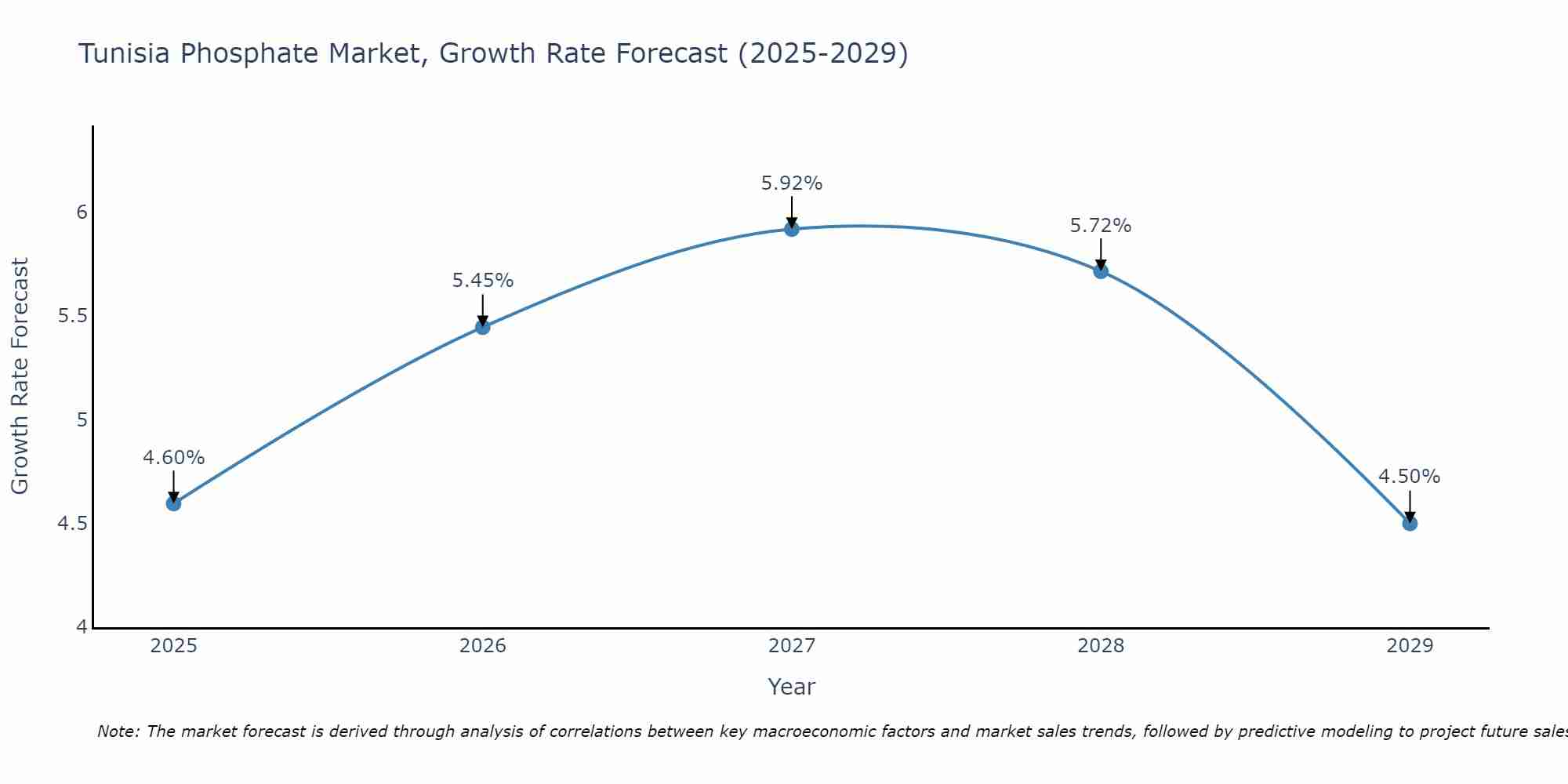
The Tunisia Phosphate Market is projected to witness mixed growth rate patterns during 2025 to 2029. Growth accelerates to 5.92% in 2027, following an initial rate of 4.60%, before easing to 4.50% at the end of the period.
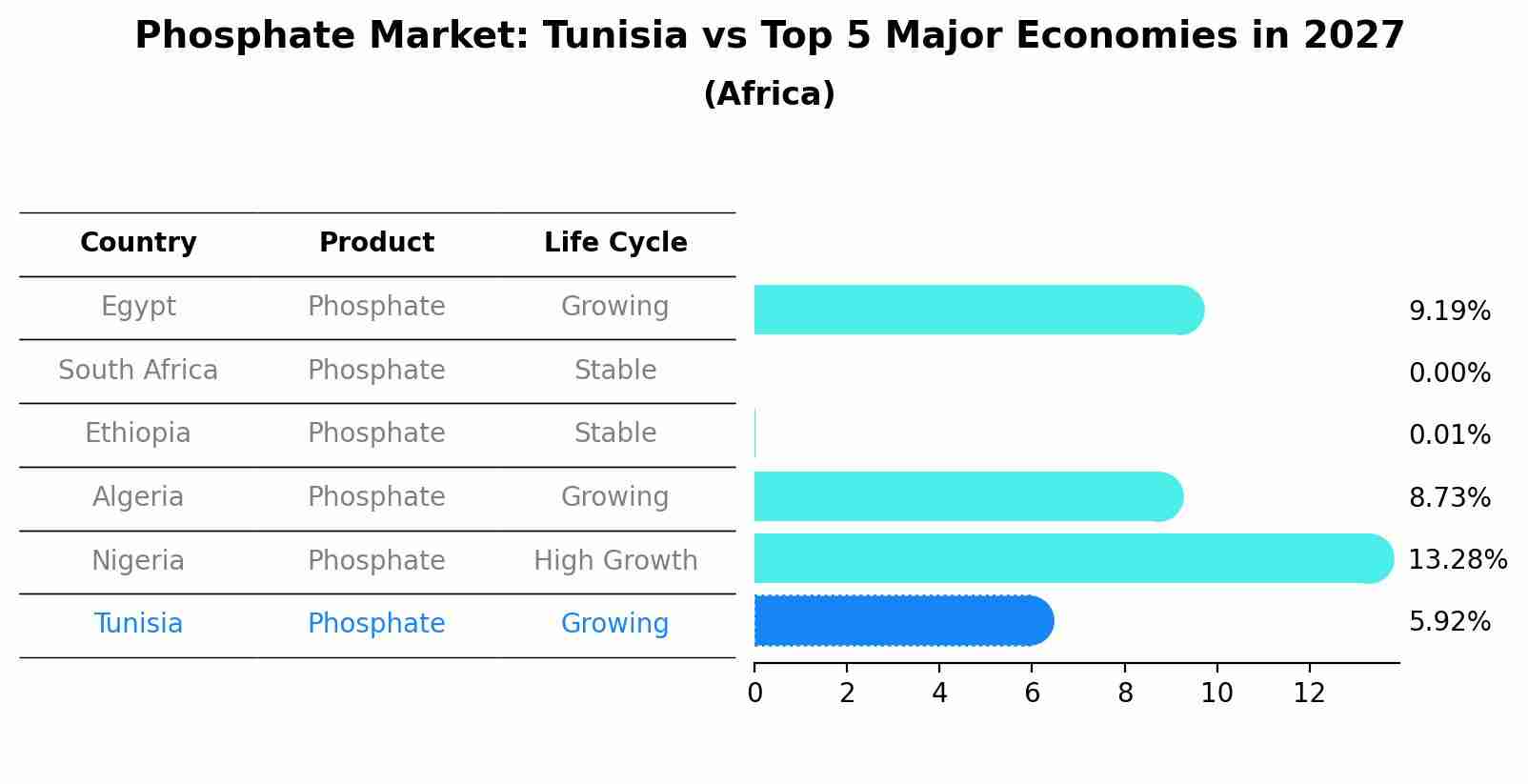
Phosphate Market: Tunisia vs Top 5 Major Economies in 2027 (Africa)
In the Africa region, the Phosphate market in Tunisia is projected to expand at a growing growth rate of 5.92% by 2027. The largest economy is Egypt, followed by South Africa, Ethiopia, Algeria and Nigeria.
Tunisia Phosphate Market Overview
The Tunisia Phosphate Market is a significant player in the global phosphate industry. Tunisia is one of the world`s largest producers and exporters of phosphate rock, with extensive reserves and mining operations concentrated mainly in the Gafsa Basin. Phosphate mining plays a crucial role in the country`s economy, providing employment opportunities and contributing to government revenues. The market is influenced by factors such as global demand for fertilizers, geopolitical developments, and environmental regulations. Tunisia`s phosphate industry faces challenges related to sustainability, resource management, and market fluctuations. Despite these challenges, the country continues to be a key player in the global phosphate market, with opportunities for growth and development in the future.
Tunisia Phosphate Market Trends and Opportunities
The Tunisia phosphate market is experiencing growth due to increasing global demand for fertilizers, driven by the growing population and the need for food security. One key trend in the market is the shift towards sustainable and environmentally friendly phosphate mining practices, in line with global sustainability goals. Opportunities in the Tunisia phosphate market include potential partnerships with international companies for technology transfer and expertise exchange, as well as investments in research and development for innovative phosphate-based products. Additionally, the increasing use of phosphate in industries such as food processing, animal feed, and chemicals presents further growth opportunities for the market. Overall, the Tunisia phosphate market is poised for expansion and diversification in the coming years.
Tunisia Phosphate Market Challenges
The Tunisia Phosphate Market faces several challenges, including fluctuating global demand and prices for phosphate-based products, increasing competition from other phosphate-producing countries, such as Morocco and China, and environmental concerns related to phosphate mining and processing. Additionally, the sector in Tunisia has been impacted by political instability and social unrest in recent years, leading to disruptions in production and export activities. The need for modernization and technology upgrades in phosphate mining and processing facilities, as well as the development of sustainable practices to mitigate environmental impact, are also key challenges facing the Tunisia Phosphate Market. Overall, navigating these challenges will require strategic planning, investment in innovation, and strong regulatory frameworks to ensure long-term sustainability and competitiveness in the global market.
Tunisia Phosphate Market Drivers
The Tunisia Phosphate Market is primarily driven by factors such as the country`s abundant phosphate reserves, its position as one of the world`s largest phosphate producers, and the increasing global demand for phosphate-based fertilizers. The agricultural sector`s reliance on phosphates for crop production and the growth of the chemical industry also contribute to the market`s growth. Additionally, government initiatives to promote phosphate mining and exports, as well as investments in infrastructure and technology improvements, play a significant role in driving the market forward. Political stability and favorable trade agreements further support the growth of the Tunisia Phosphate Market, making it an attractive industry for investors and stakeholders alike.
Tunisia Phosphate Market Government Policy
The Tunisian government plays a significant role in the phosphate market through state-owned company Groupe Chimique Tunisien (GCT), which controls most phosphate production and exports. Government policies aim to regulate and support the industry, including setting production quotas, implementing export restrictions, and ensuring environmental sustainability. In recent years, the government has focused on increasing value-added processing within the country to boost revenues and create job opportunities. Additionally, there are efforts to attract foreign investment in the sector through partnerships and joint ventures. Overall, government policies in Tunisia`s phosphate market are geared towards maximizing economic benefits while ensuring sustainable development and environmental protection.
Tunisia Phosphate Market Future Outlook
The future outlook for the Tunisia Phosphate Market appears positive, driven by increasing global demand for fertilizers and agricultural products. Tunisia is one of the largest exporters of phosphate globally, and the country`s strategic location provides easy access to major markets in Europe and Africa. The government`s focus on modernizing the phosphate industry, improving infrastructure, and enhancing production efficiency is expected to boost exports and attract foreign investments. Additionally, the growing trend towards sustainable agriculture practices and organic farming is likely to create new opportunities for phosphate-based products in the market. Overall, the Tunisia Phosphate Market is poised for growth in the coming years, supported by favorable market conditions and a strong export-oriented industry.
Key Highlights of the Report:
- Tunisia Phosphate Market Outlook
- Market Size of Tunisia Phosphate Market, 2022
- Forecast of Tunisia Phosphate Market, 2031
- Historical Data and Forecast of Tunisia Phosphate Revenues & Volume for the Period 2021 - 2031
- Tunisia Phosphate Market Trend Evolution
- Tunisia Phosphate Market Drivers and Challenges
- Tunisia Phosphate Price Trends
- Tunisia Phosphate Porter's Five Forces
- Tunisia Phosphate Industry Life Cycle
- Historical Data and Forecast of Tunisia Phosphate Market Revenues & Volume By Type/Derivative for the Period 2021 - 2031
- Historical Data and Forecast of Tunisia Phosphate Market Revenues & Volume By Ammonium Phosphate for the Period 2021 - 2031
- Historical Data and Forecast of Tunisia Phosphate Market Revenues & Volume By Calcium Phosphate for the Period 2021 - 2031
- Historical Data and Forecast of Tunisia Phosphate Market Revenues & Volume By Phosphoric Acid for the Period 2021 - 2031
- Historical Data and Forecast of Tunisia Phosphate Market Revenues & Volume By Application for the Period 2021 - 2031
- Historical Data and Forecast of Tunisia Phosphate Market Revenues & Volume By Fertilizers for the Period 2021 - 2031
- Historical Data and Forecast of Tunisia Phosphate Market Revenues & Volume By Foods & Beverages for the Period 2021 - 2031
- Historical Data and Forecast of Tunisia Phosphate Market Revenues & Volume By Detergents for the Period 2021 - 2031
- Historical Data and Forecast of Tunisia Phosphate Market Revenues & Volume By Type of Resource for the Period 2021 - 2031
- Historical Data and Forecast of Tunisia Phosphate Market Revenues & Volume By Sedimentary Marine Deposits for the Period 2021 - 2031
- Historical Data and Forecast of Tunisia Phosphate Market Revenues & Volume By Igneous & Weathered for the Period 2021 - 2031
- Historical Data and Forecast of Tunisia Phosphate Market Revenues & Volume By Biogenic for the Period 2021 - 2031
- Tunisia Phosphate Import Export Trade Statistics
- Market Opportunity Assessment By Type/Derivative
- Market Opportunity Assessment By Application
- Market Opportunity Assessment By Type of Resource
- Tunisia Phosphate Top Companies Market Share
- Tunisia Phosphate Competitive Benchmarking By Technical and Operational Parameters
- Tunisia Phosphate Company Profiles
- Tunisia Phosphate Key Strategic Recommendations






































