Tunisia Planting Equipment Market Size, Share & Growth Rate
The Tunisia Planting Equipment Market was estimated at USD 1051 Million in 2025 and is projected to reach USD 1500 Million by 2032, growing at a CAGR of 5.2% from 2026 to 2032. This growth trajectory is largely driven by the increasing need for enhanced agricultural productivity and efficiency. Furthermore, as Tunisia's farming sector faces labor shortages, there is a growing reliance on mechanized planting solutions, which are transforming traditional practices.
Tunisia Planting Equipment Market Year-wise Growth Rate and Key Drivers
This graph highlights how the Tunisia Planting Equipment Market has steadily grown over the years, supported by major growth factors.
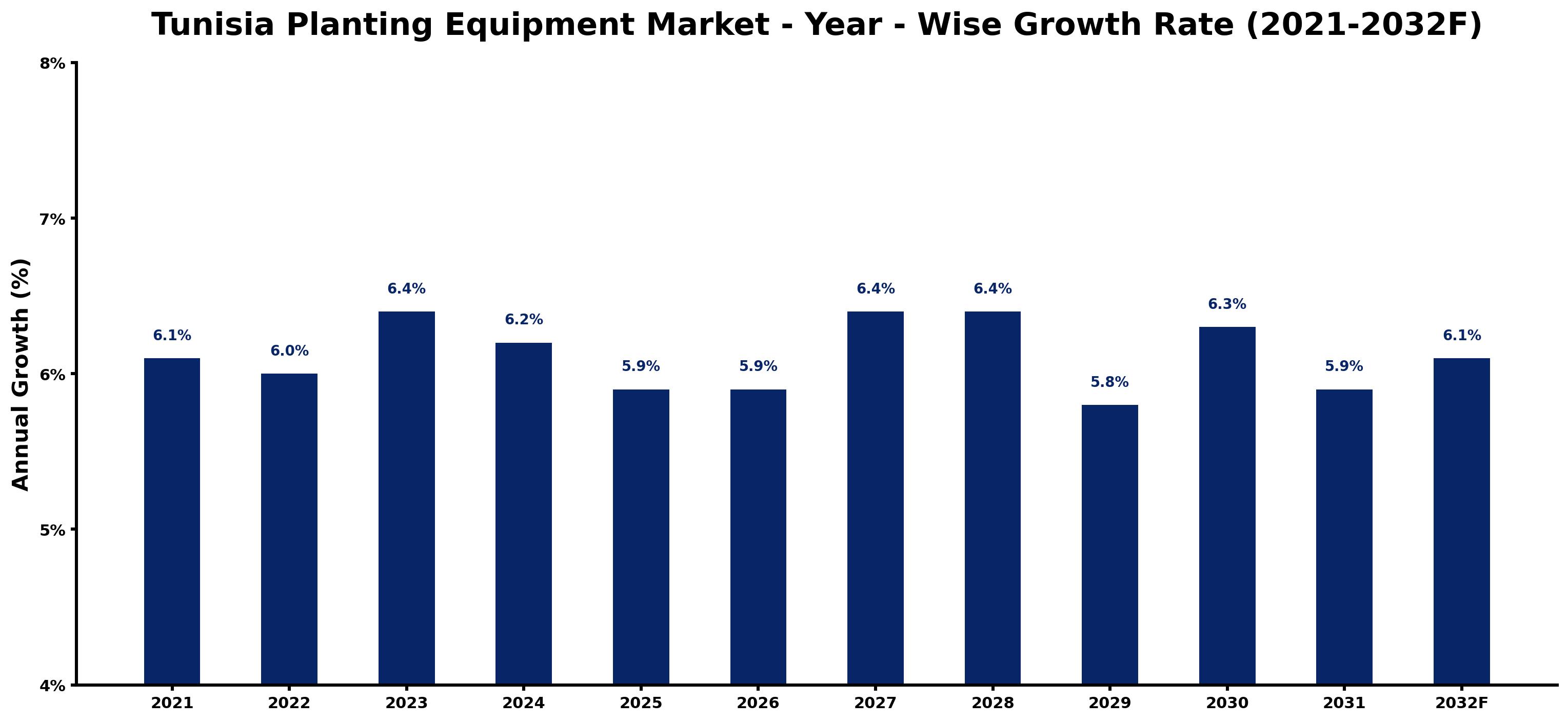
The table below presents the year‑wise growth rates along with the key drivers influencing the market
| Year | Growth Rate | Major Drivers |
| 2021 | 6.1% | Expansion of manufacturing activities |
| 2022 | 6.0% | Expansion of transportation and logistics networks |
| 2023 | 6.4% | Rising electricity demand across industries |
| 2024 | 6.2% | Growing urbanization and commercial development |
| 2025 | 5.9% | Growing urbanization and commercial development |
| 2026 | 5.9% | Increasing adoption of advanced technologies |
| 2027 | 6.4% | Rapid growth in telecom and data center sectors |
| 2028 | 6.4% | Expansion of commercial construction activities |
| 2029 | 5.8% | Rising electricity demand across industries |
| 2030 | 6.3% | Government infrastructure modernization initiatives |
| 2031 | 5.9% | Growing urbanization and commercial development |
| 2032 | 6.1% | Government infrastructure modernization initiatives |
Note - Market size estimations and growth projections presented in this report are based on 6Wresearch’s advanced forecasting approach, validated with industry datasets as of June 2026.
Tunisia Planting Equipment Market Synopsis
In recent years, the Tunisia planting equipment market has experienced a shift towards mechanization and technological adoption, reflecting a growing recognition of the value that modern equipment can deliver. As farmers embrace innovative planting solutions, the market is set to expand significantly, with new technologies enhancing efficiency and crop yields.
Looking forward, the market is expected to see a pronounced emphasis on sustainability and precision agriculture. This evolution aligns with the global trend of prioritizing environmentally friendly practices, providing farmers with the tools needed to improve their output while minimizing their ecological footprint.
Tunisia Planting Equipment Market Key Takeaways
- The market reflects a strong trend towards mechanization, with increasing adoption of precision planting technologies.
- Government initiatives are critical in promoting modern farming techniques, enhancing market growth potential.
- Sustainability and multi-functional planting equipment are becoming focal points for Tunisian farmers.
- Investment opportunities abound for companies developing advanced, cost-effective solutions tailored to local needs.
- Challenges related to technology access and infrastructure require strategic focus for market growth.
Evaluation of Restraints in Tunisia Planting Equipment Market
Despite the promising growth outlook, the Tunisia planting equipment market faces significant hurdles. Access to cutting-edge technologies remains limited, particularly for small-scale farmers who often struggle to invest in modern machinery. High upfront costs and maintenance expenses of advanced planting equipment act as deterrents. Additionally, inadequate infrastructure can result in delays, impacting timely maintenance and overall productivity. These challenges highlight the urgent need for policies that bolster technology access and provide financial support to farmers, ensuring that they can adapt and thrive in a rapidly evolving agricultural landscape.
Tunisia Planting Equipment Market Trends
One of the most notable trends in the Tunisia planting equipment market is the increased adoption of precision agriculture techniques, incorporating advanced technologies like GPS-guided systems and IoT integration. Farmers are prioritizing equipment that enhances accuracy and reduces resource waste, thereby optimizing yields. Moreover, there is a rising preference for multifunctional planting equipment capable of addressing various crop types and field conditions, which provides both versatility and cost-effectiveness in operations.
Tunisia Planting Equipment Market Opportunities
Investors will find several compelling opportunities within the Tunisia planting equipment market. There is a pronounced demand for innovative planting technologies, particularly those aimed at enhancing efficiency and reducing labor costs. Sustainable agricultural practices are gaining traction, creating avenues for investment in eco-friendly planting solutions. Additionally, partnerships with local manufacturers to develop customized equipment, along with offering training programs for farmers, can significantly enhance market penetration and build a robust business presence in this evolving landscape.
Government Initiatives in the Tunisia Planting Equipment Market
The Tunisian government plays a pivotal role in fostering agricultural development through various supportive policies. By providing subsidies and financial incentives, the government encourages farmers to modernize their planting equipment and adopt advanced technologies. Furthermore, regulations ensuring the quality and safety of equipment contribute to building trust within the market. Ongoing investments in research and development initiatives illustrate a commitment to enhancing agricultural productivity, thereby aligning with the broader objective of sustainable farming practices.
Future Insights of the Tunisia Planting Equipment Market
As we look toward the future from 2026 to 2032, the Tunisia planting equipment market is likely to see significant growth driven by the continuous uptake of precision agriculture and government initiatives aimed at enhancing agricultural practices. The trend towards mechanization will drive demand for advanced planting equipment, including precision seeders and multifunctional planters. Additionally, technological advancements will empower farmers to make data-driven decisions, thereby improving operational efficiency and resource utilization.
Tunisia Planting Equipment Market Latest Developments (May 2025 - June 2026)
In the recent months, the Tunisia planting equipment market has witnessed a surge in innovations, with companies introducing advanced planting technologies that align with sustainability goals. A growing emphasis on mechanized solutions is evident as farmers seek ways to combat labor shortages and improve crop efficiency. Collaborative efforts between government agencies and agricultural firms are also gaining momentum, focusing on developing training programs and technical support to facilitate smoother transitions to modern equipment.
Tunisia Planting Equipment Market - Key Attractiveness of the Report
- 10 Years of Market Numbers
- Historical Data Starting from 2022 to 2025
- Base Year: 2025
- Forecast Data until 2032
- Key Performance Indicators Impacting the Market
- Major Upcoming Developments and Projects
Key Highlights of the Report:
- Tunisia Planting Equipment Market Outlook
- Market Size of Tunisia Planting Equipment Market, 2025
- Forecast of Tunisia Planting Equipment Market, 2032
- Historical Data and Forecast of Tunisia Planting Equipment Revenues & Volume for the Period 2022-2032F
- Tunisia Planting Equipment Market Trend Evolution
- Tunisia Planting Equipment Market Drivers and Challenges
- Tunisia Planting Equipment Price Trends
- Tunisia Planting Equipment Porter's Five Forces
- Tunisia Planting Equipment Industry Life Cycle
- Historical Data and Forecast of Tunisia Planting Equipment Market Revenues & Volume By Type for the Period 2022-2032F
- Historical Data and Forecast of Tunisia Planting Equipment Market Revenues & Volume By Air seeders for the Period 2022-2032F
- Historical Data and Forecast of Tunisia Planting Equipment Market Revenues & Volume By Seed drills for the Period 2022-2032F
- Historical Data and Forecast of Tunisia Planting Equipment Market Revenues & Volume By Planters for the Period 2022-2032F
- Historical Data and Forecast of Tunisia Planting Equipment Market Revenues & Volume By Others for the Period 2022-2032F
- Historical Data and Forecast of Tunisia Planting Equipment Market Revenues & Volume By Design for the Period 2022-2032F
- Historical Data and Forecast of Tunisia Planting Equipment Market Revenues & Volume By Mechanical for the Period 2022-2032F
- Historical Data and Forecast of Tunisia Planting Equipment Market Revenues & Volume By Automatic for the Period 2022-2032F
- Historical Data and Forecast of Tunisia Planting Equipment Market Revenues & Volume By Crop Type for the Period 2022-2032F
- Historical Data and Forecast of Tunisia Planting Equipment Market Revenues & Volume By Cereals & grains for the Period 2022-2032F
- Historical Data and Forecast of Tunisia Planting Equipment Market Revenues & Volume By Oilseeds & pulses for the Period 2022-2032F
- Historical Data and Forecast of Tunisia Planting Equipment Market Revenues & Volume By Fruits & vegetables for the Period 2022-2032F
- Historical Data and Forecast of Tunisia Planting Equipment Market Revenues & Volume By Others for the Period 2022-2032F
- Tunisia Planting Equipment Import Export Trade Statistics
- Market Opportunity Assessment By Type
- Market Opportunity Assessment By Design
- Market Opportunity Assessment By Crop Type
- Tunisia Planting Equipment Top Companies Market Share
- Tunisia Planting Equipment Competitive Benchmarking By Technical and Operational Parameters
- Tunisia Planting Equipment Company Profiles
- Tunisia Planting Equipment Key Strategic Recommendations






































