Tunisia Plywood Market Size Growth Rate
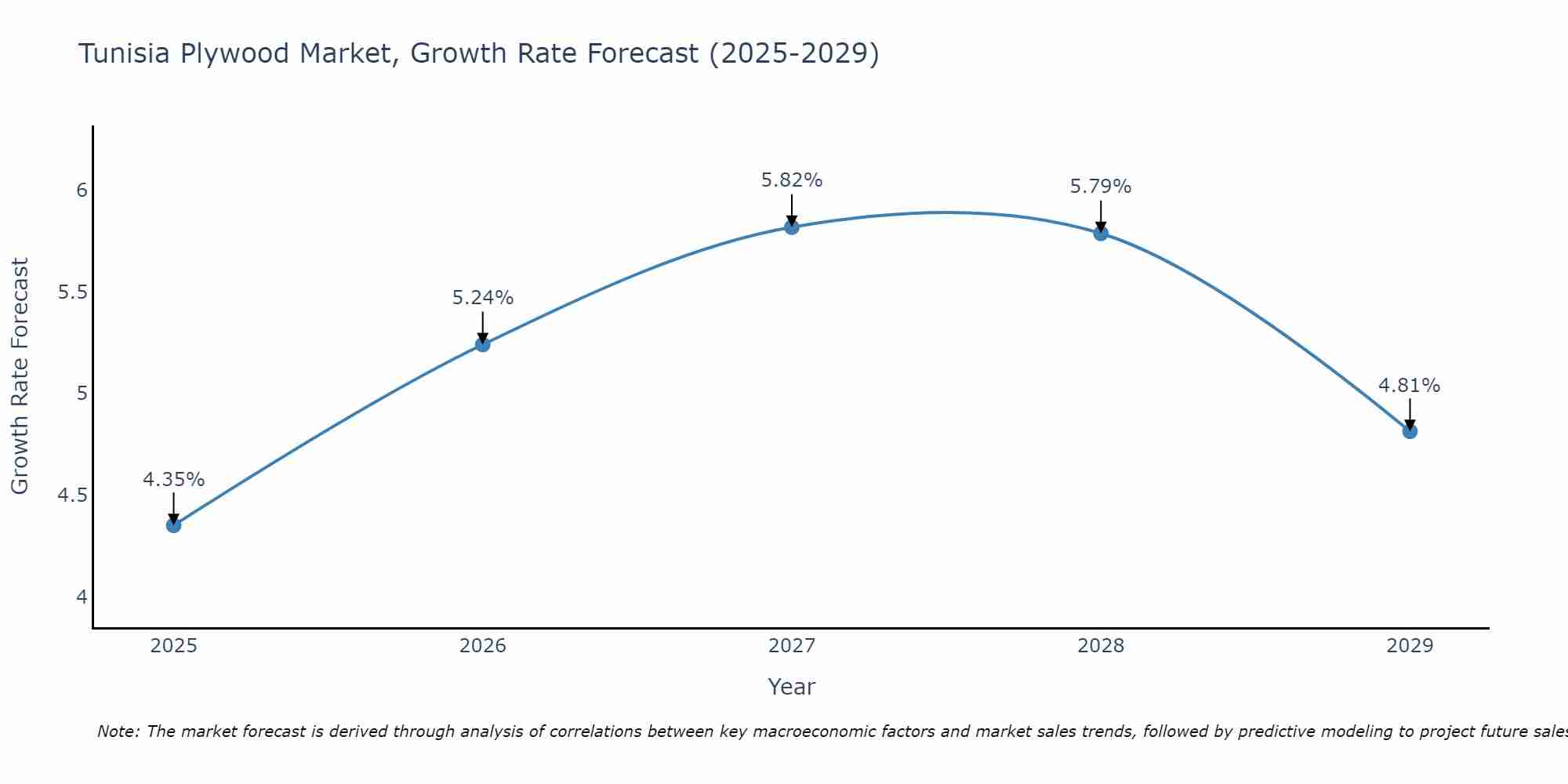
The Tunisia Plywood Market is projected to witness mixed growth rate patterns during 2025 to 2029. Starting at 4.35% in 2025, the market peaks at 5.82% in 2027, and settles at 4.81% by 2029.
Plywood Market: Tunisia vs Top 5 Major Economies in 2027 (Africa)
By 2027, the Plywood market in Tunisia is anticipated to reach a growth rate of 5.82%, as part of an increasingly competitive Africa region, where Egypt remains at the forefront, supported by South Africa, Ethiopia, Algeria and Nigeria, driving innovations and market adoption across sectors.

Tunisia Plywood Market Synopsis
The Tunisia Plywood Market is witnessing steady growth driven by the construction and furniture manufacturing industries. The increasing demand for affordable and durable building materials, coupled with a rise in infrastructure development projects, is fueling the market expansion. Importantly, sustainability concerns are leading to a shift towards eco-friendly plywood options. The market is characterized by the presence of both domestic manufacturers and international players offering a wide range of plywood products to cater to various end-user requirements. Furthermore, technological advancements in plywood manufacturing processes are enhancing product quality and performance, thereby attracting more consumers. Overall, the Tunisia Plywood Market is poised for continued growth in the foreseeable future as the construction sector continues to thrive and the trend towards sustainable building materials gains momentum.
Tunisia Plywood Market Trends
The Tunisia Plywood Market is experiencing growth driven by increasing construction activities and infrastructure development projects in the country. Demand for plywood is rising as a result of the expanding real estate sector, renovation projects, and the growing popularity of DIY home improvement activities. Sustainable and eco-friendly plywood options are gaining traction among consumers, leading to a shift towards using plywood sourced from responsibly managed forests. Manufacturers are also focusing on developing innovative plywood products with enhanced durability, water resistance, and fire-retardant properties to cater to the evolving needs of the construction industry. Additionally, the market is witnessing a trend towards digitalization and online sales platforms, making it easier for consumers to access a wide range of plywood products and compare prices conveniently.
Tunisia Plywood Market Challenges
In the Tunisia Plywood Market, some of the challenges faced include fluctuations in raw material prices, limited availability of high-quality wood for production, and competition from alternative building materials such as PVC and aluminum. Additionally, the industry is also impacted by inconsistent government regulations and policies, which can affect production costs and market demand. The market is relatively small compared to other regions, which can lead to intense competition among local manufacturers. Furthermore, economic instability and political uncertainties in the region can also pose challenges for the plywood market in Tunisia, impacting both domestic demand and export opportunities. Overall, addressing these challenges will require strategic planning, innovation, and a strong focus on quality to remain competitive in the market.
Tunisia Plywood Market Investment Opportunities
The Tunisia Plywood Market presents several investment opportunities due to increasing demand in the construction, furniture, and packaging industries. With a growing economy and infrastructure development projects, the demand for plywood is expected to rise. Investors can explore opportunities in manufacturing and distributing various types of plywood to cater to different customer needs. Additionally, investing in sustainable and eco-friendly plywood production processes can capitalize on the growing trend towards environmentally friendly products. Furthermore, partnerships with local suppliers and distributors can help investors establish a strong presence in the market and tap into the potential growth opportunities in the Tunisia Plywood Market.
Tunisia Plywood Market Future Outlook
The future outlook for the Tunisia Plywood Market appears promising, driven by increasing demand in the construction and furniture industries. The country`s growing population, urbanization trends, and infrastructure development projects are expected to bolster the demand for plywood products. Additionally, the government`s initiatives to promote sustainable construction practices and the rising awareness towards environmentally friendly materials are likely to further fuel market growth. With technological advancements and innovations in plywood production techniques, the market is anticipated to witness improved product quality and design versatility, catering to evolving consumer preferences. However, challenges such as fluctuating raw material prices and competition from alternative materials may impact market dynamics. Overall, the Tunisia Plywood Market is poised for steady growth in the coming years, supported by favorable economic conditions and industry trends.
Key Highlights of the Report:
- Tunisia Plywood Market Outlook
- Market Size of Tunisia Plywood Market, 2024
- Forecast of Tunisia Plywood Market, 2031
- Historical Data and Forecast of Tunisia Plywood Revenues & Volume for the Period 2021 - 2031
- Tunisia Plywood Market Trend Evolution
- Tunisia Plywood Market Drivers and Challenges
- Tunisia Plywood Price Trends
- Tunisia Plywood Porter's Five Forces
- Tunisia Plywood Industry Life Cycle
- Historical Data and Forecast of Tunisia Plywood Market Revenues & Volume By Size for the Period 2021 - 2031
- Historical Data and Forecast of Tunisia Plywood Market Revenues & Volume By 4 x 8 Plywood for the Period 2021 - 2031
- Historical Data and Forecast of Tunisia Plywood Market Revenues & Volume By 4 x 6 Plywood for the Period 2021 - 2031
- Historical Data and Forecast of Tunisia Plywood Market Revenues & Volume By 4 x 10 Plywood for the Period 2021 - 2031
- Historical Data and Forecast of Tunisia Plywood Market Revenues & Volume By 3 x 6 Plywood for the Period 2021 - 2031
- Historical Data and Forecast of Tunisia Plywood Market Revenues & Volume By Others for the Period 2021 - 2031
- Historical Data and Forecast of Tunisia Plywood Market Revenues & Volume By Thickness for the Period 2021 - 2031
- Historical Data and Forecast of Tunisia Plywood Market Revenues & Volume By < 8mm Plywood for the Period 2021 - 2031
- Historical Data and Forecast of Tunisia Plywood Market Revenues & Volume By 8mm 18mm Plywood for the Period 2021 - 2031
- Historical Data and Forecast of Tunisia Plywood Market Revenues & Volume By > 18mm Plywood for the Period 2021 - 2031
- Historical Data and Forecast of Tunisia Plywood Market Revenues & Volume By Grade for the Period 2021 - 2031
- Historical Data and Forecast of Tunisia Plywood Market Revenues & Volume By MR Grade Plywood for the Period 2021 - 2031
- Historical Data and Forecast of Tunisia Plywood Market Revenues & Volume By BWR Grade Plywood for the Period 2021 - 2031
- Historical Data and Forecast of Tunisia Plywood Market Revenues & Volume By Fire Resistant Grade Plywood for the Period 2021 - 2031
- Historical Data and Forecast of Tunisia Plywood Market Revenues & Volume By BWP Grade Plywood for the Period 2021 - 2031
- Historical Data and Forecast of Tunisia Plywood Market Revenues & Volume By Structural Grade Plywood for the Period 2021 - 2031
- Historical Data and Forecast of Tunisia Plywood Market Revenues & Volume By Wood Type for the Period 2021 - 2031
- Historical Data and Forecast of Tunisia Plywood Market Revenues & Volume By Softwood for the Period 2021 - 2031
- Historical Data and Forecast of Tunisia Plywood Market Revenues & Volume By Hardwood for the Period 2021 - 2031
- Historical Data and Forecast of Tunisia Plywood Market Revenues & Volume By Number of Ply for the Period 2021 - 2031
- Historical Data and Forecast of Tunisia Plywood Market Revenues & Volume By 3 Ply for the Period 2021 - 2031
- Historical Data and Forecast of Tunisia Plywood Market Revenues & Volume By 5 Ply for the Period 2021 - 2031
- Historical Data and Forecast of Tunisia Plywood Market Revenues & Volume By 7 ply and More for the Period 2021 - 2031
- Historical Data and Forecast of Tunisia Plywood Market Revenues & Volume By Sales Channel for the Period 2021 - 2031
- Historical Data and Forecast of Tunisia Plywood Market Revenues & Volume By Direct Sales for the Period 2021 - 2031
- Historical Data and Forecast of Tunisia Plywood Market Revenues & Volume By Distributors/Retailers for the Period 2021 - 2031
- Historical Data and Forecast of Tunisia Plywood Market Revenues & Volume By Application for the Period 2021 - 2031
- Historical Data and Forecast of Tunisia Plywood Market Revenues & Volume By Plywood for Furniture for the Period 2021 - 2031
- Historical Data and Forecast of Tunisia Plywood Market Revenues & Volume By Plywood for Flooring & Construction for the Period 2021 - 2031
- Historical Data and Forecast of Tunisia Plywood Market Revenues & Volume By Plywood for Automotive Interiors for the Period 2021 - 2031
- Historical Data and Forecast of Tunisia Plywood Market Revenues & Volume By Plywood for Packaging for the Period 2021 - 2031
- Historical Data and Forecast of Tunisia Plywood Market Revenues & Volume By Plywood for Marine Use for the Period 2021 - 2031
- Historical Data and Forecast of Tunisia Plywood Market Revenues & Volume By Others for the Period 2021 - 2031
- Tunisia Plywood Import Export Trade Statistics
- Market Opportunity Assessment By Size
- Market Opportunity Assessment By Thickness
- Market Opportunity Assessment By Grade
- Market Opportunity Assessment By Wood Type
- Market Opportunity Assessment By Number of Ply
- Market Opportunity Assessment By Sales Channel
- Market Opportunity Assessment By Application
- Tunisia Plywood Top Companies Market Share
- Tunisia Plywood Competitive Benchmarking By Technical and Operational Parameters
- Tunisia Plywood Company Profiles
- Tunisia Plywood Key Strategic Recommendations






































