Tunisia Point Of Sale Terminals Market Size, Share & Growth Rate
The Tunisia Point Of Sale Terminals Market was estimated at USD 238 Million in 2025 and is projected to reach USD 312 Million by 2032, growing at a CAGR of 3.9% from 2026 to 2032. This promising trajectory is primarily fueled by the rising adoption of digital payment methods across various sectors, particularly retail and hospitality. Furthermore, government initiatives aimed at fostering cashless transactions are enhancing market accessibility and encouraging businesses to invest in advanced POS technologies.
Tunisia Point Of Sale Terminals Market Year-wise Growth Rate and Key Drivers
This graph highlights how the Tunisia Point Of Sale Terminals Market has steadily grown over the years, supported by major growth factors.
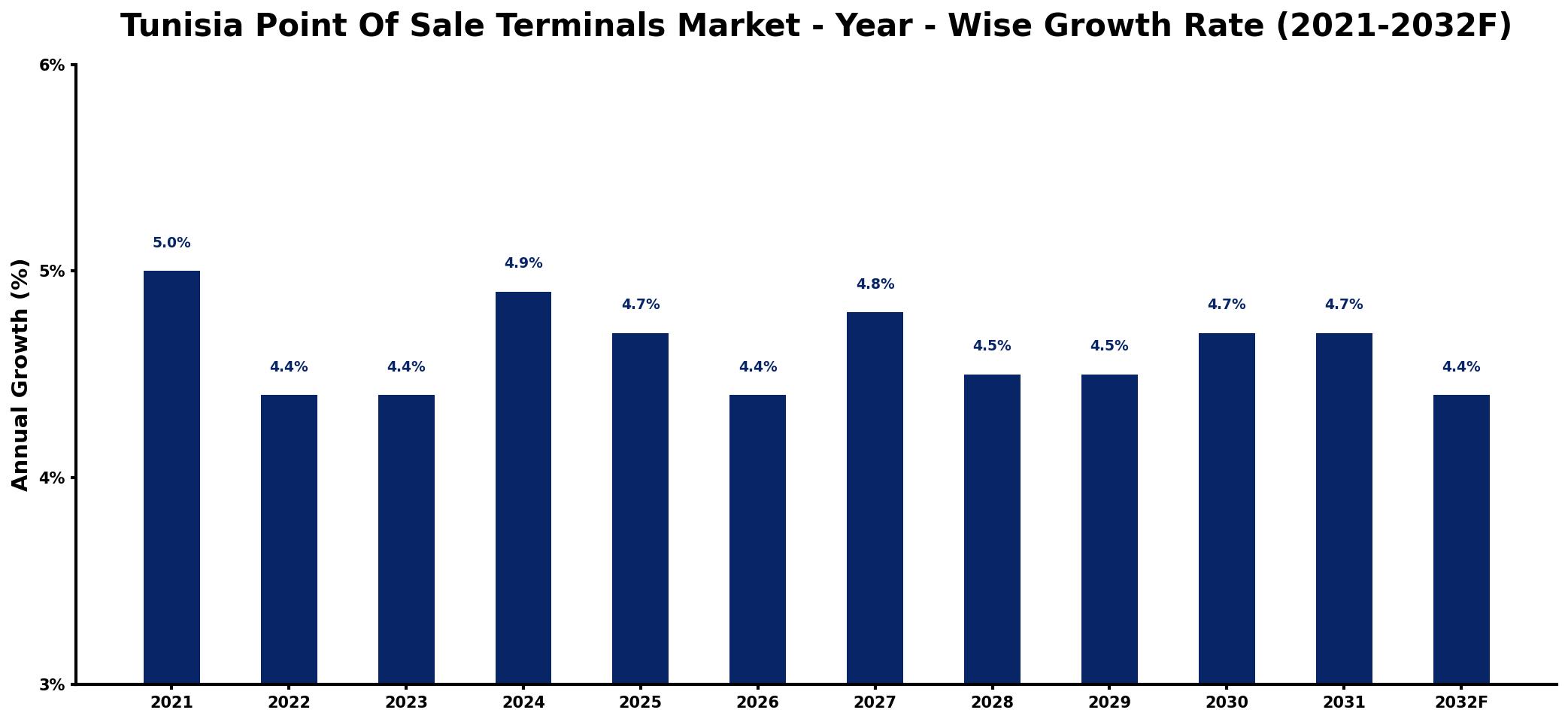
The table below presents the year‑wise growth rates along with the key drivers influencing the market
| Year | Growth Rate | Major Drivers |
| 2021 | 5.0% | increased digital payment adoption |
| 2022 | 4.4% | growing e-commerce transaction volume |
| 2023 | 4.4% | expansion of retail payment solutions |
| 2024 | 4.9% | rising consumer spending trends |
| 2025 | 4.7% | enhanced mobile payment integration |
| 2026 | 4.4% | development of fintech innovations |
| 2027 | 4.8% | surge in contactless payment usage |
| 2028 | 4.5% | growing demand for secure transactions |
| 2029 | 4.5% | expanding healthcare application demand |
| 2030 | 4.7% | increased investment in technology |
| 2031 | 4.7% | rising trend of cashless transactions |
| 2032 | 4.4% | enhanced regulatory support frameworks |
Note: Market size estimations and growth projections presented in this report are based on 6Wresearch's proprietary forecasting methodology, utilizing the latest available industry data, government publications, and primary research inputs.
Tunisia Point Of Sale Terminals Market Synopsis
The Tunisia Point Of Sale Terminals Market has recently experienced significant momentum, driven by technological advancements and an increasing consumer preference for cashless payments. However, as we look ahead, a more profound transformation is anticipated as e-commerce continues to proliferate, creating a heightened demand for sophisticated payment solutions.
Market players are now more focused on integrating mobile and cloud-based solutions into their offerings. This shift not only enhances operational efficiency but also positions businesses to leverage consumer data for improved service delivery, which is critical in an evolving retail landscape.
Tunisia Point Of Sale Terminals Market Key Takeaways
- The market is set for steady growth, driven by the shift towards digital transactions.
- Technological innovations are playing a crucial role in enhancing payment processing capabilities.
- Government policies are increasingly supportive of digital payment infrastructures.
- Challenges such as cost concerns for SMEs may hinder widespread adoption.
- Integration of customer analytics into POS systems is becoming a necessity for businesses.
Evaluation of Restraints in Tunisia Point Of Sale Terminals Market
Despite the robust growth trajectory, the Tunisia Point Of Sale Terminals Market faces significant restraints. One of the primary challenges is the high initial investment associated with purchasing and implementing POS systems. Small and medium-sized enterprises often express resistance due to budget constraints and a lack of in-house technical expertise. Moreover, ongoing maintenance and the necessity for regular system updates can deter businesses from transitioning to newer technologies. Additionally, the increasing threat of cybersecurity incidents raises concerns about data protection, impacting the overall willingness to adopt advanced POS solutions.
Tunisia Point Of Sale Terminals Market Trends
Current trends within the Tunisia Point Of Sale Terminals Market highlight a significant shift towards mobile and contactless payment solutions. Consumers are increasingly expecting seamless transactions, which encourages businesses to adopt innovative technologies. Furthermore, the incorporation of integrated software solutions that provide comprehensive customer analytics is gaining traction. This evolution is aligned with broader global trends, where enhanced user experience and data-driven decision-making have become paramount for success.
Tunisia Point Of Sale Terminals Market Opportunities
The Tunisia Point Of Sale Terminals Market presents several promising growth and investment opportunities. As digital payment systems become integral to the retail and hospitality sectors, businesses that leverage advanced POS technologies stand to gain a competitive edge. Additionally, emerging players focusing on creating cost-effective solutions tailored for SMEs can capture a significant share of the market. The growing e-commerce landscape further offers opportunities for integrated POS systems that cater to online transactions, enhancing operational efficiency for businesses of all sizes.
Government Initiatives in the Tunisia Point Of Sale Terminals Market
The Tunisian government has recognized the importance of fostering a cashless economy and is actively promoting the adoption of point-of-sale terminals. Policies designed to incentivize businesses include tax breaks for those implementing digital payment systems, alongside initiatives aimed at improving the overall digital payment infrastructure. Such measures are intended not only to boost financial inclusion but also to enhance economic transparency, thereby benefiting both consumers and businesses alike.
Future Insights of the Tunisia Point Of Sale Terminals Market
Looking ahead to 2026-2032, the Tunisia Point Of Sale Terminals Market is poised for transformative growth. With the anticipated increase in e-commerce activities and the continued shift towards digital payments, businesses will increasingly prioritize the adoption of advanced POS systems. The integration of artificial intelligence and machine learning into payment systems may also become commonplace, enabling businesses to provide personalized customer experiences while optimizing operational efficiencies.
Tunisia Point Of Sale Terminals Market Latest Developments (2025 - 2026)
In recent months, the Tunisia Point Of Sale Terminals Market has seen considerable advancements in technology deployment, with increased interest in mobile payment solutions. Additionally, collaborative efforts between financial institutions and tech companies are on the rise, focusing on enhancing security measures and improving the overall user experience. This momentum is indicative of a broader trend towards digitization in the financial sector, as stakeholders work to address both consumer demands and regulatory requirements.
Tunisia Point Of Sale Terminals Market - Key Attractiveness of the Report
- 10 Years of Market Numbers
- Historical Data Starting from 2022 to 2025
- Base Year: 2025
- Forecast Data until 2032
- Key Performance Indicators Impacting the Market
- Major Upcoming Developments and Projects
Key Highlights of the Report:
- Tunisia Point Of Sale Terminals Market Outlook
- Market Size of Tunisia Point Of Sale Terminals Market, 2025
- Forecast of Tunisia Point Of Sale Terminals Market, 2032
- Historical Data and Forecast of Tunisia Point Of Sale Terminals Revenues & Volume for the Period 2022-2032F
- Tunisia Point Of Sale Terminals Market Trend Evolution
- Tunisia Point Of Sale Terminals Market Drivers and Challenges
- Tunisia Point Of Sale Terminals Price Trends
- Tunisia Point Of Sale Terminals Porter's Five Forces
- Tunisia Point Of Sale Terminals Industry Life Cycle
- Historical Data and Forecast of Tunisia Point Of Sale Terminals Market Revenues & Volume By Product for the Period 2022-2032F
- Historical Data and Forecast of Tunisia Point Of Sale Terminals Market Revenues & Volume By Fixed for the Period 2022-2032F
- Historical Data and Forecast of Tunisia Point Of Sale Terminals Market Revenues & Volume By Mobile for the Period 2022-2032F
- Historical Data and Forecast of Tunisia Point Of Sale Terminals Market Revenues & Volume By Component for the Period 2022-2032F
- Historical Data and Forecast of Tunisia Point Of Sale Terminals Market Revenues & Volume By Hardware for the Period 2022-2032F
- Historical Data and Forecast of Tunisia Point Of Sale Terminals Market Revenues & Volume By Software for the Period 2022-2032F
- Historical Data and Forecast of Tunisia Point Of Sale Terminals Market Revenues & Volume By Services for the Period 2022-2032F
- Historical Data and Forecast of Tunisia Point Of Sale Terminals Market Revenues & Volume By Deployment for the Period 2022-2032F
- Historical Data and Forecast of Tunisia Point Of Sale Terminals Market Revenues & Volume By Cloud for the Period 2022-2032F
- Historical Data and Forecast of Tunisia Point Of Sale Terminals Market Revenues & Volume By On-premise for the Period 2022-2032F
- Historical Data and Forecast of Tunisia Point Of Sale Terminals Market Revenues & Volume By End Use for the Period 2022-2032F
- Historical Data and Forecast of Tunisia Point Of Sale Terminals Market Revenues & Volume By Restaurants for the Period 2022-2032F
- Historical Data and Forecast of Tunisia Point Of Sale Terminals Market Revenues & Volume By Retail for the Period 2022-2032F
- Historical Data and Forecast of Tunisia Point Of Sale Terminals Market Revenues & Volume By Hospitality for the Period 2022-2032F
- Historical Data and Forecast of Tunisia Point Of Sale Terminals Market Revenues & Volume By Healthcare for the Period 2022-2032F
- Historical Data and Forecast of Tunisia Point Of Sale Terminals Market Revenues & Volume By Warehouse for the Period 2022-2032F
- Historical Data and Forecast of Tunisia Point Of Sale Terminals Market Revenues & Volume By Entertainment for the Period 2022-2032F
- Historical Data and Forecast of Tunisia Point Of Sale Terminals Market Revenues & Volume By Others for the Period 2022-2032F
- Tunisia Point Of Sale Terminals Import Export Trade Statistics
- Market Opportunity Assessment By Product
- Market Opportunity Assessment By Component
- Market Opportunity Assessment By Deployment
- Market Opportunity Assessment By End Use
- Tunisia Point Of Sale Terminals Top Companies Market Share
- Tunisia Point Of Sale Terminals Competitive Benchmarking By Technical and Operational Parameters
- Tunisia Point Of Sale Terminals Company Profiles
- Tunisia Point Of Sale Terminals Key Strategic Recommendations






































