Tunisia Policy Management in Telecom Market Size & Growth Rate (2026-2032)
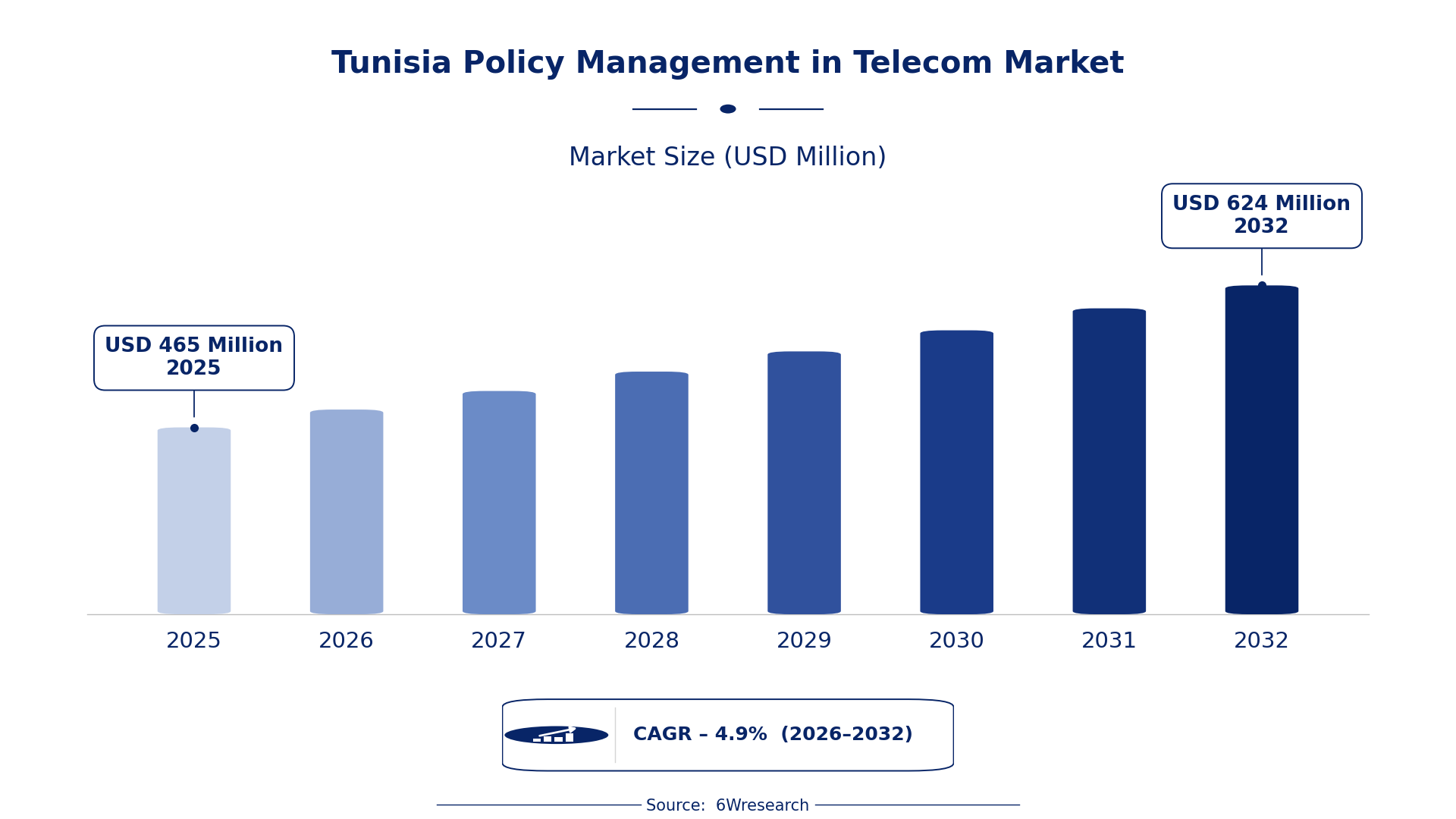
The Tunisia Policy Management in Telecom Market was estimated at USD 465 Million in 2025 and is projected to reach USD 624 Million by 2032, growing at a CAGR of 4.9% from 2026 to 2032.
Tunisia Policy Management in Telecom Market Synopsis
As Tunisia's telecommunications sector expands, the need for effective policy management becomes increasingly vital. Telecom operators are investing in innovative solutions to enhance user experience and manage network performance, reflecting a growing commitment to maintain competitive service standards.
The accelerating demand for high-speed internet, coupled with the rising adoption of smart devices, is pushing telecom providers to upgrade their policy management systems. These advancements not only ensure fair usage of resources but also facilitate the introduction of personalized services to meet diverse consumer needs.
Tunisia Policy Management in Telecom Market Year-wise Growth Rate and Key Drivers
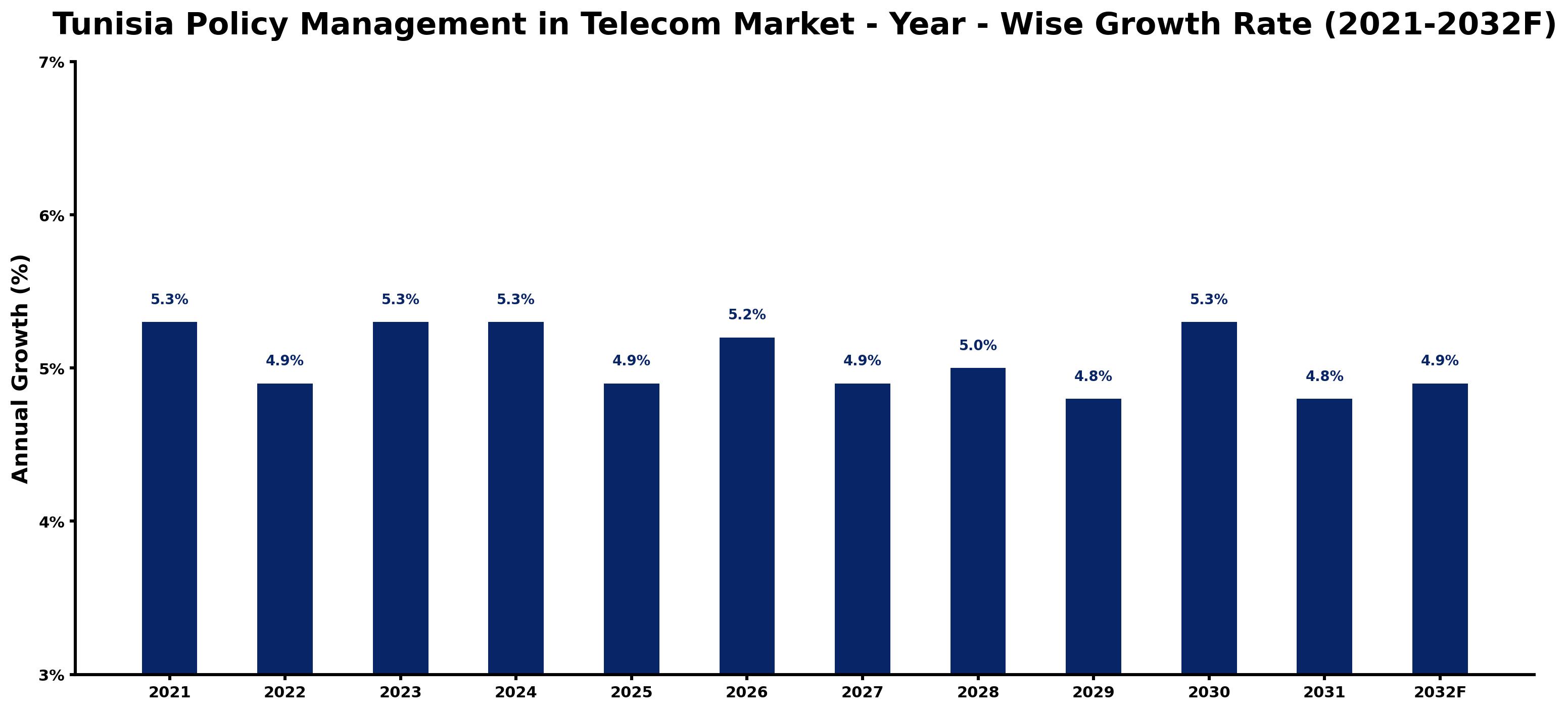
This graph illustrates the annual growth rates of the Tunisia Policy Management in Telecom Market from 2021 to 2032, highlighting a steady upward trajectory and projected expansion over the forecast period.
The table below presents the year‑wise growth rates along with the key drivers influencing the market
| Year | Growth Rate | Major Drivers |
| 2021 | 5.3% | Increase in mobile network regulatory framework by INT. |
| 2022 | 4.9% | Emerging demand for 5G services and policies. |
| 2023 | 5.3% | Government incentives for digital transformation in telecoms. |
| 2024 | 5.3% | Favorable foreign investments in telecom infrastructure projects. |
| 2025 | 4.9% | Tunisia's national broadband strategy enhancing service delivery. |
| 2026 | 5.2% | Implementation of data protection regulations improving consumer trust. |
| 2027 | 4.9% | Rising adoption of mobile payment services stimulating growth. |
| 2028 | 5.0% | Partnerships with tech firms enhancing service offerings. |
| 2029 | 4.8% | Increased focus on rural telecom access initiatives. |
| 2030 | 5.3% | Regulation changes supporting competition among telecom operators. |
| 2031 | 4.8% | Expanding mobile broadband access through national policy. |
| 2032 | 4.9% | Growing youth population driving telecom service demand. |
Note: Market size estimations and growth projections presented in this report are based on 6Wresearch's proprietary forecasting methodology, utilizing the latest available industry data, government publications, and primary research inputs.
Tunisia Policy Management in Telecom Market Key Takeaways
Below are some of the specific key takeaways from the market, including:
- High-speed internet demand drives the adoption of advanced policy management solutions.
- Government initiatives focus on enhancing network efficiency and service quality.
- The market is challenged by regulatory complexities and a shortage of skilled professionals.
- Adoption of 5G technology is expected to significantly boost market growth.
- Data services' growth necessitates real-time policy control for effective network management.
Evaluation of Restraints in Tunisia Policy Management in Telecom Market
Several factors are holding back the Tunisia Policy Management in Telecom Market. The regulatory environment remains complex, posing challenges to compliance with varying standards that telecom operators must navigate. There is also a notable lack of skilled professionals in this niche area, affecting the effective implementation of policy management solutions. Furthermore, rapid technological advancements necessitate ongoing updates, placing additional pressure on providers to keep pace with evolving requirements.
Tunisia Policy Management in Telecom Market Trends
The telecom sector in Tunisia is witnessing a shift towards intelligent policy management solutions. Operators are increasingly adopting data analytics tools to enhance customer experience and tailor services. The rollout of 5G networks not only boosts speed but also creates new avenues for policy management strategies. Furthermore, there's a growing emphasis on real-time data processing, enabling telecom companies to swiftly adjust policies in response to changing traffic patterns and user behavior.
Tunisia Policy Management in Telecom Market Opportunities
Several growth avenues are emerging within this market. The ongoing deployment of 5G technology offers telecom providers a unique chance to implement cutting-edge policy management systems. Furthermore, the increasing reliance on data analytics presents opportunities for telecom operators to enhance their service offerings. There's also a potential for collaboration between telecom firms and tech companies to develop innovative solutions tailored to the local market’s needs.
Government Initiatives in the Tunisia Policy Management in Telecom Market
The Tunisian government is actively shaping the policy management framework for the telecom sector. With a focus on improving network efficiency and service quality, regulatory bodies are implementing measures that encourage competition and investment. This environment is critical for fostering innovation and ensuring that telecom operators can effectively meet the demands of the market.
- A national digital infrastructure upgrade programme now in its rollout phase aims to enhance connectivity across urban and rural areas.
- A regulatory framework introduced in 2025 mandates billing transparency, ensuring users understand their telecom costs.
- Currently underway is a public-private partnership initiative designed to expand telecom infrastructure access, particularly in underserved regions.
- Upcoming regulations set for 2026 will focus on enhancing data privacy and security measures in telecommunications.
- Initiatives targeting skill development in policy management are being planned to address the shortage of qualified professionals in the sector.
Future Insights of the Tunisia Policy Management in Telecom Market
The outlook for the Tunisia Policy Management in Telecom Market from 2026 to 2032 indicates strong growth fueled by technological advancements and heightened competition. As telecom operators increasingly invest in policy management solutions, enhanced customer experiences are expected to drive further adoption. By adapting to emerging technologies and focusing on consumer demands, telecom providers can position themselves advantageously within this dynamic market.
Tunisia Policy Management in Telecom Market Latest Developments
In the past year, the Tunisia Policy Management in Telecom Market has seen a surge of activity aimed at enhancing service offerings and operational efficiencies. Providers are navigating regulatory frameworks while optimizing their policy management systems to respond to consumer needs more effectively.
- A major technology vendor launched an AI-driven policy management platform in early 2025, designed to improve real-time data traffic control.
- A leading regional operator initiated a customer experience enhancement programme that remains underway, focusing on personalized service delivery.
- In Q4 2025, a telecom provider upgraded its policy management infrastructure, successfully integrating advanced analytics tools.
- A public-private initiative is expected to kick off in mid-2026, aimed at expanding network capacity across the country.
- By 2027, a rollout of enhanced 5G policy management systems is planned, focused on improving service reliability and speed.
Tunisia Policy Management in Telecom Market - Key Attractiveness of the Report
- 10 Years of Market Numbers
- Historical Data Starting from 2022 to 2025
- Base Year: 2025
- Forecast Data until 2032
- Key Performance Indicators Impacting the Market
- Major Upcoming Developments and Projects
Key Highlights of the Report:
- Tunisia Policy Management in Telecom Market Outlook
- Market Size of Tunisia Policy Management in Telecom Market, 2025
- Forecast of Tunisia Policy Management in Telecom Market, 2032
- Historical Data and Forecast of Tunisia Policy Management in Telecom Revenues & Volume for the Period 2022-2032F
- Tunisia Policy Management in Telecom Market Trend Evolution
- Tunisia Policy Management in Telecom Market Drivers and Challenges
- Tunisia Policy Management in Telecom Price Trends
- Tunisia Policy Management in Telecom Porter's Five Forces
- Tunisia Policy Management in Telecom Industry Life Cycle
- Historical Data and Forecast of Tunisia Policy Management in Telecom Market Revenues & Volume By Network for the Period 2022-2032F
- Historical Data and Forecast of Tunisia Policy Management in Telecom Market Revenues & Volume By Fixed for the Period 2022-2032F
- Historical Data and Forecast of Tunisia Policy Management in Telecom Market Revenues & Volume By Wireless for the Period 2022-2032F
- Historical Data and Forecast of Tunisia Policy Management in Telecom Market Revenues & Volume By Component for the Period 2022-2032F
- Historical Data and Forecast of Tunisia Policy Management in Telecom Market Revenues & Volume By Solutions for the Period 2022-2032F
- Historical Data and Forecast of Tunisia Policy Management in Telecom Market Revenues & Volume By Services for the Period 2022-2032F
- Historical Data and Forecast of Tunisia Policy Management in Telecom Market Revenues & Volume By Deployment for the Period 2022-2032F
- Historical Data and Forecast of Tunisia Policy Management in Telecom Market Revenues & Volume By Cloud for the Period 2022-2032F
- Historical Data and Forecast of Tunisia Policy Management in Telecom Market Revenues & Volume By On-Premises for the Period 2022-2032F
- Tunisia Policy Management in Telecom Import Export Trade Statistics
- Market Opportunity Assessment By Network
- Market Opportunity Assessment By Component
- Market Opportunity Assessment By Deployment
- Tunisia Policy Management in Telecom Top Companies Market Share
- Tunisia Policy Management in Telecom Competitive Benchmarking By Technical and Operational Parameters
- Tunisia Policy Management in Telecom Company Profiles
- Tunisia Policy Management in Telecom Key Strategic Recommendations






































