Tunisia Polio Vaccine Market Size, Share & Growth Rate
The Tunisia Polio Vaccine Market was estimated at USD 1208 Million in 2025 and is projected to reach USD 1746 Million by 2032, growing at a CAGR of 5.4% from 2026 to 2032. This upward trajectory is primarily driven by ongoing government and international initiatives aimed at maintaining high vaccination coverage across the country. Furthermore, the introduction of advanced vaccine formulations and a persistent focus on reaching underserved populations will be pivotal in sustaining growth in this essential market.
Tunisia Polio Vaccine Market Year-wise Growth Rate and Key Drivers
This graph highlights how the Tunisia Polio Vaccine Market has steadily grown over the years, supported by major growth factors.
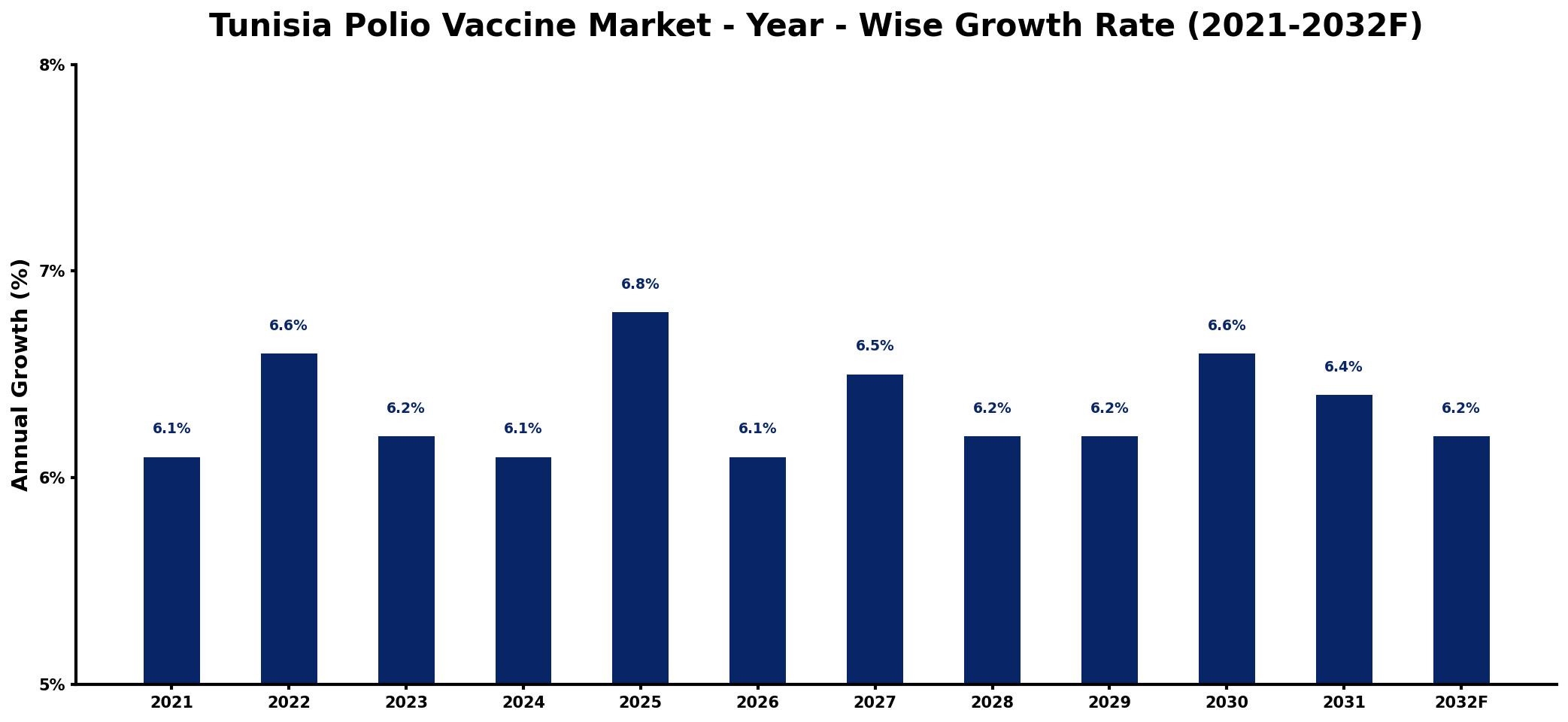
The table below presents the year‑wise growth rates along with the key drivers influencing the market
| Year | Growth Rate | Major Drivers |
| 2021 | 6.1% | Increased healthcare investment initiatives |
| 2022 | 6.6% | Growing public health awareness campaigns |
| 2023 | 6.2% | Expansion of immunization outreach programs |
| 2024 | 6.1% | Rising government healthcare funding allocations |
| 2025 | 6.8% | Strengthened partnerships with NGOs |
| 2026 | 6.1% | Enhanced cold chain logistics capabilities |
| 2027 | 6.5% | Increased production capacity investments |
| 2028 | 6.2% | Broader access to healthcare facilities |
| 2029 | 6.2% | Improved supply chain efficiencies |
| 2030 | 6.6% | stronger distribution network expansion |
| 2031 | 6.4% | Growing private sector involvement |
| 2032 | 6.2% | Strengthened community health worker programs |
Note: Market size estimations and growth projections presented in this report are based on 6Wresearch's proprietary forecasting methodology, utilizing the latest available industry data, government publications, and primary research inputs.
Tunisia Polio Vaccine Market Synopsis
Recently, Tunisia has demonstrated commendable momentum in its polio vaccination efforts, achieving impressive immunization rates. However, the market faces the challenge of maintaining this progress as it moves toward a future where continued vigilance is necessary to prevent any resurgence of the disease.
As vaccination strategies evolve, the focus will also shift toward addressing barriers such as misinformation and logistical issues in remote areas. Innovations in vaccine delivery systems and increased public awareness campaigns are expected to play crucial roles in overcoming these challenges.
Tunisia Polio Vaccine Market Key Takeaways
- The market is expected to experience robust growth fueled by sustained government initiatives and international support.
- Vaccine hesitancy remains a significant barrier to achieving optimal immunization rates.
- Logistical challenges, particularly in rural areas, are critical factors affecting distribution efficiency.
- Emerging research in vaccine technology may provide new opportunities for enhancing immunization strategies.
- Targeted government policies ensure that vaccines are widely available in healthcare settings nationwide.
Evaluation of Restraints in Tunisia Polio Vaccine Market
While the Tunisia Polio Vaccine Market is positioned for growth, several constraints hinder its full potential. Vaccine hesitancy has emerged as a prominent issue, fueled by misinformation and a lack of trust in health authorities. Additionally, logistical challenges pose significant barriers; the complexities of storing and transporting vaccines, especially to remote regions, complicate distribution efforts. Securing adequate funding for vaccination campaigns remains a critical concern, as does the challenge of addressing the specific needs of vulnerable populations who may not have easy access to healthcare services.
Tunisia Polio Vaccine Market Trends
Current trends in the Tunisia Polio Vaccine Market reflect a growing emphasis on public-private partnerships to enhance vaccine accessibility. Additionally, advancements in mobile health technologies are transforming how immunization campaigns are conducted, allowing for real-time tracking and community engagement. Furthermore, there is a notable shift toward incorporating multi-valent vaccines, which promise broader protection and efficiency in immunization efforts.
Tunisia Polio Vaccine Market Opportunities
The market presents significant opportunities for investment and innovation, particularly in the areas of vaccine distribution technologies and awareness campaigns. Collaborations with international health organizations can also amplify the impact of local initiatives. Moreover, the increased focus on immunization in rural areas indicates a fertile ground for targeted interventions that could bridge existing gaps in healthcare access.
Government Initiatives in the Tunisia Polio Vaccine Market
The Tunisian government has prioritized polio eradication through strategic public health policies and comprehensive immunization programs. These initiatives ensure that polio vaccines are readily available in all healthcare facilities across the country. Additionally, the government regularly conducts vaccination campaigns, particularly targeting children under five years of age, in collaboration with global health agencies to bolster immunization coverage and sustain Tunisias polio-free status.
Future Insights of the Tunisia Polio Vaccine Market
Looking ahead to 2026-2032, the Tunisia Polio Vaccine Market is set to evolve as new vaccination strategies and technologies emerge. There will be a continued focus on enhancing public awareness and addressing vaccine hesitancy. Furthermore, the landscape of global health may lead to increased collaboration with international organizations, fostering a more resilient approach to vaccination programs. Ensuring that all segments of the population have access to polio vaccines will be critical in maintaining Tunisias hard-won status as a polio-free nation.
Tunisia Polio Vaccine Market Latest Developments (2025 - 2026)
In recent months, Tunisia has made strides in improving the logistics of vaccine distribution, particularly in remote regions. Public health campaigns aimed at combating misinformation surrounding vaccines have also gained momentum, aiming to build public trust and boost immunization rates. Collaborations with international health agencies continue to focus on enhancing the accessibility and affordability of polio vaccines for all communities within the nation.
Tunisia Polio Vaccine Market - Key Attractiveness of the Report
- 10 Years of Market Numbers
- Historical Data Starting from 2022 to 2025
- Base Year: 2025
- Forecast Data until 2032
- Key Performance Indicators Impacting the Market
- Major Upcoming Developments and Projects
Key Highlights of the Report:
- Tunisia Polio Vaccine Market Outlook
- Market Size of Tunisia Polio Vaccine Market, 2025
- Forecast of Tunisia Polio Vaccine Market, 2032
- Historical Data and Forecast of Tunisia Polio Vaccine Revenues & Volume for the Period 2022-2032F
- Tunisia Polio Vaccine Market Trend Evolution
- Tunisia Polio Vaccine Market Drivers and Challenges
- Tunisia Polio Vaccine Price Trends
- Tunisia Polio Vaccine Porter's Five Forces
- Tunisia Polio Vaccine Industry Life Cycle
- Historical Data and Forecast of Tunisia Polio Vaccine Market Revenues & Volume By Type for the Period 2022-2032F
- Historical Data and Forecast of Tunisia Polio Vaccine Market Revenues & Volume By Oral Polio Vaccine (OPV) for the Period 2022-2032F
- Historical Data and Forecast of Tunisia Polio Vaccine Market Revenues & Volume By Inactivated Poliomyelitis Vaccine (IPV) for the Period 2022-2032F
- Historical Data and Forecast of Tunisia Polio Vaccine Market Revenues & Volume By Application for the Period 2022-2032F
- Historical Data and Forecast of Tunisia Polio Vaccine Market Revenues & Volume By Public for the Period 2022-2032F
- Historical Data and Forecast of Tunisia Polio Vaccine Market Revenues & Volume By Private for the Period 2022-2032F
- Tunisia Polio Vaccine Import Export Trade Statistics
- Market Opportunity Assessment By Type
- Market Opportunity Assessment By Application
- Tunisia Polio Vaccine Top Companies Market Share
- Tunisia Polio Vaccine Competitive Benchmarking By Technical and Operational Parameters
- Tunisia Polio Vaccine Company Profiles
- Tunisia Polio Vaccine Key Strategic Recommendations






































