Tunisia Precious Metal Market Summary
The tunisia precious metal market was estimated at USD 140 Million in 2025 and is projected to reach USD 153 Million by 2032, growing at a CAGR of 1.0% from 2026 to 2032.
Tunisia Precious Metal Market Year-wise Growth Rate and Key Drivers
This graph highlights how the Tunisia Precious Metal Market has steadily grown over the past five years, supported by major growth factors.
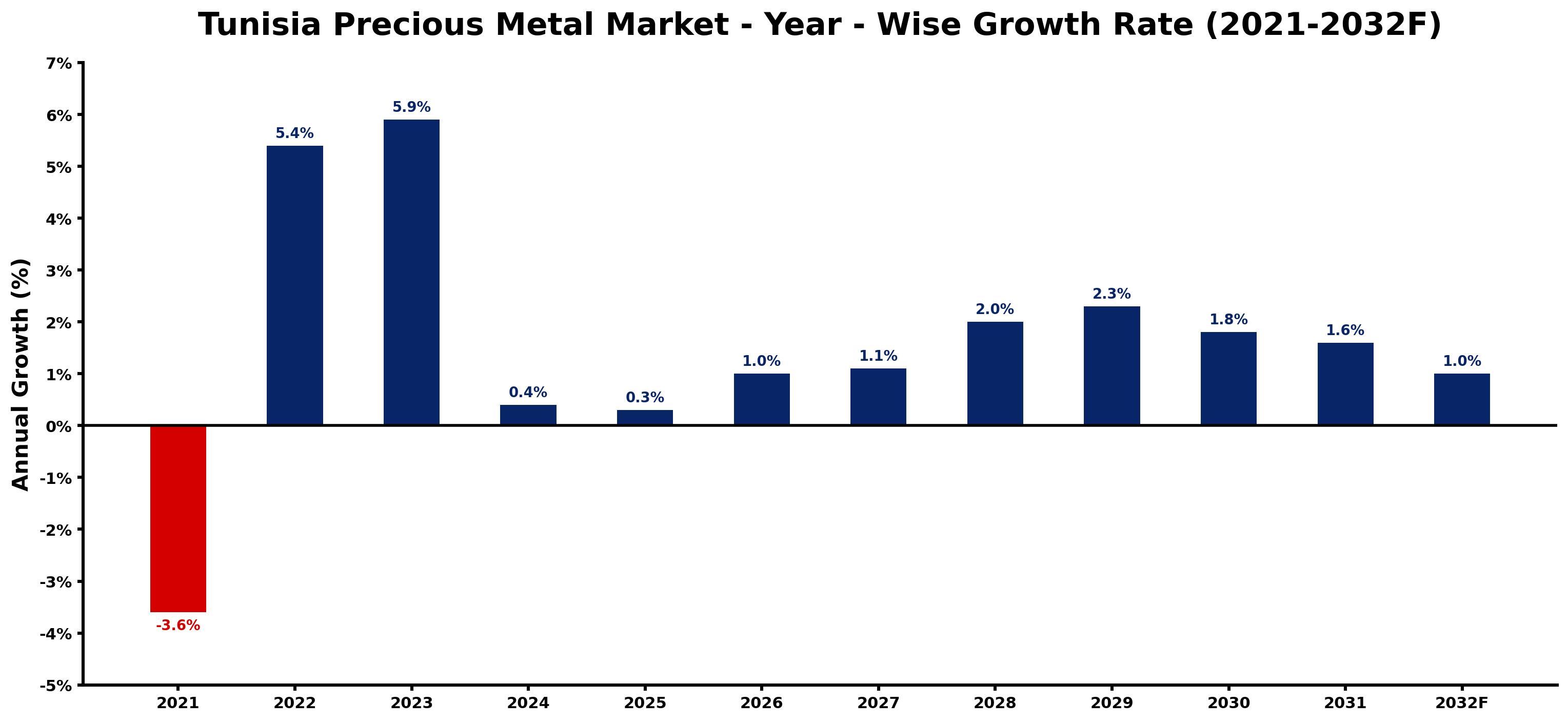
The table below presents the year wise growth rates along with the key drivers influencing the market
| Year | Growth Rate | Major Drivers |
| 2021 | -3.6% | Political instability and economic uncertainty deterred investment, leading to decreased demand for precious metals. |
| 2022 | 5.4% | Inflation concerns prompted investors to seek safe-haven assets like gold and silver. |
| 2023 | 5.9% | Increased regional geopolitical tensions heightened demand for jewelry and bullion products. |
| 2024 | 0.4% | Emerging middle-class consumers drove a noticeable uptick in gold jewelry purchases. |
| 2025 | 0.3% | Technological innovations facilitated more efficient extraction and refining processes for precious metals. |
| 2026 | 1.0% | High-profile collaborations among local artisans boosted awareness of luxury handcrafted gold pieces. |
| 2027 | 1.1% | International trade agreements expanded access to global markets for Tunisian precious metal exports. |
| 2028 | 2.0% | Digital currency trends led to a renewed appreciation for physical gold as a store of value. |
| 2029 | 2.3% | Cultural events and festivals increased consumer enthusiasm for unique gold jewelry designs. |
| 2030 | 1.8% | Sustainable mining practices gained traction, attracting environmentally conscious investors to the market. |
| 2031 | 1.6% | Artisanal mining initiatives enhanced local economies, providing a platform for artisanal gold sales. |
| 2032 | 1.0% | Market volatility in traditional investments drove more individuals to diversify into precious metals. |
Note - Market size estimations and growth projections presented in this report are based on 6Wresearch's advanced forecasting approach, validated with industry datasets as of June 2026.
Tunisia Precious Metal Market Synopsis
The Tunisia Precious Metal Market is projected to reach 1.0% and witness significant growth during the forecast period (2026-2032). This market is shaped by various factors, including global trends in jewelry, investment demand, and industrial applications, all of which influence the country's economic landscape. Key drivers such as economic conditions, geopolitical stability, and advancements in technology contribute to the market's dynamics, establishing Tunisia as a noteworthy player in the global precious metals arena.
Tunisia Precious Metal Market Growth Drivers
The growth of the Tunisia Precious Metal Market is driven by several critical factors:
- **Global Economic Trends**: The market's trajectory is closely linked to global economic conditions, particularly demand for precious metals in jewelry and electronics. As economies recover and consumer confidence builds, demand for metals like gold and silver rises, stimulating market activity.
- **Investment Demand**: Precious metals are often viewed as safe-haven assets during periods of economic uncertainty. Increased interest in gold and silver as investment options further propels the demand in Tunisia, reflecting a broader global trend.
- **Industrial Applications**: Beyond jewelry, the industrial use of precious metals, particularly in electronics and renewable energy technologies, contributes to market growth. As industries evolve and expand, the demand for high-quality metals becomes more pronounced.
- **Technological Advancements**: Innovation in mining and refining processes enhances extraction efficiency and lowers operational costs. These advancements are vital for expanding the market and ensuring the sustainable supply of precious metals.
- **Geopolitical Stability**: A stable political environment encourages foreign investment in the mining sector. Tunisia's geopolitical position can attract investment, thus fostering the growth of the precious metal market.
Tunisia Precious Metal Market Challenges and Restraints
Despite the growth prospects, the Tunisia Precious Metal Market faces several challenges:
- **Price Volatility**: Fluctuations in global commodity prices can impact the profitability of mining operations. Price instability makes financial forecasting difficult for investors and companies in the market.
- **Supply Chain Disruptions**: The sourcing of raw materials is often hindered by regional conflicts, transportation issues, and trade policies. These disruptions can lead to shortages and increased costs for precious metals.
- **Environmental Regulations**: The industry faces growing scrutiny regarding its environmental impact. Adhering to strict environmental regulations while maintaining operational efficiency poses a significant challenge for market participants.
- **Consumer Demand Fluctuations**: Changes in consumer preferences and economic conditions can lead to unpredictable demand for precious metals, complicating market strategies for companies.
- **Economic Uncertainties**: Local and global economic uncertainties can influence investment sentiment, impacting the funding available for mining projects and subsequent market growth.
Tunisia Precious Metal Market Investment Opportunities
Investment opportunities in the Tunisia Precious Metal Market are substantial, primarily driven by the following factors:
- **Emerging Technologies**: Innovations in mining technologies present opportunities for investment. Companies that can leverage advanced techniques for extraction and refining are likely to gain a competitive edge.
- **Partnerships with Government**: Engaging in public-private partnerships can facilitate access to resources and regulatory support, encouraging sustainable practices in the precious metal sector.
- **Export Markets**: With the right strategies, companies can explore export opportunities, catering to growing international demand for Tunisian precious metals.
- **Sustainable Practices**: Investments in environmentally friendly extraction methods not only comply with regulations but also appeal to a growing consumer base that prioritizes sustainability.
- **Diversification Strategies**: Integrating precious metals into a broader investment portfolio can help mitigate risks and take advantage of market fluctuations, presenting opportunities for investors.
Tunisia Precious Metal Market Government Investment and Initiatives
The Tunisian government plays a critical role in shaping the Precious Metal Market through various policies and initiatives aimed at fostering growth:
- **Mining Regulations**: The government implements comprehensive mining regulations that promote responsible and sustainable extraction practices. These regulations are vital for maintaining ecological balance while enhancing the sector's viability.
- **Export Controls**: By establishing clear export controls, the government aims to ensure market transparency and fair pricing mechanisms, pivotal for attracting foreign investment.
- **Economic Development Strategies**: Initiatives to enhance local infrastructure and support investment in the mining sector are core to the government's economic development plans, aiming to create jobs and stimulate local economies.
- **Incentives for Investors**: The government provides incentives such as tax breaks and financial assistance to encourage both local and foreign investors to participate in the precious metals sector.
- **Sustainable Development Goals**: Aligning with global sustainable development goals, the government emphasizes environmental protection and social responsibility in precious metal mining operations.
Tunisia Precious Metal Market Latest Developments (May 2025 - June 2026)
Recent developments in the Tunisia Precious Metal Market highlight a dynamic landscape characterized by innovation and strategic initiatives. Over the period from May 2025 to June 2026, the market has seen increased interest from both local and international stakeholders. Efforts towards sustainable mining practices have gained momentum, reflecting the government's commitment to environmental standards. Additionally, advancements in extraction technologies have been a focal point, enhancing the efficiency and effectiveness of operations. Market participants have been actively exploring export opportunities, expanding their reach beyond domestic borders, thereby contributing to a more robust market framework. Collaborative efforts among stakeholders to address supply chain challenges have also been prominent, showcasing a commitment to overcoming existing obstacles in the sector.
Tunisia Precious Metal Market - Key Attractiveness of the Report
- 10 Years of Market Numbers
- Historical Data Starting from 2022 to 2025
- Base Year: 2025
- Forecast Data until 2032
- Key Performance Indicators Impacting the Market
- Major Upcoming Developments and Projects
Key Highlights of the Report:
- Tunisia Precious Metal Market Outlook
- Market Size of Tunisia Precious Metal Market, 2025
- Forecast of Tunisia Precious Metal Market, 2032
- Historical Data and Forecast of Tunisia Precious Metal Revenues & Volume for the Period 2022-2032F
- Tunisia Precious Metal Market Trend Evolution
- Tunisia Precious Metal Market Drivers and Challenges
- Tunisia Precious Metal Price Trends
- Tunisia Precious Metal Porter's Five Forces
- Tunisia Precious Metal Industry Life Cycle
- Historical Data and Forecast of Tunisia Precious Metal Market Revenues & Volume By Product for the Period 2022-2032F
- Historical Data and Forecast of Tunisia Precious Metal Market Revenues & Volume By Gold for the Period 2022-2032F
- Historical Data and Forecast of Tunisia Precious Metal Market Revenues & Volume By Silver for the Period 2022-2032F
- Historical Data and Forecast of Tunisia Precious Metal Market Revenues & Volume By Platinum Group Metals (PGM) for the Period 2022-2032F
- Historical Data and Forecast of Tunisia Precious Metal Market Revenues & Volume By Applications for the Period 2022-2032F
- Historical Data and Forecast of Tunisia Precious Metal Market Revenues & Volume By Jewelry for the Period 2022-2032F
- Historical Data and Forecast of Tunisia Precious Metal Market Revenues & Volume By Industrial for the Period 2022-2032F
- Historical Data and Forecast of Tunisia Precious Metal Market Revenues & Volume By Investment for the Period 2022-2032F
- Tunisia Precious Metal Import Export Trade Statistics
- Market Opportunity Assessment By Product
- Market Opportunity Assessment By Applications
- Tunisia Precious Metal Top Companies Market Share
- Tunisia Precious Metal Competitive Benchmarking By Technical and Operational Parameters
- Tunisia Precious Metal Company Profiles
- Tunisia Precious Metal Key Strategic Recommendations






































