Tunisia Prepaid Cards Market Size, Share & Growth Rate
The Tunisia Prepaid Cards Market was estimated at USD 620 Million in 2025 and is projected to reach USD 1153 Million by 2032, growing at a CAGR of 9.3% from 2026 to 2032. This remarkable growth trajectory is being propelled by a notable shift towards cashless transactions and an increasing consumer preference for the convenience of prepaid solutions. Additionally, the rise in prepaid card adoption for corporate disbursements and travel expenses is further catalyzing market expansion.
Tunisia Prepaid Cards Market Year-wise Growth Rate and Key Drivers
This graph highlights how the Tunisia Prepaid Cards Market has steadily grown over the years, supported by major growth factors.
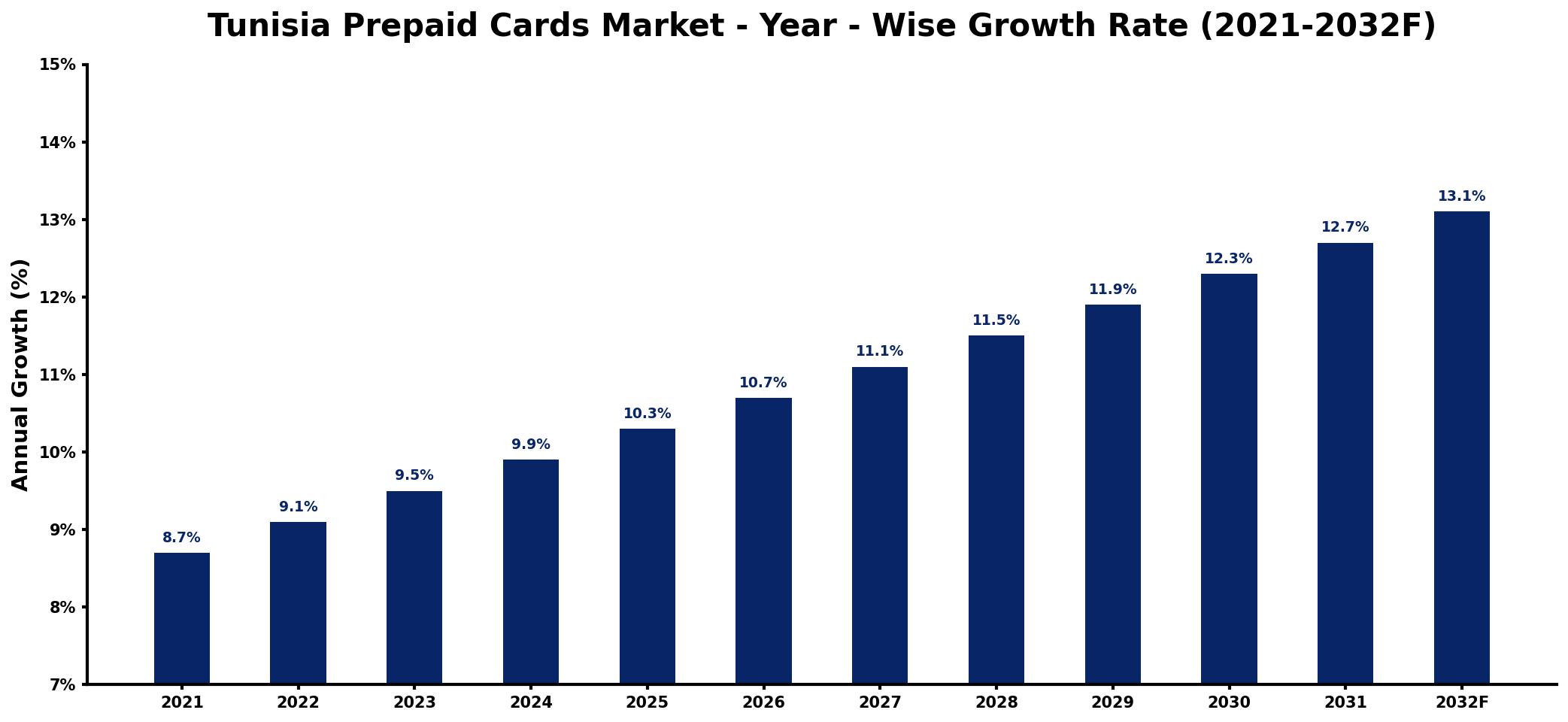
The table below presents the year‑wise growth rates along with the key drivers influencing the market
| Year | Growth Rate | Major Drivers |
| 2021 | 8.7% | Rising digital payment adoption |
| 2022 | 9.1% | Increased mobile wallet usage |
| 2023 | 9.5% | Growing e-commerce transactions volume |
| 2024 | 9.9% | Expansion of retail partnerships |
| 2025 | 10.3% | Investment in fintech innovations |
| 2026 | 10.7% | Higher consumer spending capacity |
| 2027 | 11.1% | Broadening financial inclusion initiatives |
| 2028 | 11.5% | Enhanced cross-border transaction facilities |
| 2029 | 11.9% | Development of loyalty programs |
| 2030 | 12.3% | Shift towards cashless transactions |
| 2031 | 12.7% | Improved cybersecurity measures implemented |
| 2032 | 13.1% | Surge in youth digital engagement |
Note: Market size estimations and growth projections presented in this report are based on 6Wresearch's proprietary forecasting methodology, utilizing the latest available industry data, government publications, and primary research inputs.
Tunisia Prepaid Cards Market Synopsis
The growing prevalence of prepaid cards in Tunisia reflects a significant demand among both consumers and businesses for flexible payment options. This trend is particularly beneficial in areas with limited banking infrastructure, thereby promoting financial inclusion. Coupled with strategic partnerships between financial institutions and retail networks, card accessibility and usability are steadily improving.
On the supply side, card issuers are increasingly focusing on enhancing the user experience through technological advancements and innovative features. This includes mobile app integration and enhanced security measures, which are critical in fostering consumer trust and encouraging higher adoption rates across the market.
Tunisia Prepaid Cards Market Key Takeaways
- The market is set for robust growth, driven by rising demand for cashless payments.
- Strategic collaborations between financial institutions and retailers enhance accessibility.
- Financial inclusion efforts are crucial in underserved regions of Tunisia.
- Technological innovations play a significant role in shaping market dynamics.
- Consumer awareness and education are essential for overcoming adoption barriers.
Evaluation of Restraints in Tunisia Prepaid Cards Market
Despite the positive outlook, the Tunisia Prepaid Cards Market faces several restraints. A significant barrier is the lack of consumer awareness, which hampers widespread adoption. Furthermore, card issuers must navigate stringent regulatory requirements related to financial compliance and anti-money laundering. This complex landscape can pose challenges to operational flexibility. Additionally, the emergence of mobile payments and digital wallets introduces competitive pressures that necessitate differentiation strategies for traditional prepaid card offerings.
Tunisia Prepaid Cards Market Trends
Current trends indicate a significant uptick in the use of prepaid cards for corporate expenses and employee disbursements, reflecting a growing preference among businesses for streamlined financial management. Additionally, advancements in technology are facilitating the integration of mobile wallets and contactless payment options, further driving demand. The focus on enhanced security features, such as biometric authentication, is also becoming a key trend as consumers seek more secure payment methods.
Tunisia Prepaid Cards Market Opportunities
Opportunities for growth in the Tunisia Prepaid Cards Market are plentiful. There is a significant potential for expanding the issuance of prepaid cards in rural areas, where traditional banking services are limited. Furthermore, collaboration between fintech startups and established financial institutions could drive innovation and improve service delivery. As consumers continue to embrace digital solutions, the demand for customizable and feature-rich prepaid card products is also likely to rise.
Government Initiatives in the Tunisia Prepaid Cards Market
The Tunisian government is actively promoting financial inclusion through initiatives aimed at enhancing the prepaid cards market. Policies are being enacted to educate consumers on the benefits of using prepaid cards and to implement regulations that ensure secure issuance practices. Collaborations with financial institutions to develop interoperable payment systems are also a focal point, aiming to create a more cohesive and efficient payment landscape.
Future Insights of the Tunisia Prepaid Cards Market
Looking ahead to the period from 2026 to 2032, the Tunisia Prepaid Cards Market is expected to undergo transformative growth. With increasing digital literacy and a concerted push towards cashless economies, the adoption rates for prepaid cards will likely surge. Enhanced regulatory frameworks and continued government support will pave the way for innovation, resulting in a broader range of offerings that cater to diverse consumer needs.
Tunisia Prepaid Cards Market Latest Developments (2025 - 2026)
Recent developments in the Tunisia Prepaid Cards Market have highlighted a strong focus on enhancing security measures and user experience. Financial institutions are rolling out advanced features aimed at safeguarding transactions while improving customer convenience. Additionally, educational campaigns aimed at increasing consumer awareness of prepaid card benefits have gained traction, indicating a proactive approach to market penetration.
Tunisia Prepaid Cards Market - Key Attractiveness of the Report
- 10 Years of Market Numbers
- Historical Data Starting from 2022 to 2025
- Base Year: 2025
- Forecast Data until 2032
- Key Performance Indicators Impacting the Market
- Major Upcoming Developments and Projects
Key Highlights of the Report:
- Tunisia Prepaid Cards Market Outlook
- Market Size of Tunisia Prepaid Cards Market, 2025
- Forecast of Tunisia Prepaid Cards Market, 2032
- Historical Data and Forecast of Tunisia Prepaid Cards Revenues & Volume for the Period 2022-2032F
- Tunisia Prepaid Cards Market Trend Evolution
- Tunisia Prepaid Cards Market Drivers and Challenges
- Tunisia Prepaid Cards Price Trends
- Tunisia Prepaid Cards Porter's Five Forces
- Tunisia Prepaid Cards Industry Life Cycle
- Historical Data and Forecast of Tunisia Prepaid Cards Market Revenues & Volume By Offering for the Period 2022-2032F
- Historical Data and Forecast of Tunisia Prepaid Cards Market Revenues & Volume By General Purpose Card for the Period 2022-2032F
- Historical Data and Forecast of Tunisia Prepaid Cards Market Revenues & Volume By Gift Card for the Period 2022-2032F
- Historical Data and Forecast of Tunisia Prepaid Cards Market Revenues & Volume By Government Benefit/Disbursement Card for the Period 2022-2032F
- Historical Data and Forecast of Tunisia Prepaid Cards Market Revenues & Volume By Incentive/Payroll Card for the Period 2022-2032F
- Historical Data and Forecast of Tunisia Prepaid Cards Market Revenues & Volume By Others for the Period 2022-2032F
- Historical Data and Forecast of Tunisia Prepaid Cards Market Revenues & Volume By Card Type for the Period 2022-2032F
- Historical Data and Forecast of Tunisia Prepaid Cards Market Revenues & Volume By Closed Loop Card for the Period 2022-2032F
- Historical Data and Forecast of Tunisia Prepaid Cards Market Revenues & Volume By Open Loop Card for the Period 2022-2032F
- Historical Data and Forecast of Tunisia Prepaid Cards Market Revenues & Volume By End User for the Period 2022-2032F
- Historical Data and Forecast of Tunisia Prepaid Cards Market Revenues & Volume By Retail for the Period 2022-2032F
- Historical Data and Forecast of Tunisia Prepaid Cards Market Revenues & Volume By Corporate for the Period 2022-2032F
- Historical Data and Forecast of Tunisia Prepaid Cards Market Revenues & Volume By Government/Public Sector for the Period 2022-2032F
- Tunisia Prepaid Cards Import Export Trade Statistics
- Market Opportunity Assessment By Offering
- Market Opportunity Assessment By Card Type
- Market Opportunity Assessment By End User
- Tunisia Prepaid Cards Top Companies Market Share
- Tunisia Prepaid Cards Competitive Benchmarking By Technical and Operational Parameters
- Tunisia Prepaid Cards Company Profiles
- Tunisia Prepaid Cards Key Strategic Recommendations






































